
Sponsored

Here's why convenience stores are not rushing to install EV chargers

Crissa

Well-known member
First Name
Crissa
Joined
Jul 8, 2020
Threads
138
Messages
19,571
Reaction score
31,475
Location
Santa Cruz
Vehicles
2014 Zero S, 2013 Mazda 3
Country flag
I’m thinking of a convenience store, not a gas station. Since i got the tesla I never use the kind attached to a gas station. usually i just pop in to grab a thing and yeah it’s 5 minutes or less.
Yeah, well, you're not getting gas or taking a restroom break ^-^

People always underestimate their time usage.

-Crissa
Sponsored

 

charliemagpie

Well-known member
First Name
Charlie
Joined
Jul 6, 2021
Threads
48
Messages
2,982
Reaction score
5,369
Location
Australia
Vehicles
CybrBEAST
Occupation
retired
Country flag
Whatever the average currently is

It will change if chargers are installed.

My opinion is to the detriment to the business.

?
 

Bill906

Well-known member
Joined
Mar 21, 2020
Threads
4
Messages
1,410
Reaction score
3,298
Location
Wisconsin
Vehicles
Jeep
Country flag
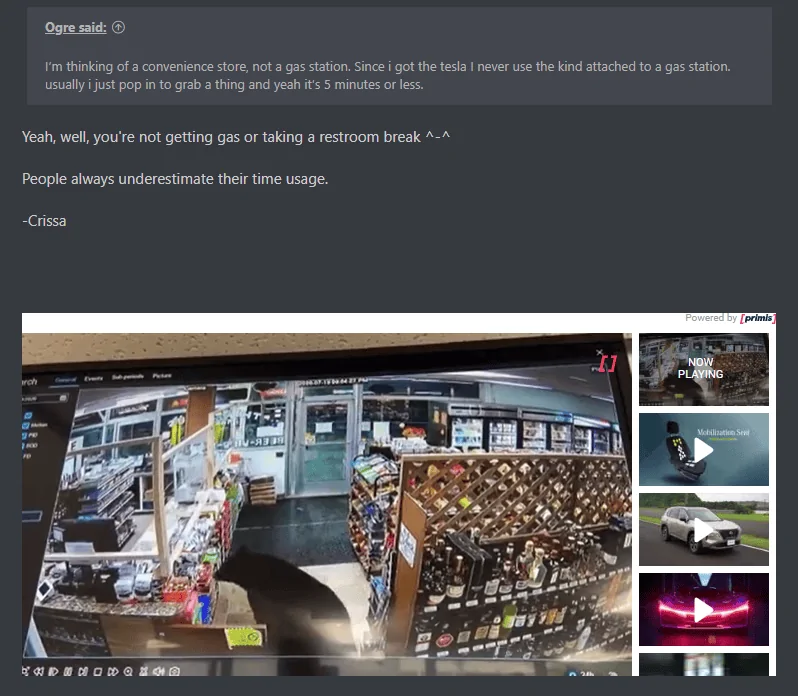
While reading the discussion about convenience stores the ad playing in the space of Crissa's post was this. My brain was trying hard to put the two together. Somehow a bear in a C-store emphasizes the fact that people underestimate their time.

*******************************************************************

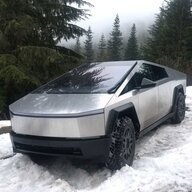
Tesla Cybertruck Here's why convenience stores are not rushing to install EV chargers 1666704169790
 

Ogre

Well-known member
First Name
Dennis
Joined
Jul 3, 2021
Threads
166
Messages
10,735
Reaction score
27,050
Location
Ogregon
Vehicles
Model Y
Country flag
Yeah, well, you're not getting gas or taking a restroom break ^-^

People always underestimate their time usage.

-Crissa
No… usually when I go to a C Store it’s the Dairy Mart for late night Ice Cream or milk.

Lots and lots and lots of convenience stores are in residential areas and lack gas stations entirely. Circle K, Seven 11, Quik-e mart, etc etc.

I have an electric car…. Usually wife takes our car to Costco for actual gas stops to safe the $0.10/ gallon. About once a month (or less) since we don’t drive the Subaru much.


HaulingAss

Well-known member
Joined
Oct 3, 2020
Threads
28
Messages
10,329
Reaction score
20,749
Location
Western Washington, USA
Vehicles
Cybertruck DM, 2010 F-150, 2018 Performance Model 3, 2024 Performance Model 3
Country flag
DC quick charging stations won't be like gas stations, it's true...

...but Level 2 fast charging should be more common. It'll charge commuters and small-scale EVs like mopeds and Leafs.
Nissan Leaf? I'm not sure why you group the Leaf with Mopeds or differentiate it from cars like the Tesla Model 3 when it comes to Level 2 Fast Charging. With a maximum L2 charge rate of 6.6kW, the Leaf is a particularly slow Level 2 charger. And it has no real advantage in efficiency so, even when limited by a slow Level 2 charger, it will not add miles of range any faster than a Model 3.

In other words, I don't see any reason why Level 2 fast charging would be anymore applicable to a Leaf than a Model 3. Neither one is going to add significant miles in a charging stop less than an hour and, if you have more time than that, it will add just as much range to either type of car.
 

HaulingAss

Well-known member
Joined
Oct 3, 2020
Threads
28
Messages
10,329
Reaction score
20,749
Location
Western Washington, USA
Vehicles
Cybertruck DM, 2010 F-150, 2018 Performance Model 3, 2024 Performance Model 3
Country flag
You are assuming her work has both solar power and EV charging stations. Neither of which are ubiquitous, cheap for he employer or a short term fix. This will be a decades-long change.
EV charging at work is happening more quickly than people think and it's driven by economics. Employers need perks to attract and retain good employees. Employees are very expensive compared to EV chargers and solar power. Even a small raise can pay for a number of EV chargers and solar panels. Even in my small town there are multiple employers who have installed EV chargers and many of them were there three or four years ago.

It's important to know that even if the business doesn't have solar panels, EV charging during the workday benefits the electrical grid dynamics because solar panel deployments continue to increase which naturally leads to a surplus of electricity through the bulk of the workday. EV's are the perfect solution to "too much solar", but only if they can charge through the middle of the day. The solar panels don't need to be onsite to use them because they feed into the grid where they can charge EV's many miles away.
 

Crissa

Well-known member
First Name
Crissa
Joined
Jul 8, 2020
Threads
138
Messages
19,571
Reaction score
31,475
Location
Santa Cruz
Vehicles
2014 Zero S, 2013 Mazda 3
Country flag
Nissan Leaf? I'm not sure why you group the Leaf with Mopeds or...
...Because they're short-range vehicles that would make use of a Destination-style charger?

A Model 3 can Supercharge, and has a larger battery. It would have to drive an hour further to encounter the same one-hop problem.

-Crissa
 

HaulingAss

Well-known member
Joined
Oct 3, 2020
Threads
28
Messages
10,329
Reaction score
20,749
Location
Western Washington, USA
Vehicles
Cybertruck DM, 2010 F-150, 2018 Performance Model 3, 2024 Performance Model 3
Country flag
...Because they're short-range vehicles that would make use of a Destination-style charger?

A Model 3 can Supercharge, and has a larger battery. It would have to drive an hour further to encounter the same one-hop problem.

-Crissa
OK, I was thinking of the newer Nissan Leaf with a range of 226 miles and the ability to fast DC charge 80% in well under an hour. It's not as good as any Tesla in terms of charging ability but I still group it in roughly the same class of vehicles (even if it is near the bottom of the pack).
 

Crissa

Well-known member
First Name
Crissa
Joined
Jul 8, 2020
Threads
138
Messages
19,571
Reaction score
31,475
Location
Santa Cruz
Vehicles
2014 Zero S, 2013 Mazda 3
Country flag
OK, I was thinking of the newer Nissan Leaf with a range of 226 miles and the ability to fast DC charge 80% in well under an hour. It's not as good as any Tesla in terms of charging ability but I still group it in roughly the same class of vehicles (even if it is near the bottom of the pack).
A Leaf can do that fast charge once or twice in a day... if you can find a working CHAdeMO station. And not all Leafs even have that hardware. It's still an optional package, and the network is eroding.

You can third-party upgrade the level 2 charging to 22kW, tho.

-Crissa


slomobile

Well-known member
First Name
Dustin
Joined
Apr 7, 2022
Threads
2
Messages
108
Reaction score
104
Location
Memphis
Vehicles
Cybertruck
Occupation
Roboticist
Country flag
Then you price your power & parking to encourage short visits.

-Crissa
How the hell do you do that? Charge alot? I'll damn well get my moneys worth and stay here as long as I want. Charge a little, or even free? Yippee I like this place. I'm gonna stay here for a while.
 

slomobile

Well-known member
First Name
Dustin
Joined
Apr 7, 2022
Threads
2
Messages
108
Reaction score
104
Location
Memphis
Vehicles
Cybertruck
Occupation
Roboticist
Country flag
Ramzey Smith, a spokesman for the Department of Energy, told CNN Business that demand charges can be mitigated through solutions like on-site battery storage, solar generation, energy management strategies and regulatory approaches.
Convenience stores could try to work around demand charges by installing battery back-ups at their chargers. The battery back-ups would enable convenience stores to slowly draw power throughout the day, especially at times of lower demand, accumulating the energy in the batteries, and then discharging it quickly when an EV needs to charge up. That way the convenience stores aren’t pulling a huge amount of power from the grid at once.
But battery-backup can make a charging station cost several times as much as otherwise
Low initial use, long lead time to recoup money, and customers who would have normally bought fuel and a coffee... have likely already charged at home.
The tuned business is now out of balance. Customer count, price points, GP. Its a whole new game.
Help me think through this. Do we actually want chargers at small gas stations? I don't think so. We can still access the attached convenience store by parking in any spot available, even at pumps. Good enough. Maybe a level 2 charger attached to the building, behind lock and key on the same giant stick as the bathroom key for emergencies. Demand charges eliminated by the limited capacity of the charger.

We must face the fact that land area occupied while charging is one of the hidden costs of EVs. That is an argument in favor of solar car ports, but it is a liability in general.

Large truck stops are already optimized for proximity to major routes, longer stays and high volume parking. We want DC fast chargers here. Their charge time is on par with semi truck refueling time. Truck stops have the capacity and sit down amenities we desire while waiting for charge, or waiting for an open charger.

What would attract a vertically integrated truck stop like Loves, Pilot, Flying J to install at least 2 fast chargers? Integrate it into their business model.

Each truck stop is also a regular fixed stop on a semi truck route, receiving fuel and supply deliveries multiple times per week. They need a giant battery pack on site to mitigate demand charges only during certain peak periods. Those demand periods are known and delivery schedules can be optimized to suit that demand. If a Tesla Semi were their regular delivery vehicle, it could serve as that demand mitigator. Charging itself only during off peak hours. Supplying consumer level DC Superchargers during peak demand periods. Driving its delivery route in the periods in between. The logistics are complicated, but they are also fixed, recurrent, noncritical, and have many potential distributed and redundant solutions.

This scenario provides at least one Semi and one consumer Supercharger at each participating location. It allows the Tesla Semi owner operator to bill the truck stop for its services as a "peak demand mitigator" at a (regulated or market based) low amount to compensate for loss of battery pack life. It allows the truck stop to enter the EV charging market with reduced immediate capital outlay.

This need not be limited to truck stop owned Tesla Semis. Any DC charging(DC output capable) EV could potentially serve as a mitigator.

When connecting to a charger, it could ask your expected time of departure. Your vehicle can maintain your preference for "minimum acceptable charge level when serving as demand mitigator". With that data, the charger can manipulate charge rate to avoid demand charges and even take some charge from your vehicle, give it to another vehicle at that charge bank, and credit your account for providing that cost saving service to the charger operator.

You would have to opt in to enable "demand mitigation mode" because you may connect to a charger with 70% capacity in your vehicle and leave an hour later with 50% capacity and a credit to your account. Or you may leave with 100% charge and a debit to your account depending on the needs of the charger station.

The same infrastructure to enable this could be used to provide peak demand power to your home from your vehicle's pack and then recharge that pack during off peak hours at the minimum rate required to meet "minimum acceptable charge level when serving as demand mitigator" prior to leaving for work in the morning.

This all has the effect of reducing peak demand for the utility and distributing demand more evenly around the clock. This is the reason utilities buy Megapacks. But this works better than Megapacks because it not only reduces demand for generation, but also transmission and distribution. Demand mitigation at the source of demand could help the utility avoid rolling blackouts, or delay upgrading generation, transmission, and distribution capacity on equipment that only requires that capacity briefly during high demand periods. Incidentally, this is the reason which utilities implement demand pricing. To discourage peak demand on borderline infrastructure. As such, utilities ought to endorse this model, even if they have plans to build their own charging stations. Whoever builds this demand mitigation system, you can bet their first and best customers will be utility owned charging stations.

Charging stations are both the cause of and solution to excess peak demand.
This reminds me of The Mysterious Benedict Society season 2 episode 2 6:20 - 7:20

A question remains. Do we want an 800v Lithium EV Semi delivering fuel to a place with literally tons of moving vehicles, people, and flowing fuel? Is it safe? Eliminating spark ignition sources on even 12v electric systems is difficult and failure prone. What happens when a Tesla sets a truck stop on fire?

If it makes you nervous, is it safe to install chargers at gas stations at all?

Do you store gas for a lawnmower in the same garage you charge your EV? What do insurance companies think on the subject?

I suppose the same questions could be raised for thousands of explosions per second and glowing hot catalytic converters in the vicinity of volatile gasoline vapor.

I don't know the answers. That is why I asked you to help me think it through.
 

Ogre

Well-known member
First Name
Dennis
Joined
Jul 3, 2021
Threads
166
Messages
10,735
Reaction score
27,050
Location
Ogregon
Vehicles
Model Y
Country flag
We must face the fact that land area occupied while charging is one of the hidden costs of EVs. That is an argument in favor of solar car ports, but it is a liability in general.
It’s not a cost. It’s a characteristic. EVs take longer to charge but require less intervention (well good chargers). In some cases this is a cost, in others it’s a feature.

If it’s parked at my home, it’s a feature. If it’s at a restaurant, it’s neither. At a quik-e-mart, there are potential downsides for the owner.

Gas stations were built around the way gas vehicles fuel up. It makes sense that the places EVs charge up will be different. What that ends up being is still in flux.
 

slomobile

Well-known member
First Name
Dustin
Joined
Apr 7, 2022
Threads
2
Messages
108
Reaction score
104
Location
Memphis
Vehicles
Cybertruck
Occupation
Roboticist
Country flag
Even a small raise can pay for a number of EV chargers and solar panels.
Either you expect the employee to buy infrastructure for the employer (very strange), or you meant "Witholding a small raise can pay for a number of EV chargers and solar panels."

As an employee, which would you prefer? Keep in mind you will likely not have any say in the type or network of charger installed and it will probably be the cheapest available to the employer, and maintained no better than other infrastructure owned by the employer. How long does it take to get your computer fixed, or a new office chair?
Sponsored


Top