
Sponsored

Some 2024 Ramp Calculations Per Q3 info

cvalue13

Well-known member
Joined
Aug 17, 2022
Threads
74
Messages
7,153
Reaction score
13,769
Location
Austin, TX
Vehicles
F150L
Occupation
Fun-employed
Country flag
There are smarter cookies in here than me, especially when it comes to maths and plotting ramps and production numbers.

So I did the ham-fisted job below, to send those smarter folks into a “you’ve done it wrong” rage, and compel them to make a better analysis.

so please correct me to death!

here’s my question and attempt;

I’d like to know how many CTs might be built total, at each 1st of the month during 2024 - assuming the ramp hits a maximum run rate of 225K/year sometime in 2025, and a mid ramp inflection point 125K/yr run rate sometime during 2024.

In the Q3 call, Musk said that for 2024 they are targeting hitting a run rate of 125,000 units. That ~means only, that at some point in 2024 they will begin to average ~335 units built / day.

If they reach that daily run rate only on the last day of 2024, they will build a lot less than 125K total trucks over the calendar year 2024.

That being only an extreme example to make the point that how many total Cybertrucks are built of CY 2024 depends when during the year they reach a maximum daily run rate of 335s. Even in that example, the exact number of units built depends on what, exactly, “S-cur ve” (as Musk mentions but never details) there is in the ramp period (between Jan 1 ‘24 and the date they hit the target run rate).

Because we know that Tesla’s ultimate target is a run rate of 250K sometime in 2025 (670 units / day), we can’t determine how many CTs might be built in CY 2024 without letting the ramp continue upwards after they hit the 125K run rate, through to when they hit the eventual max 250K run rate (which is the capacity limit of the existing line).

Under this model, and curious about the number of CTs that might be built in 2024 (or 2025 for that matter), I did some back-of-napkin math (ie OpenAI).

For simplicity, I looked at only the hypos where the daily max run rate max of 250K was achieved on either Jan. 1st ‘25 (the most optimistic scenario), or the first of each next month, through to Dec. 1st ‘25 (the least optimistic scenario).


Tesla Cybertruck Some 2024 Ramp Calculations Per Q3 info E89F8678-F4CF-45C9-BA99-9E995F07C2FE


In the most optimistic scenario (max run rate of 670 units/day is achieved on Jan. 1, 2025) it would mean ~135K CTs are built in 2024 total. In the most pessimistic scenario (max run rate of 670 units/day isn’t achieved until Dec. 1, 2025) ~91K CTs are built in 2024 total.

If we instead take Musk’s comments regarding ‘18 months from now’ as the relevant point of reach 670 units/day, that would be April 2025, in which case in 2024 a total of ~123K units are produced.

This is just one scenario assuming just one simple s-curve model, basically linear, to approximate how the ramp progresses. A more detailed outcome would require more s-curve analysis for the ramp-up phase.

Beyond me. Hopefully not you.

other key assumptions:
  1. Jan. 1 2024 ramp starts with 10 units.
  2. The average production during the phase is taken as the midpoint between the starting production and max capacity (335 units/day).
  3. Once the max capacity is reached, production is a constant 670 units/day,
  4. No builds occur on Saturdays (to approximate downtime on the line).
  5. Each month has roughly 4 Saturdays, leading to 4 non-production days per month.

In all, I was surprised to find that based on these assumptions, Musk’s claim that ~18mo from now would be when the line hits maximum capacity, results in a ramp during 2024 that results in ~125K total units being built in 2024 (matching the daily run rate target to be hit sometime in 2024). However, based on this model (specifically the S-curve assumed), this scenario would have ramp achieving a run rate of 335 units/day (the 125k/year inflection point), not during 2024, but instead mid-February 2025.

For the model to assume that the 335 units/day would occur in 2024, Dec. must contain that date (or else the max run rate of 670 units/day occurs in 2024, contrary to the stated expectation).


If the inflection point is reached on December 1, 2024 (which is halfway through the ramp-up), then (based on the S-curve assumed) it would take only an additional month from that date to reach the maximum rate of 670 units/day, by approximately mid-January 1, 2025.


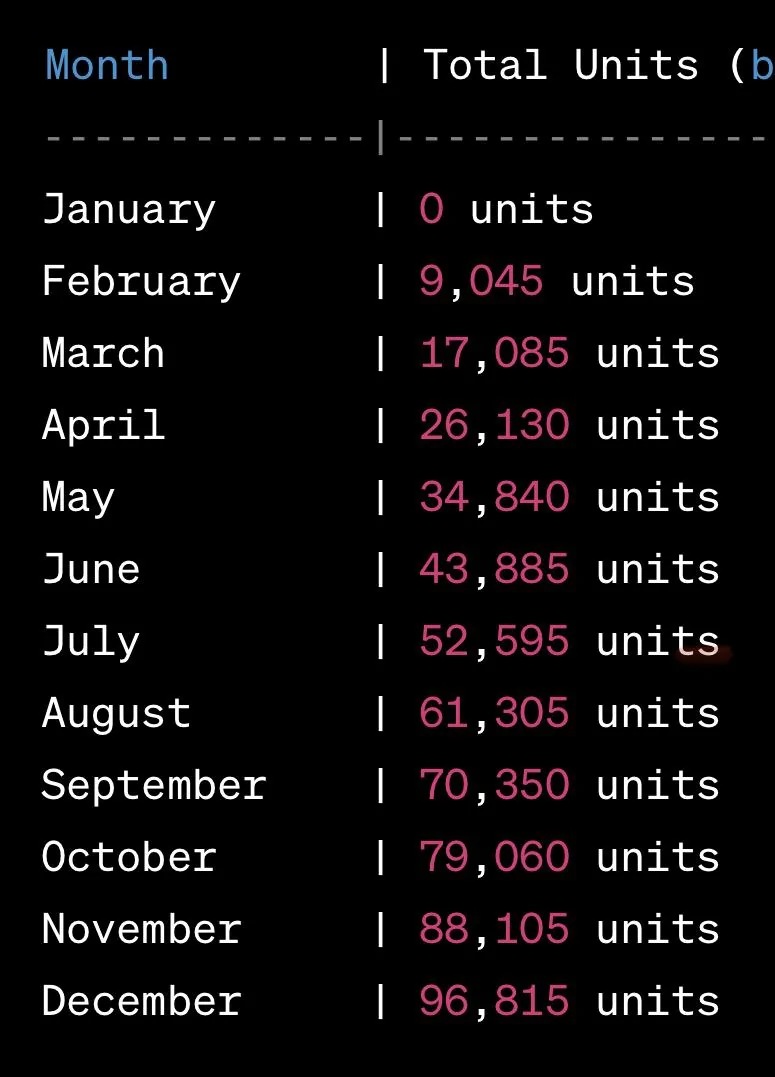
Under this scenario, here’s how many CT’s would be produced total at each point of the 1st of each month through 2024 (calculated as of the 1st of each month)

Tesla Cybertruck Some 2024 Ramp Calculations Per Q3 info 426F699C-FBBC-4055-BA52-09D215B05B6E


Better math folks out there?
Sponsored


JBee

Well-known member
First Name
JB
Joined
Nov 22, 2019
Threads
18
Messages
4,913
Reaction score
6,362
Location
Australia
Vehicles
Cybertruck
Occupation
. Professional Hobbyist
Country flag
There are smarter cookies in here than me, especially when it comes to maths and plotting ramps and production numbers.

So I did the ham-fisted job below, to send those smarter folks into a “you’ve done it wrong” rage, and compel them to make a better analysis.

so please correct me to death!

here’s my question and attempt;

I’d like to know how many CTs might be built total, at each 1st of the month during 2024 - assuming the ramp hits a maximum run rate of 225K/year sometime in 2025, and a mid ramp inflection point 125K/yr run rate sometime during 2024.

In the Q3 call, Musk said that for 2024 they are targeting hitting a run rate of 125,000 units. That ~means only, that at some point in 2024 they will begin to average ~335 units built / day.

If they reach that daily run rate only on the last day of 2024, they will build a lot less than 125K total trucks over the calendar year 2024.

That being only an extreme example to make the point that how many total Cybertrucks are built of CY 2024 depends when during the year they reach a maximum daily run rate of 335s. Even in that example, the exact number of units built depends on what, exactly, “S-cur ve” (as Musk mentions but never details) there is in the ramp period (between Jan 1 ‘24 and the date they hit the target run rate).

Because we know that Tesla’s ultimate target is a run rate of 250K sometime in 2025 (670 units / day), we can’t determine how many CTs might be built in CY 2024 without letting the ramp continue upwards after they hit the 125K run rate, through to when they hit the eventual max 250K run rate (which is the capacity limit of the existing line).

Under this model, and curious about the number of CTs that might be built in 2024 (or 2025 for that matter), I did some back-of-napkin math (ie OpenAI).

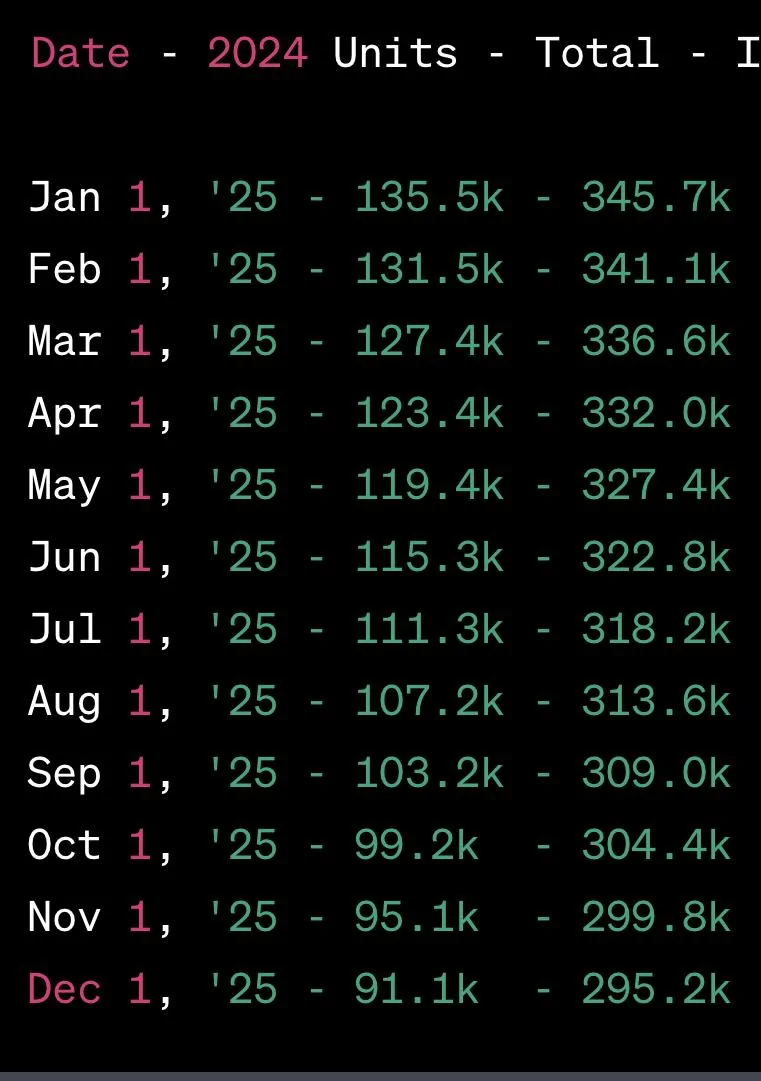
For simplicity, I looked at only the hypos where the daily max run rate max of 250K was achieved on either Jan. 1st ‘25 (the most optimistic scenario), or the first of each next month, through to Dec. 1st ‘25 (the least optimistic scenario).


E89F8678-F4CF-45C9-BA99-9E995F07C2FE.webp


In the most optimistic scenario (max run rate of 670 units/day is achieved on Jan. 1, 2025) it would mean ~135K CTs are built in 2024 total. In the most pessimistic scenario (max run rate of 670 units/day isn’t achieved until Dec. 1, 2025) ~91K CTs are built in 2024 total.

If we instead take Musk’s comments regarding ‘18 months from now’ as the relevant point of reach 670 units/day, that would be April 2025, in which case in 2024 a total of ~123K units are produced.

This is just one scenario assuming just one simple s-curve model, basically linear, to approximate how the ramp progresses. A more detailed outcome would require more s-curve analysis for the ramp-up phase.

Beyond me. Hopefully not you.

other key assumptions:
  1. Jan. 1 2024 ramp starts with 10 units.
  2. The average production during the phase is taken as the midpoint between the starting production and max capacity (335 units/day).
  3. Once the max capacity is reached, production is a constant 670 units/day,
  4. No builds occur on Saturdays (to approximate downtime on the line).
  5. Each month has roughly 4 Saturdays, leading to 4 non-production days per month.

In all, I was surprised to find that based on these assumptions, Musk’s claim that ~18mo from now would be when the line hits maximum capacity, results in a ramp during 2024 that results in ~125K total units being built in 2024 (matching the daily run rate target to be hit sometime in 2024). However, based on this model (specifically the S-curve assumed), this scenario would have ramp achieving a run rate of 335 units/day (the 125k/year inflection point), not during 2024, but instead mid-February 2025.

For the model to assume that the 335 units/day would occur in 2024, Dec. must contain that date (or else the max run rate of 670 units/day occurs in 2024, contrary to the stated expectation).


If the inflection point is reached on December 1, 2024 (which is halfway through the ramp-up), then (based on the S-curve assumed) it would take only an additional month from that date to reach the maximum rate of 670 units/day, by approximately mid-January 1, 2025.


Under this scenario, here’s how many CT’s would be produced total at each point of the 1st of each month through 2024 (calculated as of the 1st of each month)
426F699C-FBBC-4055-BA52-09D215B05B6E.webp


Better math folks out there?
Before we head down this road I'd like to first understand broadly what we are modelling, and what results are of most interest?

Is it just:

1) when will I get my Cybertruck
2) and how cell production will affect production capacity
3) any other supply constraints (lithium refining etc)
4) manufacturing constraints from assembly lines (unboxed etc)
5) when new factories come online

The model could get pretty big, so the question then becomes how do we want to interact to manipulate it? Just by adjusting sensitivities and adding prediction milestones?

In my modelling I just approximated the percentage of growth required each month manually, to reach the milestone outputs they announced.

I also added the cell production numbers and the 10million or so they have on hand to find out how much of a buffer that would create for the cell ramp, and keep the CT output numbers going unhindered.

I think the s-curve might also be compressed on the front end, and then spreads out through the bulk of the middle then tapers off more logarithmic in the end. The reason for this shape is that in the beginning the line configuration will constrain productivity, then once the assembly line is configured the middle will just be optimising line speed and have week after week growth, which will then taper out as soon as they get within 20% or so of design through put.

After that it's adding production lines. What they look like is the question.

On the subject of the "unboxed method lines" I have the following observations to make. If they apply I don't know, but I thought I'd share them nonetheless.

I'm not sure how the parallel "feed lines" in the unboxed method ramp, in that they could be less sensitive to hold ups than a single feed line, and might be able to ramp differently. The reason I say this is that a single stoppage on the main assembly line stops the whole line if it exceeds the station time, but on a parallel assembly setup a single stoppage on a feed line won't affect any other, until they reach the final assembly line where the boxes are assembled.

Then if you add "storage" of "boxes" at the end of each feed line, like with the battery cells they are "pre-making" stock of, then you end up with a "buffer" for each feed line to compensate for stoppages, so that the main assembly line can continue unimpeded. Plus if the feed lines are more prone to stoppages you could even add lines for that box if it really comes to it. It's also highly likely that all the testing and QC is taken care of in the feed lines, which means there could be next to no stoppages on the final assembly line at all, and most of the line risk is contained in the feed lines instead, which can then be managed individually.

Overall, I think we can get a rough idea of production with a basic model, and then can adjust as we go along. A bit like google maps that always changes the time to destination as you go along so it's always right... ;)
 
Last edited:
OP
OP
cvalue13

cvalue13

Well-known member
Joined
Aug 17, 2022
Threads
74
Messages
7,153
Reaction score
13,769
Location
Austin, TX
Vehicles
F150L
Occupation
Fun-employed
Country flag
Before we head down this road I'd like to first understand broadly what we are modelling, and what results are of most interest?
for my part, the curiosity was pretty simple:

Musks ‘125K run rate in 2024, and 250k in 2025’ comments’ give some rough guidance about how many CTs might actually get produced in 2024.

We could get a rough lower and upper bounds of possibility total number that may be built in 2024, as well as the rate at which they they may be delivered through 2024.

For a person that’s say, 100k in the reservation que, then, you can get upper/lower bounds of expectations.

Depending on ramp, it could be Tesla doesn’t build unit 100K at all in 2024 (and still hit the 125K run rate), or early in 2024 (if they hit it quickly).

I dunno

Some people have Wordle, I have puzzles like this. ?‍?
 

Arctic_White

Well-known member
First Name
Ray
Joined
Feb 8, 2021
Threads
4
Messages
372
Reaction score
605
Location
Edmonton, AB
Vehicles
Model S Plaid; CT on order
Country flag
for my part, the curiosity was pretty simple:

Musks ‘125K run rate in 2024, and 250k in 2025’ comments’ give some rough guidance about how many CTs might actually get produced in 2024.

We could get a rough lower and upper bounds of possibility total number that may be built in 2024, as well as the rate at which they they may be delivered through 2024.

For a person that’s say, 100k in the reservation que, then, you can get upper/lower bounds of expectations.

Depending on ramp, it could be Tesla doesn’t build unit 100K at all in 2024 (and still hit the 125K run rate), or early in 2024 (if they hit it quickly).

I dunno

Some people have Wordle, I have puzzles like this. ?‍?
If anything I've learned about Musk is that you should take everything he says with a grain of salt when it comes to timelines.

If he is saying 125K run-rate sometime in 2024, consider it to mean sometime in 2025. LOL.

I don't think the ramp will be that quick, to be brutally honest.


Gurule92

Well-known member
Joined
Sep 2, 2021
Threads
201
Messages
3,825
Reaction score
7,373
Location
Colorado Springs
Vehicles
MYP
Occupation
"Cyber" stuff
Country flag
So, by your math. If Tesla went in direct line order. And doesn't prioritize people who originally reserved a tri motor, I would see my truck before the end of summer next year! Bittersweet cause I want it now but I could wait till summer.

And my wallet would like me better if I do
 
OP
OP
cvalue13

cvalue13

Well-known member
Joined
Aug 17, 2022
Threads
74
Messages
7,153
Reaction score
13,769
Location
Austin, TX
Vehicles
F150L
Occupation
Fun-employed
Country flag
If anything I've learned about Musk is that you should take everything he says with a grain of salt when it comes to timelines.

If he is saying 125K run-rate sometime in 2024, consider it to mean sometime in 2025. LOL.

I don't think the ramp will be that quick, to be brutally honest.
i 100% agree

Personally, I I get a very confused face when - after everything in Tesla’s history - people essentially take positions like “Musk said 125K run rare in 2024, so that’s gospel”. Sometimes he hits (eg the China factory completing in 2019), but more often he’s ‘we do the impossible late.’

but, this separate exercise here is to assume Musk’s aspirations are met (caveat emptor), and then understand what success would really look like.

again, in part driven by some folks appearing to misunderstand what it means, in terms of total numbers of CTs produced over the next 24 months, when Musk talks of run rates. Eg, it does not necessarily mean 125K units will be produced in 2024, and definitely doesn’t mean that in Q1 they’ll produce 1/4 that number, etc.

Besides, for like two f’n years people have put together sophisticated run rate production calculations based on made up hopium numbers like 500K/yr, followed by 1.5M/yr the next, etc., and shouted down anyone who doubted the infallible ease with which Tesla will outsell F150’s by 2026

im glad to have Musk’s expectations from Musk’s mouth, and delve into those assumptions - rather than the you-know-who’s
 

SolarWizard

Well-known member
First Name
MB
Joined
Nov 18, 2020
Threads
22
Messages
1,255
Reaction score
2,202
Location
San Diego
Vehicles
AWD
Occupation
solar, DCFC & battery biz owner
Country flag
I read the chart as capacity not production
The same chart showed capacity to build 100,000 S&X but they aint making or selling that many
 
OP
OP
cvalue13

cvalue13

Well-known member
Joined
Aug 17, 2022
Threads
74
Messages
7,153
Reaction score
13,769
Location
Austin, TX
Vehicles
F150L
Occupation
Fun-employed
Country flag
I read the chart as capacity not production
The same chart showed capacity to build 100,000 S&X but they aint making or selling that many
chart said that for sure.

it was in the discussion Musk talked about run rate

but good point that I’m going off memory when could just look this up and memorialize what did/didn’t get said - so I went back to confirm

You’re right that the 125K relative to 2024 only comes from the chart, which as you say only describes line capacity not necessarily an expectation of run rate target in 2024.

Instead, convo on the call was entirely about when a 250K run rate, eg full capacity of the line, would be reached - and that was discussed as being sometime in 2025 - and he takes a flyer on middle of 2025.

So, at some point we should ask whether the ‘capacity’ statement in the deck isn’t so much about a ramp limit as it is a materials/line limit they anticipate. They are after all saying the capacity in 2024 is 125K, which means there’s some capacity constraint on an otherwise 250K anticipated line.

which makes me all the more confident my approach was (happy accident) focused on 2024+2025, toward the max 250K run rate. From there can simply back into what a given ramp would look like in terms of total # of units in 2024

here’s the relev

In the opening comments: “It's a great product, but financially, it will take, I don't know, a year to 18 months before it is a significant positive cash flow contributor.”

Q&A:

Q: How many Cybertruck deliveries do you anticipate for 2024?

“It's difficult to make an accurate guess at this point. Going back to what I said earlier that the ramp is going to be extremely difficult. And like I said, there's no way around that.…

[T]he more uncharted the territory, the less predictable the outcome. Now, I can say that if you say, well, where will things end up, I think we'll end up with roughly 0.25 million Cybertrucks a year, but we're not -- I don't think we're going to reach that output rate next year.

I think we'll probably reach it sometime in 2025. That's my best guess.”

Q:We learned earlier on the call, it sounds like you don't think the truck will ramp to significant volume until its third year of production.

“Yeah. I mean, to be clear, it's not really the third year of production. It's kind of like the 18th month of production is roughly my guess. So, it's just that they happen -- it will happen -- is that the -- it starts this year, spans next year, and gets to 2025.

So, technically, there are three calendar years in there, but there's actually only 18 months, not three years. I would be very disappointed if it took us -- and that would be shocking if it took us three years. But 18 months from initial deliveries to have -- to reach volume and reach prosperity with an immense -- I can't tell you how much the blood, sweat, and tears level required to achieve. That is just staggering.”
 

newwave1331

Well-known member
Joined
Jun 30, 2020
Threads
12
Messages
526
Reaction score
1,465
Location
NJ
Vehicles
Ordered: Cybertruck Tri FSD x 3
Country flag
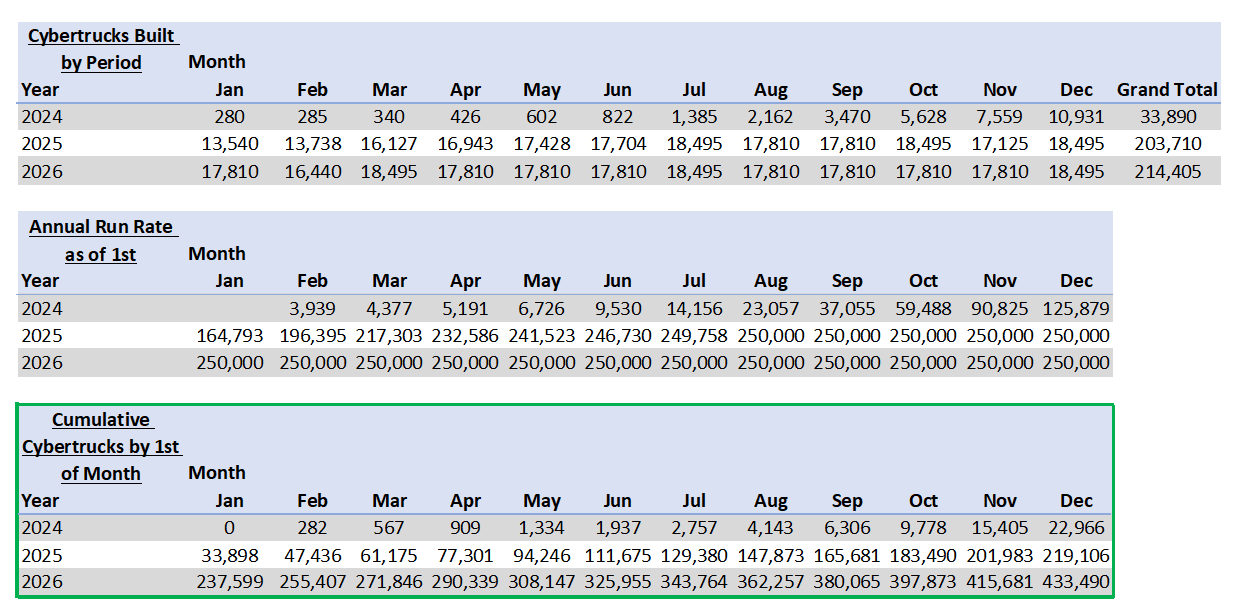
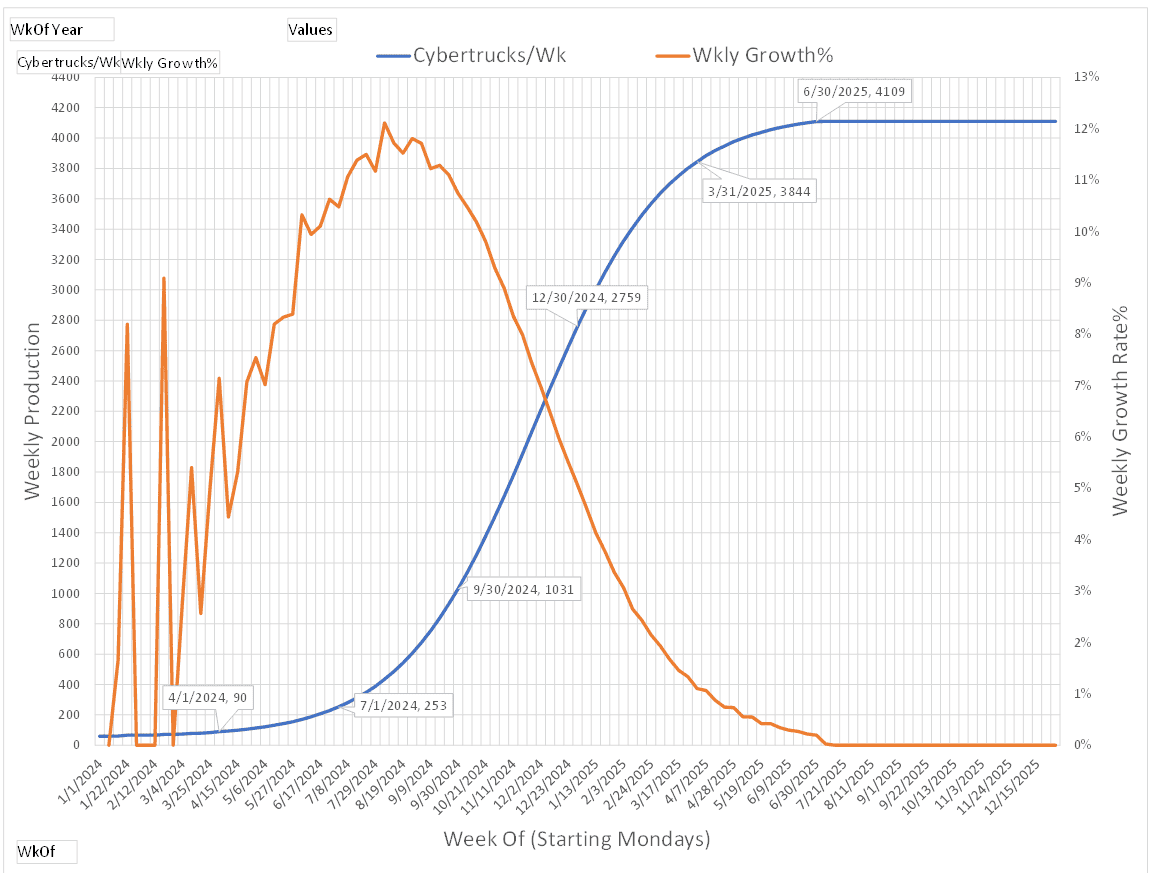
@cvalue13 this is just a ballpark with throwing some math at Elon's comments that you highlighted. The lateral shift of the ramp maters most and the growth rate needs to be something realistic. This model hits 80% production (breakeven point?) in Q1 2025, 100% production in Q2 2025, with a midpoint 12/1/2024.

Below is just how my darts hit the board. Green outlined table or 3rd if your color blind (Cumulative Cybertrucks by 1st of Month) would be your chart to approximate if your ##XXX in line.

Tesla Cybertruck Some 2024 Ramp Calculations Per Q3 info Screenshot 2023-10-26 213341


So if you were #10,000 you would get yours in October of 2024! If you were #50,000 you get it in February of 2025. If you were #100,000 you get it in May 2025.

Tesla Cybertruck Some 2024 Ramp Calculations Per Q3 info Screenshot 2023-10-26 213020


@JBee sounds like he's got something more involved and it could be much different than a traditional ramp.


OP
OP
cvalue13

cvalue13

Well-known member
Joined
Aug 17, 2022
Threads
74
Messages
7,153
Reaction score
13,769
Location
Austin, TX
Vehicles
F150L
Occupation
Fun-employed
Country flag
Reposting this from another thread, as it’s a genuine curiosity whether anyone has other/better data on it:


here’s what I find for the 4 quarters cumulative deliveries post production launch.


Model 3: 30k
Model Y: 70k
Model S refresh: 19k
Model X refresh: 19k
Semi (3 of 4 quarters): zero

Anyone have better and different stats?

Because the above data should suggest the CT first 4 quarters cumulative deliveries expectations

and for every view that “Tesla has learned a lot and is better at ramping,” there’s the countervailing fact the CT manufacturing is so unique (to say nothing of Musk’s constant expectation-setting in this respect)

seems to net out
 

Tiberius

Well-known member
Joined
Sep 2, 2023
Threads
0
Messages
198
Reaction score
422
Location
Texas
Vehicles
Model 3
Occupation
Chief cook and bottlewasher
Country flag
that is a nicely thought out chart, although my own hopes are for slightly better ;)
In my head I justify the optimism on the causes of the slow M3 ramp, like over automation and unrealistic expectations of that.
Obviously the Y ramp benefited for similarity and those hard lessons.
So my hope is that while this is lots of new stuff in terms of the build, they won’t make the same mistakes (just make new ones) - which gets to somewhere in-between.
The other unknown is how many of those reservations will convert to orders
There are lots of folks going to be tracking it for sure.
 

Jhodgesatmb

Well-known member
First Name
Jack
Joined
Dec 1, 2019
Threads
89
Messages
6,488
Reaction score
9,025
Location
San Francisco Bay area
Website
www.arbor-studios.com
Vehicles
Tesla Cybertruck FS AWD, Tesla Model Y LR
Occupation
Retired AI researcher
Country flag
We know that Tesla told regulators that they expect to initially make > 125K Cybertrucks at GigaAiustin, and that, if their estimates are correct, a yearly volume of 250K, but not exactly when (Elon originally said 2024 but it seems that might have been pushed to 2025). 250K per year is 5,000 per week (at 50 weeks per year). Half of that is 2,500 per week, or 350 per day.

it took Tesla about a year to reach 5,000 Model Ys per week at each of GigaAustin and GigaBerlin.

Elon has said that Cybertruck manufacturing is challenging but he said that about the Model 3 when they first began making it. Once they figure that out, though, their history is to double manufacturing volume every couple of months. My guess is that they will also double Cybertruck manufacturing every couple of months. The question in my mind is how many Cybertrucks they will be able to make per week when they start the high volume line. I would be very surprised if they cannot make 50/day by the end of 2023. Let’s say 250/week. Six doubles by the end of 2024 would put them at over 5,000/week by this time next year (even doubling every 3 months they would still reach 5,000 per month next year). Does anyone think that Tesla won’t be able to make 50 Cybertrucks per day by the end of the year, or that they won’t be able to double production every 2-3 months like they have for other vehicles?

On any given day they are already making 4 Cybertrucks, so it is not a stretch for me to believe they can make 50/day by the end of the year.

We will see what actually happens but it should be interesting.
 
OP
OP
cvalue13

cvalue13

Well-known member
Joined
Aug 17, 2022
Threads
74
Messages
7,153
Reaction score
13,769
Location
Austin, TX
Vehicles
F150L
Occupation
Fun-employed
Country flag
We know that Tesla told regulators that they expect to initially make > 125K Cybertrucks at GigaAiustin
huh?

can you cite what you’re referring to, because I believe you're confused

the rest of your post certainly is
 

newwave1331

Well-known member
Joined
Jun 30, 2020
Threads
12
Messages
526
Reaction score
1,465
Location
NJ
Vehicles
Ordered: Cybertruck Tri FSD x 3
Country flag
that is a nicely thought out chart, although my own hopes are for slightly better ;)
Keep Cybertruck production (and the production staff) in your prayers lol. We all want our rolling, bullet resistant refrigerators ASAP.

The other unknown is how many of those reservations will convert to orders
I'm guessing a good chunk of these tightened up RCs we are seeing coming off the line now are going to end up in service centers so people can see it in person and at some point, test drives. Just the old humor/hypothesis that make sense to me but nothing to confirm that. Tesla will want to sure up their demand numbers on Cybertruck with the added bonus of getting people in showrooms to get some SEXY sales.

There are lots of folks going to be tracking it for sure.
Joe Tegtmeyer, please get drone shots of all vins coming off the line each flight. Thanks. Im sure we can do a go fund me for a higher zoom drone.

I believe @greggertruck has been stalking VINs coming off the line. VINs and date off the line would help with updating projected timeline.

We know that Tesla told regulators that they expect to initially make > 125K Cybertrucks at GigaAiustin, and that, if their estimates are correct, a yearly volume of 250K, but not exactly when (Elon originally said 2024 but it seems that might have been pushed to 2025). 250K per year is 5,000 per week (at 50 weeks per year). Half of that is 2,500 per week, or 350 per day.

it took Tesla about a year to reach 5,000 Model Ys per week at each of GigaAustin and GigaBerlin.

Elon has said that Cybertruck manufacturing is challenging but he said that about the Model 3 when they first began making it. Once they figure that out, though, their history is to double manufacturing volume every couple of months. My guess is that they will also double Cybertruck manufacturing every couple of months. The question in my mind is how many Cybertrucks they will be able to make per week when they start the high volume line. I would be very surprised if they cannot make 50/day by the end of 2023. Let’s say 250/week. Six doubles by the end of 2024 would put them at over 5,000/week by this time next year (even doubling every 3 months they would still reach 5,000 per month next year). Does anyone think that Tesla won’t be able to make 50 Cybertrucks per day by the end of the year, or that they won’t be able to double production every 2-3 months like they have for other vehicles?

On any given day they are already making 4 Cybertrucks, so it is not a stretch for me to believe they can make 50/day by the end of the year.

We will see what actually happens but it should be interesting.
Thank you for this very informative insight. I'd enjoy seeing you put some monthly numbers to this insight and show how it links back to comments on the Q3 earning call.
Sponsored


Top