
Sponsored

Losing Mileage per 80% Charge over Time

CyberGus

Well-known member
First Name
Gus
Joined
May 22, 2021
Threads
91
Messages
10,246
Reaction score
33,915
Location
Austin, TX
Vehicles
1981 DeLorean, 2024 Cybertruck
Occupation
IT Specialist
Country flag
I doubt it's degradation. A large group of people have reported their "battery health" even at 50k miles, mine is 99%.
Sure, some have reported 0% degradation after months of driving, which is not possible. I believe those packs had a slightly higher original capacity than the rated kWh, so they still appear to be at full capacity even after some slight degradation.

You would think that the variances in the cells would average out, so that all packs should be effectively the same. However, it's best for the pack when all cells perform equally, so they are grouped together by voltage.
Sponsored

 

henchman24

Well-known member
Joined
Jul 19, 2023
Threads
0
Messages
370
Reaction score
611
Location
Wyoming
Vehicles
Dual Motor Cybertruck
Country flag
Sure, some have reported 0% degradation after months of driving, which is not possible. I believe those packs had a slightly higher original capacity than the rated kWh, so they still appear to be at full capacity even after some slight degradation.

You would think that the variances in the cells would average out, so that all packs should be effectively the same. However, it's best for the pack when all cells perform equally, so they are grouped together by voltage.
The 4680 Tesla cell is known to have some significant variation in capacity (for a mass produced battery cell). They rate the pack at the low end of their threshold for scrap. Which they use a significantly lower variance than other cells to improve their scrap rate. A CT pack having 2-3+% more capacity isn't all that unusual.
 

Gaximus

Well-known member
Joined
Jun 22, 2024
Threads
23
Messages
1,462
Reaction score
2,287
Location
Mead, CO
Vehicles
CyberBeast, Model 3, Jeep Wrangler, Yamaha R6
Occupation
Software Developer
Country flag
No Tesla model updates rated driving range based on your driving habits.
Then why if it says I will make it to my destination with 20% left, and I accelerate to 95mph it lowers that percentage, then if I slow down to 50mph it increases. Seems like that is driving range updated based on driving habits.
 

CyberGus

Well-known member
First Name
Gus
Joined
May 22, 2021
Threads
91
Messages
10,246
Reaction score
33,915
Location
Austin, TX
Vehicles
1981 DeLorean, 2024 Cybertruck
Occupation
IT Specialist
Country flag
Then why if it says I will make it to my destination with 20% left, and I accelerate to 95mph it lowers that percentage, then if I slow down to 50mph it increases. Seems like that is driving range updated based on driving habits.
Measuring instantaneous consumption is different from collecting efficiency figures over many drives.
 

eswimm

Well-known member
Joined
Jun 6, 2024
Threads
3
Messages
556
Reaction score
995
Location
Charlotte, NC
Vehicles
Model Y, Cybertruck
Country flag
If I understand your last comment accurately you are saying the best way to preserve battery life long term is to bounce between say 30% and 50% and charge more frequently vs. running it down and charging up to 80% less frequently? Am I understanding you correctly?
Technically, the middle of the pack range is best for cell health (40-60%, 30-70%). More frequent, smaller charges are better than less frequent, larger charges. Practically, you'd probably never notice any difference and luck is more likely to be a larger factor in your long term battery health.

Rated range is a calculation based on the BMS's estimated capacity (using cell voltage to estimate state of charge) and a fixed Wh/mi efficiency by vehicle and wheel configuration. Lithium batteries have a very consistent voltage to state of charge relationship, so the BMS should generally be very accurate. In large batteries however, cell balance becomes a significant issue and can lead to BMS inaccuracies. Frequent charging to low state of charge (especially unplugging right after reaching your desired SoC) can keep the battery from properly balancing cells and present the appearance of degradation.

Degradation is an inevitable reality and the result of both charge cycles (miles) and time. There's absolutely nothing you can do to avoid it and with Tesla's extremely advanced battery and thermal management, little you can really do to even influence it. 2% degradation (260 to 255 miles) wouldn't be considered excessive degradation for 4 months/3k miles although it might be a little higher than average.

One thing to keep in mind, Tesla's don't trickle charge. If you charge to 80% and it completes at 10pm, when you come back to your vehicle at 8am, you could have lost 1-2% charge if the car was doing anything other than sleeping. It needs to drop about 3% before the charger will kick back on and top off. So if you're trying to measure degradation, keep track of the rated range when charging completes and before the battery has a chance to cool down or be drained a little.


eswimm

Well-known member
Joined
Jun 6, 2024
Threads
3
Messages
556
Reaction score
995
Location
Charlotte, NC
Vehicles
Model Y, Cybertruck
Country flag
Then why if it says I will make it to my destination with 20% left, and I accelerate to 95mph it lowers that percentage, then if I slow down to 50mph it increases. Seems like that is driving range updated based on driving habits.
Navigation arrival range is absolutely based on your driving habits. Just not the displayed rated range.
 

henchman24

Well-known member
Joined
Jul 19, 2023
Threads
0
Messages
370
Reaction score
611
Location
Wyoming
Vehicles
Dual Motor Cybertruck
Country flag
Then why if it says I will make it to my destination with 20% left, and I accelerate to 95mph it lowers that percentage, then if I slow down to 50mph it increases. Seems like that is driving range updated based on driving habits.
You're using two completely different things. The rated range in miles for the battery display vs the route planning. The battery display is always tied to EPA rating. Percentage of battery X EPA rated range adjusted for estimated degradation vs a trip planner that take into consideration elevation, route speed, wind, temps, traffic etc etc.
 

Gaximus

Well-known member
Joined
Jun 22, 2024
Threads
23
Messages
1,462
Reaction score
2,287
Location
Mead, CO
Vehicles
CyberBeast, Model 3, Jeep Wrangler, Yamaha R6
Occupation
Software Developer
Country flag
Navigation arrival range is absolutely based on your driving habits. Just not the displayed rated range.
I know this, but you said there is no Tesla model that updates rated driving range based on driving habits. And I was just clarifying that they do have a predictive range model that calculates based on driving habits.
 

CyberGus

Well-known member
First Name
Gus
Joined
May 22, 2021
Threads
91
Messages
10,246
Reaction score
33,915
Location
Austin, TX
Vehicles
1981 DeLorean, 2024 Cybertruck
Occupation
IT Specialist
Country flag
And I was just clarifying that they do have a predictive range model that calculates based on driving habits.
Here’s a X post directly from Tesla where they detail many of the variables used to calculate range.


Nowhere do they mention “driving habits”, and I cannot find this stated anywhere. Do you have a source that claims the computer will estimate range based on previous trips?
 

Gaximus

Well-known member
Joined
Jun 22, 2024
Threads
23
Messages
1,462
Reaction score
2,287
Location
Mead, CO
Vehicles
CyberBeast, Model 3, Jeep Wrangler, Yamaha R6
Occupation
Software Developer
Country flag
Nowhere do they mention “driving habits”, and I cannot find this stated anywhere. Do you have a source that claims the computer will estimate range based on previous trips?
Bullet 4 says "- Avg acceleration/deceleration" that is your driving habits. Specific to you, and no one else. (Source)


CyberGus

Well-known member
First Name
Gus
Joined
May 22, 2021
Threads
91
Messages
10,246
Reaction score
33,915
Location
Austin, TX
Vehicles
1981 DeLorean, 2024 Cybertruck
Occupation
IT Specialist
Country flag
Bullet 4 says "- Avg acceleration/deceleration" that is your driving habits. Specific to you, and no one else. (Source)
I think we're talking past in other in violent agreement.

Of course the calculation includes consumption based on driving style... but only for the current trip. Nothing you did yesterday should affect the drive you take today. This is where we seem to differ.

In your theory, if I tow for a week getting 150mi of range, and then head out on Monday without a trailer, the range estimate will still be based on last week's 1000Wh/mi?

It doesn't need to know how you drove last week, it is not relevant to today.

I guess an easy way to test this is to switch driver profiles sitting in the driveway, and see if that affects the range estimate. Any saved "driving style" statistics would need to be segregated by user, right?
 

bosshog

Well-known member
First Name
roardog
Joined
Dec 7, 2024
Threads
2
Messages
346
Reaction score
200
Location
canada
Vehicles
Cyber truck , Maserati ,Mercedes
Country flag
Interesting discussion .

During winter with much lower ambient temps close to 0 degrees Celsius and below what is the recommendation then of charging … still the same numbers ideal 50% or higher . Or some other strategy . Does the cold harm the battery and if so how to mitigate this harm .
 

Beetlebug62

Well-known member
First Name
Ken
Joined
Mar 24, 2025
Threads
6
Messages
457
Reaction score
802
Location
Maine, USA
Vehicles
2018 Tesla Model 3 LR-AWD, 2025 CyberTruck dual-motor
Occupation
retired
Country flag
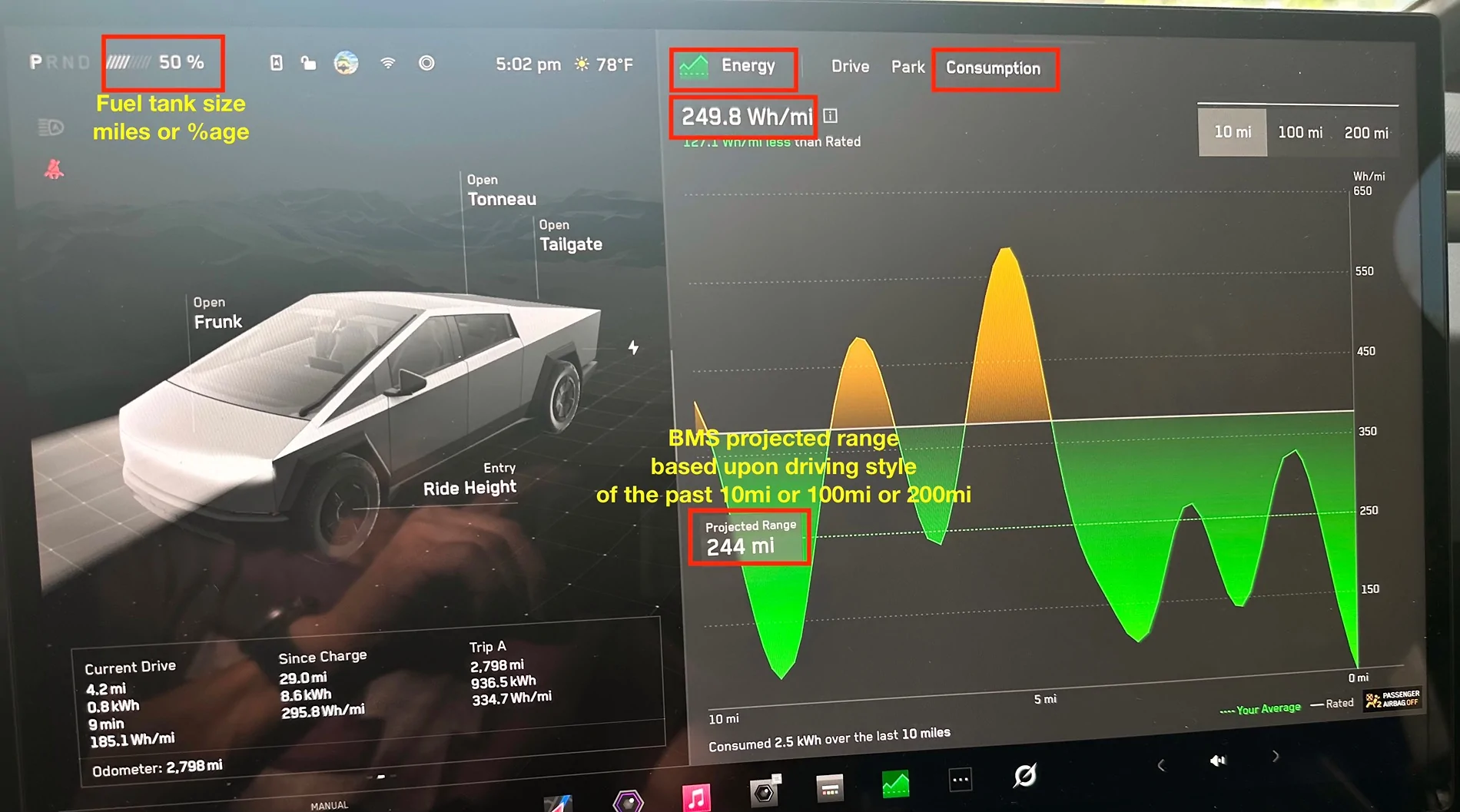
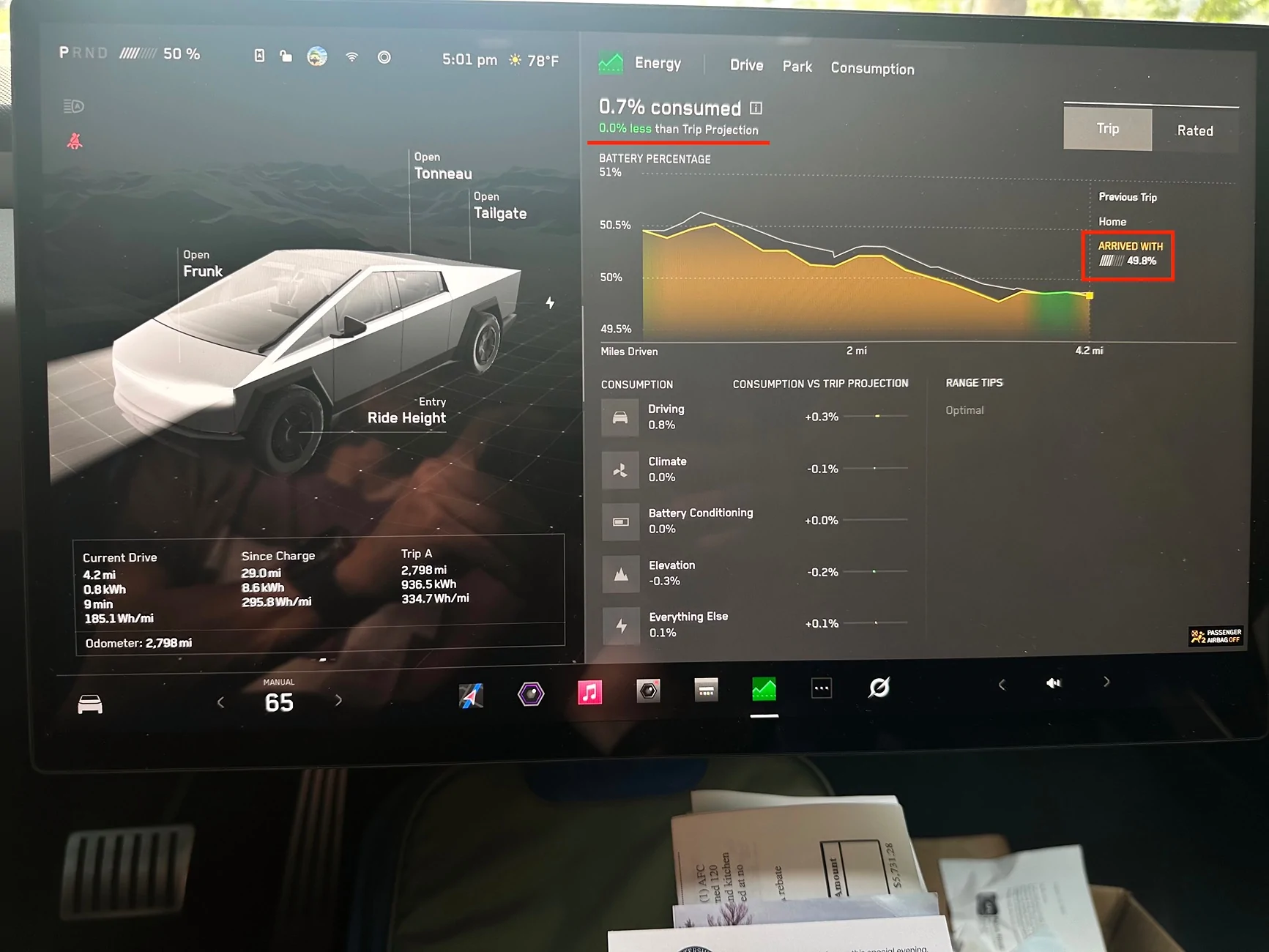
The top of the display has your fuel tank gauge, whether in miles of range or %age. That's based upon the EPA-rating. This is where people get confused. Honestly, it should always show %age like a fuel gauge. When it shows miles, people get the wrong impression that it's showing miles based upon their driving. It's not.

Everywhere else where it shows range on the Energy screens, it's showing "projected range" calculated by the BMS based upon your driving style. It seems obvious because it's showing your driving efficiency. In my example, I have 244mi of projected range with 50% of my battery left. Obviously, my battery isn't rated for 488mi, but if I drive from the gym back to my home, continuously, I might be able to drive that far.
Tesla Cybertruck Losing Mileage per 80% Charge over Time IMG_2189
Tesla Cybertruck Losing Mileage per 80% Charge over Time IMG_2188
 

Beetlebug62

Well-known member
First Name
Ken
Joined
Mar 24, 2025
Threads
6
Messages
457
Reaction score
802
Location
Maine, USA
Vehicles
2018 Tesla Model 3 LR-AWD, 2025 CyberTruck dual-motor
Occupation
retired
Country flag
Interesting discussion .

During winter with much lower ambient temps close to 0 degrees Celsius and below what is the recommendation then of charging … still the same numbers ideal 50% or higher . Or some other strategy . Does the cold harm the battery and if so how to mitigate this harm .
In my experience heat kills batteries not cold.

What's confusing is that heat helps electrons move more freely, so it's good for charging, quickly. Cold makes the electrons move slowly, so not good for regen braking, and it can limit capacity when really cold; but, I've not heard of anyone bricking their EV battery due to cold.

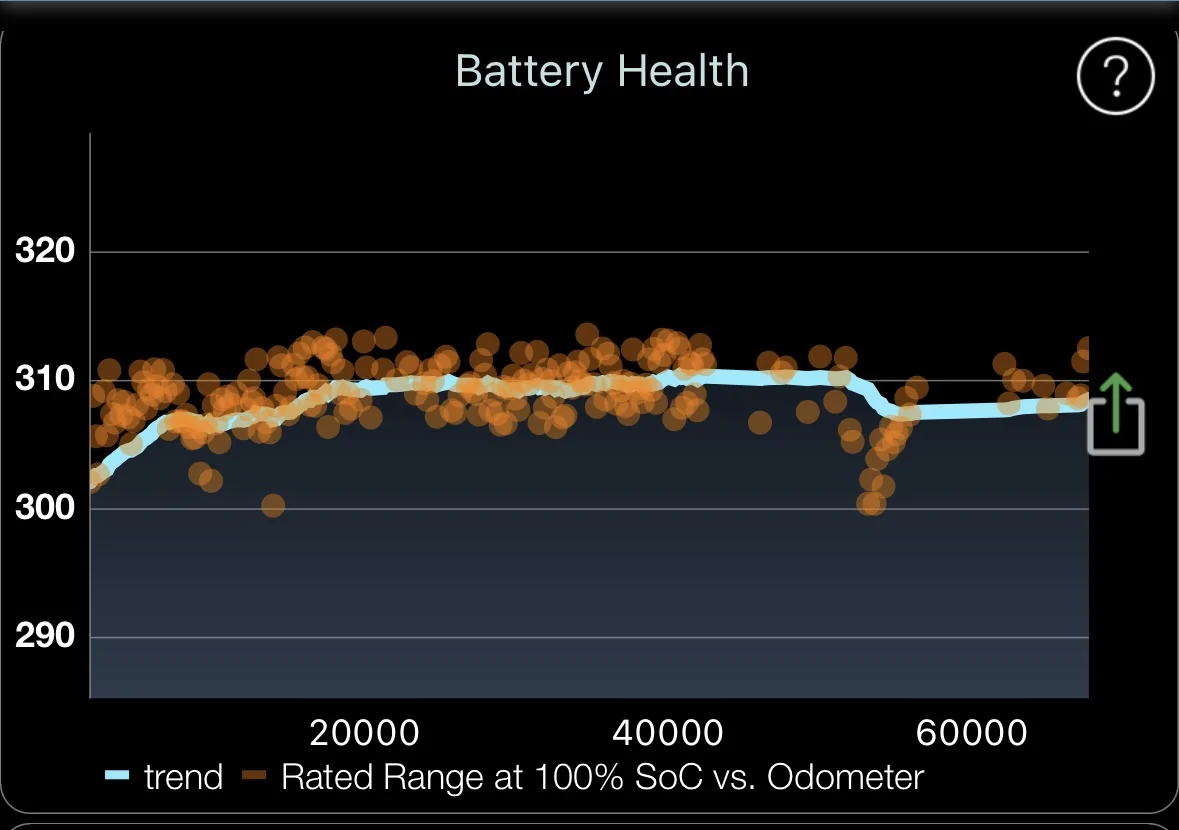
Actually, a lot of people believe that a cold environment helps with battery longevity. For example, my 2018 Mod3 maintained its full EPA-rating for 6+yrs. My car lived outside in the Maine winters.
Tesla Cybertruck Losing Mileage per 80% Charge over Time IMG_5436

The chart is from the Stats app.

So, possibly, cold is good for battery longevity, but inconvenient for driving.

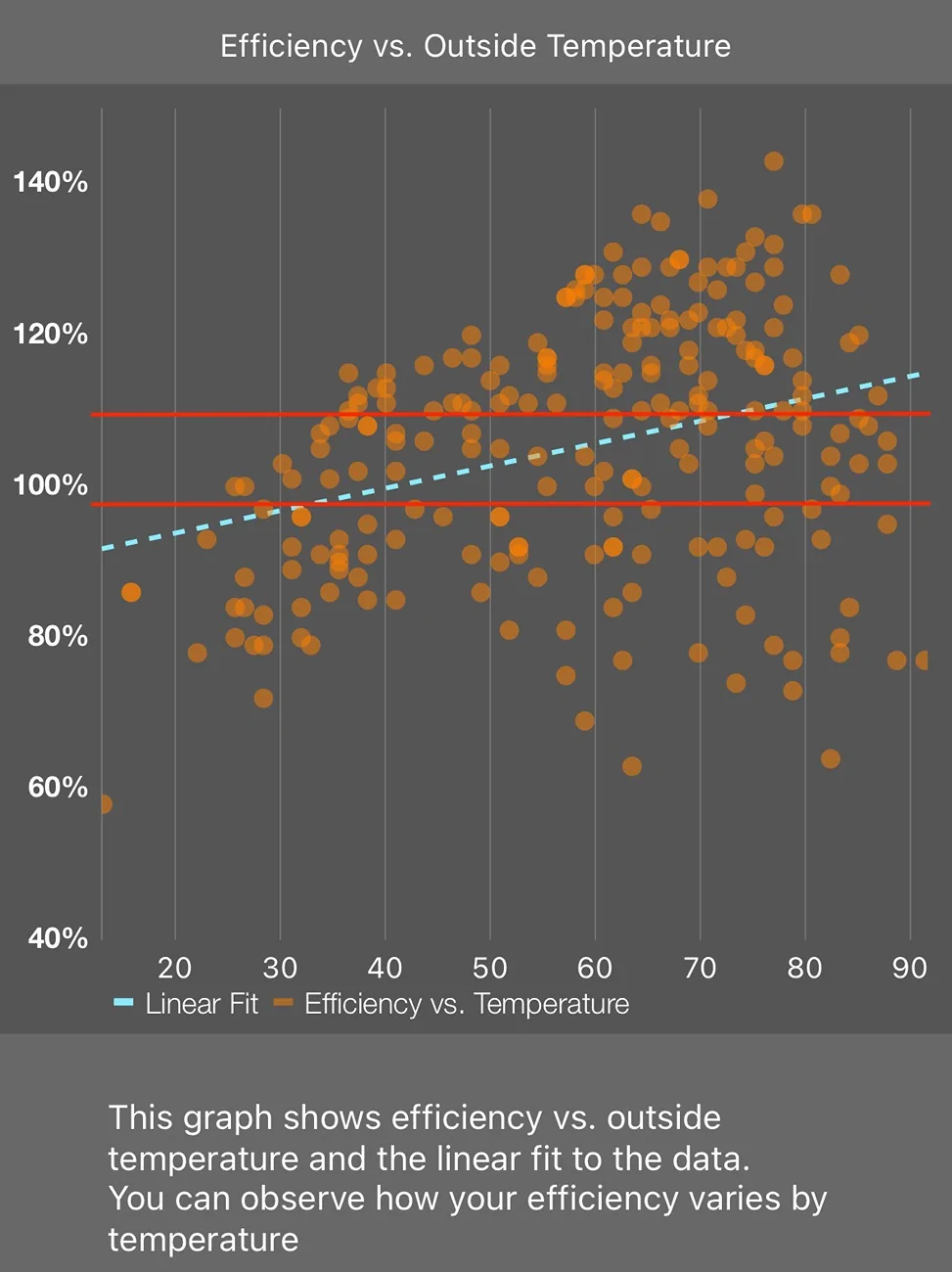
Now for daily driving, I would charge to whatever level you need for your daily drive; balance convenience and utility. If you charge to 60% in summer, and drive between 60 and 40% for your daily commute; then maybe charge to 65% in Winter. At 32°f, I find my range drops between 20-30%. If you're using 20% for your daily commute, then 20-30% more would be 24-26% used, right?

Below I drew two red lines at 32°f and 72°f. The difference is barely more than 10% difference in efficiency. On the other hand, the "best fit" line is not really that good, so I estimate the real difference I saw to be between 20-30% when driving at 32°f.
Tesla Cybertruck Losing Mileage per 80% Charge over Time IMG_5435
 
Last edited:

CyberGus

Well-known member
First Name
Gus
Joined
May 22, 2021
Threads
91
Messages
10,246
Reaction score
33,915
Location
Austin, TX
Vehicles
1981 DeLorean, 2024 Cybertruck
Occupation
IT Specialist
Country flag
During winter with much lower ambient temps close to 0 degrees Celsius and below what is the recommendation then of charging … still the same numbers ideal 50% or higher . Or some other strategy . Does the cold harm the battery and if so how to mitigate this harm .
For storage, colder is better. Heat will increase the rate of calendar degradation.

During usage however, the cells will have optimal characteristics at higher temps. That's why you get reduced range and performance when the ambient temp is very low. That's also why the pack is "preconditioned" to a higher temperature when you navigate to a Supercharger; the higher temp allows for faster charging.

Of course, the cells heat when charged, so the cooling system runs at 100% to keep the temp down lol.
Sponsored


Top