
Sponsored
Cybertruck Towing Common Sense FAQ
- Thread starter PerfectFlaw
- Start date
- Watchers 5

Woodrick
Well-known member
- First Name
- Ed
- Joined
- Dec 30, 2023
- Threads
- 6
- Messages
- 4,786
- Reaction score
- 4,762
- Location
- Gainesville Ga
- Vehicles
- Model 3, Model Y, Cybertruck AWD
- Occupation
- Consultant

Need to tow 400 miles?
My Model Y certainly did, down and back!
My Model Y certainly did, down and back!
Texarado
Well-known member
- Joined
- Jan 19, 2024
- Threads
- 18
- Messages
- 307
- Reaction score
- 547
- Location
- Dallas TX
- Vehicles
- ’24 CT AWD FS; ’18 Model 3 AWD
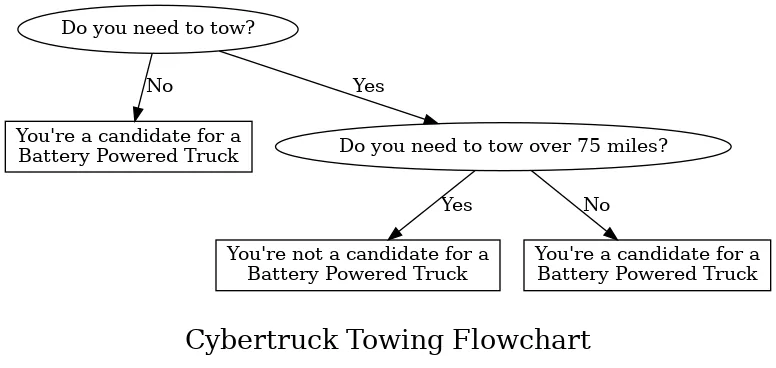
In a very black & white world, this chart works.
There’s a lot of dogging on those who want to tow a trailer with an EV truck (or car). For full timers, that seems like a difficult challenge. For casual campers, it’s just a modification of what the travel leg to your campsite looks like.
Keep in mind, just 5-6 years ago during the Model 3 ramp, many people would use the same chart but put “Do you need to drive more than 200 miles?” in the bubble. If I drove 800-1000 miles per week, I wouldn’t drive an EV. I make a 800-1000 road trip 2-3 times a year and an EV is just fine. Same analysis with towing.

Crissa
Well-known member
- First Name
- Crissa
- Joined
- Jul 8, 2020
- Threads
- 138
- Messages
- 19,571
- Reaction score
- 31,475
- Location
- Santa Cruz
- Vehicles
- 2014 Zero S, 2013 Mazda 3
It depends, the EV will be cheaper for those miles but it really depends on how far you're driving every day: 200/day aka 1000/wk is fine if you're getting back to a Level 2 charger each night.Keep in mind, just 5-6 years ago during the Model 3 ramp, many people would use the same chart but put “Do you need to drive more than 200 miles?” in the bubble. If I drove 800-1000 miles per week, I wouldn’t drive an EV. I make a 800-1000 road trip 2-3 times a year and an EV is just fine. Same analysis with towing.
-Crissa
Texarado
Well-known member
- Joined
- Jan 19, 2024
- Threads
- 18
- Messages
- 307
- Reaction score
- 547
- Location
- Dallas TX
- Vehicles
- ’24 CT AWD FS; ’18 Model 3 AWD
Sorry, I meant an 800-1000 mile drive (not spread over a week). 800-1000 miles at a time is doable in my Model 3, but it does add to the time. Week in, week out, it might wear me out because that’s a lot of supercharger time. But, having to deal with that inconvenience a few times a year… who cares? The day-in, day-out driving of the car far outweighs any of that inconvenience of long roadtrips.It depends, the EV will be cheaper for those miles but it really depends on how far you're driving every day: 200/day aka 1000/wk is fine if you're getting back to a Level 2 charger each night.
-Crissa
Crissa
Well-known member
- First Name
- Crissa
- Joined
- Jul 8, 2020
- Threads
- 138
- Messages
- 19,571
- Reaction score
- 31,475
- Location
- Santa Cruz
- Vehicles
- 2014 Zero S, 2013 Mazda 3
And with how many chargers there are lately, unless you're driving out into the wilderness, you're just going to match up charging with bio breaks.
-Crissa
-Crissa

Gigahorse
Well-known member
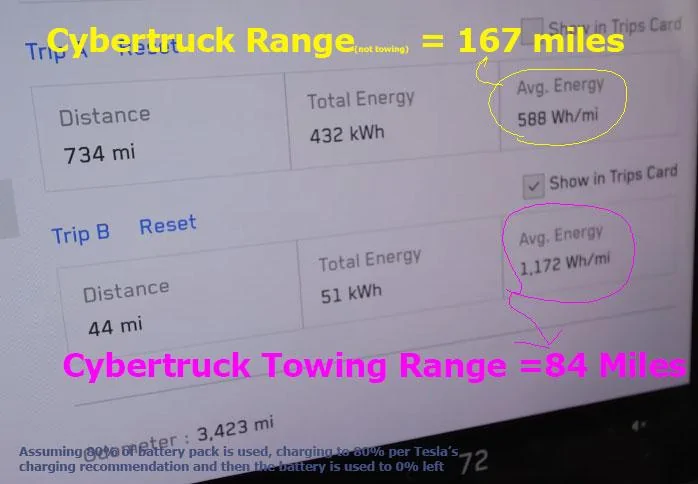
Would say I agree, only edit would be "Do you need to tow over 75 miles ROUND TRIP?" as some might assume that means they need to tow 75 miles and that includes getting back.
Some nuance in load type, speed, etc. But think your chart is pretty fair.
Woodrick
Well-known member
- First Name
- Ed
- Joined
- Dec 30, 2023
- Threads
- 6
- Messages
- 4,786
- Reaction score
- 4,762
- Location
- Gainesville Ga
- Vehicles
- Model 3, Model Y, Cybertruck AWD
- Occupation
- Consultant
I didn't really count, but we stopped about every 50 miles or so, it took longer, but whatever pain it was towing it, was well made up by using the boat. When we had to drop the boat, my wife had it down to about a minute a two and the worst part is the safety chain placement on the Model Y. You pretty well have to sit to get to them. Stops were probably around 20-30 minutes. The Cybertruck uses more power, so that may be 30-40 minutes.How many charges and how much time charging each time?
But the thing to remember was that was 2 days (out and back) out of 365. We still haul the trailer, but most of the trips are to the local lake. And that's nothing to even think about.
And that's a lot to say since we have two Tesla that alternate access to a single 120V outlet.
Texarado
Well-known member
- Joined
- Jan 19, 2024
- Threads
- 18
- Messages
- 307
- Reaction score
- 547
- Location
- Dallas TX
- Vehicles
- ’24 CT AWD FS; ’18 Model 3 AWD
This is the part that is almost always forgotten. The number of people who tow full time and drive more than 100 miles (assuming for argument sake that’s the number) is few and far between…But the thing to remember was that was 2 days (out and back) out of 365. We still haul the trailer, but most of the trips are to the local lake. And that's nothing to even think about.
And that's a lot to say since we have two Tesla that alternate access to a single 120V outlet.

scottyah
Well-known member
- First Name
- Scott
- Joined
- Dec 14, 2022
- Threads
- 13
- Messages
- 461
- Reaction score
- 817
- Location
- San Diego, CA
- Vehicles
- 2025 AWD CT
- Occupation
- ~ ~ C Y B E R S P O O N ~ ~
Exactly, I know Rivian was doing work to put chargers right at the bounds of National Parks to promote how they're adventure vehicles, but if you're going camping for a weekend or a fishing trip or whatever, you're typically trying your hardest to get as far from the kind of places that have superchargers.Would say I agree, only edit would be "Do you need to tow over 75 miles ROUND TRIP?" as some might assume that means they need to tow 75 miles and that includes getting back.
Some nuance in load type, speed, etc. But think your chart is pretty fair.

I'm not trying to drive 500 miles in one day straight shot, I'm trying to go 100 miles, take it off-roading/camping, then come back without having to stop at a slow charger in the boonies listing "4 Connectors up to 6kW ".
- First Name
- Matthew
- Joined
- Sep 25, 2020
- Threads
- 9
- Messages
- 149
- Reaction score
- 178
- Location
- Utah
- Vehicles
- None
- Banned
- #12
Thanks for the great info. I have 2 Model Ys and I have been tempted to put a hitch on one of them. (unless I get the CT)I didn't really count, but we stopped about every 50 miles or so, it took longer, but whatever pain it was towing it, was well made up by using the boat. When we had to drop the boat, my wife had it down to about a minute a two and the worst part is the safety chain placement on the Model Y. You pretty well have to sit to get to them. Stops were probably around 20-30 minutes. The Cybertruck uses more power, so that may be 30-40 minutes.
But the thing to remember was that was 2 days (out and back) out of 365. We still haul the trailer, but most of the trips are to the local lake. And that's nothing to even think about.
And that's a lot to say since we have two Tesla that alternate access to a single 120V outlet.
Crissa
Well-known member
- First Name
- Crissa
- Joined
- Jul 8, 2020
- Threads
- 138
- Messages
- 19,571
- Reaction score
- 31,475
- Location
- Santa Cruz
- Vehicles
- 2014 Zero S, 2013 Mazda 3
Tow 100 miles, then... offroad with the truck... then tow back 100 miles?I'm not trying to drive 500 miles in one day straight shot, I'm trying to go 100 miles, take it off-roading/camping, then come back without having to stop at a slow charger in the boonies listing "4 Connectors up to 6kW ".
That seems like an odd use case in an ever shrinking space without superchargers and where you're never stopping?
-Crissa
scottyah
Well-known member
- First Name
- Scott
- Joined
- Dec 14, 2022
- Threads
- 13
- Messages
- 461
- Reaction score
- 817
- Location
- San Diego, CA
- Vehicles
- 2025 AWD CT
- Occupation
- ~ ~ C Y B E R S P O O N ~ ~
Tow 100 miles, then... offroad with the truck... then tow back 100 miles?
That seems like an odd use case in an ever shrinking space without superchargers and where you're never stopping?
-Crissa
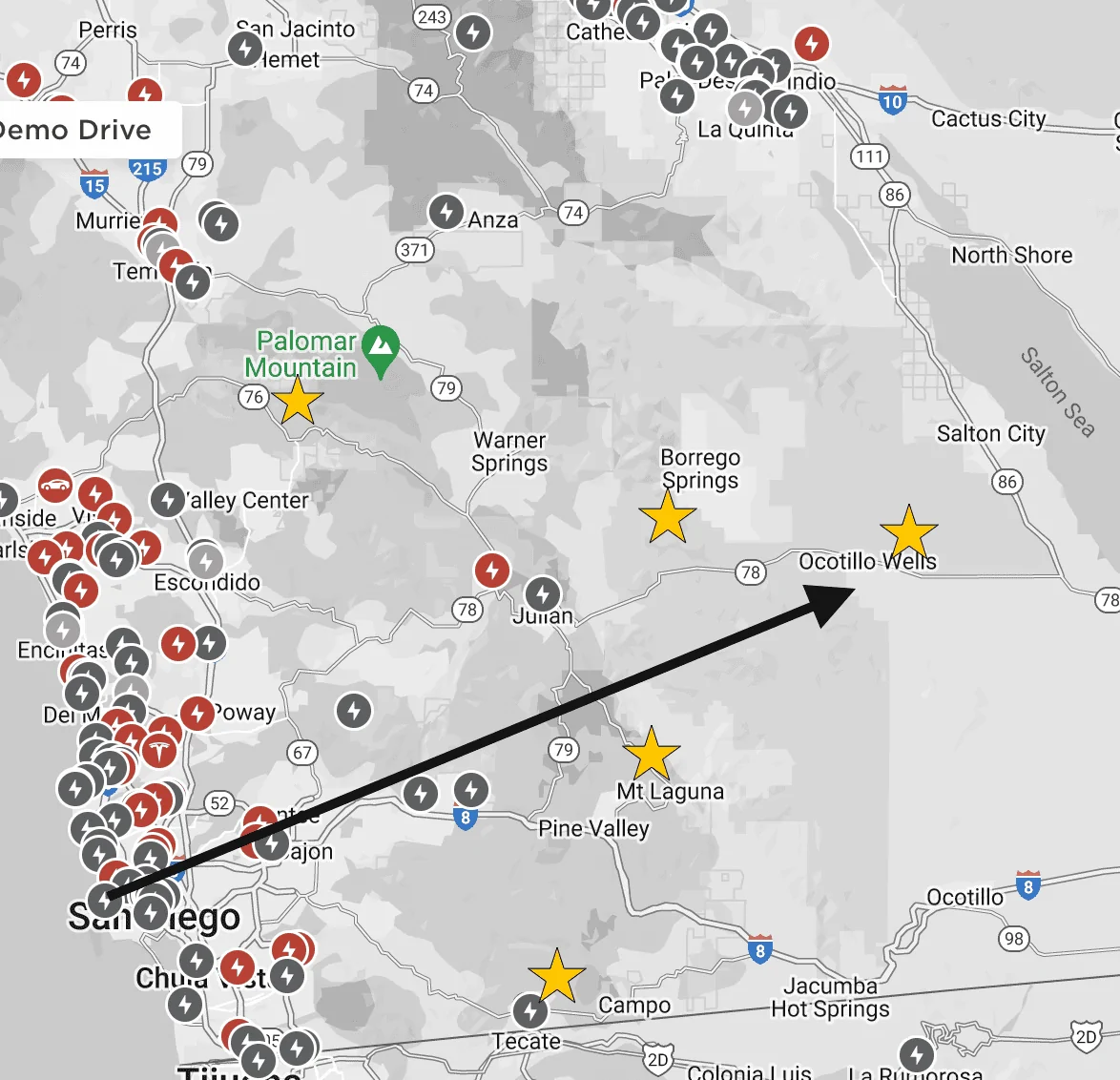
It's for sure a different world than a lot of people who are drawn to Tesla's (until the specs on the Cybertruck were released), but it's pretty hard to overstate how common this is in my neighborhood and ones around me. Every other house has a decked out 4runner, Tacoma, or trailer. From semi-costal San Diego to Ocotillo Wells (image)/ Anza Borrego area it's 100 miles. Specifically from my door to the entry gate it's exactly 99 miles without stops. It's a gradual up then a drop down to the valley.
People are towing out off-roading toys, trailers, dirt bikes, etc then camping for 1-2 nights then heading back. Once you unload the trailer at camp (usually boondocking), you drive around to a nice area to hike or just offroad for fun, exploring the area and whatnot.
As you can see in the picture, there are not enough stations for the new range on the cybertruck. I admit I was a fool for believing the numbers, for not knowing EV's don't work that way, etc. I just know my 1998 Mercury can make it (without towing), and the CT's 500 mile range would have been more than enough to tow 200 miles and some playing/AC running/marg making in-between.
I'm just posting because there seem to be a lot of people here who don't realize there is a very real use case for a 500 mile truck, and Superchargers are not always a convenient way to take a potty break on a road trip. Yes, everyone I've ever driven with has been perfectly capable of holding their bladders for two hours when we go before leaving and can go right when we get to camp.

PilotPete
Well-known member
- First Name
- Pete
- Joined
- May 8, 2023
- Threads
- 12
- Messages
- 1,578
- Reaction score
- 3,969
- Vehicles
- Porsche, BMW, M3LR on order
- Occupation
- Chief Pilot
In all seriousness, 67 to 78, just before Julian, top off at the SC and go to ocotillo wells, on the way back, stop just after Julian if you need, or hit one of the 2 in El Cajon, (I’ve used the one in the Costco Parking lot there) or go all the way home if you can. Looks like that works with any triple digit range, or even less.
It's for sure a different world than a lot of people who are drawn to Tesla's (until the specs on the Cybertruck were released), but it's pretty hard to overstate how common this is in my neighborhood and ones around me. Every other house has a decked out 4runner, Tacoma, or trailer. From semi-costal San Diego to Ocotillo Wells (image)/ Anza Borrego area it's 100 miles. Specifically from my door to the entry gate it's exactly 99 miles without stops. It's a gradual up then a drop down to the valley.
People are towing out off-roading toys, trailers, dirt bikes, etc then camping for 1-2 nights then heading back. Once you unload the trailer at camp (usually boondocking), you drive around to a nice area to hike or just offroad for fun, exploring the area and whatnot.
As you can see in the picture, there are not enough stations for the new range on the cybertruck. I admit I was a fool for believing the numbers, for not knowing EV's don't work that way, etc. I just know my 1998 Mercury can make it (without towing), and the CT's 500 mile range would have been more than enough to tow 200 miles and some playing/AC running/marg making in-between.
I'm just posting because there seem to be a lot of people here who don't realize there is a very real use case for a 500 mile truck, and Superchargers are not always a convenient way to take a potty break on a road trip. Yes, everyone I've ever driven with has been perfectly capable of holding their bladders for two hours when we go before leaving and can go right when we get to camp.
Sponsored


