Sponsored

Vortex generators?

Hemi314

Active member
First Name
Tom
Joined
May 3, 2025
Threads
5
Messages
34
Reaction score
34
Location
Missouri
Vehicles
Ford Maverick, Ford fairmont, Dodge Viper ACR
Occupation
.
Country flag
Are there any aerodynamics experts in here?

Would vortex generators placed on the leading edge of the roof help out with aero by reducing negative pressure over the roof and tonneau? On long highway trips, any reduced drag at all would be significant for range.

From my understanding, it seems like they would help, but figuring out the size and placement would be the trick. The windshield/roof of the CT is shaped somewhat like a wing. Apparently you want the vortex generator to be placed slightly perpendicular to airflow.

Anyone tried this?
Sponsored
 

Beetlebug62

Well-known member
First Name
Ken
Joined
Mar 24, 2025
Threads
6
Messages
457
Reaction score
802
Location
Maine, USA
Vehicles
2018 Tesla Model 3 LR-AWD, 2025 CyberTruck dual-motor
Occupation
retired
Country flag
Perpendicular, like a gurney flap? Dunno, works for wings, but it has airflow on top and bottom.

Just thinking about it, the air detaches at the roof peak, creating a large draggy low pressure space behind. The goal would be to reduce the size of the low pressure space which will make it less draggy. You may be right, a gurney flap could start the air to tumble and stay closer to the roofline, reducing the size of the low-pressure zone. I'd try ¼" and ½". Instead of 3D printing a flap, I'd try rubber strips with 3M tape. There has to be something with an "L" shape that could allow you to test the concept. Now you have me thinking I should look on Amazon.

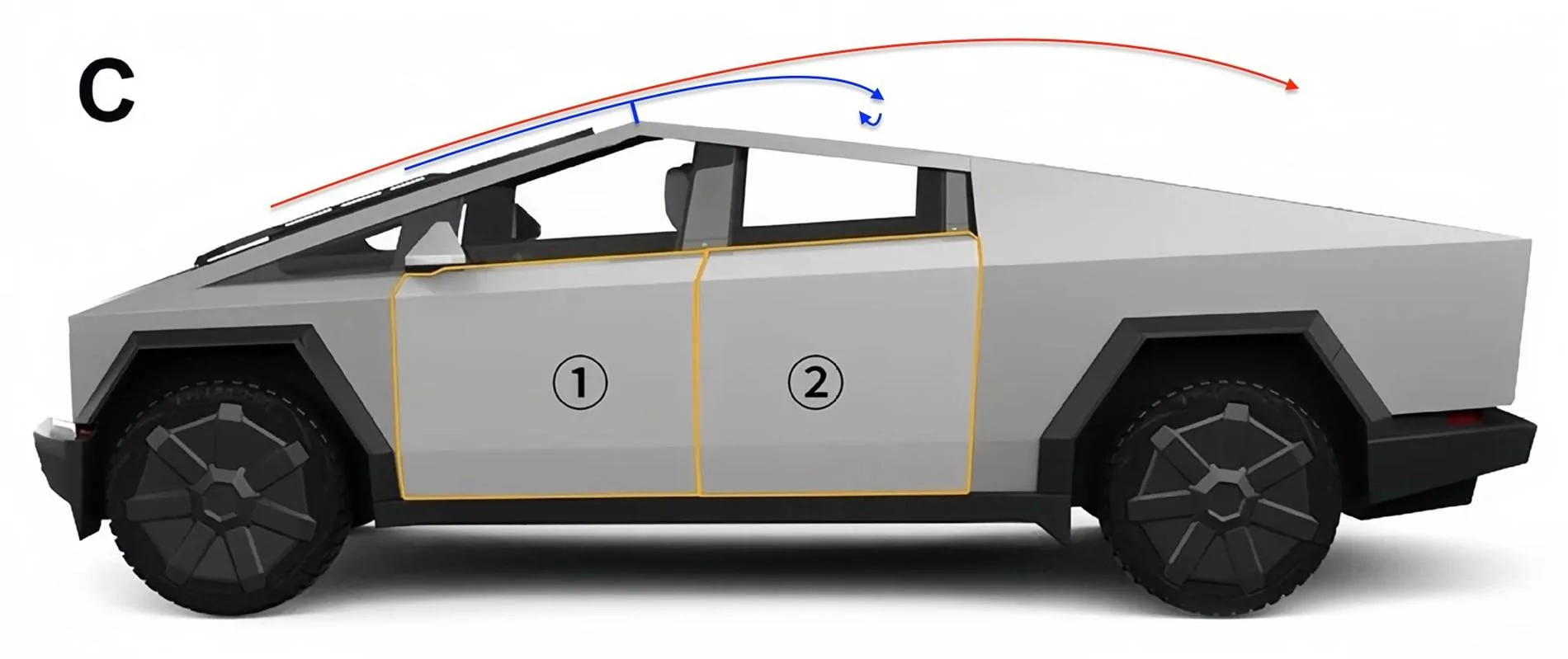
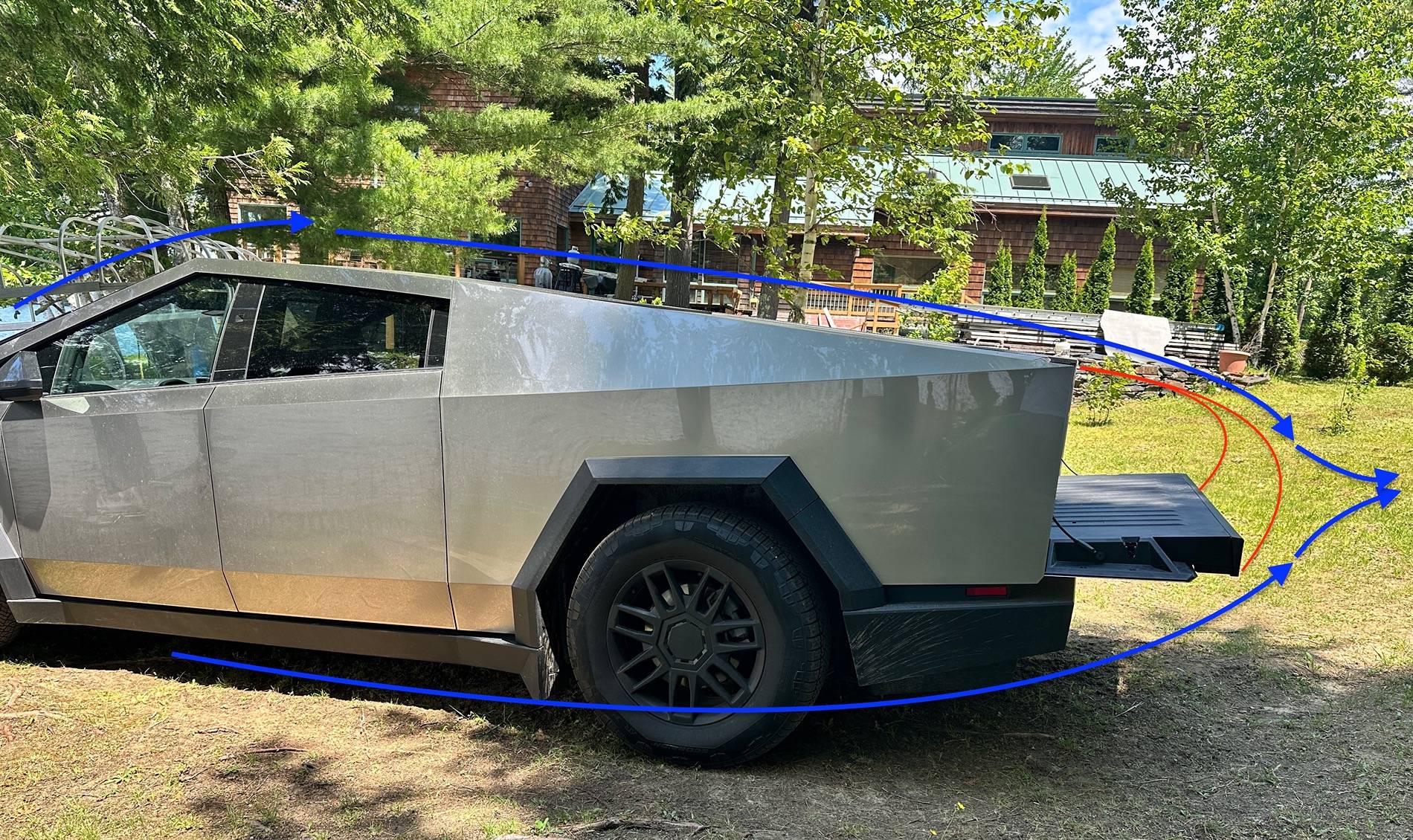
Here's a little illustration, with the red line showing normal airflow, with a big draggy low-pressure zone behind the peak. The blue line shows how a gurney flap would start the aero tumble earlier, bringing it down closer to the roofline, making the draggy low-pressure area smaller.
Tesla Cybertruck Vortex generators? Image 47
 
Last edited:
OP
OP
Hemi314

Hemi314

Active member
First Name
Tom
Joined
May 3, 2025
Threads
5
Messages
34
Reaction score
34
Location
Missouri
Vehicles
Ford Maverick, Ford fairmont, Dodge Viper ACR
Occupation
.
Country flag
Perpendicular, like a gurney flap? Dunno, works for wings, but it has airflow on top and bottom.

Just thinking about it, the air detaches at the roof peak, creating a large draggy low pressure space behind. The goal would be to reduce the size of the low pressure space which will make it less draggy. You may be right, a gurney flap could start the air to tumble and stay closer to the roofline, reducing the size of the low-pressure zone. I'd try ¼" and ½". Instead of 3D printing a flap, I'd try rubber strips with 3M tape. There has to be something with an "L" shape that could allow you to test the concept. Now you have me thinking I should look on Amazon.

Here's a little illustration, with the red line showing normal airflow, with a big draggy low-pressure zone behind the peak. The blue line shows how a gurney flap would start the aero tumble earlier, bringing it down closer to the roofline, making the draggy low-pressure area smaller.
Image 47.webp
Just from looking at a gurney flap, it looks like it might introduce more drag on the leading edge than it would alleviate over the back. Vortex generators seem like they would impose very very little drag inherently.

Not quite like a gurney flap. VG’s are supposed to be angled a few degrees into the airstream in order to generate turbulent flow. If they point directly into the oncoming airstream they don’t do anything.

The image you are showing is exactly why I think VG’s would help. And before anyone says that if they worked, Tesla would have installed them, that is not necessarily the case. They might have thought the looks are too off putting or something else.

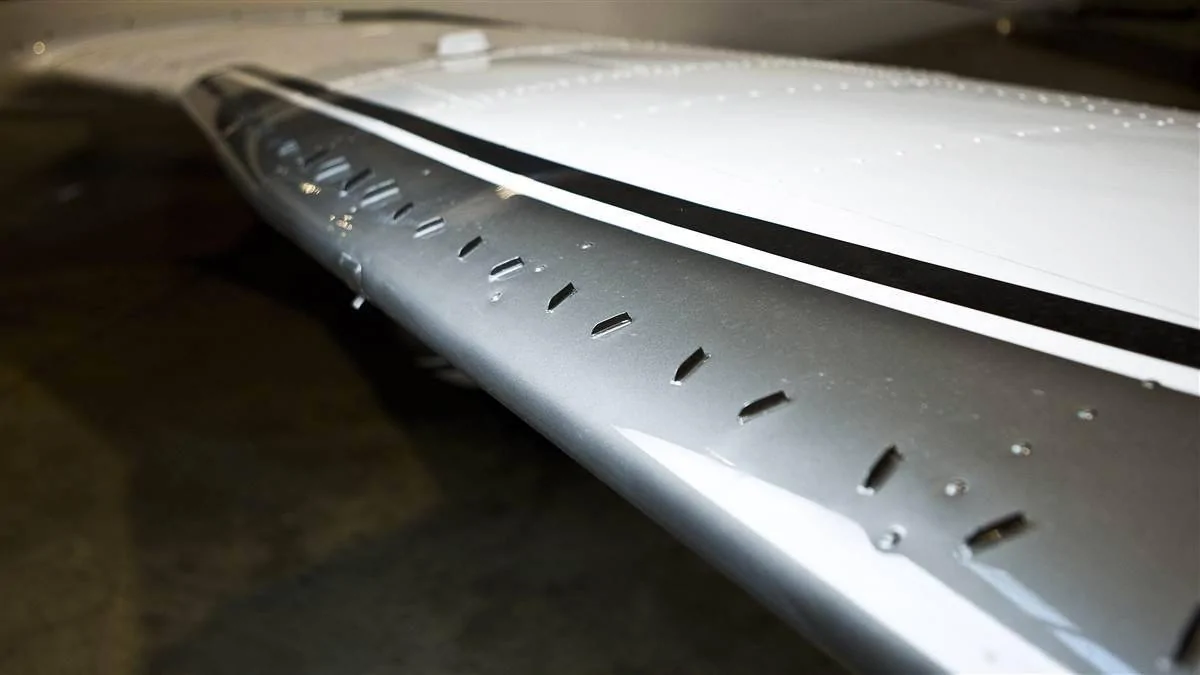
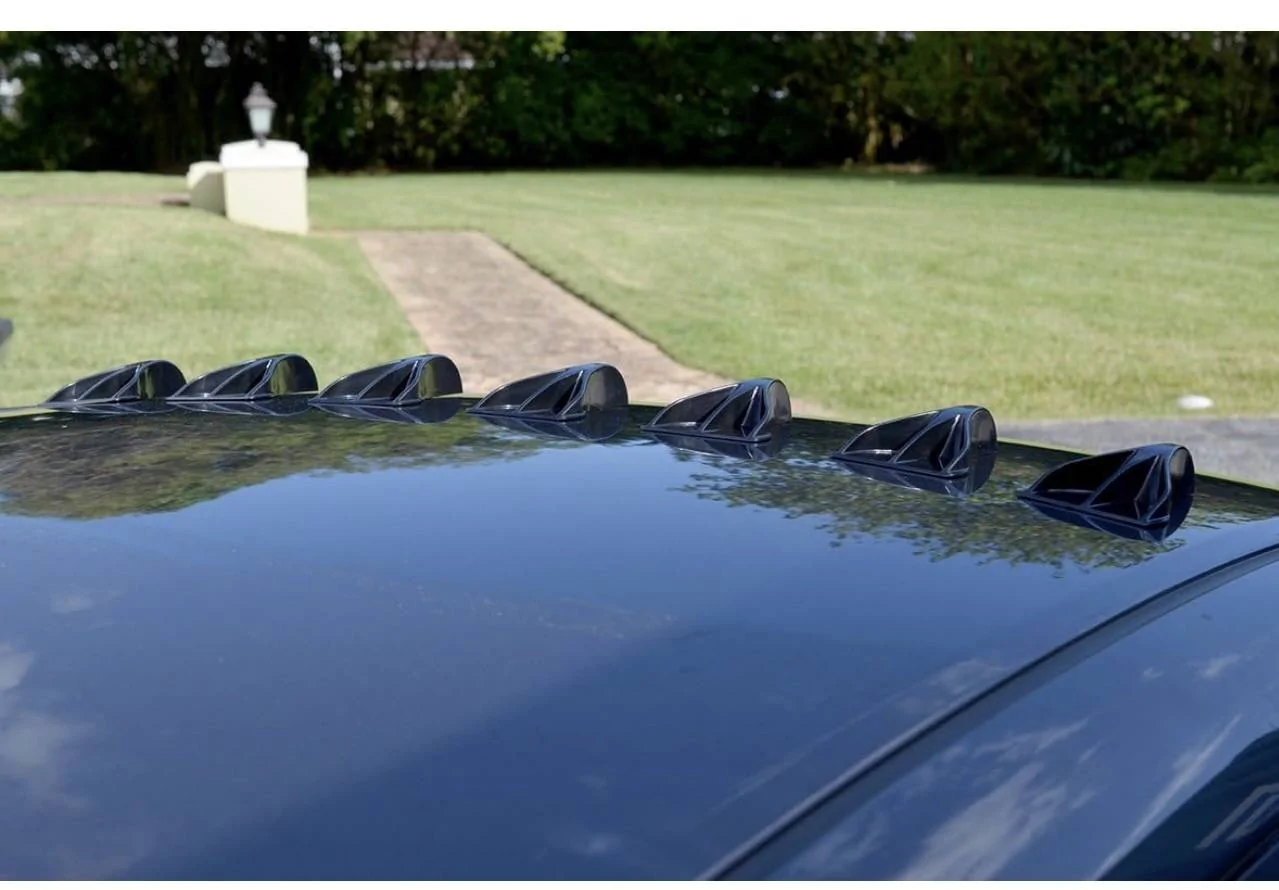
Vortex generators are often used in racing applications to control airflow and also people tend to install the just in front of the rear glass on some cars to help with neg pressure.

Tesla Cybertruck Vortex generators? IMG_5377
Tesla Cybertruck Vortex generators? IMG_5378
 

Beetlebug62

Well-known member
First Name
Ken
Joined
Mar 24, 2025
Threads
6
Messages
457
Reaction score
802
Location
Maine, USA
Vehicles
2018 Tesla Model 3 LR-AWD, 2025 CyberTruck dual-motor
Occupation
retired
Country flag
Just from looking at a gurney flap, it looks like it might introduce more drag on the leading edge than it would alleviate over the back. Vortex generators seem like they would impose very very little drag inherently.

Not quite like a gurney flap. VG’s are supposed to be angled a few degrees into the airstream in order to generate turbulent flow. If they point directly into the oncoming airstream they don’t do anything.

The image you are showing is exactly why I think VG’s would help. And before anyone says that if they worked, Tesla would have installed them, that is not necessarily the case. They might have thought the looks are too off putting or something else.

Vortex generators are often used in racing applications to control airflow and also people tend to install the just in front of the rear glass on some cars to help with neg pressure.

IMG_5377.jpeg
IMG_5378.jpeg
Yeah, I was initially thinking about vortex generators like an upside down diffuser; but, when I read perpendicular, I was thinking you might be referring to a gurney flap. Either way, it's an idea worth testing.
 
OP
OP
Hemi314

Hemi314

Active member
First Name
Tom
Joined
May 3, 2025
Threads
5
Messages
34
Reaction score
34
Location
Missouri
Vehicles
Ford Maverick, Ford fairmont, Dodge Viper ACR
Occupation
.
Country flag
Yeah, I was initially thinking about vortex generators like an upside down diffuser; but, when I read perpendicular, I was thinking you might be referring to a gurney flap. Either way, it's an idea worth testing.
I actually sent an email to an aerodynamicist at a local college. We will see if he shares his secrets lol. Another benefit of VG’s is that they should also quiet the wind noise (if they work in this application)


HaulingAss

Well-known member
Joined
Oct 3, 2020
Threads
28
Messages
10,329
Reaction score
20,750
Location
Western Washington, USA
Vehicles
Cybertruck DM, 2010 F-150, 2018 Performance Model 3, 2024 Performance Model 3
Country flag
Are there any aerodynamics experts in here?

Would vortex generators placed on the leading edge of the roof help out with aero by reducing negative pressure over the roof and tonneau? On long highway trips, any reduced drag at all would be significant for range.

From my understanding, it seems like they would help, but figuring out the size and placement would be the trick. The windshield/roof of the CT is shaped somewhat like a wing. Apparently you want the vortex generator to be placed slightly perpendicular to airflow.

Anyone tried this?
I've always been interested in doing more with less (increasing efficiency no matter the application). If we increased the efficiency of every ICE engine in N. America by 1%, we would save an astounding 2.2 billion gallons of fuel per year. Many people can't even comprehend how big a billion is! And that's just from a 1% increase in efficiency.

So, yes, I'm very interested in increasing efficiency by small amounts, even on an electric vehicle and even though I don't need more range and the money savings would be relatively inconsequential. It's like free energy (minus any time and materials you put into the task).

The problem with making aero improvements is it's very difficult to measure the actual improvement without expensive and sophisticated equipment and a lot of time spent testing. Certainly, sophisticated airflow simulation software is capable of being run on affordable computers, but even this requires a lot of time and expertise.

While the Cybertruck's wedge shape breaks new ground in terms of a full-sized pickup truck's aerodynamic drag reduction, it's also obvious that a certain amount of aerodynamic refinement was omitted to keep the design pure and avoid extraneous parts. The engineers addressed the easiest pickings, the areas around the wheels, with the aero flaps in front of each tire and the Aero wheel covers, but I would like to see them take on a project to create a Cybertruck aero kit. Because they have the resources available to develop this for many.

But individuals can still make educated guesses as to what might lower drag, it's just difficult to verify real world results. I think at lower freeway speeds the airflow over the roof peak doesn't have significant separation so vortex generators would only be a significant benefit at higher freeways speeds, probably over 70 mph. Vortex generators are interesting because they are small, and easily added, with little potential downside.

I think the area most ripe for big gains is behind the tailgate. A lightweight "tail" at least 6 feet long would probably offer a much bigger improvement than vortex generators. It could be made out of Dow Blue (closed cell foam) Board and be attached at the top edge of the tailgate with a backward folding hinge with removeable retainers on the bottom (so the tailgate could still be opened). This would of course be awkward and get in the way of many things (like parking, charging, etc) but the efficiency improvement would be significant at any speed of 50 mph or higher. It could be pretty wild looking too. I recommend covering it in silver metallic film, so it looks like an extension of the stainless steel.
 

Beetlebug62

Well-known member
First Name
Ken
Joined
Mar 24, 2025
Threads
6
Messages
457
Reaction score
802
Location
Maine, USA
Vehicles
2018 Tesla Model 3 LR-AWD, 2025 CyberTruck dual-motor
Occupation
retired
Country flag
I've always been interested in doing more with less (increasing efficiency no matter the application). If we increased the efficiency of every ICE engine in N. America by 1%, we would save an astounding 2.2 billion gallons of fuel per year. Many people can't even comprehend how big a billion is! And that's just from a 1% increase in efficiency.

So, yes, I'm very interested in increasing efficiency by small amounts, even on an electric vehicle and even though I don't need more range and the money savings would be relatively inconsequential. It's like free energy (minus any time and materials you put into the task).

The problem with making aero improvements is it's very difficult to measure the actual improvement without expensive and sophisticated equipment and a lot of time spent testing. Certainly, sophisticated airflow simulation software is capable of being run on affordable computers, but even this requires a lot of time and expertise.

While the Cybertruck's wedge shape breaks new ground in terms of a full-sized pickup truck's aerodynamic drag reduction, it's also obvious that a certain amount of aerodynamic refinement was omitted to keep the design pure and avoid extraneous parts. The engineers addressed the easiest pickings, the areas around the wheels, with the aero flaps in front of each tire and the Aero wheel covers, but I would like to see them take on a project to create a Cybertruck aero kit. Because they have the resources available to develop this for many.

But individuals can still make educated guesses as to what might lower drag, it's just difficult to verify real world results. I think at lower freeway speeds the airflow over the roof peak doesn't have significant separation so vortex generators would only be a significant benefit at higher freeways speeds, probably over 70 mph. Vortex generators are interesting because they are small, and easily added, with little potential downside.

I think the area most ripe for big gains is behind the tailgate. A lightweight "tail" at least 6 feet long would probably offer a much bigger improvement than vortex generators. It could be made out of Dow Blue (closed cell foam) Board and be attached at the top edge of the tailgate with a backward folding hinge with removeable retainers on the bottom (so the tailgate could still be opened). This would of course be awkward and get in the way of many things (like parking, charging, etc) but the efficiency improvement would be significant at any speed of 50 mph or higher. It could be pretty wild looking too. I recommend covering it in silver metallic film, so it looks like an extension of the stainless steel.
Maybe with the tailgate down, you can put on a fairing from the tonneau down, in a reverse teardrop.
Tesla Cybertruck Vortex generators? IMG_1327.JPG

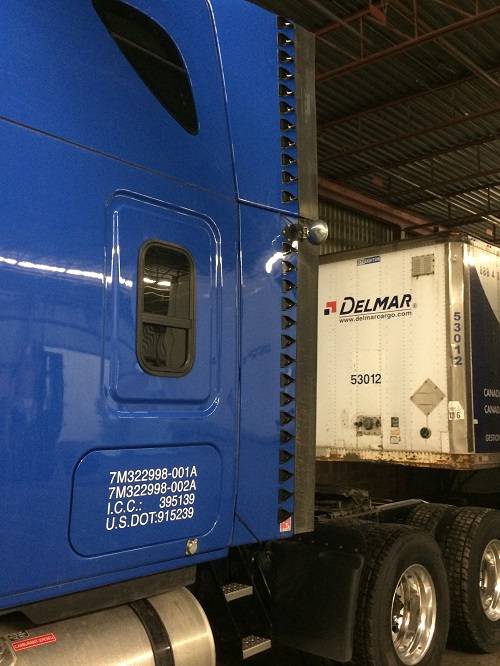
I do like the idea of semis usinging vortex generators on the sides and top, sort of creating a shadow body extension that allows the flow to extend off the back smoothly.
 
Last edited:
OP
OP
Hemi314

Hemi314

Active member
First Name
Tom
Joined
May 3, 2025
Threads
5
Messages
34
Reaction score
34
Location
Missouri
Vehicles
Ford Maverick, Ford fairmont, Dodge Viper ACR
Occupation
.
Country flag
I've always been interested in doing more with less (increasing efficiency no matter the application). If we increased the efficiency of every ICE engine in N. America by 1%, we would save an astounding 2.2 billion gallons of fuel per year. Many people can't even comprehend how big a billion is! And that's just from a 1% increase in efficiency.

So, yes, I'm very interested in increasing efficiency by small amounts, even on an electric vehicle and even though I don't need more range and the money savings would be relatively inconsequential. It's like free energy (minus any time and materials you put into the task).

The problem with making aero improvements is it's very difficult to measure the actual improvement without expensive and sophisticated equipment and a lot of time spent testing. Certainly, sophisticated airflow simulation software is capable of being run on affordable computers, but even this requires a lot of time and expertise.

While the Cybertruck's wedge shape breaks new ground in terms of a full-sized pickup truck's aerodynamic drag reduction, it's also obvious that a certain amount of aerodynamic refinement was omitted to keep the design pure and avoid extraneous parts. The engineers addressed the easiest pickings, the areas around the wheels, with the aero flaps in front of each tire and the Aero wheel covers, but I would like to see them take on a project to create a Cybertruck aero kit. Because they have the resources available to develop this for many.

But individuals can still make educated guesses as to what might lower drag, it's just difficult to verify real world results. I think at lower freeway speeds the airflow over the roof peak doesn't have significant separation so vortex generators would only be a significant benefit at higher freeways speeds, probably over 70 mph. Vortex generators are interesting because they are small, and easily added, with little potential downside.

I think the area most ripe for big gains is behind the tailgate. A lightweight "tail" at least 6 feet long would probably offer a much bigger improvement than vortex generators. It could be made out of Dow Blue (closed cell foam) Board and be attached at the top edge of the tailgate with a backward folding hinge with removeable retainers on the bottom (so the tailgate could still be opened). This would of course be awkward and get in the way of many things (like parking, charging, etc) but the efficiency improvement would be significant at any speed of 50 mph or higher. It could be pretty wild looking too. I recommend covering it in silver metallic film, so it looks like an extension of the stainless steel.
Actually, after finding some CFD info on the Cybertruck, I think you are right. It appears the airflow over the roof/tonneau stays fairly attached. There is a huge negative pressure area behind the tailgate though, and it seems VG’s installed in the tailgate would help.
Apparently it is common practice for truckers to install a product called ecofins on the back of their trailers and they report realistic fuel economy gains.

Tesla Cybertruck Vortex generators? IMG_5380
 

Gaximus

Well-known member
Joined
Jun 22, 2024
Threads
23
Messages
1,462
Reaction score
2,287
Location
Mead, CO
Vehicles
CyberBeast, Model 3, Jeep Wrangler, Yamaha R6
Occupation
Software Developer
Country flag
This is an interesting idea, looking at wind tunnel test of the CT, there is very little air separation at the peak. Most of it happens at the tail gate. And the biggest hit (literally) is that front. Need a road trip cone to put on the front.
 
OP
OP
Hemi314

Hemi314

Active member
First Name
Tom
Joined
May 3, 2025
Threads
5
Messages
34
Reaction score
34
Location
Missouri
Vehicles
Ford Maverick, Ford fairmont, Dodge Viper ACR
Occupation
.
Country flag
This is an interesting idea, looking at wind tunnel test of the CT, there is very little air separation at the peak. Most of it happens at the tail gate. And the biggest hit (literally) is that front. Need a road trip cone to put on the front.
Yes after looking into it more I agree with you. Found some CFD info on CT. Not much separation after the peak, but after the tailgate is a mess. I think VG’s could help if installed at the tailgate .
 
  • Like
Reactions: Mal


Mal

Well-known member
First Name
Mal
Joined
Feb 13, 2024
Threads
31
Messages
637
Reaction score
1,619
Location
WA
Vehicles
'24 CB "Rocinante"
Country flag
Yes after looking into it more I agree with you. Found some CFD info on CT. Not much separation after the peak, but after the tailgate is a mess. I think VG’s could help if installed at the tailgate .
Reducing all that wind turbulence behind the tailgate might also keep the rear camera clearer in rain. I've been wanting to experiment with wind guides back there for a while.
 

HaulingAss

Well-known member
Joined
Oct 3, 2020
Threads
28
Messages
10,329
Reaction score
20,750
Location
Western Washington, USA
Vehicles
Cybertruck DM, 2010 F-150, 2018 Performance Model 3, 2024 Performance Model 3
Country flag
Actually, after finding some CFD info on the Cybertruck, I think you are right. It appears the airflow over the roof/tonneau stays fairly attached.
That depends upon the speed the airflow simulation or test is performed at. You could be going only 65 mph into a 10 mph headwind which would simulate a speed of 75 mph, and I bet the airflow is starting to do very different things than what the simulation shows. I think the airflow DOES separate at the roof at higher speeds. More simulations or testing is needed. Tesla has this data, but they generally don't publish it.

Does anyone have a pitot tube for the front of the Cybertruck? ? That would be a quick way to know what your effective speed is, in terms of aerodynamic drag, without having to keep track of what the wind is doing.
Sponsored


Top