Sponsored

Why Cybertruck Should Have a Performance Variant with Very High Regen Capability

craigcoker

Member
First Name
Craig
Joined
Nov 1, 2024
Threads
0
Messages
5
Reaction score
14
Location
san diego
Vehicles
cybertruck
Occupation
race car driver
Country flag
3. Dramatically increase regen capability. I think this is something that Tesla should do on all their vehicles. This is the way to unlock substantially better braking performance with the same tires and configuration just as Tesla is consistently able to beat ICE traction control systems in positive acceleration. The idea is to leverage the incredible sensitivity and control of the electric motors to allow better management of wheel slip compared to the ABS controller. In an ideal world, this would also allow elimination of the ABS system thereby reducing cost and weight as well. This would have the additional benefit of capturing of more of the kinetic energy of the vehicle during stopping (especially harder stops). Of course there are technical challenges but I am sure Tesla is up to it and fairly certain it could be done without major cost increases within reason.

Here's hoping that CT 2.0 has super high performance regen, -500 lbs of weight, a performance variant and +200 miles of EPA range.
I love the thought you put into this! Increased regen would be good under some scenarios but not all. I’ll lay out for you why it is not always good for precision driving, track and off-road.

Braking on a straight and initiating a turn with regen can be helpful. If done right It mimics trail braking and helps distribute weight to the front of the vehicle while promoting more grip to the front tires. It also allows the vehicle to rotate better. What it doesn’t help with is mid turn and sometimes exiting a turn. The three sections of a turn is turn in, mid turn (or apex) and exiting the turn. To master those three sections you generally want to connect all of them in one linear process while creating the proper weight distribution throughout. The problem with regen is as soon as you lift on power the weight of the vehicle shifts and can loose continuous grip to the tire(s) you need most. This is usually a problem durning long, sweeping mid turns. For those fast sweeping turns this could also create a snap over steer scenario where weight distribution is erratic and the driver cannot control or manage the throttle properly. Regen is less severe exiting a turn as most drivers naturally roll on throttle and weight distribution to the back tires is accomplished. There is still a chance Regen can effect exit if the driver excels too early and needs to lift off power. This will cause another scenario of erratic weight distribution. The last issue regen promotes is thermal management spikes and heat soak. If the vehicle has high regen it would not allow the vehicle to mitigate thermal management properly. There will always be power output and power input. The drive units, battery, and supporting components are working double time with minimal time to recover.

There is some solutions to all this but requires either software update from Tesla or brake upgrades.

1. If Tesla could deactivate regen mid turn and exit then it could get rid of excessive weight distribution while allowing more consistent grip throughout the turn. You could argue the driver should learn smoother throttle inputs but that is just not possible on all turns and throttle lift is needed. It also doesn’t solve the problem of thermal management issues. This solution helps but is not the ultimate fix.

2. Imo the better solution for precision driving, tracking and off-roading is upgraded brake components with minimal to no regen activated. What brake components you ask? Ultimately all of them but on a budget I would start with high temp brake fluid, steel braided lines and a better pad compound. The next would be upgraded calipers and rotors. This solution should allow better weight distribution and proper driver input over regen intrusion. It also reduces the power going back into the vehicle which allows time for thermal management to recover from heat soak.

Hope you find these thoughts helpful!
Sponsored
 
  • Like
Reactions: REM

Gaximus

Well-known member
Joined
Jun 22, 2024
Threads
23
Messages
1,462
Reaction score
2,287
Location
Mead, CO
Vehicles
CyberBeast, Model 3, Jeep Wrangler, Yamaha R6
Occupation
Software Developer
Country flag
Its stopping power is limited by its tires, not brakes or Regen. Better tires or lighter car will make it stop faster. Bigger brakes and better Regen, will allow it to stop more consistently, say on a racetrack, where your hitting the brakes hard on every corners.

Good right up, but the CyberTruck is just supposed to be a truck. But in typical Elon fashion, made it stomp almost everything out there because, it's electric, and it can.
 

nocyber

Well-known member
First Name
Michael
Joined
Oct 4, 2024
Threads
6
Messages
132
Reaction score
193
Location
Wisconsin
Vehicles
Tesla Model S, Raptor R, Subaru Ascent
Country flag
I don’t like the idea of increasing regen specifically for cold/winter/hazardous road conditions. This is the top reason I chose not to purchase the Hummer EV. My neighbor has one, and it’s an absolute joy to drive and mess around with but it’s a death trap in the winter and the regen - not the weight/tires - are the largest contributors of this feeling.

Tesla has really dialed in the regen on their vehicles to all weather performance. I had an R1S last winter and it was brutal in the holiday months until the snow mode update came out that limited the regen significantly as it was originally causing crazy accidents. I didn’t even let me wife drive it with snow tires on because of how it would lock up.

I’m not concerned at all with the Cyberbeast.. but we will see.
 

HaulingAss

Well-known member
Joined
Oct 3, 2020
Threads
28
Messages
10,334
Reaction score
20,756
Location
Western Washington, USA
Vehicles
Cybertruck DM, 2010 F-150, 2018 Performance Model 3, 2024 Performance Model 3
Country flag
I've seen a number of posts describing the CyberTruck as a sports car in various ways. I thought it worth putting up a few numbers to show that as currently configured, the CyberTruck is definitely not a sports car and in fact may be one of the most imbalanced vehicles on the road today in terms of performance envelope.
Considering your post on the whole, what stands out to me is that it's very unlikely you own or have driven a Cybertruck. First of all, the Cybertruck is only a sports car relative to other pickup trucks (and most of them have far lower payload capacities). None of the vehicles on your list can pack the payload the Cybertruck does with ease. Of course it's not going to compare well with a hot blooded sports car like the C8 Corvette. I'm surprised you even put it on the list! It shows a lack of understanding of why people say the Cybertruck drives like a sports car (it's relative to other pickup trucks).

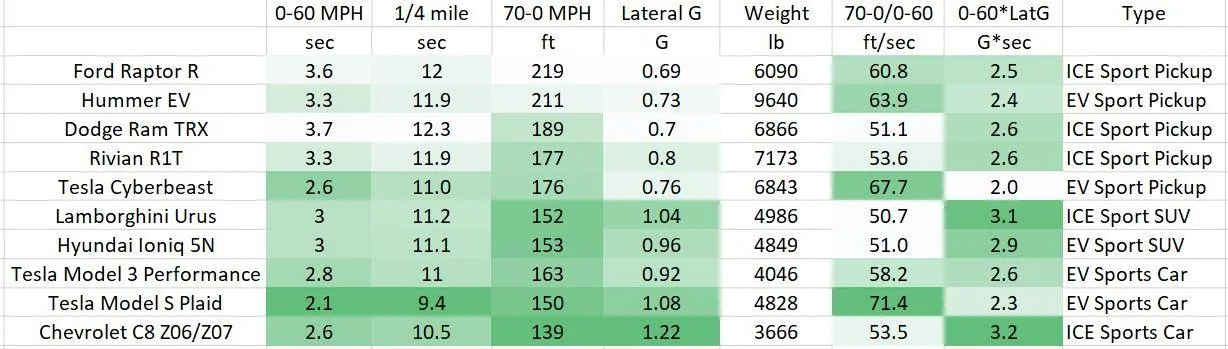
Comparing to its peer group (high performance off-road pickups), the CyberTruck shows how well Tesla is doing, taking the shortest distance to stop from 70, having the quickest 0-60 and 1/4, nearly the lightest overall weight and second best on cornering performance. However, the overperformance on positive acceleration is definitely not matched by overperformance on braking or cornering which is easy to see from the last two columns which attempt to balance the two factors (braking over accelerating in the first column and accelerating times cornering in the second). In the first column, lower numbers are more balanced and in the second, higher numbers are more balanced. Cybertruck is the worst of the group on both metrics, especially cornering to accelerating balance and in fact is the worst of the entire table in column 2 and the second worst in column 1 (Model S Plaid is the worst in column 1).
Your idea of what provides "balance" is misguided. Historically, when someone says a sporting car is very balanced, they refer to to the handling, they are saying it has neither heavy understeer or oversteer. However, the concept you introduce (out of thin air) actually penalizes a car for having better acceleration. What matters for braking performance is not how fast a car accelerates, but what speed it can reach (a metric that you conspicuously left out of your made up "balance" metric). A skilled driver is never forced to use acceleration that is too much for conditions so there is zero downside to having more than you need in any situation. Enough time spent on this misguided "balance" concept. It's meaningless.

This chart is at the heart of your misquided notion that the Cybertruck somehow falls down when it comes to sporty performance. First of all, the skidpad and braking numbers are highly dependent on tires. The Cybertrucks numbers are on All-Terrain tires, yet you are comparing them to numbers returned from vehicles wearing hot-blooded sporting tires, DOT legal racing tires. This is just silly in the extreme.

There are a lot of things that are wrong with this chart. The Model S Plaid is not a Sports Car either, it's a powerful four door sedan, at best, a Sports-Touring Sedan. In any case, the wild assortment of vehicle types included just shows that you fail to understand that when people claim the Cybertruck is like a sports car, it's relative to the class of of vehicle it's actually in, a pickup truck!


Basically tweak the suspension geometry, possibly higher rate suspension/shocks, add lower profile performance all seasons and bigger brakes.
You seem unaware that the Cybertruck has dynamically adjustable suspension rates and damping rates. The computer controls it depending upon speeds and conditions to manage comfort/performance. It could easily be programmed to be more sporty (at the expense of having a harsher ride).

Dramatically increase regen capability. I think this is something that Tesla should do on all their vehicles. This is the way to unlock substantially better braking performance with the same tires and configuration just as Tesla is consistently able to beat ICE traction control systems in positive acceleration.
This comment demonstrates a lack of understanding of vehicle performance, especially when it comes to braking distances. The amount of braking available is determined by the amount of friction available between the tire and the road. Adding more regen will not change the stopping distance of any vehicle.

As a side observation, it appears to me that Tesla dynamically adjusts the amount of regen based upon the payload. My observation is that the regen is boosted when I'm loaded to the full GVWR such that the rate of deceleration remains more consistent, regardless of load. I haven't verified this with Tesla, it's just a seat of the pants observation, but what is your experience? Have you even driven a loaded Cybertruck (or a Cybertruck at all)? It really doesn't sound like you have.

The idea is to leverage the incredible sensitivity and control of the electric motors to allow better management of wheel slip compared to the ABS controller. In an ideal world, this would also allow elimination of the ABS system thereby reducing cost and weight as well. This would have the additional benefit of capturing of more of the kinetic energy of the vehicle during stopping (especially harder stops). Of course there are technical challenges but I am sure Tesla is up to it and fairly certain it could be done without major cost increases within reason.
This is probably the most misguided and unrealistic comment of all your comments. First of all, the brakes on the Cybertruck can absorb more braking energy per unit of time than even a battery twice the size could. The problem is there is not enough traction at the road surface to do so.

Secondly, when you say this would capture more kinetic energy during stopping, that is only true when stopping with enough force to have to blend in friction brakes. And that is an insignificant percent of all driving. Tesla designs the amount of regen to suit how their vehicles are actually used, to increase real world driving range, without having excessive braking simply because you removed your foot from the accelerator. I know you think you have a better way, and maybe you would prefer stronger regen braking, but most motorists would not. Tesla designs vehicles for the real world, for their customers, not to say they have the mostest regen braking.

Here's hoping that CT 2.0 has super high performance regen, -500 lbs of weight, a performance variant and +200 miles of EPA range.
You're dreaming if you think the 2500 lb. payload capacity could be maintained while losing 500 lbs. of mass and increasing the range by 200 miles. That's just fantasy land, Tesla has to work within the limits imposed by physics. And they are very good at it. Better than their competition. And no, that does not include the C8 Corvette. :cool:
 
OP
OP

CosmicOwl

Member
Joined
Nov 15, 2023
Threads
1
Messages
11
Reaction score
43
Location
USA
Vehicles
Chevy Colorado
Country flag
Considering your post on the whole, what stands out to me is that it's very unlikely you own or have driven a Cybertruck. First of all, the Cybertruck is only a sports car relative to other pickup trucks (and most of them have far lower payload capacities). None of the vehicles on your list can pack the payload the Cybertruck does with ease. Of course it's not going to compare well with a hot blooded sports car like the C8 Corvette. I'm surprised you even put it on the list! It shows a lack of understanding of why people say the Cybertruck drives like a sports car (it's relative to other pickup trucks).


I do not own a CyberTruck, nor have I driven one. I have however driven a lot of different vehicles of all different types and aside from the steer by wire (which I am super enthused for) I am fairly certain I know what it feels like to drive the CT. The intent of my discussion was to show the total range of performance possible amongst vehicles on the road and to indicate that the CyberBeast in particular has an unusual performance envelope which is proportionally more in favor of acceleration over deceleration.

Your idea of what provides "balance" is misguided. Historically, when someone says a sporting car is very balanced, they refer to to the handling, they are saying it has neither heavy understeer or oversteer. However, the concept you introduce (out of thin air) actually penalizes a car for having better acceleration. What matters for braking performance is not how fast a car accelerates, but what speed it can reach (a metric that you conspicuously left out of your made up "balance" metric). A skilled driver is never forced to use acceleration that is too much for conditions so there is zero downside to having more than you need in any situation. Enough time spent on this misguided "balance" concept. It's meaningless.

I didn't say handling balance. A better choice would have been performance envelope. In any case, the concept is definitely not meaningless. Think about people talking about how terrible drag cars are to drive on the street because they don't turn or stop but they accelerate incredibly well. I've driven a low 8 sec drag car with skinnies on the front, it's bananas! Similarly, when fast AWD vehicles first came out (GMC Typhoon for instance), people had to adjust to the fact the the brakes felt relatively worse because the acceleration was so much increased. Similar things happen to many drivers every year in the winter or the rain, because AWD vehicles still accelerate surprisingly well (usually because people don't use all the acceleration in the dry but do use all of it in the snow) but they don't brake as well as they used to so proportionally it feels worse. It is absolutely true that the CyberBeast accelerates incredibly well but doesn't brake or turn proportionally that well.

This chart is at the heart of your misquided notion that the Cybertruck somehow falls down when it comes to sporty performance. First of all, the skidpad and braking numbers are highly dependent on tires. The Cybertrucks numbers are on All-Terrain tires, yet you are comparing them to numbers returned from vehicles wearing hot-blooded sporting tires, DOT legal racing tires. This is just silly in the extreme.

The point is to show that vehicles with extreme acceleration performance (ie usually sports cars) have much better brakes than the similarly accelerating CyberBeast.

There are a lot of things that are wrong with this chart. The Model S Plaid is not a Sports Car either, it's a powerful four door sedan, at best, a Sports-Touring Sedan. In any case, the wild assortment of vehicle types included just shows that you fail to understand that when people claim the Cybertruck is like a sports car, it's relative to the class of of vehicle it's actually in, a pickup truck!

What people say is the Cybertruck drives like a sports car or is the best driving vehicle I ever owned. I take people's words at face value. If they meant to say relative to an F150, they should say that. You know what assuming makes you right Mr. H?

Please also note that the Urus (and a number of fast SUVs as well as the rate performance pickups like the GMC Cyclone and SVT Ford Lightning) is a large, heavy machine that can tow and haul a lot of stuff (~30% less than the CT) and has much better braking and handling than the CT. This is what I was saying a performance variant of the CT might be like.


You seem unaware that the Cybertruck has dynamically adjustable suspension rates and damping rates. The computer controls it depending upon speeds and conditions to manage comfort/performance. It could easily be programmed to be more sporty (at the expense of having a harsher ride).

I am aware of that however it seems likely that component changes would be required for maximum performance as it seems unlikely that Tesla would have built in the bandwidth for performance they aren't using. In other words, they probably didn't design the adaptive suspension to have the range to go from soft off-road to maximum attack on-road.

This comment demonstrates a lack of understanding of vehicle performance, especially when it comes to braking distances. The amount of braking available is determined by the amount of friction available between the tire and the road. Adding more regen will not change the stopping distance of any vehicle.

Actually you missed the main point of what I was saying which is that active motor control of regen can be more precise in managing the traction limits and so this should allow Tesla to achieve braking performance that is greater than what is possible with a traditional ABS system for any given vehicle and tire combination. This is a potential performance advantage that is only possible for EVs.

As a side observation, it appears to me that Tesla dynamically adjusts the amount of regen based upon the payload. My observation is that the regen is boosted when I'm loaded to the full GVWR such that the rate of deceleration remains more consistent, regardless of load. I haven't verified this with Tesla, it's just a seat of the pants observation, but what is your experience? Have you even driven a loaded Cybertruck (or a Cybertruck at all)? It really doesn't sound like you have.

I have not to either point. It would be ideal from a user interface perspective for the acceleration response to the controls to remain constant regardless of vehicle loading.

This is probably the most misguided and unrealistic comment of all your comments. First of all, the brakes on the Cybertruck can absorb more braking energy per unit of time than even a battery twice the size could. The problem is there is not enough traction at the road surface to do so.

Secondly, when you say this would capture more kinetic energy during stopping, that is only true when stopping with enough force to have to blend in friction brakes. And that is an insignificant percent of all driving. Tesla designs the amount of regen to suit how their vehicles are actually used, to increase real world driving range, without having excessive braking simply because you removed your foot from the accelerator. I know you think you have a better way, and maybe you would prefer stronger regen braking, but most motorists would not. Tesla designs vehicles for the real world, for their customers, not to say they have the mostest regen braking.

The regen can be modulated with the accelerator pedal from 0 to maximum. There is definitely an argument to be made that simply lifting off the accelerator shouldn't give you 100% braking because that would be quite dangerous. I would prefer to have it as it is on my M3P (say maybe 0.3G of accel at full lift off) and then have the brake pedal delivery the remaining range of .3-1G with regen.

I have a 24 M3P and I often find that I am using the maximum amount of regen or more often I am consciously reducing my deceleration to avoid using the friction brakes. I would definitely like a significantly higher maximum regen capability and the ability to adjust how high that limit is on the pedal. Why not capture more energy? The same argument could easily be made about why have so much power to accelerate? I enjoy high accelerations and I am willing to pay for them. I enjoy the fact that EV power and regen in particular mean that enjoying accel/decel is much less of an impact on efficiency.

Anyway, the main point was to improve emergency stopping for safety as well as improving efficiency. Any discussion like this quickly becomes a question of details and none of us have enough of the details to know the trade-offs involved.


You're dreaming if you think the 2500 lb. payload capacity could be maintained while losing 500 lbs. of mass and increasing the range by 200 miles. That's just fantasy land, Tesla has to work within the limits imposed by physics. And they are very good at it. Better than their competition. And no, that does not include the C8 Corvette. :cool:

The engineering process (especially at Tesla and SpaceX) involves making a product and then improving upon it with subsequent iterations often substantially. It is impossible to fully optimize everything without real world experience and iterations. This is a big part of why products can improve so much over time with the right team working on them. Absolutely the numbers I threw out are very aggressive. Here's how they could potentially happen:

-battery energy density increase of 30% (Roadster to CyberTruck was 32%)
-efficiency increase of 10% overall (all areas but aero seems the obvious one)
-battery capacity increase of 51% (~even weight with other two lines above)
-design and materials improvement (for example experience with Gigacasting which is a very new area) reduces the rest of the vehicle weight by 9%

Again, challenging targets but these are exactly the kind of targets Elon gives to people.

Lastly, who knows who the competitors are, I don't presume to speak for anyone except myself. You can easily get a C8 Z51 and a Colorado for less than the price of a CyberBeast. I in fact have a C8 and a Colorado and I have not exercised my Cybertruck reservation because the two vehicles are better to me than the one given the current CT design and price. If I could get a CT that matched the specs of my Colorado for the price, I absolutely would. If I could get a CT that matched the specs of my C8, I absolutely would. Is it possible within physics for a single vehicle to nearly entirely envelope the capabilities of a Colorado and a C8 Z51? A qualified yes... the Urus does it with the exception that it can't go off-road as well as the Colorado and it doesn't feel quite as good as the C8 despite basically hitting the numbers. Do I think Tesla can make a vehicle that can match the Urus and go off-road simple by switching tires? Yes I do, and that would be a sweet machine. Would Tesla sell more CTs at higher average prices if they had 3 variants - CyberTruck, CyberBeast and CyberHammer, yes, I think so. I am personally baffled by Tesla's lack of variants given the effort they go to in making production lines from scratch but I'm not privy to the details. Maybe the CyberHammer is coming to squash the competition once Tesla gets production humming smoothly?


MadMaxTX

Well-known member
Joined
May 24, 2024
Threads
4
Messages
86
Reaction score
124
Location
TX
Vehicles
Cybertruck
Country flag
I'm not sure why balance is the goal. Excellent acceleration and pretty good braking -- better than the other heavy weights, if I read you chart correctly. Sounds pretty good to me. If I want to buy a heavy weight truck, CB beats the others beats the others hands down. Why would anyone think it should be compared to a sports car? But, hey, I'm all for improvements!
 

Gaximus

Well-known member
Joined
Jun 22, 2024
Threads
23
Messages
1,462
Reaction score
2,287
Location
Mead, CO
Vehicles
CyberBeast, Model 3, Jeep Wrangler, Yamaha R6
Occupation
Software Developer
Country flag
I do not own a CyberTruck, nor have I driven one.
Had you started your original post this way, you would have saved a lot of people a lot of time. (It’s also silly to claim “other than steer by wire, I’m fairly certain I know what it feels like to like to drive a CyberTruck.“)
Sponsored


Top