cybercricket
Well-known member
- Thread starter
- #1
Folks, if you were to use a kinetic rope to pull another vehicle out with the CT, would you use the hitch receiver as the attachment point, or use the front attachment points instead ?
Sponsored

I have those accessories. Note that the strap is a static one, not intended for yanking. Rhino also makes kinetic ropes which are available on Amazon, and my question is about those. Basically I am wondering which one is more strong for dynamic load - front or the rear bumper of CT. My hunch is they're roughly the same given both attach to an aluminum casting, but I haven't seen any specs for the front attachment points so far.Keep these in the truck. I would try to use the hitch if possible.
https://a.co/d/fB0mwFN
https://a.co/d/iSagOJn
https://a.co/d/gIrV2IO
Either one is plenty strong enough so use the recovery point that makes the most sense for the situation. Often one of the front recovery points will win because:Folks, if you were to use a kinetic rope to pull another vehicle out with the CT, would you use the hitch receiver as the attachment point, or use the front attachment points instead ?
I have a kinetic recovery strap, a recovery (rear) hitch, and soft shackles. I plan to use either the front or the rear based on road / trail circumstances at the time. I also have an electric Warn winch that can be soft shackled to the front or the rear.I have those accessories. Note that the strap is a static one, not intended for yanking. Rhino also makes kinetic ropes which are available on Amazon, and my question is about those. Basically I am wondering which one is more strong for dynamic load - front or the rear bumper of CT. My hunch is they're roughly the same given both attach to an aluminum casting, but I haven't seen any specs for the front attachment points so far.
Great info!Either one is plenty strong enough so use the recovery point that makes the most sense for the situation. Often one of the front recovery points will win because:
1) You can see what you are doing
2) You have your choice of left or right side of the vehicle
3) The front wheels steer more so you can change the direction you are pulling from with more control.
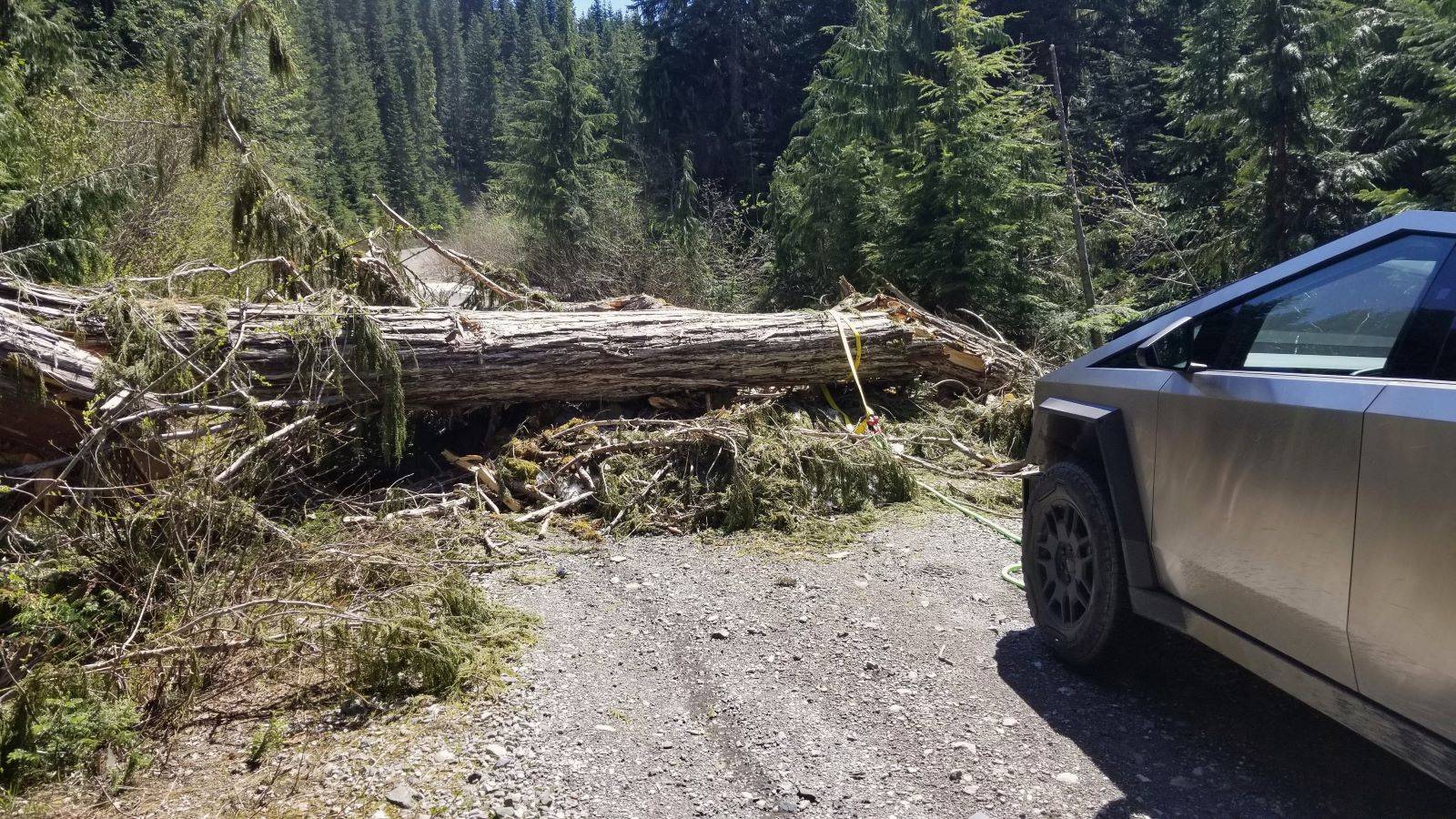
I just posted this photo on another thread:
![]()
This log was still partially connected on the right side of the road so I knew I would have to give it a good tug to break it free. I used a 50' 1" recovery rope with a heavy-duty tow strap wrapped twice around the log and 1/2" Kevlar soft shackles, if I recall.
When using a kinetic recovery rope the load is distributed much more gently over time so you can apply quite a heavy jerk without anything breaking (just make sure you don't jerk something heavy right back at yourself!).
I left about 10 feet of slack and backed up about 8 mph and left my foot on the throttle for a second or so after I felt the rope come tight. A mighty crack of wood splintering resulted and the tree broke free about 6 feet. I then proceeded to steer toward the uphill side of the road and the log ended up neatly just above the shallow ditch.
If you know you will need to apply a much higher force than in the example above, say you are trying to extract a much heavier vehicle from a ditch, maybe even a motorhome (assuming there is a strong enough anchor point available on the stuck vehicle), or in cases where you will pulling while the Cybertruck is sitting on a sheet of ice, the rear hitch has at least one important advantage. Being on the centerline of the vehicle you can pull parallel to the rope and know that the rope will not cause the vehicle to yaw in a different direction as it's loaded as it could if you pull in a straight line from an off-center attachment point. This is only a concern with really hard pulls or if the traction is quite limited.
Even with an off-center attachment point, yaw can be controlled if the truck is at the correct angle to the pull, it's just easier to line everything up in a straight line. In most situations pulling from an off-center attachment is not a big issue, and the steerability/visibility of the pull wins out. One reason to pull from the rear receiver is if it's more important to see where you are going than it is to watch the extraction.
I'm not a fan of steel shackles simply because they give me the willies imagining the havoc they could wreak if they came loose for any reason. But I do carry a two-inch recovery hitch with a 3/4" forged shackle for rear pulls, simply because my recovery hitch is not designed for soft shackles (I bought it before soft shackles were popular). If I were to replace it, I would get something like this:
Soft Shackle Receiver Adapter, 2.0 size – Brennan's Garage
I'm not endorsing that particular brand, just showing what's available these days. The primary advantage is it's quite a bit lighter (and doesn't induce irrational willies). Even basic recovery gear adds up in weight and since I keep it in the truck year-round, I don't want it weighing me down.
I also would avoid Amazon for this type of critical gear. I’ve had great customer service and received highest-quality gear from Ironman 4x4:I'd be REAL careful buying recovery gear from Amazon. I've received so many fakes that I wouldn't buy anything safety-related there. Buy direct from ARB or Yankum and select load ratings appropriately. Rhino might be fine, too; I'm just leery of safety gear made in China. We're talking a 7000lb vehicle so you'll want a max break strength of 3-5x that. Definitely a kinetic rope, too, rather than a tow strap.
That's kind of silly to avoid a particular retailer just because they carry a full range of quality (from high quality to potential junk), just buy the good stuff. If you want to pay extra for the retailer to pick out what they think is the good stuff (or good enough) that's fine too. Amazon carries plenty of name brand stuff too, and some of the less expensive stuff is high quality too, it's just hard to know what you're getting unless it's a known brand.I also would avoid Amazon for this type of critical gear. I’ve had great customer service and received highest-quality gear from Ironman 4x4:
https://ironman4x4america.com/store...zd7QlzV-wlSIHA9XnO3feyXnsIp_Xl6VDTpwTk.QaTDAa
I have the top two in my truck also but do not think in my areas the soft shackles would help.Keep these in the truck. I would try to use the hitch if possible.
https://a.co/d/fB0mwFN
https://a.co/d/iSagOJn
https://a.co/d/gIrV2IO
That's not a kinetic recovery rope because it's made of polyester (which has less stretch). Sure, it's advertised as a "recovery tow strap" but it will be much more limiting than a kinetic recovery rope.
Amazon is littered with fakes, both because of third-party sellers and because of inventory co-mingling. Example: ARB soft shackles. Look at the review photos: ALL are of fakes! They look like simple nylon rope and the proof is their load rating: “14,500KGS.” Real ARB soft shackles are rated for 14.5 tons. Kilograms aren’t even a measurement of force. That is why I stand by my statement to avoid Amazon for safety-critical gear.That's kind of silly to avoid a particular retailer just because they carry a full range of quality (from high quality to potential junk), just buy the good stuff.