
PungoteagueDave
Well-known member
- First Name
- David
- Joined
- Mar 2, 2025
- Threads
- 2
- Messages
- 932
- Reaction score
- 1,006
- Location
- Boynton Beach
- Vehicles
- ‘25 Tesla Cybertruck, ‘26 Tesla MY Launch, ‘13 Porsche C4S, ‘26 BMW R1300 GSA
- Occupation
- retired

We have a historical precedent regarding what will occur when Tesla loses all access to tax credits at the end of this year, assuming the current version of the tax law is enacted, probably likely with respect to EV tax credits.I think we can all agree that Cybertrucks would sell better if prices dropped by $15K or $20K. But this is not going to happen.
For one thing, Tesla is currently taking orders for the "low-priced" RWD Cybertruck, which costs $70K (or $62.5K after the $7.5K federal tax credit). The first RWD deliveries are currently scheduled for July-August. If the AWD Cybertruck (currently starting at $80K) was discounted tomorrow by $15K or $20K, it would be priced lower than the forthcoming RWD Cybertruck, which would make no sense.
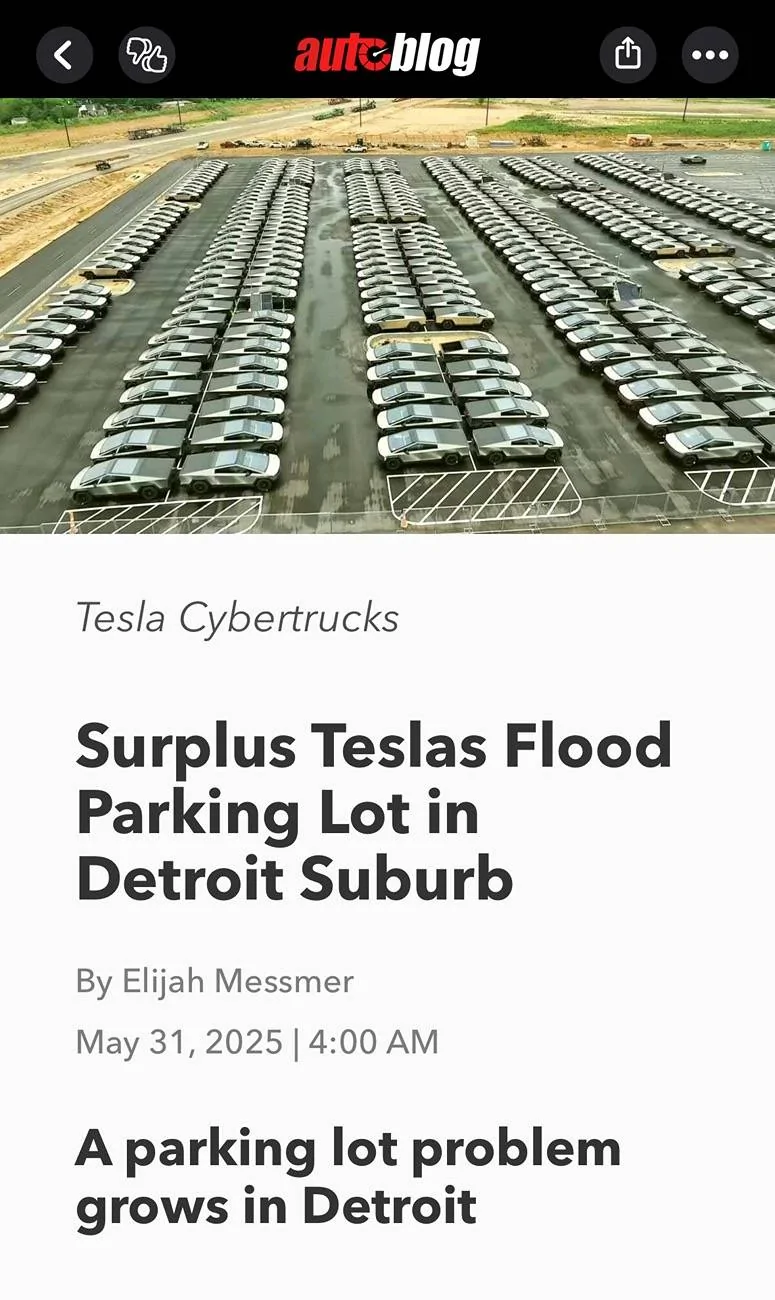
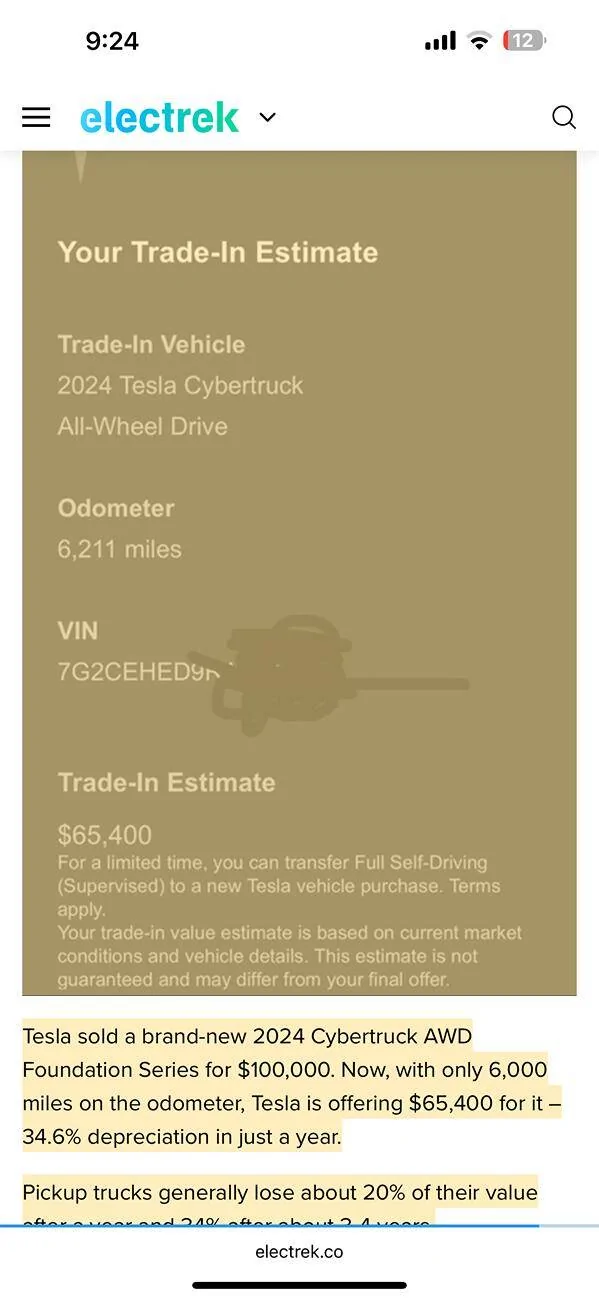
It's clear that Tesla overproduced Cybertrucks last year, which is why they still have 2024s (including Foundation Series) in inventory. My guess is that the inventory situation will gradually improve, but not because of price cuts to stimulate demand -- instead, Tesla will cut production and reduce supply. Tesla should release the 2Q 2025 production numbers on July 2, so we should find out then if production is down.
Another factor that could help to clear Cybertruck inventory this year is the (probable) loss of the $7.5K federal tax credit. In the long run, of course, this is bad news for the sales of Cybertrucks (and other EVs). But in the short run, some people will rush to buy in 2025, so they can save $7.5K before the tax credit goes poof.
Bottom line: it's certainly possible that we could see some end-of-quarter incentives on Cybertrucks in June 2025, like the 1.99% APR financing deal that was offered in March. But I don't expect to see any new discounts. The inventory situation will gradually improve, even without discounts, as Tesla cuts back on production.
Tesla lost tax credits beginning in the second quarter of 2019, which is when its sales surpassed the former 200k cumulative per-manufacturer EV sales figure that caused tax credits to end. I purchased a 2019 MX in September 2019 and received a half-credit of $3,750 on that year's tax return. By the end of 2019 the tax credit was entirely phased out for Tesla. The response? Tesla immediately reduced the price for all models by $7,500.
That's what will likely occur this time. The $62k base model 2wd CT will become $55k MSRP. There will still be two problems for Tesla at that point. First, at that price point it is likely that there will be a flat or negative sales margin, something Tesla has never been willing to accept in it's history. And it's not as though this can be made up by increasing sales volumes.
Second, there are still plenty of full size pickup trucks selling for well under $40k for work and industrial use. I just paid $38k for a new 2025 basic gasoline-powered F250 for our aquaculture farm.
For Tesla's CT to become competitive in the broader truck market, it would have to do things to remove costs that may not be possible with the base CT format and cost structure. The battery format and cast aluminum frame structures are game-changing in some respects, but the are so expensive that this only works for higher-priced trucks.
The basic modular cab-and-bed-on-steel-frame truck format is still the most versatile and economical for the 80% of pickups that are sold to government, fleets, and contractors. Tesla has no answer for that huge demand sector at this point, despite having initially targeted the average truck market.
There was no way to meet both the CT design objectives and the average price levels for utility pickup trucks. I refer to this as the Rivian Conundrum, a trapbtyat I was quite surprised to see Tesla fall into given its historical profit discipline. There was clearly some hubris, and Tesla was ultimately forced into compromises all along the way, hence the delays in initial CT deliveries, and eventual inability to meet many of its targets, culminating in last month's decision to abandon the range extender project and the loss of AP from the promised feature set. Reality is a b*tch.
Sponsored
Last edited: