MEDICALJMP
Well-known member
- First Name
- Jeff
- Joined
- Apr 28, 2020
- Threads
- 248
- Messages
- 1,238
- Reaction score
- 2,486
- Location
- Omaha, NE
- Vehicles
- Toyota Avalon, Rav4, Tri-motor Cybertruck
- Occupation
- Nurse

- Thread starter
- #1
Here’s why convenience stores aren’t rushing to replace gas pumps with EV chargers
By Matt McFarland, CNN Business
Updated 2:43 PM EDT, Tue October 18, 2022
03:02 - Source: CNN
Washington, DC CNN —
Gas stations with convenience stores seem like an obvious location for electric vehicle chargers. Drivers could grab a drink or snack while waiting for their vehicle to charge. But despite available federal funding to build EV chargers, many stores aren’t biting. The reason? High electric utility fees on charging stations make them unappealing – and unprofitable – for convenience store owners.
The bipartisan infrastructure bill is providing $7.5 billion to help pay for electric vehicle chargers that could help gradually replace gas pumps. But sky-high fees combined with competition from utilities and spotty electric vehicle uptake have dampened interest from convenience stores in building out this essential infrastructure.
Charging four vehicles at once at a station could cost the operator $250,000 a year in supplemental fees, called demand charges, according to Jigar Shah, Head of Energy Services at Electrify America, which operates the largest public charger network in the US.
Electric utilities, whose operations and fees vary from state to state, charge demand charges, which apply when businesses draw a lot of power at once, even if only for a short time period. Residential customers generally don’t pay them.
Demand charges can make up 90% of a charging station’s electric costs, research has found. These fees can vary widely and are triggered by drawing a lot of energy at once, which is required to quickly charge even a single electric vehicle.
Retailers with a high volume of sales can pass these costs on to customers without them feeling a marked increase in charging costs.
When chargers make sense
Jacob Maass, commercial fuels manager at Iowa-based Kum and Go, said the convenience store has become more careful and strategic about where it places electric vehicle chargers since installing its first charger in 2008. In 2017 it installed its first fast charger, which charges vehicles more quickly but can bring those huge fees because of how fast it gulps power. Kum and Go has chargers at 35 of its 400 locations. Even a single charger operating at the speeds required by the Biden charging grants could lead to large fees.
Maass said Kum and Go is interested in how to get people out of their cars during electric vehicle charging and into its convenience stores. Businesses like Kum and Go depend on their fuel pumps to attract customers who make purchases in their stores. Convenience stores with fuel pumps account for 80% of fuel purchased in the US, according to the industry trade group.
But despite all that revenue, the real money lies when customers step inside a convenience store for an additional purchase. Most profits come not from fuel, but convenience store sales.

A Kum & Go LC gas station is shown in Colorado, Springs, Colorado.
Chet Strange/Bloomberg/Getty Images
Some electrification experts say convenience stores could seize a huge opportunity. Customers charging electric vehicles must stick around longer, so they may be more likely to buy food and other goods.
But the risk of chargers being unprofitable may slow the buildout of fast chargers and adoption of electric vehicles.
Ramzey Smith, a spokesman for the Department of Energy, told CNN Business that demand charges can be mitigated through solutions like on-site battery storage, solar generation, energy management strategies and regulatory approaches.
Some states and utilities have already taken steps to lessen fees so charger installation isn’t hampered. New York’s utility regulator proposed last month that the state’s utilities should offer lower rates to public EV chargers that are used sparingly. These fees would gradually increase the more chargers are used.
To date, 36 states have addressed or begun to address demand charges, according to Chargepoint, which helps businesses set-up chargers.
For now, convenience stores like Kum and Go risk thousands of dollars in demand charges in many states, depending on how customers utilize their chargers.
For EV charger operators with a high volume of customers, these fees can be less significant. They can be spread out evenly among a large pool of customers. But for businesses in areas with light adoption of electric vehicles, the fees are too onerous to pass on to a customer who will be unwilling to pay extra to charge their vehicle.
“While EV adoption is low, utilization will also be low, and costs for electricity will be high,” Minnesota, one of many states to identify demand charges as a challenge, cautioned in its electric vehicle charging plan.
Maass says that Kum and Go now works with utility companies to make sure they’ll be able to afford the rates. Some offer special rates for electric vehicle charging.
“They knock them down to where we’re not losing everything that we have, or everything we’re making just to have an EV charger on site,” Maass told CNN Business.
Convenience stores could try to work around demand charges by installing battery back-ups at their chargers. The battery back-ups would enable convenience stores to slowly draw power throughout the day, especially at times of lower demand, accumulating the energy in the batteries, and then discharging it quickly when an EV needs to charge up. That way the convenience stores aren’t pulling a huge amount of power from the grid at once.
A driver stops at a Tesla charging station at a Sheetz.
Nate Smallwood/Bloomberg/Getty Images
The infrastructure bill sends federal money to states, who can award it through grants to entities that want to install electric chargers. But these grant applicants, who could be businesses, municipal governments or non-profits, will have to provide 20% of funds for chargers.
Federal funds can be used to cover batteries, according to the Department of Energy’s Smith. Some charger operators have already turned to batteries. Electrify America has installed battery storage at more than 140 of its fast-charging stations.
But battery-backup can make a charging station cost several times as much as otherwise, according to John DeBoer, who leads electric mobility efforts at Siemens, which installs chargers for companies like Amazon.
Fresh competition
Some convenience stores are also concerned about direct competition from utilities.
Trevor Walter, a Sheetz executive testifying for the National Association of Convenience Stores on Capitol Hill earlier this year, warned of the “threat of regulated utilities making use of their status as monopolies to gain a competitive edge over private businesses.”
Many utilities effectively have monopolies on their markets, as the costs to enter their markets are exorbitantly high. This lack of competition in their core business gives them an advantage over most private companies they may compete with on electric chargers.
Utilities also may not have any incentive to adjust their demand charges if they’re building their own electric vehicle chargers. Most utilities are not building out electric vehicle chargers, but some have started to.
Xcel, a utility operating in Minnesota, has said it plans to build hundreds of chargers in the state. Xcel declined to comment for this story.
Georgia Power is investing in electric vehicle charging too. It has characterized its investment as supplemental to other businesses. It has claimed the chargers are primarily in places that are unlikely to see private investment.
“No private business is going to risk thousands of dollars of buying and installing and maintaining and operating EV charging stations if there’s the risk or reality of Georgia Power or Xcel or Dominion [Power] doing the exact same thing down the street for half the price,” said Ryan McKinnon, a spokesman for the Charge Ahead Partnership, which represents business.
https://www.cnn.com/2022/10/18/business/ev-chargers-convenience-store/index.html
By Matt McFarland, CNN Business
Updated 2:43 PM EDT, Tue October 18, 2022
03:02 - Source: CNN
Washington, DC CNN —
Gas stations with convenience stores seem like an obvious location for electric vehicle chargers. Drivers could grab a drink or snack while waiting for their vehicle to charge. But despite available federal funding to build EV chargers, many stores aren’t biting. The reason? High electric utility fees on charging stations make them unappealing – and unprofitable – for convenience store owners.
The bipartisan infrastructure bill is providing $7.5 billion to help pay for electric vehicle chargers that could help gradually replace gas pumps. But sky-high fees combined with competition from utilities and spotty electric vehicle uptake have dampened interest from convenience stores in building out this essential infrastructure.
Charging four vehicles at once at a station could cost the operator $250,000 a year in supplemental fees, called demand charges, according to Jigar Shah, Head of Energy Services at Electrify America, which operates the largest public charger network in the US.
Electric utilities, whose operations and fees vary from state to state, charge demand charges, which apply when businesses draw a lot of power at once, even if only for a short time period. Residential customers generally don’t pay them.
Demand charges can make up 90% of a charging station’s electric costs, research has found. These fees can vary widely and are triggered by drawing a lot of energy at once, which is required to quickly charge even a single electric vehicle.
Retailers with a high volume of sales can pass these costs on to customers without them feeling a marked increase in charging costs.
When chargers make sense
Jacob Maass, commercial fuels manager at Iowa-based Kum and Go, said the convenience store has become more careful and strategic about where it places electric vehicle chargers since installing its first charger in 2008. In 2017 it installed its first fast charger, which charges vehicles more quickly but can bring those huge fees because of how fast it gulps power. Kum and Go has chargers at 35 of its 400 locations. Even a single charger operating at the speeds required by the Biden charging grants could lead to large fees.
Maass said Kum and Go is interested in how to get people out of their cars during electric vehicle charging and into its convenience stores. Businesses like Kum and Go depend on their fuel pumps to attract customers who make purchases in their stores. Convenience stores with fuel pumps account for 80% of fuel purchased in the US, according to the industry trade group.
But despite all that revenue, the real money lies when customers step inside a convenience store for an additional purchase. Most profits come not from fuel, but convenience store sales.
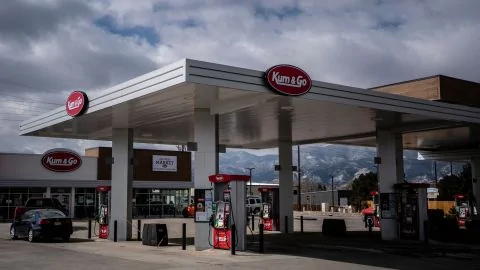
A Kum & Go LC gas station is shown in Colorado, Springs, Colorado.
Chet Strange/Bloomberg/Getty Images
Some electrification experts say convenience stores could seize a huge opportunity. Customers charging electric vehicles must stick around longer, so they may be more likely to buy food and other goods.
But the risk of chargers being unprofitable may slow the buildout of fast chargers and adoption of electric vehicles.
Ramzey Smith, a spokesman for the Department of Energy, told CNN Business that demand charges can be mitigated through solutions like on-site battery storage, solar generation, energy management strategies and regulatory approaches.
Some states and utilities have already taken steps to lessen fees so charger installation isn’t hampered. New York’s utility regulator proposed last month that the state’s utilities should offer lower rates to public EV chargers that are used sparingly. These fees would gradually increase the more chargers are used.
To date, 36 states have addressed or begun to address demand charges, according to Chargepoint, which helps businesses set-up chargers.
For now, convenience stores like Kum and Go risk thousands of dollars in demand charges in many states, depending on how customers utilize their chargers.
For EV charger operators with a high volume of customers, these fees can be less significant. They can be spread out evenly among a large pool of customers. But for businesses in areas with light adoption of electric vehicles, the fees are too onerous to pass on to a customer who will be unwilling to pay extra to charge their vehicle.
“While EV adoption is low, utilization will also be low, and costs for electricity will be high,” Minnesota, one of many states to identify demand charges as a challenge, cautioned in its electric vehicle charging plan.
Maass says that Kum and Go now works with utility companies to make sure they’ll be able to afford the rates. Some offer special rates for electric vehicle charging.
“They knock them down to where we’re not losing everything that we have, or everything we’re making just to have an EV charger on site,” Maass told CNN Business.
Convenience stores could try to work around demand charges by installing battery back-ups at their chargers. The battery back-ups would enable convenience stores to slowly draw power throughout the day, especially at times of lower demand, accumulating the energy in the batteries, and then discharging it quickly when an EV needs to charge up. That way the convenience stores aren’t pulling a huge amount of power from the grid at once.
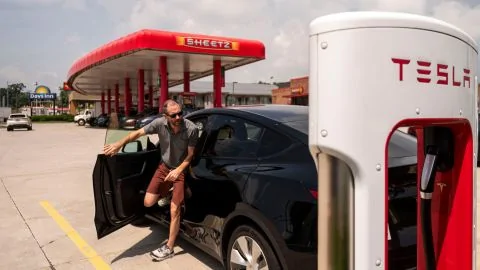
A driver stops at a Tesla charging station at a Sheetz.
Nate Smallwood/Bloomberg/Getty Images
The infrastructure bill sends federal money to states, who can award it through grants to entities that want to install electric chargers. But these grant applicants, who could be businesses, municipal governments or non-profits, will have to provide 20% of funds for chargers.
Federal funds can be used to cover batteries, according to the Department of Energy’s Smith. Some charger operators have already turned to batteries. Electrify America has installed battery storage at more than 140 of its fast-charging stations.
But battery-backup can make a charging station cost several times as much as otherwise, according to John DeBoer, who leads electric mobility efforts at Siemens, which installs chargers for companies like Amazon.
Fresh competition
Some convenience stores are also concerned about direct competition from utilities.
Trevor Walter, a Sheetz executive testifying for the National Association of Convenience Stores on Capitol Hill earlier this year, warned of the “threat of regulated utilities making use of their status as monopolies to gain a competitive edge over private businesses.”
Many utilities effectively have monopolies on their markets, as the costs to enter their markets are exorbitantly high. This lack of competition in their core business gives them an advantage over most private companies they may compete with on electric chargers.
Utilities also may not have any incentive to adjust their demand charges if they’re building their own electric vehicle chargers. Most utilities are not building out electric vehicle chargers, but some have started to.
Xcel, a utility operating in Minnesota, has said it plans to build hundreds of chargers in the state. Xcel declined to comment for this story.
Georgia Power is investing in electric vehicle charging too. It has characterized its investment as supplemental to other businesses. It has claimed the chargers are primarily in places that are unlikely to see private investment.
“No private business is going to risk thousands of dollars of buying and installing and maintaining and operating EV charging stations if there’s the risk or reality of Georgia Power or Xcel or Dominion [Power] doing the exact same thing down the street for half the price,” said Ryan McKinnon, a spokesman for the Charge Ahead Partnership, which represents business.
https://www.cnn.com/2022/10/18/business/ev-chargers-convenience-store/index.html
Sponsored
Last edited: