Sponsored

JayWebbMD

Well-known member
First Name
Jay
Joined
May 1, 2024
Threads
5
Messages
46
Reaction score
92
Location
Pensacola, FL
Vehicles
2011 Audi TTS, 2023 Genesis GV70, awaiting Beast
Country flag
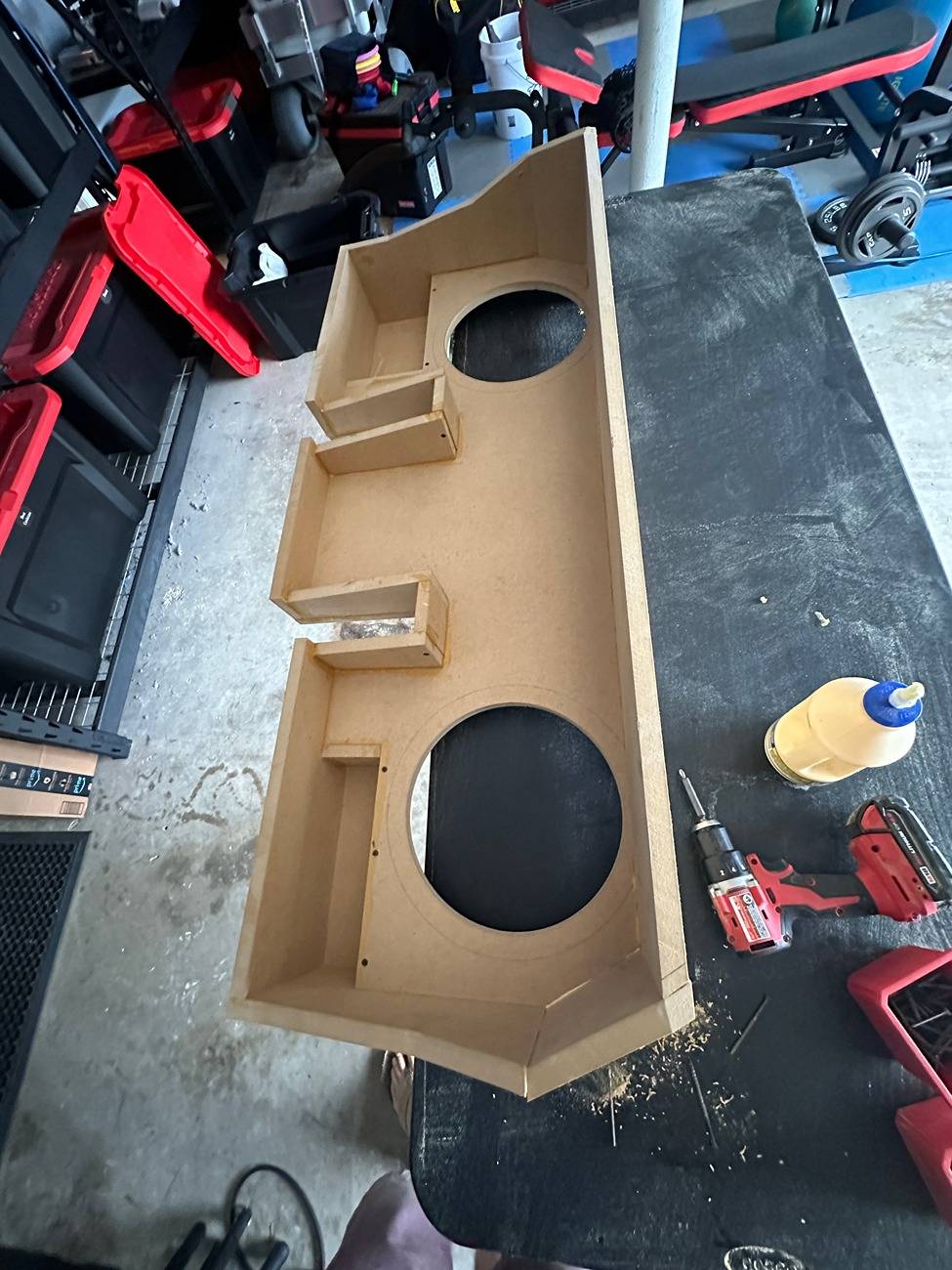
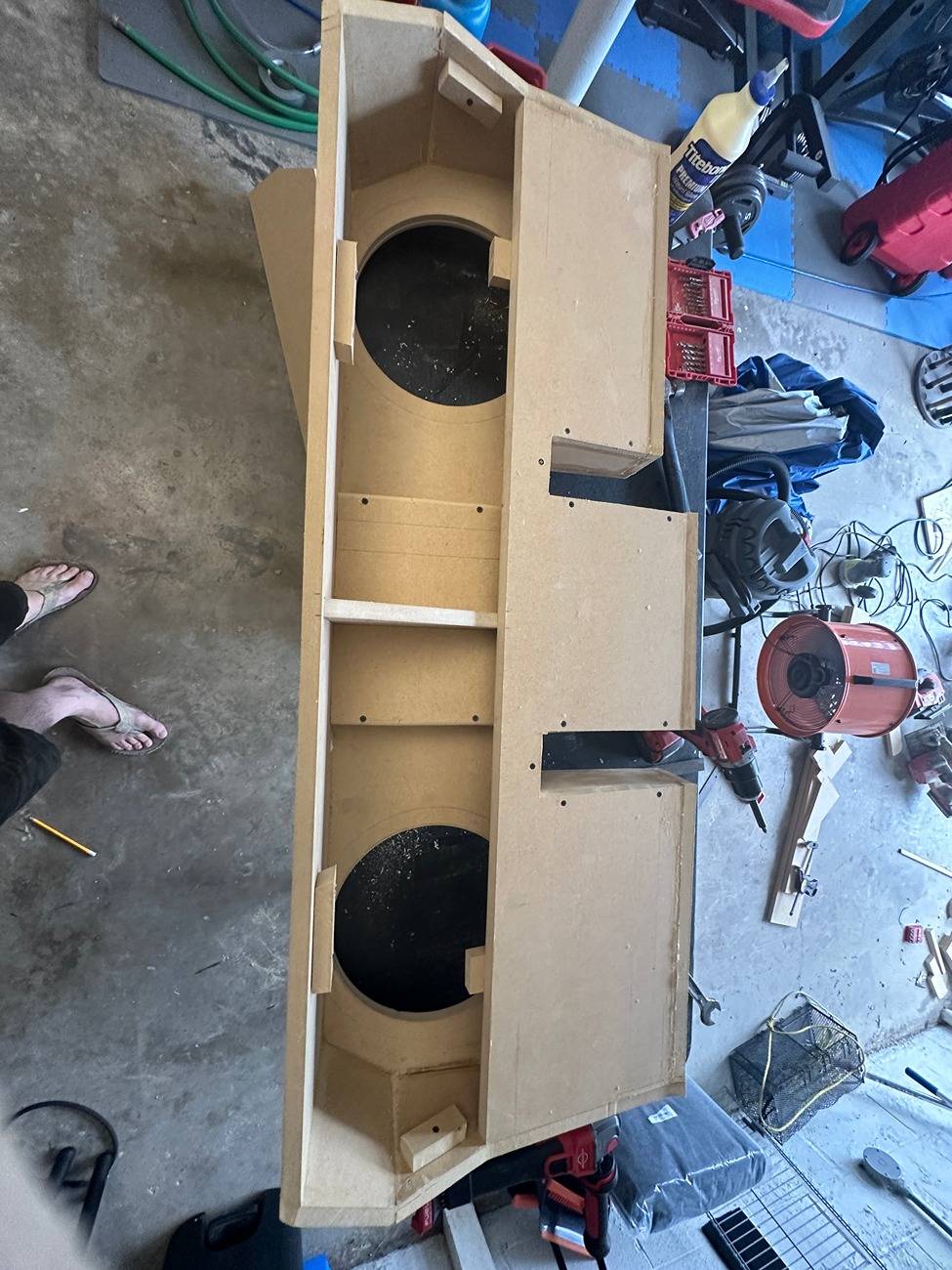
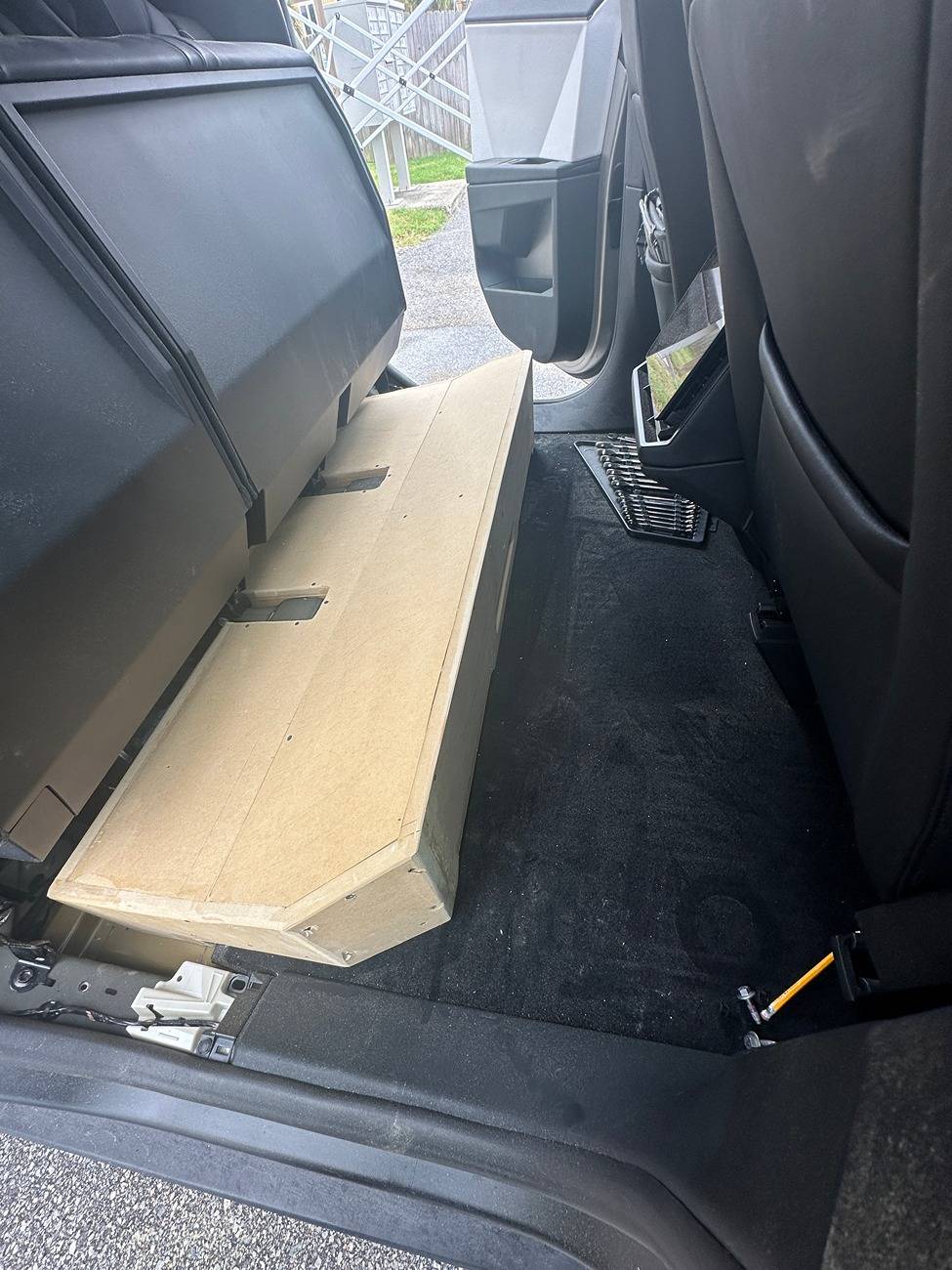
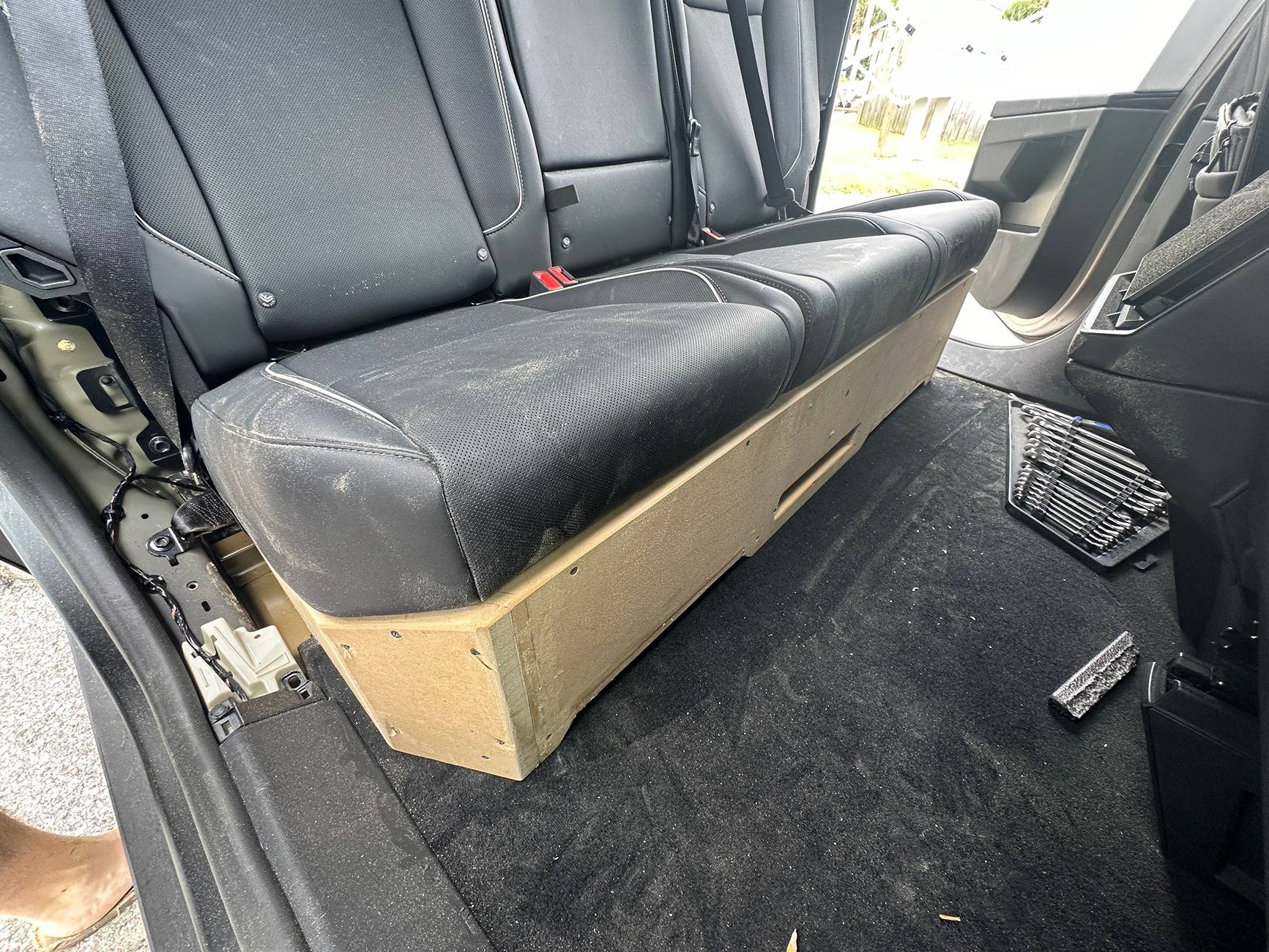
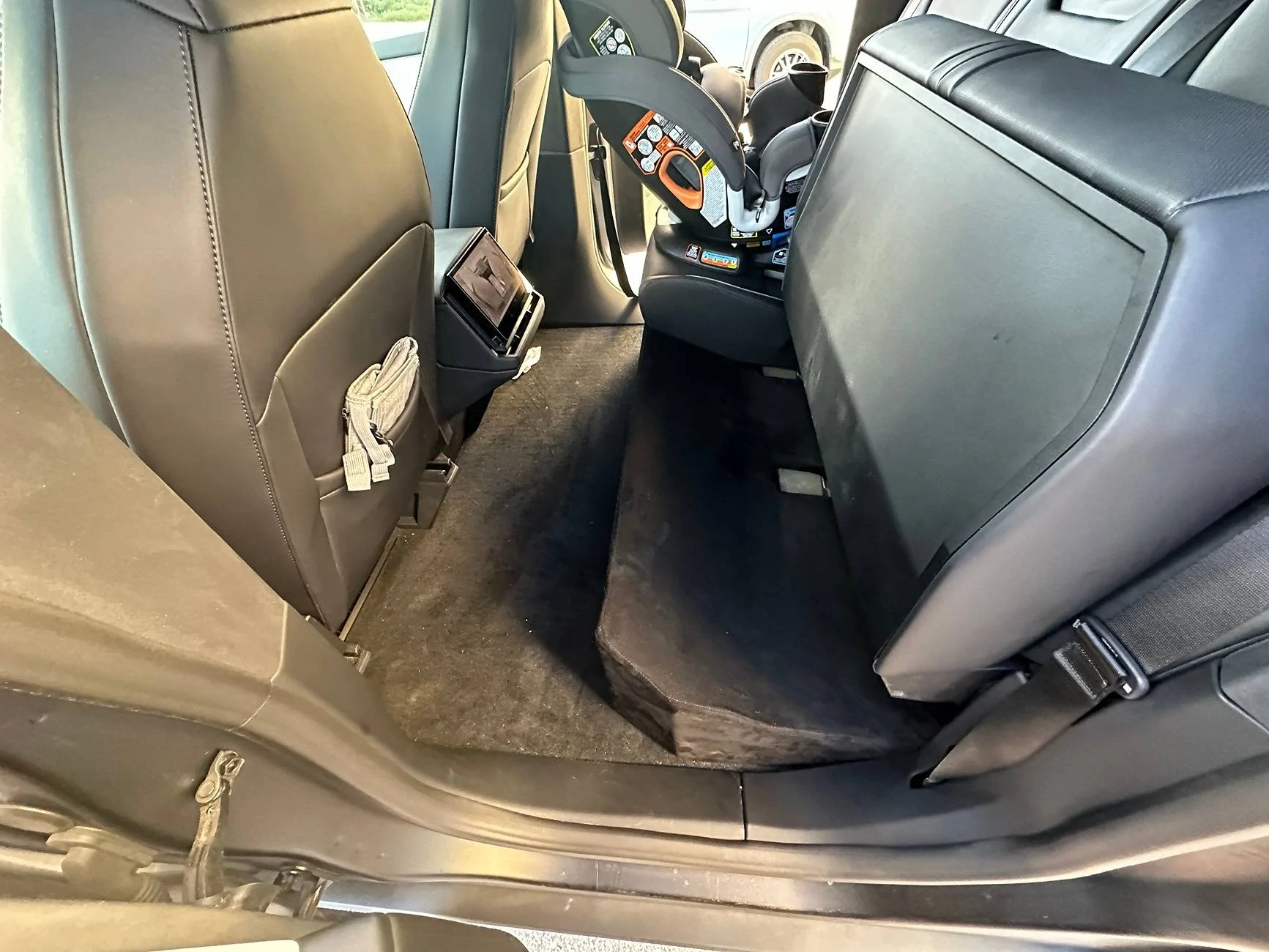
Finally finished a project that's been in the works for awhile. Its 2 shallow mount 12's in a ported box and a DIY amplifier that you can read more about below. It runs off of the 120V plug in the center console. I removed the factory subs and ran the factory sub wires into an Epicenter Micro module which is powered from a dedicated 15V output from the amplifier. It sounds fantastic. I can turn them on and off and control the level with the factory subwoofer control on the touchscreen. The factory system was good "for a factory system," but now that I've got real bass, I can lower the bass level on the radio, which lets me go to full volume without causing the door speakers to distort and I can now hear the full audio range and understand the vocals with the windows down at 70 mph, which is my bar for a good system. I know there are other easier ways to do this, but for those who like details, here's the full rundown:

Equipment:

Discussion:
  • Subwoofers
    • I had these laying around from years ago. I did a full Rockford Fosgate system in my last car and needed to fill in some midbass between the 8" Punch Pro midranges and the T1 15" subwoofer, so I bought these, but ended up using 10's instead. I actually always hated these subs when we sold them when I worked at Best Buy because we only sold them in a 0.5 cubic foot sealed prefab box and it sounded like ass every time. I actually built the box in such a way that I could change one inner wall and extend the port to better suit JL TW3's, because I expected these to also sound like ass. Now that it's all done, I'm pretty impressed by them, so I won't be changing unless I blow these.
  • Box
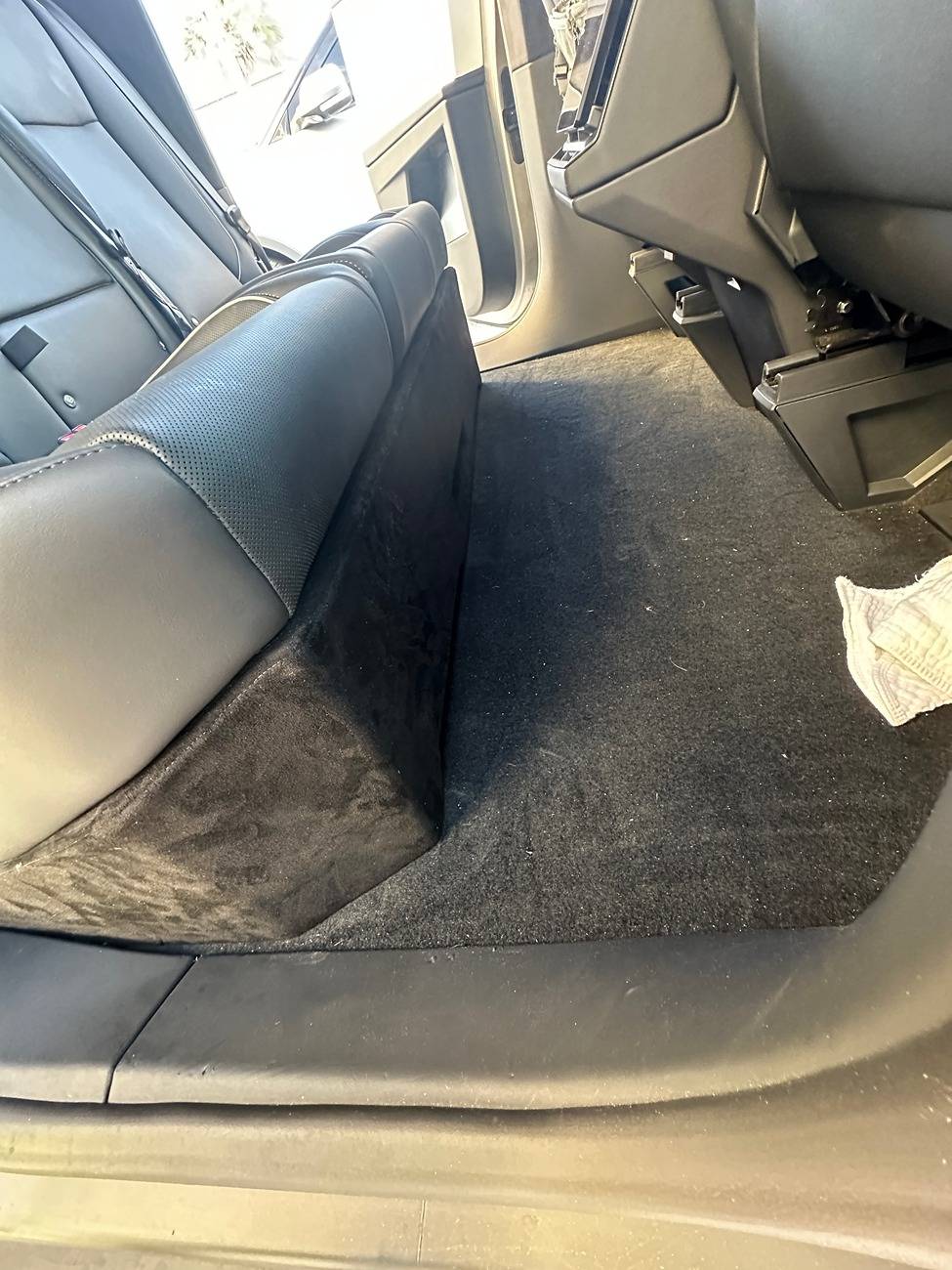
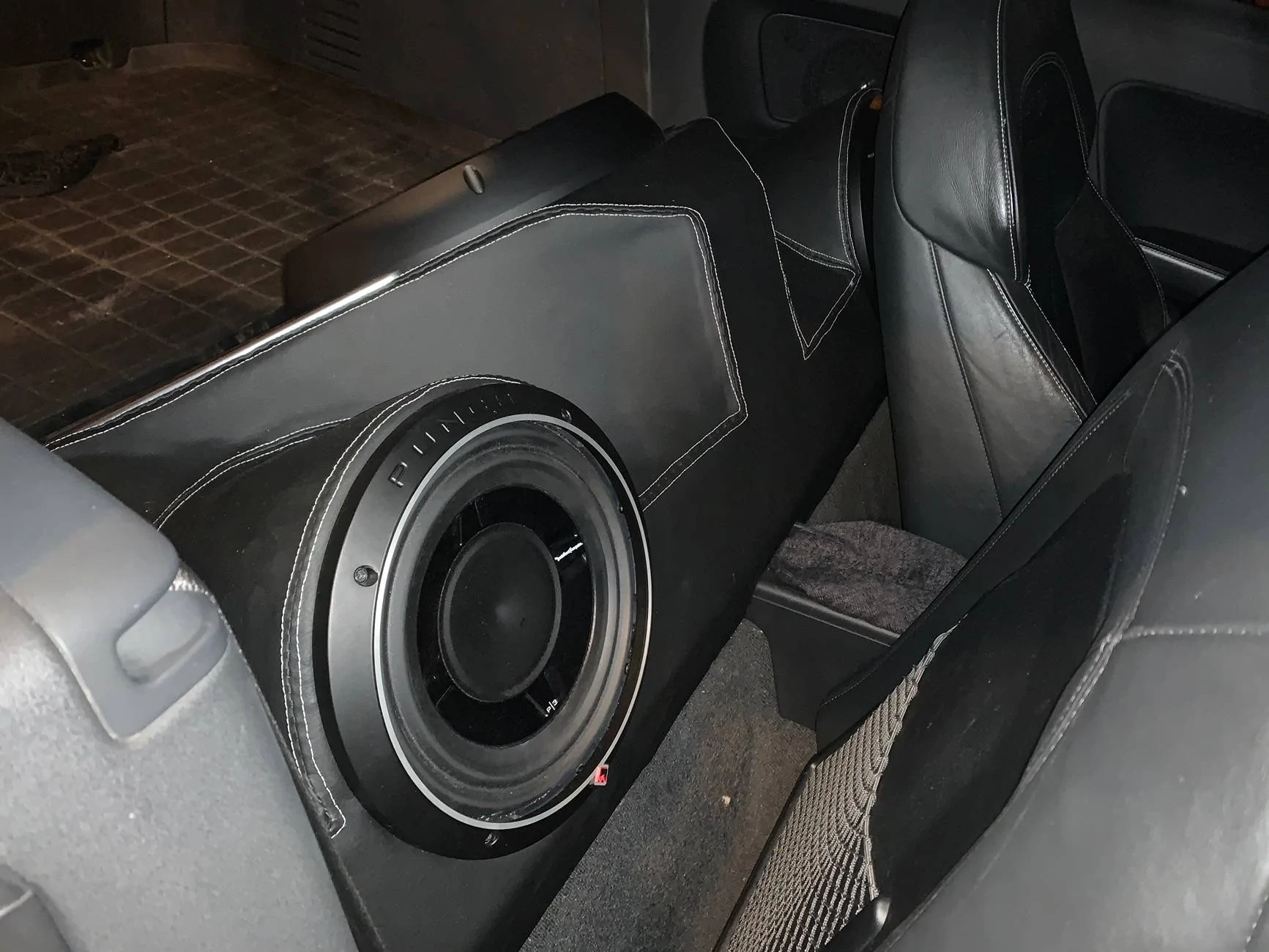
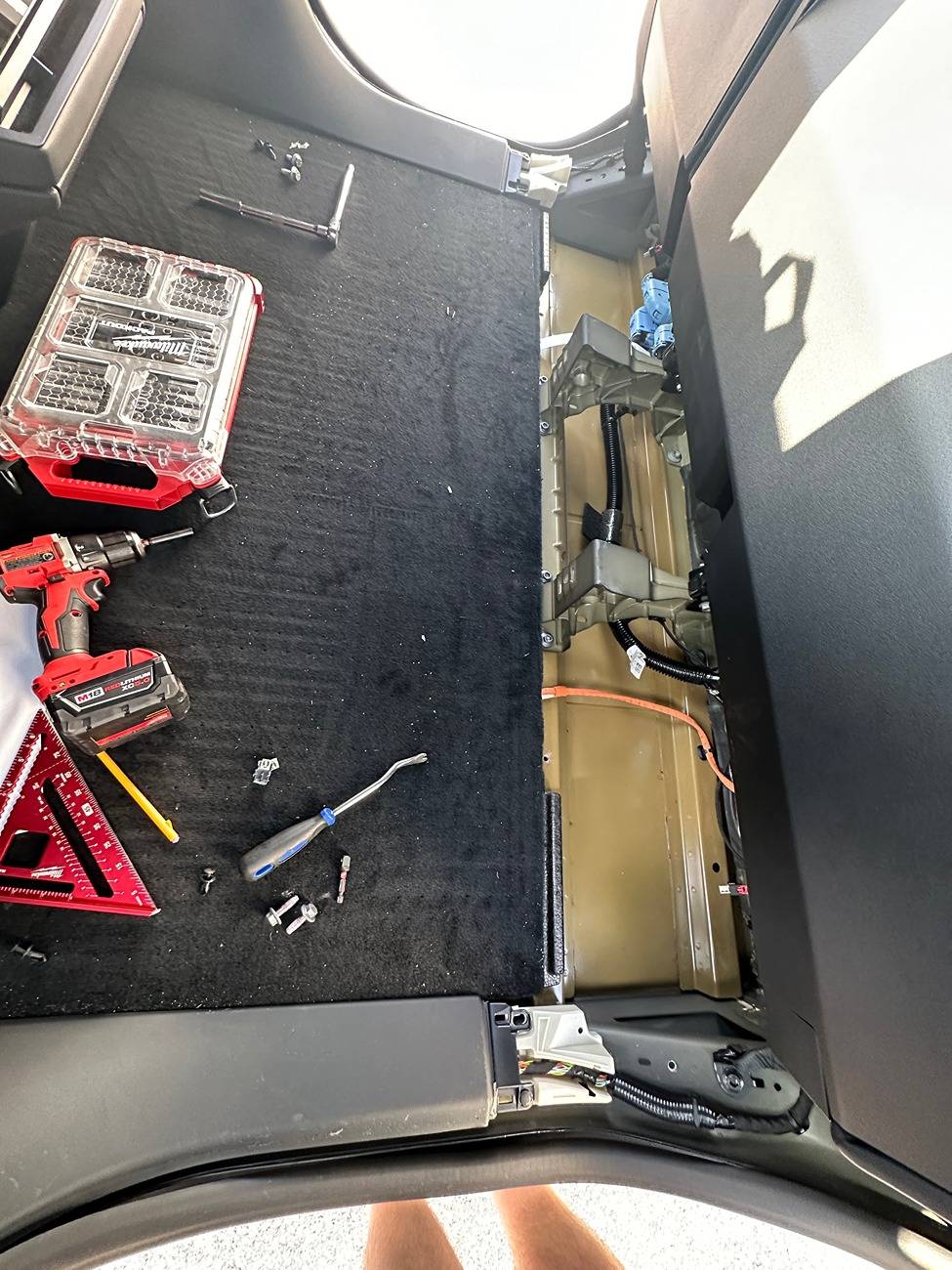
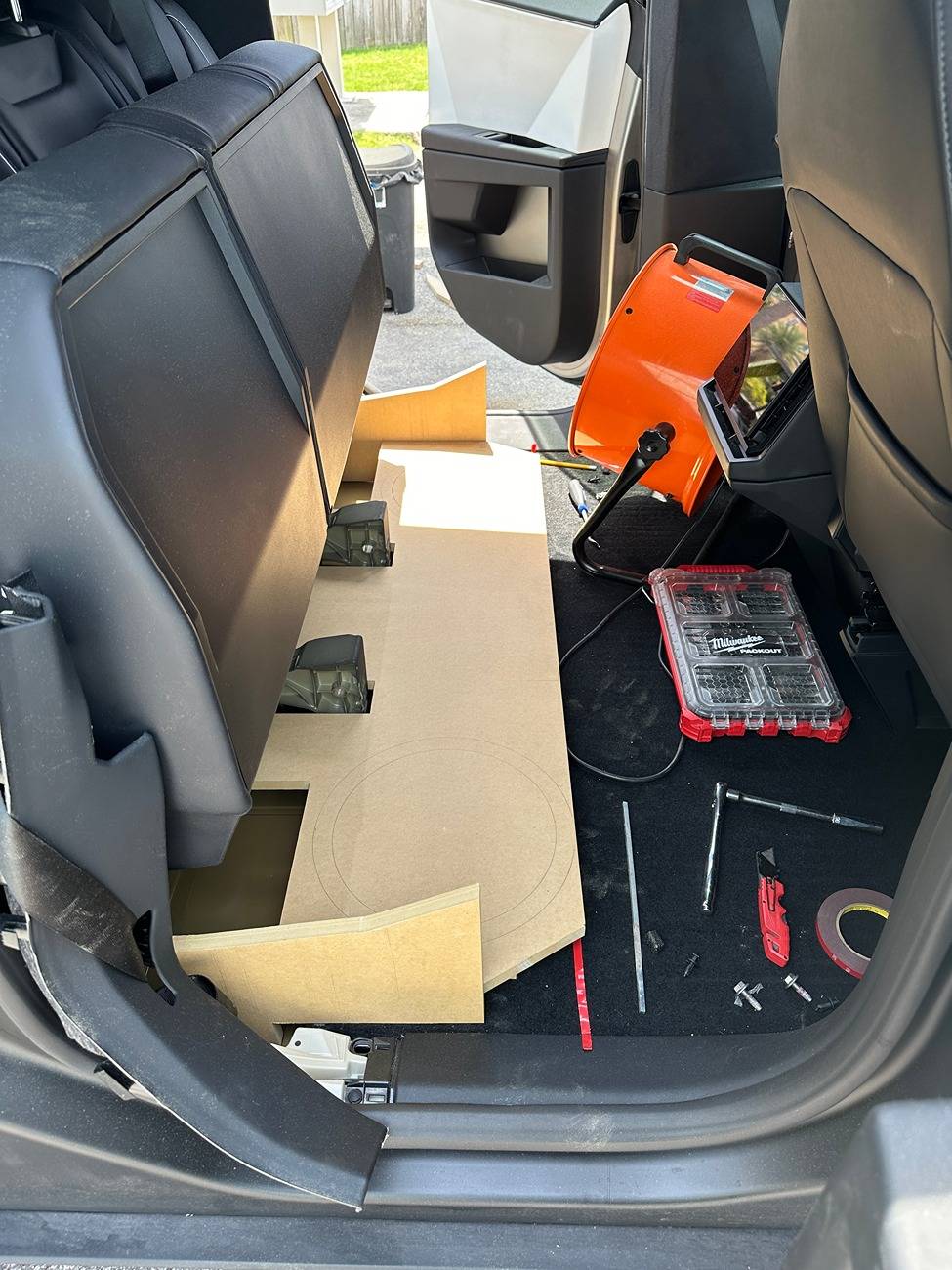
    • The box was pretty complex. I needed 2.5 cubic feet not counting the port and sub volume, so I roughed out what I needed and just kind of started building the side pieces to their maximum dimensions, then came as far forward as I could, left 1" for the subs to downfire, and found I was short by about .2 cubic feet. So I ultimately had to build little extra chambers on the sides to take advantage of the extra space where it dips down to the floor. It came out extremely close to 2.5. The port area is a little less than it calls for, the front frame of the subwoofers sits on the carpet, and the seats take a strong push down to lock into place, but considering what I had to work with, it came out great and sounds awesome.
    • I'm not great at upholstery, so I bought this cheap suede expecting that I would screw it up, learn from my mistakes, then redo it with real Alcantara. It came out good enough for me, so this is how it will stay.
  • Amplifier
    • The only other subwoofer system I've seen was the one by Tint World in Orlando where they used 48 to 12 V step down converters. Initially I wanted to beef up the 48V system with extra batteries and use 48V amplifiers. Unfortunately, the biggest 48V amplifier I could find was 300 watts RMS. I suspect this has something to do with convenience and cost. Its most likely a Class D circuit powered directly by the 48VDC input with no power conversion stage. So this is where I first got my idea to build my own amplifier.
    • I found this originally: https://store.sure-electronics.com/product/619 . This board runs off of 25-50VDC and had the power and load rating I needed, so I ordered it. When it came in, I connected it to (4) 12V LiFePo4 batteries in series, which came to 52.4V. I assumed there was some leeway in the supply voltage rating. That was not the case. It jammed on my 15" in my old car for about 30 seconds, then I tried to test the limits and burned it up. Contacted the company and they said I was running it out of spec, so they wouldn't replace it. At this point I investigated the voltage in the truck a bit more. Tesla's documentation says the 48V circuit can technically range from 28 to 58 volts and the stock "48V" battery is actually 41.6 Volts and the actual voltage on my 48V accessory line was 46.8 Volts. With that kind of variability, I didn't think I could reliably count on it to charge any configuration of lithium batteries. I'm sure the 12V step down converters also charge a bit unpredictably unless there's some kind of output voltage regulation built into them.
    • The other option was to run off of the 120V system. I looked at a bunch of home and DJ amps and couldn't make heads or tails of it. At least with car audio, you get RMS and Peak power ratings and you can guess how true that is based on the brand's reputation and the cost. With home and DJ amps, it was anywhere from $0.25 to $5.00 per watt and specs and reviews were all over the place. The other thing I noticed when looking at pictures of these amps with the cases off is that they have all kinds of big wire harnesses dangling all over the place that would probably not do well in a constant vibration environment. Many also had loud fans, digital displays, and other stuff that I didn't want. So I decided to build my own amp.
    • Amplifier module:
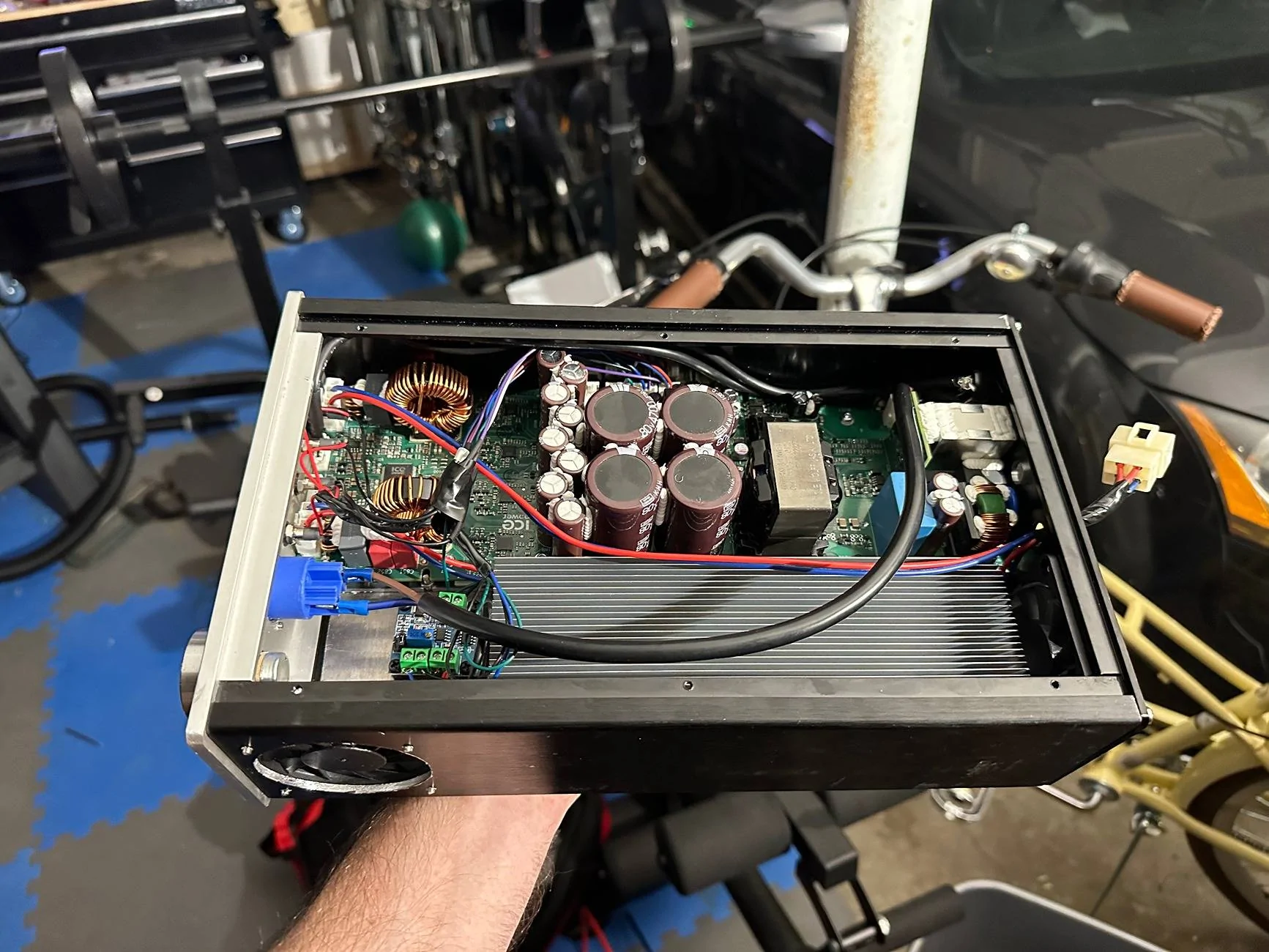
      • I found the ICEPower 1200AS2, which is discussed on several threads in diy audio forums. The specs are much more technical than what you'll find for any consumer ready amplifier. But suffice it to say that it should be able to reliably give me 400 watts RMS x 2 with appropriate cooling, and it seems to be doing so. You have to buy the harnesses for it separately and they didn't have all of them on parts express, so I ordered them from the manufacturer.
    • Case:
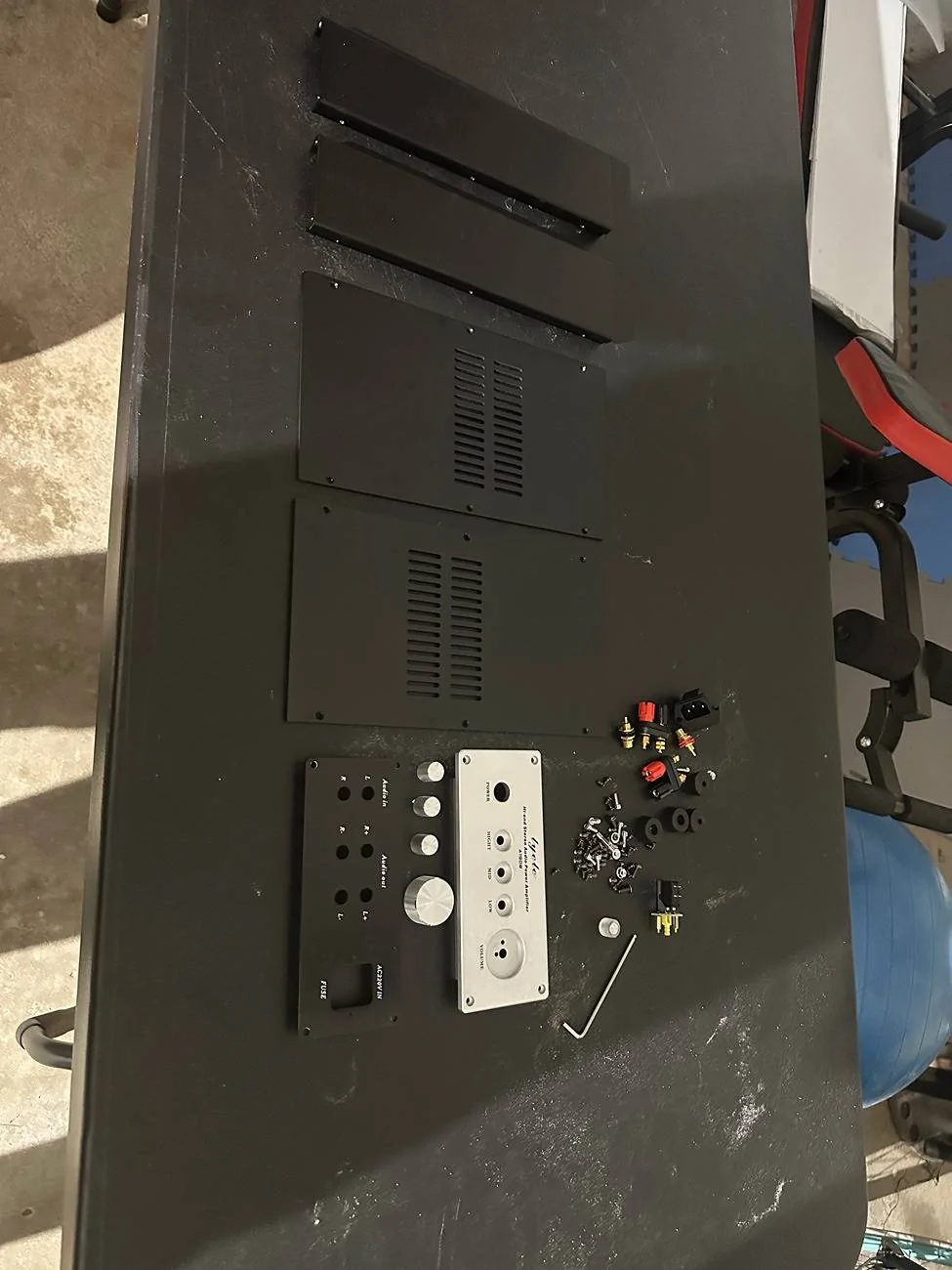
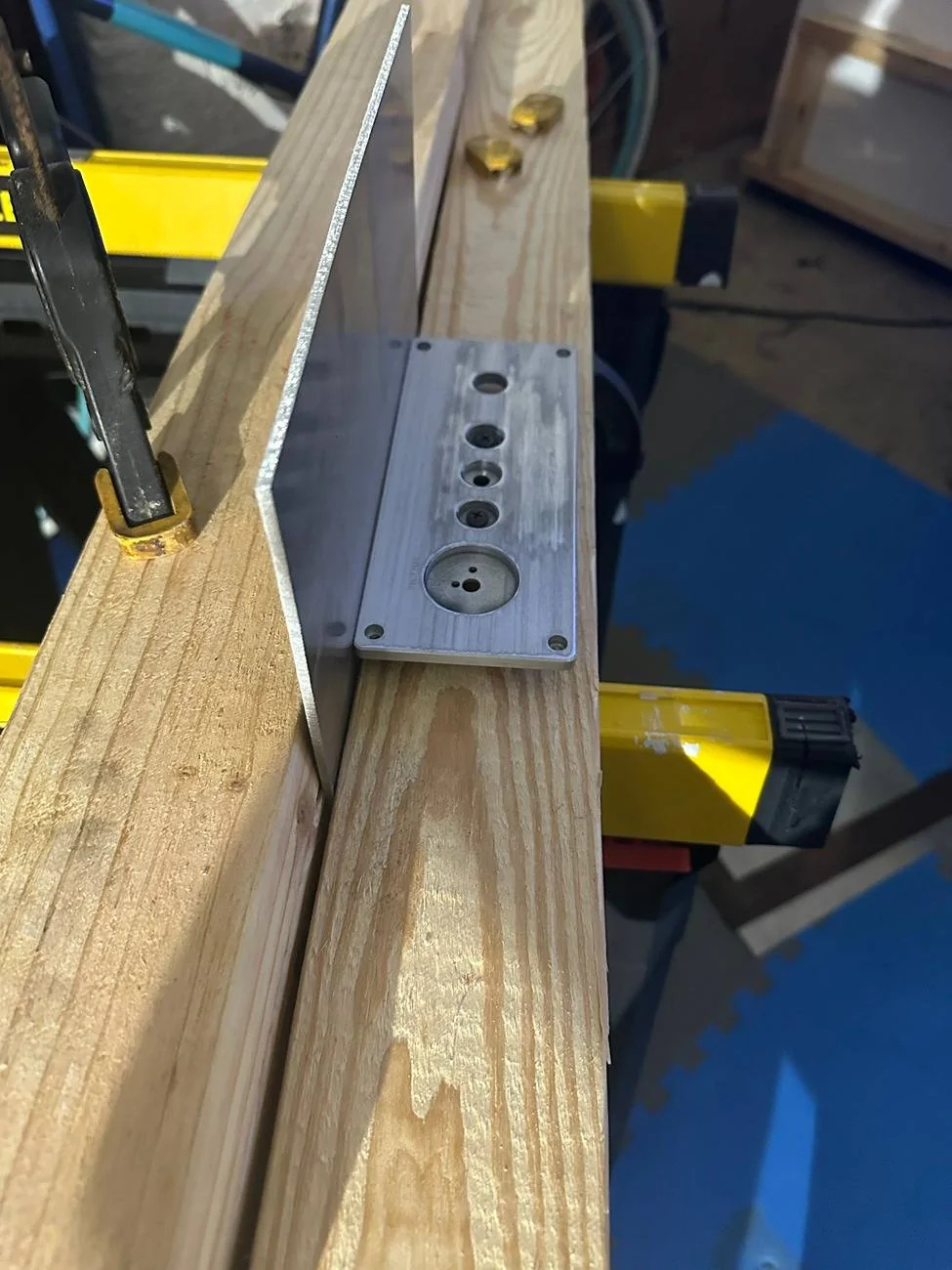
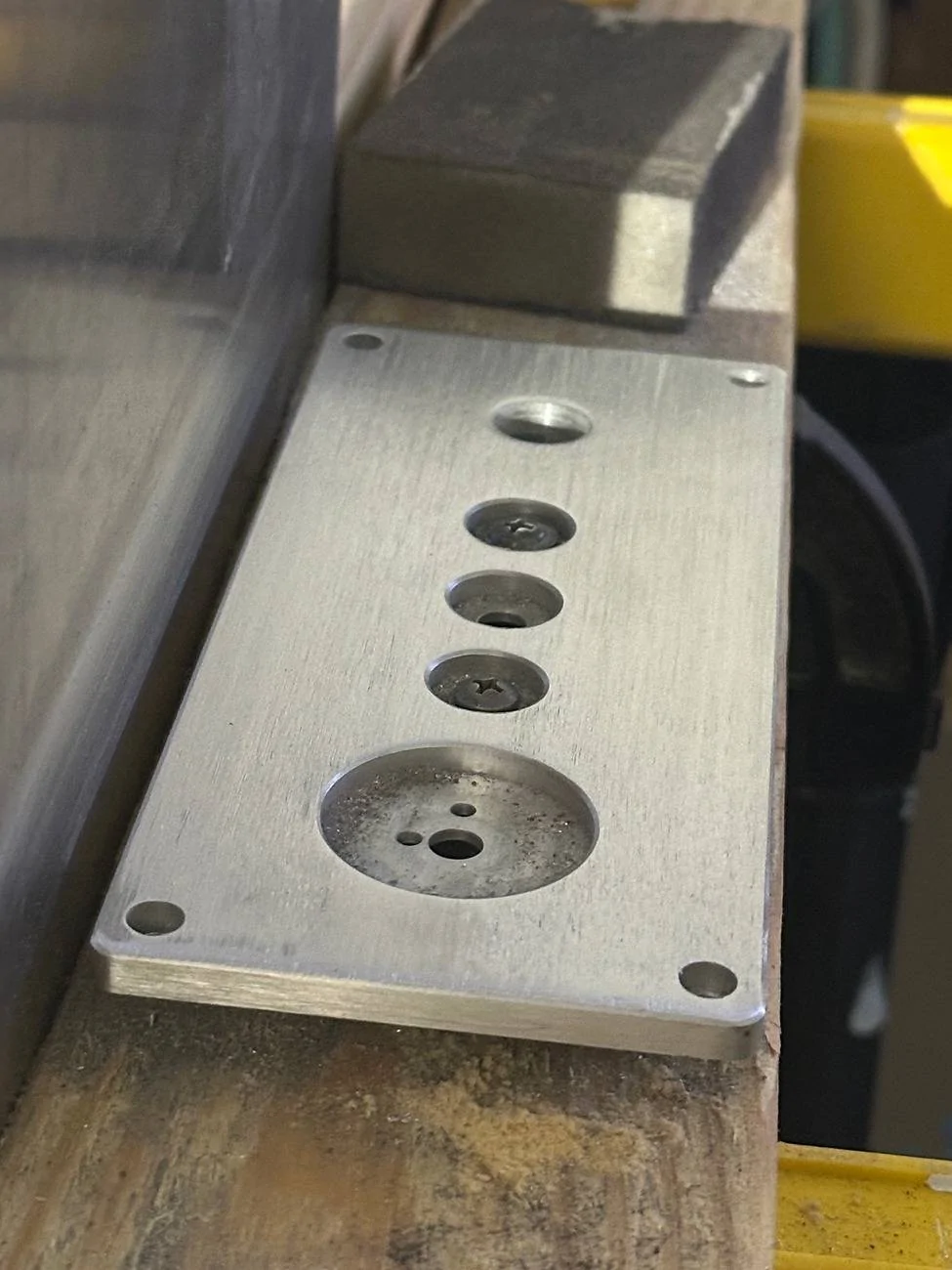
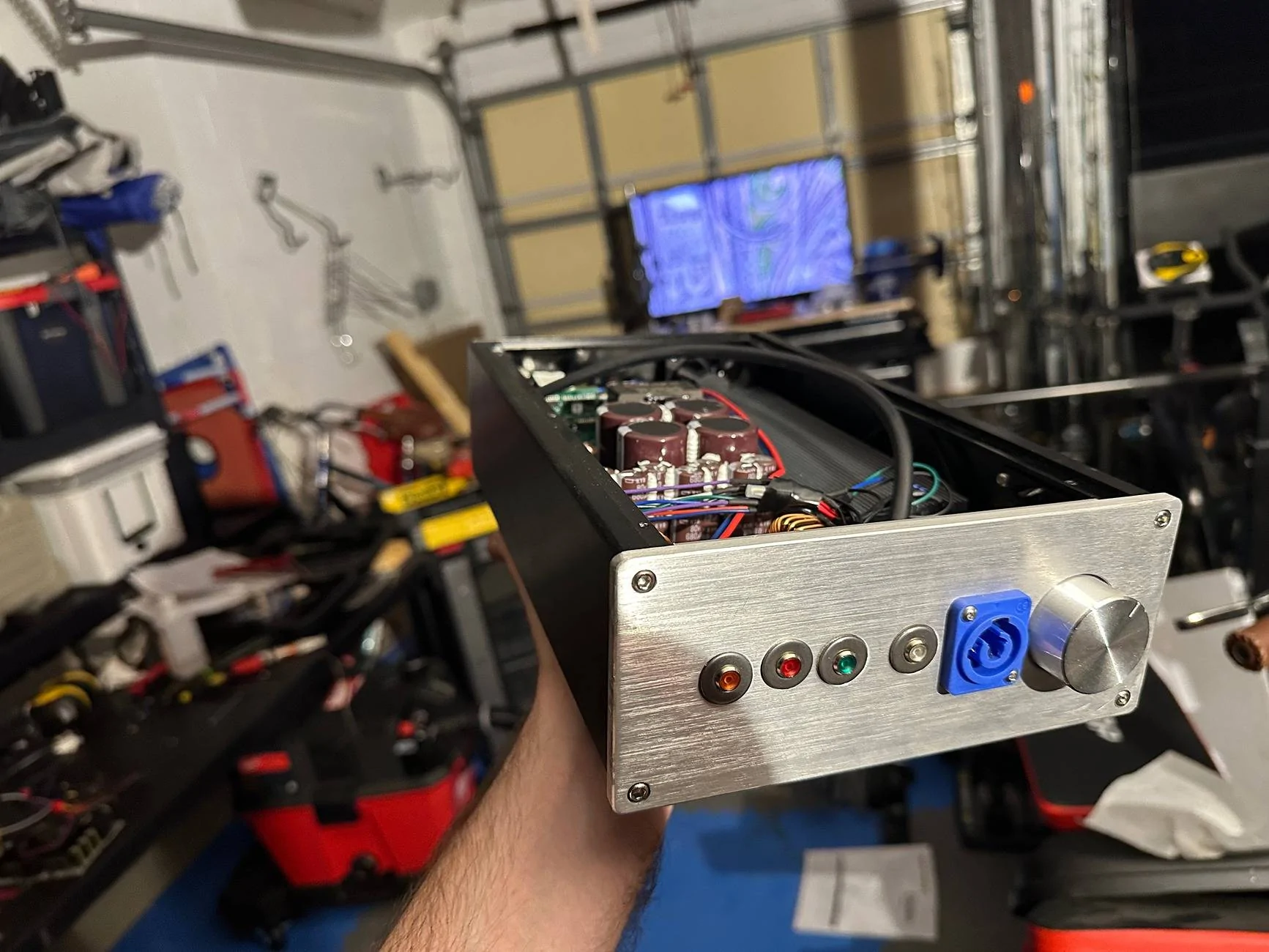
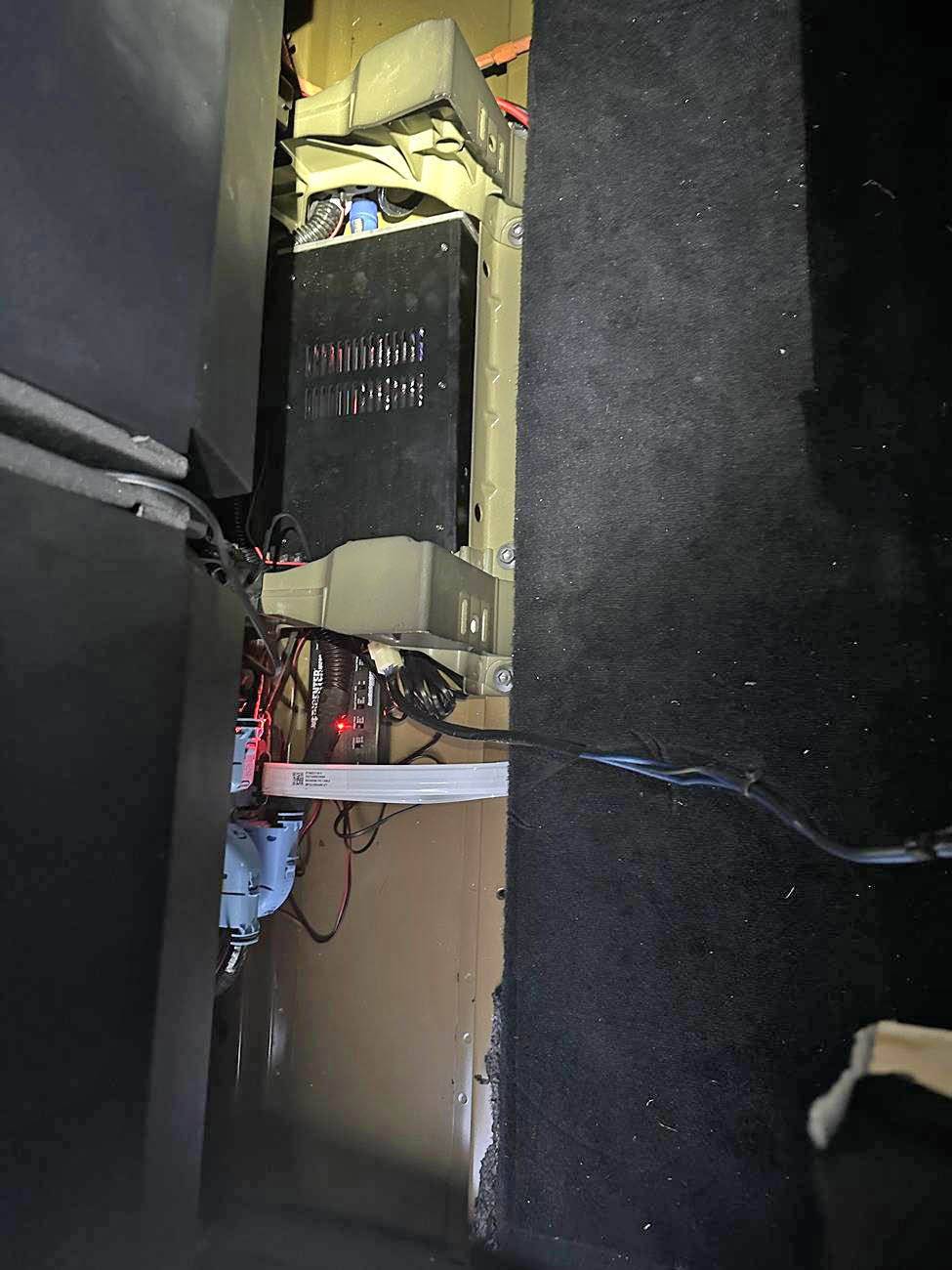
      • This took forever to find a case small enough to fit between the rear seat mounts but big enough to fit the amplifier board and all of the stuff that goes with it. After hours of searching, I found the one listed above on AliExpress. It comes with all those holes and markings on it, so I had to grind all that off with a belt sander. Once it was assembled, it fit in that space with less than a few mm to spare in any direction. The board also fit exactly flush with the inner walls of the case.
      • I put LED's in the holes for the tuning knobs. Those are some stainless washers I had sitting around that happened to be the right inner and outer diameter. And I had to drill one extra hole and was very lazy about it, so its off center...the only part my friend commented on in this whole project...
      • The volume knob is purely decorative. I would have to build a voltage divider circuit to be able to use it as gain control and I would need two of them since its a 2 channel amp, so I just ditched that part.
      • The case came with RCA jacks, speaker wire posts, and a standard 3 prong AC input. Those 3 prong AC inputs are only rated for 10 or 15 amps, but I figured I could see burst power as high as 1600 watts at around 75% efficiency, so I may be pulling over 15 amps on occasion. I initially installed the RCA jacks and speaker wire posts, but they crowded everything too much, so I ditched them for wires coming straight out from the case.
    • Cooling:
      • I know this is a weird way to do cooling, but its 2 fans, one blowing in, one blowing out. They're controlled by a little PWM controller that takes the temperature signal from the board (0-3VDC) and converts it to a PWM signal to drive the fans. The board itself is built on top of a flat aluminum plate. I put 2 layers of 1/8" aluminum on the bottom of the case to level it and mounted the board and the heatsink to them. It should be enough aluminum mass to effectively transfer the heat from the board to the heatsink and the fans should ensure good airflow in and out of the case.
  • Preamp:
    • I originally installed a PAC high power line output converter and could only get the amp to pull a max of 0.7 kW from the outlet with the LOC level, sub level on the radio, and volume all maxed. The amp itself doesn't have built in gain control, so I needed something to boost it. This could be done with a cheaper module than the Epicenter since the factory subwoofer signal is already a low pass signal, but I wanted a little more tunability. I considered a few others, but the 15V output from the amplifier is limited at 500 mA and others required a little more than that. The Epicenter only needed 300 mA.
    • I have the Epicenter on the lowest voltage output setting, have both tuning knobs all the way down, and factory subwoofer level at -4.0 for standard listening and occasionally turn it up to 0.0. So it clearly has a lot more to give if needed.
  • Wiring:
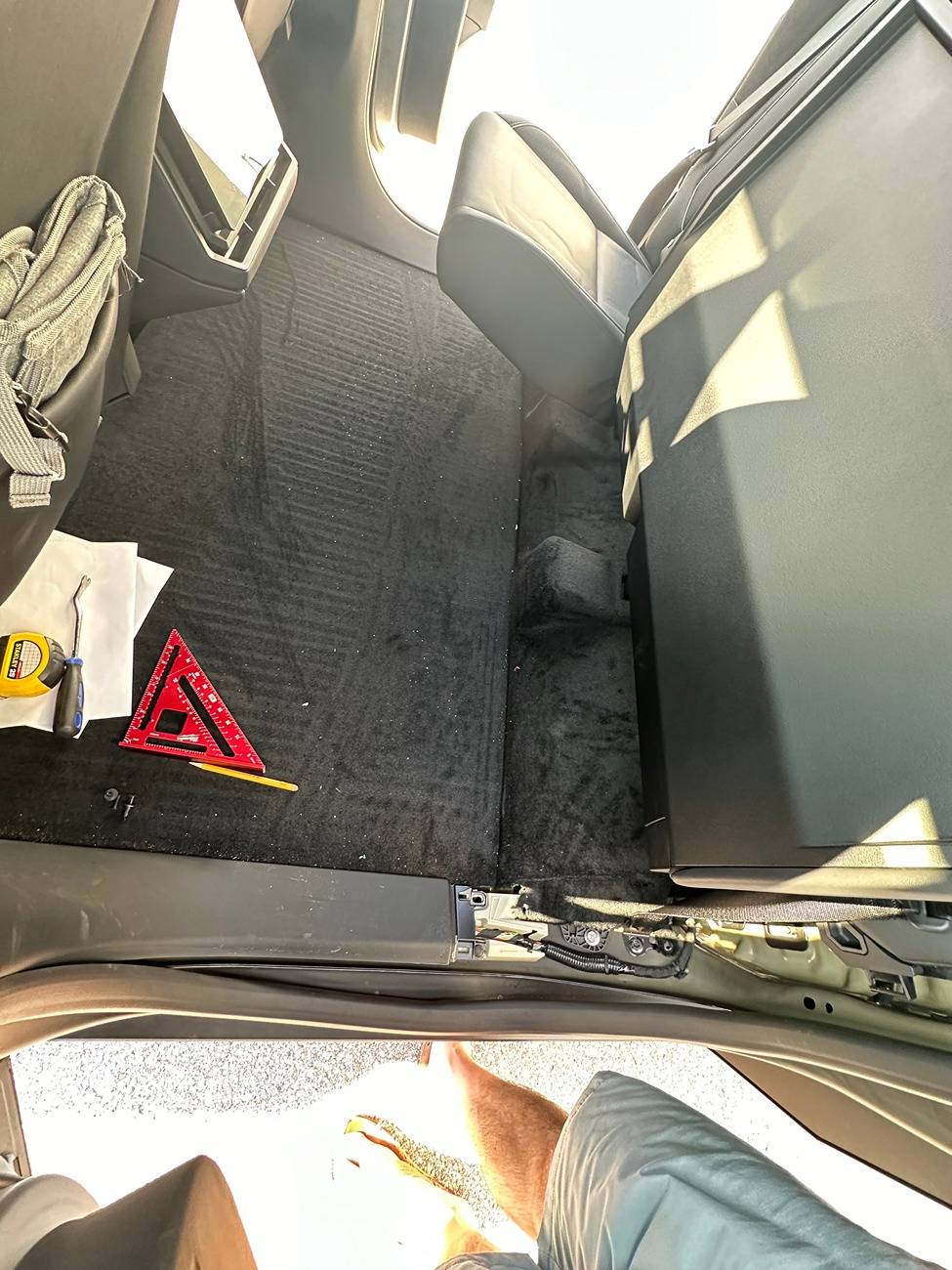
    • The power wires are 8 gauge wires lazily run beneath the carpet to the center console. You can't tell when its all put back together unless you look from the side and see the carpet is just a little bit lifted up in the center. You could probably take the time to cut holes in the styrofoam that's attached to the bottom of the carpet to make channels for the wires, but I didn't care that much. You would probably not want to run the wires all the way to the side because you'd be running non-shielded 120V cables a long way right next to sensitive data wires.
    • I wanted to tap into the wires before the outlet, but it turns out that the orange tape wrapped wires are individually shielded wires, so to tap into them, I'd have to destroy the shielding or massively dissect into them, which I feel like would be a safety hazard and maybe invalidate warranties and/or insurance. These shielded wires continue all the way to the outlet itself, which is sealed and can't be disassembled. So to simplify everything, I just hid the wire all the way until its in the console, then have it plugged into the outlet. The other nice thing about that is I can unplug it if I need to.
I think that's it. Let me know what you think!

Tesla Cybertruck Aftermarket subwoofer, ported box, and custom 120V amp install in Cybertruck B502284A-1771-4B23-8993-85E466CFBFA5IMG_6681
Tesla Cybertruck Aftermarket subwoofer, ported box, and custom 120V amp install in Cybertruck 67D85D2B-ADB5-497F-825A-EF1A09C57852IMG_6682
Tesla Cybertruck Aftermarket subwoofer, ported box, and custom 120V amp install in Cybertruck EC5F99CE-216D-48E6-97C5-711F07552319IMG_6684
Tesla Cybertruck Aftermarket subwoofer, ported box, and custom 120V amp install in Cybertruck 2E0BCC70-7D52-400C-B7FD-B017889CD35EIMG_6689
Tesla Cybertruck Aftermarket subwoofer, ported box, and custom 120V amp install in Cybertruck FAF46B82-82DE-443F-AF8C-CEFF8E88B19BIMG_6690
Tesla Cybertruck Aftermarket subwoofer, ported box, and custom 120V amp install in Cybertruck B568D970-4784-4814-B7E4-BA3725388112IMG_6693
Tesla Cybertruck Aftermarket subwoofer, ported box, and custom 120V amp install in Cybertruck 02B676AE-96BF-49BA-89AA-2871B4EFAD4EIMG_6696
Tesla Cybertruck Aftermarket subwoofer, ported box, and custom 120V amp install in Cybertruck 4B21DC64-244E-4E29-8208-5A914979AC9DIMG_6852
Tesla Cybertruck Aftermarket subwoofer, ported box, and custom 120V amp install in Cybertruck 7C65331D-ED79-432A-8DA2-4E3D972DB1B9IMG_6849
Tesla Cybertruck Aftermarket subwoofer, ported box, and custom 120V amp install in Cybertruck FC430F16-EEC2-49CD-A80B-70BBEA92EA79IMG_6960
Tesla Cybertruck Aftermarket subwoofer, ported box, and custom 120V amp install in Cybertruck BA37CDEA-D36E-41C4-8403-F3BED59A9393IMG_7001
Tesla Cybertruck Aftermarket subwoofer, ported box, and custom 120V amp install in Cybertruck 972C358B-0CE8-4671-8542-ED28484B744CIMG_7003
Tesla Cybertruck Aftermarket subwoofer, ported box, and custom 120V amp install in Cybertruck D599CBEE-1863-4E59-994D-D339CC2C0530IMG_7021
Tesla Cybertruck Aftermarket subwoofer, ported box, and custom 120V amp install in Cybertruck 0844B209-FC1A-47C1-B452-9CB4F3619B00IMG_7025


Tesla Cybertruck Aftermarket subwoofer, ported box, and custom 120V amp install in Cybertruck A9798D5C-54F8-4464-9319-78001C6EF18EIMG_7102
Sponsored


Nomogas1

Member
Joined
Feb 21, 2020
Threads
0
Messages
15
Reaction score
21
Location
WA
Vehicles
Model 3, Model Y, Eagle Talon TSi AWD, SAWD CT (Ordered & waiting)
Country flag
Finally finished a project that's been in the works for awhile. Its 2 shallow mount 12's in a ported box and a DIY amplifier that you can read more about below. It runs off of the 120V plug in the center console. I removed the factory subs and ran the factory sub wires into an Epicenter Micro module which is powered from a dedicated 15V output from the amplifier. It sounds fantastic. I can turn them on and off and control the level with the factory subwoofer control on the touchscreen. The factory system was good "for a factory system," but now that I've got real bass, I can lower the bass level on the radio, which lets me go to full volume without causing the door speakers to distort and I can now hear the full audio range and understand the vocals with the windows down at 70 mph, which is my bar for a good system. I know there are other easier ways to do this, but for those who like details, here's the full rundown:

Equipment:

Discussion:
  • Subwoofers
    • I had these laying around from years ago. I did a full Rockford Fosgate system in my last car and needed to fill in some midbass between the 8" Punch Pro midranges and the T1 15" subwoofer, so I bought these, but ended up using 10's instead. I actually always hated these subs when we sold them when I worked at Best Buy because we only sold them in a 0.5 cubic foot sealed prefab box and it sounded like ass every time. I actually built the box in such a way that I could change one inner wall and extend the port to better suit JL TW3's, because I expected these to also sound like ass. Now that it's all done, I'm pretty impressed by them, so I won't be changing unless I blow these.
  • Box
    • The box was pretty complex. I needed 2.5 cubic feet not counting the port and sub volume, so I roughed out what I needed and just kind of started building the side pieces to their maximum dimensions, then came as far forward as I could, left 1" for the subs to downfire, and found I was short by about .2 cubic feet. So I ultimately had to build little extra chambers on the sides to take advantage of the extra space where it dips down to the floor. It came out extremely close to 2.5. The port area is a little less than it calls for, the front frame of the subwoofers sits on the carpet, and the seats take a strong push down to lock into place, but considering what I had to work with, it came out great and sounds awesome.
    • I'm not great at upholstery, so I bought this cheap suede expecting that I would screw it up, learn from my mistakes, then redo it with real Alcantara. It came out good enough for me, so this is how it will stay.
  • Amplifier
    • The only other subwoofer system I've seen was the one by Tint World in Orlando where they used 48 to 12 V step down converters. Initially I wanted to beef up the 48V system with extra batteries and use 48V amplifiers. Unfortunately, the biggest 48V amplifier I could find was 300 watts RMS. I suspect this has something to do with convenience and cost. Its most likely a Class D circuit powered directly by the 48VDC input with no power conversion stage. So this is where I first got my idea to build my own amplifier.
    • I found this originally: https://store.sure-electronics.com/product/619 . This board runs off of 25-50VDC and had the power and load rating I needed, so I ordered it. When it came in, I connected it to (4) 12V LiFePo4 batteries in series, which came to 52.4V. I assumed there was some leeway in the supply voltage rating. That was not the case. It jammed on my 15" in my old car for about 30 seconds, then I tried to test the limits and burned it up. Contacted the company and they said I was running it out of spec, so they wouldn't replace it. At this point I investigated the voltage in the truck a bit more. Tesla's documentation says the 48V circuit can technically range from 28 to 58 volts and the stock "48V" battery is actually 41.6 Volts and the actual voltage on my 48V accessory line was 46.8 Volts. With that kind of variability, I didn't think I could reliably count on it to charge any configuration of lithium batteries. I'm sure the 12V step down converters also charge a bit unpredictably unless there's some kind of output voltage regulation built into them.
    • The other option was to run off of the 120V system. I looked at a bunch of home and DJ amps and couldn't make heads or tails of it. At least with car audio, you get RMS and Peak power ratings and you can guess how true that is based on the brand's reputation and the cost. With home and DJ amps, it was anywhere from $0.25 to $5.00 per watt and specs and reviews were all over the place. The other thing I noticed when looking at pictures of these amps with the cases off is that they have all kinds of big wire harnesses dangling all over the place that would probably not do well in a constant vibration environment. Many also had loud fans, digital displays, and other stuff that I didn't want. So I decided to build my own amp.
    • Amplifier module:
      • I found the ICEPower 1200AS2, which is discussed on several threads in diy audio forums. The specs are much more technical than what you'll find for any consumer ready amplifier. But suffice it to say that it should be able to reliably give me 400 watts RMS x 2 with appropriate cooling, and it seems to be doing so. You have to buy the harnesses for it separately and they didn't have all of them on parts express, so I ordered them from the manufacturer.
    • Case:
      • This took forever to find a case small enough to fit between the rear seat mounts but big enough to fit the amplifier board and all of the stuff that goes with it. After hours of searching, I found the one listed above on AliExpress. It comes with all those holes and markings on it, so I had to grind all that off with a belt sander. Once it was assembled, it fit in that space with less than a few mm to spare in any direction. The board also fit exactly flush with the inner walls of the case.
      • I put LED's in the holes for the tuning knobs. Those are some stainless washers I had sitting around that happened to be the right inner and outer diameter. And I had to drill one extra hole and was very lazy about it, so its off center...the only part my friend commented on in this whole project...
      • The volume knob is purely decorative. I would have to build a voltage divider circuit to be able to use it as gain control and I would need two of them since its a 2 channel amp, so I just ditched that part.
      • The case came with RCA jacks, speaker wire posts, and a standard 3 prong AC input. Those 3 prong AC inputs are only rated for 10 or 15 amps, but I figured I could see burst power as high as 1600 watts at around 75% efficiency, so I may be pulling over 15 amps on occasion. I initially installed the RCA jacks and speaker wire posts, but they crowded everything too much, so I ditched them for wires coming straight out from the case.
    • Cooling:
      • I know this is a weird way to do cooling, but its 2 fans, one blowing in, one blowing out. They're controlled by a little PWM controller that takes the temperature signal from the board (0-3VDC) and converts it to a PWM signal to drive the fans. The board itself is built on top of a flat aluminum plate. I put 2 layers of 1/8" aluminum on the bottom of the case to level it and mounted the board and the heatsink to them. It should be enough aluminum mass to effectively transfer the heat from the board to the heatsink and the fans should ensure good airflow in and out of the case.
  • Preamp:
    • I originally installed a PAC high power line output converter and could only get the amp to pull a max of 0.7 kW from the outlet with the LOC level, sub level on the radio, and volume all maxed. The amp itself doesn't have built in gain control, so I needed something to boost it. This could be done with a cheaper module than the Epicenter since the factory subwoofer signal is already a low pass signal, but I wanted a little more tunability. I considered a few others, but the 15V output from the amplifier is limited at 500 mA and others required a little more than that. The Epicenter only needed 300 mA.
    • I have the Epicenter on the lowest voltage output setting, have both tuning knobs all the way down, and factory subwoofer level at -4.0 for standard listening and occasionally turn it up to 0.0. So it clearly has a lot more to give if needed.
  • Wiring:
    • The power wires are 8 gauge wires lazily run beneath the carpet to the center console. You can't tell when its all put back together unless you look from the side and see the carpet is just a little bit lifted up in the center. You could probably take the time to cut holes in the styrofoam that's attached to the bottom of the carpet to make channels for the wires, but I didn't care that much. You would probably not want to run the wires all the way to the side because you'd be running non-shielded 120V cables a long way right next to sensitive data wires.
    • I wanted to tap into the wires before the outlet, but it turns out that the orange tape wrapped wires are individually shielded wires, so to tap into them, I'd have to destroy the shielding or massively dissect into them, which I feel like would be a safety hazard and maybe invalidate warranties and/or insurance. These shielded wires continue all the way to the outlet itself, which is sealed and can't be disassembled. So to simplify everything, I just hid the wire all the way until its in the console, then have it plugged into the outlet. The other nice thing about that is I can unplug it if I need to.
I think that's it. Let me know what you think!

B502284A-1771-4B23-8993-85E466CFBFA5IMG_6681.jpeg
67D85D2B-ADB5-497F-825A-EF1A09C57852IMG_6682.jpeg
EC5F99CE-216D-48E6-97C5-711F07552319IMG_6684.jpeg
2E0BCC70-7D52-400C-B7FD-B017889CD35EIMG_6689.jpeg
FAF46B82-82DE-443F-AF8C-CEFF8E88B19BIMG_6690.jpeg
B568D970-4784-4814-B7E4-BA3725388112IMG_6693.jpeg
02B676AE-96BF-49BA-89AA-2871B4EFAD4EIMG_6696.jpeg
4B21DC64-244E-4E29-8208-5A914979AC9DIMG_6852.jpeg
7C65331D-ED79-432A-8DA2-4E3D972DB1B9IMG_6849.jpeg
FC430F16-EEC2-49CD-A80B-70BBEA92EA79IMG_6960.jpeg
BA37CDEA-D36E-41C4-8403-F3BED59A9393IMG_7001.jpeg
972C358B-0CE8-4671-8542-ED28484B744CIMG_7003.jpeg
D599CBEE-1863-4E59-994D-D339CC2C0530IMG_7021.jpeg
0844B209-FC1A-47C1-B452-9CB4F3619B00IMG_7025.jpeg


A9798D5C-54F8-4464-9319-78001C6EF18EIMG_7102.jpeg
This project reminds me when I was younger (late 80's). I made a custom enclosure for 2X 15-inch subwoofers and on top are the 4 Soundstream amplifiers, crossovers, fusses/power distribution (good old days). I had a Mazda B2200 extra cab and that's where I mounted them after removing the folding rear seats. The 8-inch mids and tweeters were mounted on door panels.


Gaximus

Well-known member
Joined
Jun 22, 2024
Threads
23
Messages
1,475
Reaction score
2,313
Location
Mead, CO
Vehicles
CyberBeast, Model 3, Jeep Wrangler, Yamaha R6
Occupation
Software Developer
Country flag
Looks amazing, wanted to do a custom box in my model S, but couldn’t find a decent power source(my previous setup in my BMW had 2 4000W RMS Amps) I didn’t that much, but the model S had no reliable source. I also wanted a separate battery to charge so it would take any range. This setup is great, because you can just kill the outlet if range is an issue, plus see how much it’s actually using. Nice Job
 

XCeilidhX

Well-known member
First Name
Drew
Joined
Oct 25, 2022
Threads
10
Messages
405
Reaction score
724
Location
Silicon Valley & Surrounds
Vehicles
Model 3, Model Y, CB 047XXX, previously a Model S
Country flag
First of all, strong work. Looks great. Appreciate very much you posting all the details—yes I read them and will re-read them despite those (Ahem Jack27, lol) that say i would need an award for doing so. I’ll decline the award—and the deets matter for those obsessed with sound. Some won’t understand because they have other priorities and interests. To each their own.

glad it passes your 70 mph test and after blowing the right front door speaker in my oem Model S system I totally get your point on no strain on the front speakers now. That’s awesome.

this is a personal preference thing, but with all that work, why go ported when you are adding an amp and sealed subs are so much cleaner? Perhaps ported subs don’t bother you like they do me (most of the time) OR perhaps you made the unicorn ported sub that sounds as good as a sealed sub (it happens… rarely).

i am particularly impressed with your custom cabinet build integration AND finding a way to do-it-yourself with the stock system for adding an amp as that is really tricky with the way Tesla makes their stereos and in particular with a 48v distribution architecture. Bravo, bro. Props extraordinaire.

so what have you been listening to on your new system to test it out?

again, great work. Wow.

cheers

ps-when Tesla lets us add in our own DAC somehow i’ll be doing some kind of sonic happy dance for days on end.

pps-is the MD at the end if your handle for medical doctorate? If so, what’s your specialty? I’m EM.
 
Last edited:

KuMX

Well-known member
First Name
Ku
Joined
Nov 15, 2019
Threads
170
Messages
421
Reaction score
2,728
Location
Socal
Vehicles
Cybertruck AWD + 2017 Model X
Country flag
Amazing writeup and stereo system upgrade project! Love to see these DIY showing no fear of dealing with the electrical / electronics in a EV ?

Noticed you didn't change the OEM tweeters and mid range speakers. Are they a future project or you think that they're good enough to leave alone?
 
OP
OP

JayWebbMD

Well-known member
First Name
Jay
Joined
May 1, 2024
Threads
5
Messages
46
Reaction score
92
Location
Pensacola, FL
Vehicles
2011 Audi TTS, 2023 Genesis GV70, awaiting Beast
Country flag
First of all, strong work. Looks great. Appreciate very much you posting all the details—yes I read them and will re-read them despite those (Ahem Jack27, lol) that say i would need an award for doing so. I’ll decline the award—and the deets matter for those obsessed with sound. Some won’t understand because they have other priorities and interests. To each their own.

glad it passes your 70 mph test and after blowing the right front door speaker in my oem Model S system I totally get your point on no strain on the front speakers now. That’s awesome.

this is a personal preference thing, but with all that work, why go ported when you are adding an amp and sealed subs are so much cleaner? Perhaps ported subs don’t bother you like they do me (most of the time) OR perhaps you made the unicorn ported sub that sounds as good as a sealed sub (it happens… rarely).

i am particularly impressed with your custom cabinet build integration AND finding a way to do-it-yourself with the stock system for adding an amp as that is really tricky with the way Tesla makes their stereos and in particular with a 48v distribution architecture. Bravo, bro. Props extraordinaire.

so what have you been listening to on your new system to test it out?

again, great work. Wow.

cheers

ps-when Tesla lets us add in our own DAC somehow i’ll be doing some kind of sonic happy dance for days on end.

pps-is the MD at the end if your handle for medical doctorate? If so, what’s your specialty? I’m EM.
Thanks!
-I have never really understood why people prefer sealed boxes. I’ve always seen it as a compromise based on space. I know there’s some tightness and midbass loss with ported, but being able to shake the seatbelts at 25 Hz is more important to me than the midbass. I discussed this a little, but the subwoofer setup in my last car (mk2 Audi TTS) was a 15 in a big ported box facing rearward and two small sealed 10’s facing forward. The heart of the system was the Alpine 12 channel DSP, the PXE-0850X, which has 31 bands of variable frequency EQ for all channels and crossovers up to 48dB/octave. The idea was to truly separate the frequency ranges between the 10’s and the 15. I spent so many hours with an RTA mic trying to perfect it and never could get it just right. There was always some narrow range of frequencies that had cancellation and with the right tuning, I got the 15 to cover as high as about 250 Hz well. I ultimately swapped the 10’s for Punch Pro 10” midranges and targeted the 200-500 Hz range. So the lesson for me was that I’m not really missing anything with a ported sub. These subs in particular I had always hated, but had only heard them in sealed boxes. They have a really stiff suspension, so that actually works very well with the ported box because they recoil quickly enough to sound tight, but have the excursion needed for the lows, though I’m sure they’re not the most efficient on the low end.

Tesla Cybertruck Aftermarket subwoofer, ported box, and custom 120V amp install in Cybertruck IMG_5396
Tesla Cybertruck Aftermarket subwoofer, ported box, and custom 120V amp install in Cybertruck IMG_2326

-As far as songs for testing, one of the hardest ones to get right is “Still fly” by Big Tymers. It sounds great with this setup. The highest bass note is a little quiet, but it’s not jarring. “Forgot About Dre” is another tough one that sounds great. If I’m showing off the power, I like “Burn the House Down” by AJR.
-I doubt Tesla will ever let us use our own DAC, but as part of the research for this, I found out that iDataLink that makes the Maestro integration module that brings factory radio touchscreen controls to aftermarket stereos is testing an A2B audio integration module for new Ford’s. I learned from this forum that Tesla uses A2B for the audio signal, but there may be an extra step in the encoding that may not be able to be worked out so easily. So I’m not holding my breath, but it does seem like it would be easy for Tesla to just make a module that lets you snag the audio signal from somewhere and do whatever you want with your setup. If anyone from Tesla is reading this, please do this!
-Yes the MD is for medical doctorate. I’m an IR doc in Pensacola, FL. I was a car stereo installer for about 8 years, but decided I’d rather let that be a hobby and do something else to support the hobbies lol


OP
OP

JayWebbMD

Well-known member
First Name
Jay
Joined
May 1, 2024
Threads
5
Messages
46
Reaction score
92
Location
Pensacola, FL
Vehicles
2011 Audi TTS, 2023 Genesis GV70, awaiting Beast
Country flag
Amazing writeup and stereo system upgrade project! Love to see these DIY showing no fear of dealing with the electrical / electronics in a EV ?

Noticed you didn't change the OEM tweeters and mid range speakers. Are they a future project or you think that they're good enough to leave alone?
I actually think they’re good enough, which surprises me. My concern with upgrading them is any aftermarket speaker will need more power for the same volume level (for the most part). The audio signal comes from I believe one of 3 body controllers, so to amplify them, there would be a lot of running wires all over the car, which introduces sources of noise. Then you’d be stepping down an already amplified signal and reamplifying it, so that’s more noise. Then there’s the issue of power, for which all of the stuff I mentioned before applies. In my case, an extra benefit to my amplifier board is it has connectors to power a separate ICEPower amplifier of up to about 300 watts using its power supply, so I could at least amplify the door speakers in the future and probably use a component set with the tweeters somewhere in the dash.
 

wtibbit

Well-known member
First Name
Wayne
Joined
Aug 27, 2020
Threads
12
Messages
819
Reaction score
1,617
Location
DFW
Vehicles
Cybertruck AWD FS, Mercedes sedan, Corvette coupe, 1968 Cougar XR-7
Occupation
Retired Engineering Program Director
Country flag
Finally finished a project that's been in the works for awhile. Its 2 shallow mount 12's in a ported box and a DIY amplifier that you can read more about below. It runs off of the 120V plug in the center console. I removed the factory subs and ran the factory sub wires into an Epicenter Micro module which is powered from a dedicated 15V output from the amplifier. It sounds fantastic. I can turn them on and off and control the level with the factory subwoofer control on the touchscreen. The factory system was good "for a factory system," but now that I've got real bass, I can lower the bass level on the radio, which lets me go to full volume without causing the door speakers to distort and I can now hear the full audio range and understand the vocals with the windows down at 70 mph, which is my bar for a good system. I know there are other easier ways to do this, but for those who like details, here's the full rundown:

Equipment:

Discussion:
  • Subwoofers
    • I had these laying around from years ago. I did a full Rockford Fosgate system in my last car and needed to fill in some midbass between the 8" Punch Pro midranges and the T1 15" subwoofer, so I bought these, but ended up using 10's instead. I actually always hated these subs when we sold them when I worked at Best Buy because we only sold them in a 0.5 cubic foot sealed prefab box and it sounded like ass every time. I actually built the box in such a way that I could change one inner wall and extend the port to better suit JL TW3's, because I expected these to also sound like ass. Now that it's all done, I'm pretty impressed by them, so I won't be changing unless I blow these.
  • Box
    • The box was pretty complex. I needed 2.5 cubic feet not counting the port and sub volume, so I roughed out what I needed and just kind of started building the side pieces to their maximum dimensions, then came as far forward as I could, left 1" for the subs to downfire, and found I was short by about .2 cubic feet. So I ultimately had to build little extra chambers on the sides to take advantage of the extra space where it dips down to the floor. It came out extremely close to 2.5. The port area is a little less than it calls for, the front frame of the subwoofers sits on the carpet, and the seats take a strong push down to lock into place, but considering what I had to work with, it came out great and sounds awesome.
    • I'm not great at upholstery, so I bought this cheap suede expecting that I would screw it up, learn from my mistakes, then redo it with real Alcantara. It came out good enough for me, so this is how it will stay.
  • Amplifier
    • The only other subwoofer system I've seen was the one by Tint World in Orlando where they used 48 to 12 V step down converters. Initially I wanted to beef up the 48V system with extra batteries and use 48V amplifiers. Unfortunately, the biggest 48V amplifier I could find was 300 watts RMS. I suspect this has something to do with convenience and cost. Its most likely a Class D circuit powered directly by the 48VDC input with no power conversion stage. So this is where I first got my idea to build my own amplifier.
    • I found this originally: https://store.sure-electronics.com/product/619 . This board runs off of 25-50VDC and had the power and load rating I needed, so I ordered it. When it came in, I connected it to (4) 12V LiFePo4 batteries in series, which came to 52.4V. I assumed there was some leeway in the supply voltage rating. That was not the case. It jammed on my 15" in my old car for about 30 seconds, then I tried to test the limits and burned it up. Contacted the company and they said I was running it out of spec, so they wouldn't replace it. At this point I investigated the voltage in the truck a bit more. Tesla's documentation says the 48V circuit can technically range from 28 to 58 volts and the stock "48V" battery is actually 41.6 Volts and the actual voltage on my 48V accessory line was 46.8 Volts. With that kind of variability, I didn't think I could reliably count on it to charge any configuration of lithium batteries. I'm sure the 12V step down converters also charge a bit unpredictably unless there's some kind of output voltage regulation built into them.
    • The other option was to run off of the 120V system. I looked at a bunch of home and DJ amps and couldn't make heads or tails of it. At least with car audio, you get RMS and Peak power ratings and you can guess how true that is based on the brand's reputation and the cost. With home and DJ amps, it was anywhere from $0.25 to $5.00 per watt and specs and reviews were all over the place. The other thing I noticed when looking at pictures of these amps with the cases off is that they have all kinds of big wire harnesses dangling all over the place that would probably not do well in a constant vibration environment. Many also had loud fans, digital displays, and other stuff that I didn't want. So I decided to build my own amp.
    • Amplifier module:
      • I found the ICEPower 1200AS2, which is discussed on several threads in diy audio forums. The specs are much more technical than what you'll find for any consumer ready amplifier. But suffice it to say that it should be able to reliably give me 400 watts RMS x 2 with appropriate cooling, and it seems to be doing so. You have to buy the harnesses for it separately and they didn't have all of them on parts express, so I ordered them from the manufacturer.
    • Case:
      • This took forever to find a case small enough to fit between the rear seat mounts but big enough to fit the amplifier board and all of the stuff that goes with it. After hours of searching, I found the one listed above on AliExpress. It comes with all those holes and markings on it, so I had to grind all that off with a belt sander. Once it was assembled, it fit in that space with less than a few mm to spare in any direction. The board also fit exactly flush with the inner walls of the case.
      • I put LED's in the holes for the tuning knobs. Those are some stainless washers I had sitting around that happened to be the right inner and outer diameter. And I had to drill one extra hole and was very lazy about it, so its off center...the only part my friend commented on in this whole project...
      • The volume knob is purely decorative. I would have to build a voltage divider circuit to be able to use it as gain control and I would need two of them since its a 2 channel amp, so I just ditched that part.
      • The case came with RCA jacks, speaker wire posts, and a standard 3 prong AC input. Those 3 prong AC inputs are only rated for 10 or 15 amps, but I figured I could see burst power as high as 1600 watts at around 75% efficiency, so I may be pulling over 15 amps on occasion. I initially installed the RCA jacks and speaker wire posts, but they crowded everything too much, so I ditched them for wires coming straight out from the case.
    • Cooling:
      • I know this is a weird way to do cooling, but its 2 fans, one blowing in, one blowing out. They're controlled by a little PWM controller that takes the temperature signal from the board (0-3VDC) and converts it to a PWM signal to drive the fans. The board itself is built on top of a flat aluminum plate. I put 2 layers of 1/8" aluminum on the bottom of the case to level it and mounted the board and the heatsink to them. It should be enough aluminum mass to effectively transfer the heat from the board to the heatsink and the fans should ensure good airflow in and out of the case.
  • Preamp:
    • I originally installed a PAC high power line output converter and could only get the amp to pull a max of 0.7 kW from the outlet with the LOC level, sub level on the radio, and volume all maxed. The amp itself doesn't have built in gain control, so I needed something to boost it. This could be done with a cheaper module than the Epicenter since the factory subwoofer signal is already a low pass signal, but I wanted a little more tunability. I considered a few others, but the 15V output from the amplifier is limited at 500 mA and others required a little more than that. The Epicenter only needed 300 mA.
    • I have the Epicenter on the lowest voltage output setting, have both tuning knobs all the way down, and factory subwoofer level at -4.0 for standard listening and occasionally turn it up to 0.0. So it clearly has a lot more to give if needed.
  • Wiring:
    • The power wires are 8 gauge wires lazily run beneath the carpet to the center console. You can't tell when its all put back together unless you look from the side and see the carpet is just a little bit lifted up in the center. You could probably take the time to cut holes in the styrofoam that's attached to the bottom of the carpet to make channels for the wires, but I didn't care that much. You would probably not want to run the wires all the way to the side because you'd be running non-shielded 120V cables a long way right next to sensitive data wires.
    • I wanted to tap into the wires before the outlet, but it turns out that the orange tape wrapped wires are individually shielded wires, so to tap into them, I'd have to destroy the shielding or massively dissect into them, which I feel like would be a safety hazard and maybe invalidate warranties and/or insurance. These shielded wires continue all the way to the outlet itself, which is sealed and can't be disassembled. So to simplify everything, I just hid the wire all the way until its in the console, then have it plugged into the outlet. The other nice thing about that is I can unplug it if I need to.
I think that's it. Let me know what you think!

B502284A-1771-4B23-8993-85E466CFBFA5IMG_6681.jpeg
67D85D2B-ADB5-497F-825A-EF1A09C57852IMG_6682.jpeg
EC5F99CE-216D-48E6-97C5-711F07552319IMG_6684.jpeg
2E0BCC70-7D52-400C-B7FD-B017889CD35EIMG_6689.jpeg
FAF46B82-82DE-443F-AF8C-CEFF8E88B19BIMG_6690.jpeg
B568D970-4784-4814-B7E4-BA3725388112IMG_6693.jpeg
02B676AE-96BF-49BA-89AA-2871B4EFAD4EIMG_6696.jpeg
4B21DC64-244E-4E29-8208-5A914979AC9DIMG_6852.jpeg
7C65331D-ED79-432A-8DA2-4E3D972DB1B9IMG_6849.jpeg
FC430F16-EEC2-49CD-A80B-70BBEA92EA79IMG_6960.jpeg
BA37CDEA-D36E-41C4-8403-F3BED59A9393IMG_7001.jpeg
972C358B-0CE8-4671-8542-ED28484B744CIMG_7003.jpeg
D599CBEE-1863-4E59-994D-D339CC2C0530IMG_7021.jpeg
0844B209-FC1A-47C1-B452-9CB4F3619B00IMG_7025.jpeg


A9798D5C-54F8-4464-9319-78001C6EF18EIMG_7102.jpeg
I read the whole thing, @Jack27, because I'm that kind of person ;).

I'd also never add a more sub-bass to the truck's fine-sounding audio system, because I'm not that kind of person, either ?, but I really admire a job well done!

Great work, @JayWebbMD!!
 

Zane Edwards

Well-known member
First Name
ZMAN
Joined
Feb 18, 2024
Threads
21
Messages
426
Reaction score
573
Location
California
Vehicles
Audi R8, BMW 4 Conv. MB GLS, Tesla CT AWD
Occupation
Exec
Country flag
Finally finished a project that's been in the works for awhile. Its 2 shallow mount 12's in a ported box and a DIY amplifier that you can read more about below. It runs off of the 120V plug in the center console. I removed the factory subs and ran the factory sub wires into an Epicenter Micro module which is powered from a dedicated 15V output from the amplifier. It sounds fantastic. I can turn them on and off and control the level with the factory subwoofer control on the touchscreen. The factory system was good "for a factory system," but now that I've got real bass, I can lower the bass level on the radio, which lets me go to full volume without causing the door speakers to distort and I can now hear the full audio range and understand the vocals with the windows down at 70 mph, which is my bar for a good system. I know there are other easier ways to do this, but for those who like details, here's the full rundown:

Equipment:

Discussion:
  • Subwoofers
    • I had these laying around from years ago. I did a full Rockford Fosgate system in my last car and needed to fill in some midbass between the 8" Punch Pro midranges and the T1 15" subwoofer, so I bought these, but ended up using 10's instead. I actually always hated these subs when we sold them when I worked at Best Buy because we only sold them in a 0.5 cubic foot sealed prefab box and it sounded like ass every time. I actually built the box in such a way that I could change one inner wall and extend the port to better suit JL TW3's, because I expected these to also sound like ass. Now that it's all done, I'm pretty impressed by them, so I won't be changing unless I blow these.
  • Box
    • The box was pretty complex. I needed 2.5 cubic feet not counting the port and sub volume, so I roughed out what I needed and just kind of started building the side pieces to their maximum dimensions, then came as far forward as I could, left 1" for the subs to downfire, and found I was short by about .2 cubic feet. So I ultimately had to build little extra chambers on the sides to take advantage of the extra space where it dips down to the floor. It came out extremely close to 2.5. The port area is a little less than it calls for, the front frame of the subwoofers sits on the carpet, and the seats take a strong push down to lock into place, but considering what I had to work with, it came out great and sounds awesome.
    • I'm not great at upholstery, so I bought this cheap suede expecting that I would screw it up, learn from my mistakes, then redo it with real Alcantara. It came out good enough for me, so this is how it will stay.
  • Amplifier
    • The only other subwoofer system I've seen was the one by Tint World in Orlando where they used 48 to 12 V step down converters. Initially I wanted to beef up the 48V system with extra batteries and use 48V amplifiers. Unfortunately, the biggest 48V amplifier I could find was 300 watts RMS. I suspect this has something to do with convenience and cost. Its most likely a Class D circuit powered directly by the 48VDC input with no power conversion stage. So this is where I first got my idea to build my own amplifier.
    • I found this originally: https://store.sure-electronics.com/product/619 . This board runs off of 25-50VDC and had the power and load rating I needed, so I ordered it. When it came in, I connected it to (4) 12V LiFePo4 batteries in series, which came to 52.4V. I assumed there was some leeway in the supply voltage rating. That was not the case. It jammed on my 15" in my old car for about 30 seconds, then I tried to test the limits and burned it up. Contacted the company and they said I was running it out of spec, so they wouldn't replace it. At this point I investigated the voltage in the truck a bit more. Tesla's documentation says the 48V circuit can technically range from 28 to 58 volts and the stock "48V" battery is actually 41.6 Volts and the actual voltage on my 48V accessory line was 46.8 Volts. With that kind of variability, I didn't think I could reliably count on it to charge any configuration of lithium batteries. I'm sure the 12V step down converters also charge a bit unpredictably unless there's some kind of output voltage regulation built into them.
    • The other option was to run off of the 120V system. I looked at a bunch of home and DJ amps and couldn't make heads or tails of it. At least with car audio, you get RMS and Peak power ratings and you can guess how true that is based on the brand's reputation and the cost. With home and DJ amps, it was anywhere from $0.25 to $5.00 per watt and specs and reviews were all over the place. The other thing I noticed when looking at pictures of these amps with the cases off is that they have all kinds of big wire harnesses dangling all over the place that would probably not do well in a constant vibration environment. Many also had loud fans, digital displays, and other stuff that I didn't want. So I decided to build my own amp.
    • Amplifier module:
      • I found the ICEPower 1200AS2, which is discussed on several threads in diy audio forums. The specs are much more technical than what you'll find for any consumer ready amplifier. But suffice it to say that it should be able to reliably give me 400 watts RMS x 2 with appropriate cooling, and it seems to be doing so. You have to buy the harnesses for it separately and they didn't have all of them on parts express, so I ordered them from the manufacturer.
    • Case:
      • This took forever to find a case small enough to fit between the rear seat mounts but big enough to fit the amplifier board and all of the stuff that goes with it. After hours of searching, I found the one listed above on AliExpress. It comes with all those holes and markings on it, so I had to grind all that off with a belt sander. Once it was assembled, it fit in that space with less than a few mm to spare in any direction. The board also fit exactly flush with the inner walls of the case.
      • I put LED's in the holes for the tuning knobs. Those are some stainless washers I had sitting around that happened to be the right inner and outer diameter. And I had to drill one extra hole and was very lazy about it, so its off center...the only part my friend commented on in this whole project...
      • The volume knob is purely decorative. I would have to build a voltage divider circuit to be able to use it as gain control and I would need two of them since its a 2 channel amp, so I just ditched that part.
      • The case came with RCA jacks, speaker wire posts, and a standard 3 prong AC input. Those 3 prong AC inputs are only rated for 10 or 15 amps, but I figured I could see burst power as high as 1600 watts at around 75% efficiency, so I may be pulling over 15 amps on occasion. I initially installed the RCA jacks and speaker wire posts, but they crowded everything too much, so I ditched them for wires coming straight out from the case.
    • Cooling:
      • I know this is a weird way to do cooling, but its 2 fans, one blowing in, one blowing out. They're controlled by a little PWM controller that takes the temperature signal from the board (0-3VDC) and converts it to a PWM signal to drive the fans. The board itself is built on top of a flat aluminum plate. I put 2 layers of 1/8" aluminum on the bottom of the case to level it and mounted the board and the heatsink to them. It should be enough aluminum mass to effectively transfer the heat from the board to the heatsink and the fans should ensure good airflow in and out of the case.
  • Preamp:
    • I originally installed a PAC high power line output converter and could only get the amp to pull a max of 0.7 kW from the outlet with the LOC level, sub level on the radio, and volume all maxed. The amp itself doesn't have built in gain control, so I needed something to boost it. This could be done with a cheaper module than the Epicenter since the factory subwoofer signal is already a low pass signal, but I wanted a little more tunability. I considered a few others, but the 15V output from the amplifier is limited at 500 mA and others required a little more than that. The Epicenter only needed 300 mA.
    • I have the Epicenter on the lowest voltage output setting, have both tuning knobs all the way down, and factory subwoofer level at -4.0 for standard listening and occasionally turn it up to 0.0. So it clearly has a lot more to give if needed.
  • Wiring:
    • The power wires are 8 gauge wires lazily run beneath the carpet to the center console. You can't tell when its all put back together unless you look from the side and see the carpet is just a little bit lifted up in the center. You could probably take the time to cut holes in the styrofoam that's attached to the bottom of the carpet to make channels for the wires, but I didn't care that much. You would probably not want to run the wires all the way to the side because you'd be running non-shielded 120V cables a long way right next to sensitive data wires.
    • I wanted to tap into the wires before the outlet, but it turns out that the orange tape wrapped wires are individually shielded wires, so to tap into them, I'd have to destroy the shielding or massively dissect into them, which I feel like would be a safety hazard and maybe invalidate warranties and/or insurance. These shielded wires continue all the way to the outlet itself, which is sealed and can't be disassembled. So to simplify everything, I just hid the wire all the way until its in the console, then have it plugged into the outlet. The other nice thing about that is I can unplug it if I need to.
I think that's it. Let me know what you think!

B502284A-1771-4B23-8993-85E466CFBFA5IMG_6681.jpeg
67D85D2B-ADB5-497F-825A-EF1A09C57852IMG_6682.jpeg
EC5F99CE-216D-48E6-97C5-711F07552319IMG_6684.jpeg
2E0BCC70-7D52-400C-B7FD-B017889CD35EIMG_6689.jpeg
FAF46B82-82DE-443F-AF8C-CEFF8E88B19BIMG_6690.jpeg
B568D970-4784-4814-B7E4-BA3725388112IMG_6693.jpeg
02B676AE-96BF-49BA-89AA-2871B4EFAD4EIMG_6696.jpeg
4B21DC64-244E-4E29-8208-5A914979AC9DIMG_6852.jpeg
7C65331D-ED79-432A-8DA2-4E3D972DB1B9IMG_6849.jpeg
FC430F16-EEC2-49CD-A80B-70BBEA92EA79IMG_6960.jpeg
BA37CDEA-D36E-41C4-8403-F3BED59A9393IMG_7001.jpeg
972C358B-0CE8-4671-8542-ED28484B744CIMG_7003.jpeg
D599CBEE-1863-4E59-994D-D339CC2C0530IMG_7021.jpeg
0844B209-FC1A-47C1-B452-9CB4F3619B00IMG_7025.jpeg


A9798D5C-54F8-4464-9319-78001C6EF18EIMG_7102.jpeg
that is some amazing craftsmanship, looks OEM, nice job.
 

UberNoob

Well-known member
Joined
Jun 5, 2024
Threads
6
Messages
1,146
Reaction score
1,760
Location
Florida
Vehicles
CyberBeast & M3P
Occupation
Desktop Security Engineer
Country flag
I’d let you do mine. Let me know when it’s done.
 

Jason B

Well-known member
Joined
Jul 12, 2024
Threads
3
Messages
97
Reaction score
34
Location
usa
Vehicles
Cyberbeast
Country flag
Impressive! How's the setup doing? Still like it?
Sponsored


Top