
Sponsored

TexasRaider

Well-known member
First Name
JR
Joined
Jan 10, 2023
Threads
33
Messages
931
Reaction score
843
Location
Denton
Vehicles
Cybertruck + MS
Occupation
Civil
Country flag
Hopefully this will come with road hazard warranty also. Or else, I’ll have Discount Tire price match.
Sponsored
 

HaulingAss

Well-known member
Joined
Oct 3, 2020
Threads
28
Messages
10,426
Reaction score
20,964
Location
Western Washington, USA
Vehicles
Cybertruck DM, 2010 F-150, 2018 Performance Model 3, 2024 Performance Model 3
Country flag
But having said that, now that the temperature is staying above the freeze point, I'm chomping at the bit to get them off and the regular wheels back on. The Duratracs will start melting away as the days get warmer and they're too expensive to allow that to happen.
Is there evidence of that? I mean, all tires wear more quickly in warm weather but my experience has been the Duratracs are not a true winter compound so I was hoping they wouldn't "melt away" in warm weather. They seem to get their winter traction from the deep lugs and a good amount of voids in the treads.
 

BrockN

Well-known member
First Name
Brock
Joined
Jan 1, 2025
Threads
7
Messages
413
Reaction score
621
Location
Kamloops BC Canada
Vehicles
'24 FS Cybertruck, '23 MY, '15 MS
Occupation
Engineer
Country flag
Is there evidence of that? I mean, all tires wear more quickly in warm weather but my experience has been the Duratracs are not a true winter compound so I was hoping they wouldn't "melt away" in warm weather. They seem to get their winter traction from the deep lugs and a good amount of voids in the treads.
If you look at the tread, you'll see siping in the true snowflake tires. That's for ice and you won't find it on a typical all season tire. The exception I've seen is the Nokian WRG4/5 four season tires which have it and they do perform well in all four seasons, although not as well as a Hakkapeliitta R5 car winter.

A winter rubber compound is different to a regular all season compound and is designed to be grippy even when really cold. It actually gets pretty terrible in warmer weather. Rolling resistance is poor too.

Maybe the Duratrac winter is more like the WRG4 and able to be reasonably durable in the heat... I'm not a tire engineer... ?‍♂

However, my expectation is that it won't be an overly great summer performer based on my observations that:

- they performed really well this winter on ice, as I've come to expect from a good ice radial like the Hakka R5 and it's predecessors.

- they're not feeling very gripping on asphalt in the warmer 15C weather we've been having here, when they're pushed to brake hard...just like an ice radial, they feel a bit scrabbly (if that's a word!) on asphalt.

- Their rolling resistance seems to be much poorer than the AT tires the truck came with, which seems to be related to winter rubber compound (based on ten winters in my Model S).

Boil that all down and I would expect poor summer durability and performance like you'd get from a regular winter tire. It's walking like a duck and talking like a duck, so I think it's a duck...or in this case, an actual winter tire.

And if they were fine for summer use, why didn't the truck arrive from the factory with them installed? I'd say because they aren't up to the challenge.
 

dalton108

Well-known member
First Name
Dalton
Joined
Oct 17, 2020
Threads
132
Messages
4,068
Reaction score
8,206
Location
USA
Vehicles
‘24 FS/CB; ‘24 MX; ‘23 MS PLAID (Prior: ‘20-MY; ‘21-M3P) (Also: ‘14-FJ; ‘21-C8)
Occupation
Lawyer
Country flag
If you look at the tread, you'll see siping in the true snowflake tires. That's for ice and you won't find it on a typical all season tire. The exception I've seen is the Nokian WRG4/5 four season tires which have it and they do perform well in all four seasons, although not as well as a Hakkapeliitta R5 car winter.

A winter rubber compound is different to a regular all season compound and is designed to be grippy even when really cold. It actually gets pretty terrible in warmer weather. Rolling resistance is poor too.

Maybe the Duratrac winter is more like the WRG4 and able to be reasonably durable in the heat... I'm not a tire engineer... ?‍♂

However, my expectation is that it won't be an overly great summer performer based on my observations that:

- they performed really well this winter on ice, as I've come to expect from a good ice radial like the Hakka R5 and it's predecessors.

- they're not feeling very gripping on asphalt in the warmer 15C weather we've been having here, when they're pushed to brake hard...just like an ice radial, they feel a bit scrabbly (if that's a word!) on asphalt.

- Their rolling resistance seems to be much poorer than the AT tires the truck came with, which seems to be related to winter rubber compound (based on ten winters in my Model S).

Boil that all down and I would expect poor summer durability and performance like you'd get from a regular winter tire. It's walking like a duck and talking like a duck, so I think it's a duck...or in this case, an actual winter tire.

And if they were fine for summer use, why didn't the truck arrive from the factory with them installed? I'd say because they aren't up to the challenge.
The same reason they didn’t put KO2s or KO3s on, because they wanted to sell a car with the maximum range possible and they designed a tire to fit the styling of the car and match the fancy, but impractical, wheel covers.

Tesla and GoodYear created a tire that’s all cattle and no hat. It looks good, but it can’t handle the snow and it has relatively thin tread so it wears out quicker than for whatever reason you think these DuraTracs will in the summer. We have tons of reports here of people getting less than 10,000 miles on those tires. I’ve seen that myself at only 5000 miles on those tires which is one of the reasons I switched to the DuraTracs which will ultimately be replaced with KO3s.

“If you look at the tread, you'll see siping in the true snowflake tires. That's for ice and you won't find it on a typical all season tire.”

This statement is patently false! KO2 are 1 million years old and have siping all over the place!

Principal parts of the re-engineering of that tire (i.e. the KO3) was to improve the siping and wet performance. I’m not a tire engineer either, but I can read, and I’ve been running 3 peak tires - in the desert- for the better part of two decades. I always do my homework before purchasing and I’ve watched hours of videos about these tires.

You want to only run them in the winter? By all means that’s your prerogative. You’d be missing the point of what the tire was designed to do simply because Tesla sold it to you as a “winter tire” but; whatever; your money, your rig, your call.
 
Last edited:

BrockN

Well-known member
First Name
Brock
Joined
Jan 1, 2025
Threads
7
Messages
413
Reaction score
621
Location
Kamloops BC Canada
Vehicles
'24 FS Cybertruck, '23 MY, '15 MS
Occupation
Engineer
Country flag
Principal parts of the re-engineering of that tire (i.e. the KO3) was to improve the siping and wet performance. I’m not a tire engineer either, but I can read, and I’ve been running 3 peak tires - in the desert- for the better part of two decades. I always do my homework before purchasing and I’ve watched hours of videos about these tires.

You want to only run them in the winter? By all means that’s your prerogative. You’d be missing the point of what the tire was designed to do simply because Tesla sold it to you as a “winter tire” but; whatever; your money, your rig, your call.
What's interesting to note is BFG's own advertising material. It talks about snow and it talks about mud. But I didn't see any reference to ice.

Tread design for ice is critical. If it throws snow well too, that's great, but I like to stay on the highway when the roads are icy. The rubber compound is critical for that and it typically doesn't do well in hot conditions.

I don't care about the OEM tires. I assume they'll wear out quickly like all OEM tires do. What I care about is maintaining tread depth for ice performance and that means swapping them off before they melt off. I'll figure out an all season tire when the time comes. But for now, I have been favourably impressed with the Duratracs on ice but not on range or warm weather performance feel so they're about to be pulled off.

Where I am, snowflake symbol tires are mandatory, on the main highway I drive, for 6 months of the year. I don't skimp on winter safety and performance is more important than tread life.


HaulingAss

Well-known member
Joined
Oct 3, 2020
Threads
28
Messages
10,426
Reaction score
20,964
Location
Western Washington, USA
Vehicles
Cybertruck DM, 2010 F-150, 2018 Performance Model 3, 2024 Performance Model 3
Country flag
What's interesting to note is BFG's own advertising material. It talks about snow and it talks about mud. But I didn't see any reference to ice.
That's a good point, and I think it speaks directly to the rubber compound, that it is not a true winter rubber compound. Because traction on hard ice relies heavily on traction at the molecular level of the rubber compound and very little on the mechanical level (such as siping and aggressive tread patterns). That's because ice is too hard for a soft material like a rubber edge to "bite" on cold, hard ice.

Tread design for ice is critical. If it throws snow well too, that's great, but I like to stay on the highway when the roads are icy. The rubber compound is critical for that and it typically doesn't do well in hot conditions.
I suspect you accidentally misspoke when you said tread design is critical for ice traction (seeing how you followed it up with the correct statement that rubber compound is critical for ice traction). That said, the endless variety of different types of ice and snow conditions make this a complex subject. with few absolutes.

For example, true winter tires are designed to pack with snow to increase traction on snow and ice. This works particularly well when temperatures are at least a few degrees below zero, and the ice crystals are still sharp on a microscopic level (old ice crystals sublimate into the air and sharp crystals become blunt and rounded, reducing traction).

The snow packed into the tread pattern can increases traction on cold, hard ice because the crystals are pointed and can interlock with ice on a molecular level. The snow crystals in the snow packed into the tread can also wick away water from the interface layer via capillary action. A thin film of melted ice (water) is what makes ice so slippery (an ice skaters blades are lubricated by a film of water that melts from friction of the blade on ice). Snow packed into the tread can make ice a lot less slippery by wicking water molecules away from the interface layer as it melts due to friction.

The Duratracs are below average in their ability to pack with snow compared to a true winter tire. I suspect this is due to both the open tread design and the rubber compound not being a true winter compound. That said, their deep, open and aggressive tread pattern witth a high ratio of void to tread is very good at mechanical traction in sloppy conditions. The tread can bite deeper into the snow/slush where it can gain more traction.

Even when not packed with snow, a good winter rubber compound has a micro-porous surface that can interlock with ice crystals on the roads surface. This is where I notice the Duratracs, while better than most non-winter rated tires, are not as good as winter only tires (tires that must be removed in the summer).

Grok3 provided the best laymen's description of what I'm talking about above that I have ever seen published anywhere:


A winter tire tread compound increases traction on ice primarily through molecular friction, though mechanical friction plays a supporting role. The distinction lies in how the tire interacts with the ice surface, and the specialized rubber compound of winter tires is key to their performance.
Molecular Friction (Primary Mechanism)

  • Rubber compound properties: Winter tires use a softer, more pliable rubber compound with high silica content or natural rubber blends that remain flexible at low temperatures (below 45°F or 7°C). This flexibility allows the tire to conform to the microscopic irregularities of the ice surface.
  • Adhesion at the molecular level: When the soft rubber contacts ice, it creates temporary molecular bonds (van der Waals forces) between the tire and the ice. These bonds form and break as the tire moves, generating grip through a "stickiness" effect. This is most effective on smooth or wet ice, where mechanical interlocking is minimal.
  • Temperature dependence: The compound is engineered to stay pliable down to -40°F (-40°C), maximizing contact area and molecular interaction. Studies (e.g., from tire manufacturers like Nokian or Bridgestone) show that this adhesion can increase friction coefficients on ice by 20–50% compared to all-season tires, which harden and lose grip below freezing.
Mechanical Friction (Secondary Mechanism)
  • Sipes and tread design: Winter tires feature aggressive siping—thousands of tiny slits in the tread blocks—that mechanically bite into ice or snow. This provides some interlocking grip, especially on rough or textured ice, by creating edges that dig in.
  • Surface penetration: On slightly softer ice or packed snow, the tread can physically displace material, enhancing traction. However, on hard, polished ice, this effect diminishes because the ice is too solid for significant penetration.
  • Limits: Mechanical friction is less dominant on ice than on snow, where deeper tread patterns excel. Ice’s low shear strength and smoothness limit how much the tread can "grab" mechanically.
Why Molecular Friction Dominates on Ice
  • Ice characteristics: Ice, especially at temperatures near or below 0°F (-18°C), is hard and slick, with a thin layer of liquid water often present (due to pressure or slight melting). Mechanical grip struggles here because there’s little for the tread to dig into, unlike snow or gravel.
  • Test evidence: Research, such as from the Tire Rack or ASTM studies on tire-ice friction, shows that winter tire compounds outperform harder rubber (e.g., summer tires) on ice even with identical tread patterns. For example, a winter tire might achieve a friction coefficient of 0.2–0.3 on ice, while an all-season tire drops to 0.1–0.15, largely due to the compound’s molecular adhesion.
  • Wet ice enhancement: On wet ice, the compound also wicks away water via silica’s hydrophilic properties, keeping the rubber in direct contact with the solid ice for better molecular bonding.
Conclusion
The winter tire tread compound boosts traction on ice primarily through molecular friction, leveraging its soft, flexible nature to maximize adhesion at a microscopic level. Mechanical friction from sipes and tread patterns supplements this, particularly on rougher or softer ice, but it’s the compound’s molecular interaction that gives winter tires their edge in icy conditions. This is why a worn winter tire with the right compound can still outperform a new all-season tire on ice.


Where I am, snowflake symbol tires are mandatory, on the main highway I drive, for 6 months of the year. I don't skimp on winter safety and performance is more important than tread life.
The winter three peak snowflake designation was developed around 1999 by N. American tire and rubber manufacturers in response to competion from European tire manufacturers who had greatly surpassed American tire makers in terms of grippy winter rubber compounds.

The 3-Peak Mountain Snowflake standard only requires 10% better ice acceleration than a particular reference all-season tire. This is noteable because a good winter tire can easily double the ice traction of a non-winter tire on ice. 10% better is not saying much. In other words, it's a winter designation that purposefully sets a very low bar to hide the fact that European tire manufacturers had much better winter rubber compounds at the turn of the last century.

European tire makers failed to take advantage of creating an ice traction rating system that would cover the entire range of capabilities when it came to winter traction abilities. The US/Canadian standard was adopted by European tire makers, because it's all that existed and their winter tires could easily meet the very low bar. It's worth noting that many 3-Peak Mountain Snowflake rated tires do a hell of a lot better than 10% better while other tires barely squeak by. The Duratracs are good enough that I wouldn't say they barely squeak by, but they are also far from those that excel.

Even today there is no official standard that denotes a winter tire that goes far beyond the 3 peak mountain snowflake standard. Some tires bearing this designation on the sidewall are absolutely terrible in icy conditions (but still 10% better than the reference all-season tire). Some all-season tires without the 3 Peak Mountain Snowflake designation have better ice traction than some tires with the designation simply because the manufacturer decided not to certify it as a 3 Peak Mountain Snowflake certified tire. This might be done so as to not compete with other tires in their line that do carry the winter designation.

Back to the Duratracs. They are quite capable in many winter conditions, but I don't consider them a true winter tire (although they meet the legal definitions of one). This is noticed on hard ice where they are acceptable but not great. On my recent trip to Reno and back to Northern Washington I encountered a great deal of different winter conditions using the Duratracs. One section north of Reno was so slick the semi-trucks were only going 25 mph on a level, straight highway through the high desert. I've seen this happen a number of times in my winter driving career, and with a true winter tire I have typically been able to safely travel much faster than the semi-trucks when my car was equipped with non-studded winter-only tires. Not with the Duratracs because they are not a true winter tire. I was only able to safely travel about 15 mph faster than the semi-trucks.

On another section of remote and twisty highway with zero traffic winding through some high pine forests in Eastern Oregon the road was consistently icy in such a manner that I could only safely travel 40-50 mph (and that was pushing it). With the grip from a true winter tire I would have been ripping it up at 60-65 mph.

Having said all that, I don't believe true winter tires for trucks like the Cybertruck actually exist. If they do, they would be a huge compromise in everything but winter/ice grip. They would have very short treadlife and be subject to chunking and tearing off-road (and maybe on road too). They would probably limit the max payload too (the Duratracs are rated well over the axle weights of a fully loaded Cybertruck). This is not to crap on the Duratracs, they are good tires as far as I can tell so far, they just come with significant compromises considering they don't excel on ice as many good studless winter tires for passenger cars do.
 

HaulingAss

Well-known member
Joined
Oct 3, 2020
Threads
28
Messages
10,426
Reaction score
20,964
Location
Western Washington, USA
Vehicles
Cybertruck DM, 2010 F-150, 2018 Performance Model 3, 2024 Performance Model 3
Country flag
- they're not feeling very gripping on asphalt in the warmer 15C weather we've been having here, when they're pushed to brake hard...just like an ice radial, they feel a bit scrabbly (if that's a word!) on asphalt.

- Their rolling resistance seems to be much poorer than the AT tires the truck came with, which seems to be related to winter rubber compound (based on ten winters in my Model S).

Boil that all down and I would expect poor summer durability and performance like you'd get from a regular winter tire. It's walking like a duck and talking like a duck, so I think it's a duck...or in this case, an actual winter tire.
I attribute the poor pavement performance to the deep unsupported lugs. Same with the high rolling resistance.

And if they were fine for summer use, why didn't the truck arrive from the factory with them installed? I'd say because they aren't up to the challenge.
I'm confident that Tesla didn't equip the Cybertruck with the Duratracs as the standard OEM tire because the deep unsupported lugs give very poor performance on pavement, low grip and poor efficiency (they would have had to lower the range numbers significantly). Sure, the tall lugs stiffen up a little below freezing, but they still have very poor corner grip, on pavement, even in the cold, due to those tall lugs.

They are particularly poor on wet pavement, even if it's 33 degrees F.
 

Outdoors

Well-known member
First Name
Outdoors
Joined
Nov 19, 2019
Threads
18
Messages
1,928
Reaction score
3,527
Location
North West Montana
Vehicles
S,CT,R2, Slate (order)
If you look at the tread, you'll see siping in the true snowflake tires. That's for ice and you won't find it on a typical all season tire. The exception I've seen is the Nokian WRG4/5 four season tires which have it and they do perform well in all four seasons, although not as well as a Hakkapeliitta R5 car winter.

A winter rubber compound is different to a regular all season compound and is designed to be grippy even when really cold. It actually gets pretty terrible in warmer weather. Rolling resistance is poor too.

Maybe the Duratrac winter is more like the WRG4 and able to be reasonably durable in the heat... I'm not a tire engineer... ?‍♂

However, my expectation is that it won't be an overly great summer performer based on my observations that:

- they performed really well this winter on ice, as I've come to expect from a good ice radial like the Hakka R5 and it's predecessors.

- they're not feeling very gripping on asphalt in the warmer 15C weather we've been having here, when they're pushed to brake hard...just like an ice radial, they feel a bit scrabbly (if that's a word!) on asphalt.

- Their rolling resistance seems to be much poorer than the AT tires the truck came with, which seems to be related to winter rubber compound (based on ten winters in my Model S).

Boil that all down and I would expect poor summer durability and performance like you'd get from a regular winter tire. It's walking like a duck and talking like a duck, so I think it's a duck...or in this case, an actual winter tire.

And if they were fine for summer use, why didn't the truck arrive from the factory with them installed? I'd say because they aren't up to the challenge.
I have the Nokian. I found the compound much stiffer compared to the Duratrac which I also own, and used during the winter. The horror of me using such a thing the Duratracs during the winter. It worked fine for me. I also use chains, and found I could put my chains on in about five minutes. They worked good for me, and we have spikes on our S and chains on our 3. Some cry and whine about what they wished they had actually done in life, but never did. Oh well. Drink some Mate and relax you tire folks.
 

buyitrita

Member
First Name
Theresa
Joined
Dec 9, 2023
Threads
0
Messages
11
Reaction score
8
Location
Texas
Vehicles
2021 S Plaid, 2024 CT LEFS
Country flag
I bought a set for South Texas - mistake. Mounted on 04/23, demounted on 04/24.
For Sale - $1800. Less than 100 miles.
 

BrockN

Well-known member
First Name
Brock
Joined
Jan 1, 2025
Threads
7
Messages
413
Reaction score
621
Location
Kamloops BC Canada
Vehicles
'24 FS Cybertruck, '23 MY, '15 MS
Occupation
Engineer
Country flag
I attribute the poor pavement performance to the deep unsupported lugs. Same with the high rolling resistance.

I'm confident that Tesla didn't equip the Cybertruck with the Duratracs as the standard OEM tire because the deep unsupported lugs give very poor performance on pavement, low grip and poor efficiency (they would have had to lower the range numbers significantly). Sure, the tall lugs stiffen up a little below freezing, but they still have very poor corner grip, on pavement, even in the cold, due to those tall lugs.

They are particularly poor on wet pavement, even if it's 33 degrees F.
I'm with you on all of that.

You were right in an earlier comment about misspeaking on tread design and ice performance. I'm often accused of going into the weeds on technical subjects, so thought it was better to skim over molecular stuff - LOL. I've run Nokian for years and Gislaved before that. The one set of Blizzaks I had were not great at all.

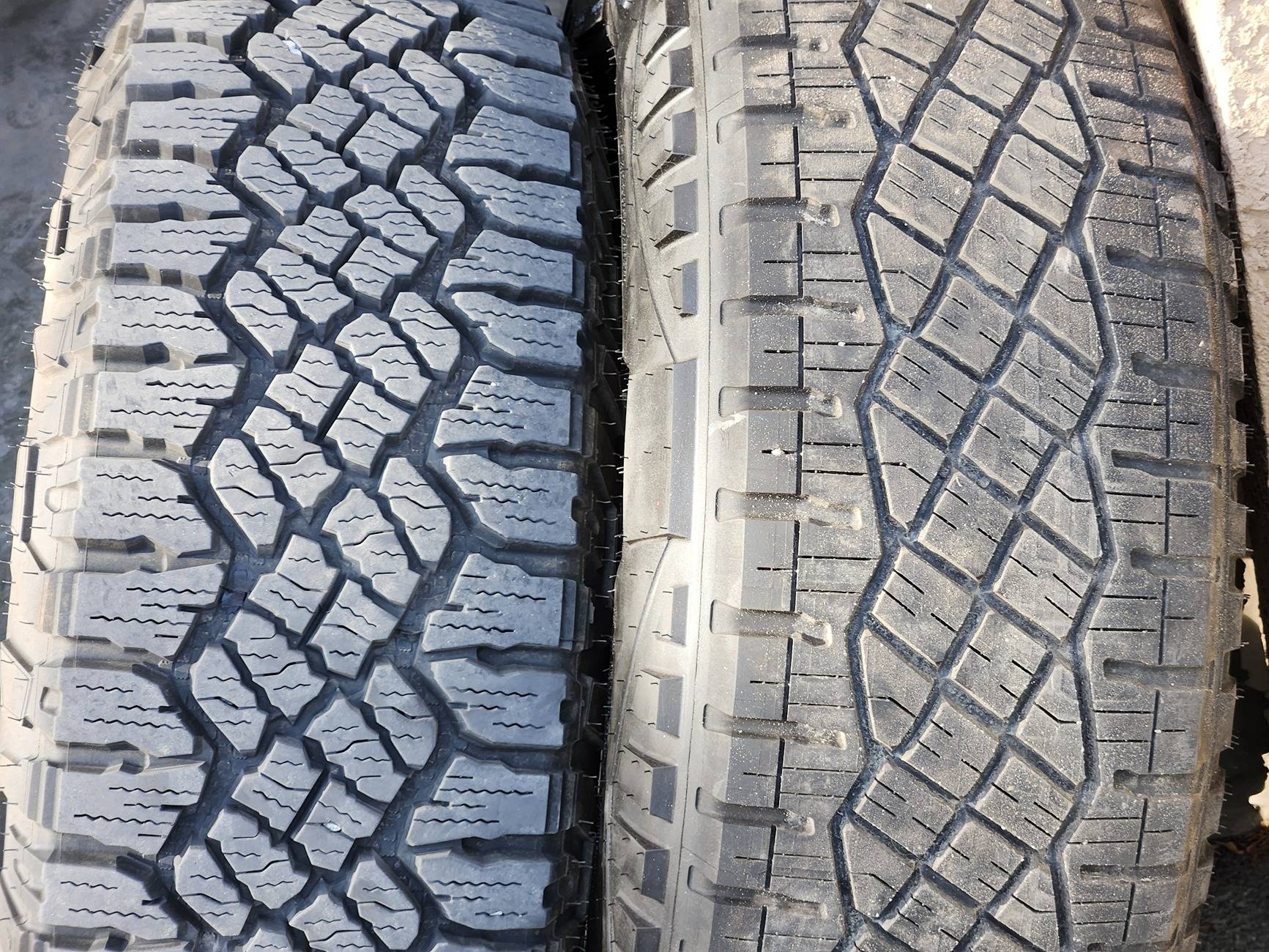
I'm glad that I'm not the only one unimpressed with the Duratracs in above-zero conditions. I swapped my Duratracs off a couple of weeks ago, to put the OEM AT tires back on. It's interesting to see the comparison:
Tesla Cybertruck Goodyear DuraTrac Tire now available on Tesla Shop site for $485 Cybertruck tires


When I talk about siping, and in particular, the siping on a winter tire, I'm referring to the wiggly sipes on the Duratrac (left side of photo). The typical straight sipes for rain never seem to be evident on a true winter tire. Interesting to note the difference in tread shape too. I agree that there probably isn't a true winter ice radial available for this size and vehicle application, but the tread design on the left is certainly more typical of what you'd see on a true winter tire... at least in my experience.

I'm happy enough with them as a winter tire. They could be better, of course, but I'm not complaining! And I agree with your thoughts on why Tesla didn't make them the OEM tire. I mentioned in another thread how much of an efficiency improvement I saw after switching to the ATs - it's significant! The best I managed with the Duratracs was around 450 Wh/mi. After swapping over to the ATs, that dropped to around 375 Wh/mi.... similar temperatures and driving conditions/speeds. Not an insignificant improvement!

And the performance on asphalt is also much improved. Quieter, smoother and just firmer. I hate taking up space in my garage with a second set of wheels and tires, but it's my reality... :LOL:


Garee

Well-known member
First Name
Gary
Joined
Sep 1, 2022
Threads
1
Messages
137
Reaction score
76
Location
St Cloud, Florida
Vehicles
Cybertruck
Occupation
Retired
Country flag
Any recommendations for strictly on the road tires to last?
 

TyPope

Well-known member
First Name
Ty
Joined
Mar 31, 2020
Threads
33
Messages
3,249
Reaction score
4,980
Location
Chesapeake Beach, MD
Vehicles
'23 MYLR, FS Cyberbeast 280xx
Occupation
Current Operations for... an organization
Country flag
I was just on the Tesla Shop site and can't find the original ATs. Are these equivalent to the originals?
Cybertruck Goodyear DuraTrac RT Tire

They are the only ones other than the Winter tire that I see on the site.

I just want something that looks tough like the ATs on the Beast, is as efficient, isn't loud (Lordy, some trucks have REALLY loud tires!) and is good for an occasional snow commute. I'm not looking to climb mountain trails in the snow... any longer. Nor am I looking for a Winter tire.

Please advise
 

BrockN

Well-known member
First Name
Brock
Joined
Jan 1, 2025
Threads
7
Messages
413
Reaction score
621
Location
Kamloops BC Canada
Vehicles
'24 FS Cybertruck, '23 MY, '15 MS
Occupation
Engineer
Country flag
I was just on the Tesla Shop site and can't find the original ATs. Are these equivalent to the originals?
Cybertruck Goodyear DuraTrac RT Tire

They are the only ones other than the Winter tire that I see on the site.

I just want something that looks tough like the ATs on the Beast, is as efficient, isn't loud (Lordy, some trucks have REALLY loud tires!) and is good for an occasional snow commute. I'm not looking to climb mountain trails in the snow... any longer. Nor am I looking for a Winter tire.

Please advise
I'd look into the Nokian Outpost nAT. It's supposed been re-worked for EV efficiency.
 

Metal Storm

Member
First Name
Kelley
Joined
Mar 21, 2021
Threads
0
Messages
11
Reaction score
5
Location
Ft Myers Fl
Vehicles
Ford F150
Country flag
You will get some range loss and more noise than the stock AT tires. Stats were 13,649 miles, 6788 kWh, 495.8 WH/Mi. About half of this amount was my trip from WA to Texas. Nice overall ride.
How are those Michelin's still doing? I will be needing tires soon. I would like to get more miles out of a set of tires.
 

TyPope

Well-known member
First Name
Ty
Joined
Mar 31, 2020
Threads
33
Messages
3,249
Reaction score
4,980
Location
Chesapeake Beach, MD
Vehicles
'23 MYLR, FS Cyberbeast 280xx
Occupation
Current Operations for... an organization
Country flag
I'd look into the Nokian Outpost nAT. It's supposed been re-worked for EV efficiency.
Thanks! I kind of like those.
Sponsored


Top