
Sponsored

Traction battery interface

Tinker71

Well-known member
First Name
Ray
Joined
Aug 8, 2020
Threads
93
Messages
1,610
Reaction score
2,102
Location
Utah
Vehicles
1976 VW EV bus, 2007 Sienna, Tesla M3, Cancelled CT2 rez - holding for $65k
Occupation
Project Manager
Country flag
Any idea what the watts and voltage that the tonneau cover will generate and how it might actually charge the traction pack? From personal experience stepping 500 watts of 32VDC up to 120VDC is hard. I could not imagine trying to get to 600VDC or whatever the CT will end up with.

Elon talked about solar wings. Would they plug into the tonneau cover output? If so, what ever converter they are using would be able to accept a range of watts and volts. That is some sophisticated electronics. The point of all this I would love to have multiple means of charging the traction pack from low voltage dc power. Solar obviously, but also a fuel cell.

A fuel cell would be awesome for up north and cold weather camping. Turn it on when ever you need heat and you get a little power as well. The tech and cost is not great now, but I could envision someone coming out with a ~2000 watt model for a couple thousand in the next couple years. Being able to tie into the battery cooling/heating circulation octovalve loop could be handy as well. Think parking in a remote lot at 20C below for a week.

The other interface I would like to see would be an auxiliary battery connection. In the homebrew EV world with a split pack you build 2 packs of equal voltage and size and then run then together in parallel. So if you had a sophisticated switch that you could turn when you plugged in a auxiliary pack to place it in parallel with the vehicle pack would you need build the aux pack as a ~90/110/180 kWh (CT1/2/3)? or again with xxx circuitry could you match the aux pack to what ever the main pack is doing and get it to charge as a single battery?

I am thinking a cube of batteries you might be able to rent on occasion strap in the bed or a pack in your trailer when you need the extra capacity. Mostly the trailer pack concept.
Sponsored


 

OneLapper

Well-known member
First Name
Mark
Joined
Dec 3, 2019
Threads
12
Messages
457
Reaction score
931
Location
NE Conn
Vehicles
BMW 328d Sportswagon
Country flag
I'm no EE but I imagine the solar vault cover will use a micro inverter to generate AC, that will power the onboard 110vac charger.

At least that's how I would do it. Again, not being an EE.
 

ajdelange

Well-known member
First Name
A. J.
Joined
Dec 8, 2019
Threads
4
Messages
3,203
Reaction score
3,409
Location
Virginia/Quebec
Vehicles
Tesla X LR+, Lexus SUV, Toyota SR5, Toyota Landcruiser
Occupation
EE (Retired)
Country flag
Any idea what the watts and voltage that the tonneau cover will generate...
Musk has spoken of 15 miles per day. That's about 7.5 kWh and I assume he speaks of optimistic conditions such as where there are 7 hrs of full sun equivalent per day which makes the math easy and means 1 kW from the array.

and how it might actually charge the traction pack?
This is pure speculation on my part but Tesla charges it batteries from the mains by rectifying, chopping the DC, sending the resulting AC through a small transformer (small because of the 10's of kHz frequency) and rectifying the transformer output. Voltage regulation is accomplished by PWM of the chopping.

From personal experience stepping 500 watts of 32VDC up to 120VDC is hard. I could not imagine trying to get to 600VDC or whatever the CT will end up with.
DC/DC converters with MPPT abound so I don't think it would be hard to get to 120 but you don't need to go to 120, just whatever voltage is best for the inverter. The big step up would be done in the transformer. And it wouldn't be that big. The CT is going to run at about 385 as do other Tesla vehicles. The transformer is really there more for isolation than step up.

Elon talked about solar wings. Would they plug into the tonneau cover output? If so, what ever converter they are using would be able to accept a range of watts and volts. That is some sophisticated electronics. The point of all this I would love to have multiple means of charging the traction pack from low voltage dc power.
Many of us have wished for the ability to plug external solar panels into a bank of connectors in the bed of the truck for such applications. I have no idea whether such will be available.

Solar obviously, but also a fuel cell.

A fuel cell would be awesome for up north and cold weather camping. Turn it on when ever you need heat and you get a little power as well.
A fuel cell burning what? Methanol maybe but in case you are not aware of what killed the hydrogen fuel cell cars it was problems with producing, transporting and storing hydrogen. In any case Musk refers to then as "fool cells" so don't expect to see them on Tesla products any time soon.

Being able to tie into the battery cooling/heating circulation octovalve loop could be handy as well.
I've thought that being able to plug into the glycol loop might be a neat way to make it possible to put a refrigerated cooler in the frunk but it's pretty clear that something like one of the ARB units with a 12V plug in the frunk would be much more practical.


The other interface I would like to see would be an auxiliary battery connection.
Maybe someday but I don't see anything like that coming soon.
 
Last edited:

ajdelange

Well-known member
First Name
A. J.
Joined
Dec 8, 2019
Threads
4
Messages
3,203
Reaction score
3,409
Location
Virginia/Quebec
Vehicles
Tesla X LR+, Lexus SUV, Toyota SR5, Toyota Landcruiser
Occupation
EE (Retired)
Country flag
I'm no EE but I imagine the solar vault cover will use a micro inverter to generate AC, that will power the onboard 110vac charger.
I am (or was) but that doesn't mean your thought is without merit. I too thought of the existing charger (or at least it's basic architecture) as the solution. Of course we could both be completely off base here.
 
OP
OP
Tinker71

Tinker71

Well-known member
First Name
Ray
Joined
Aug 8, 2020
Threads
93
Messages
1,610
Reaction score
2,102
Location
Utah
Vehicles
1976 VW EV bus, 2007 Sienna, Tesla M3, Cancelled CT2 rez - holding for $65k
Occupation
Project Manager
Country flag
A fuel cell burning what? Methanol maybe but in case you are not aware of what killed the hydrogen fuel cell cars it was problems with producing, transporting and storing hydrogen. In any case Musk refers to then as "fool cells" so don't expect to see them on Tesla products any time soon.
[/QUOTE]

I was thinking natural gas. It is readily available in Utah anyway. Slow and steady charging would add up over 12+ hours.


Dirt Worker

Well-known member
First Name
Todd
Joined
Apr 12, 2020
Threads
10
Messages
143
Reaction score
332
Location
McMinnville, OR
Vehicles
Corvair Corsa, Mini Cooper, T880 Kenworth, CT
Occupation
Excavation Company
Country flag
Each battery cell is only 4.2 volts at peak charge. I'm sure they will find the most efficient route. I thought that the tonneau was going to supply an additional 40 miles but now see that is with the optional fold out wings. 15 miles is what is projected which can still be a big difference between making it home or not. How many people got lucky to commute NW in the AM an SE in the PM?
 

Crissa

Well-known member
First Name
Crissa
Joined
Jul 8, 2020
Threads
138
Messages
19,571
Reaction score
31,475
Location
Santa Cruz
Vehicles
2014 Zero S, 2013 Mazda 3
Country flag
I'm no EE but I imagine the solar vault cover will use a micro inverter to generate AC, that will power the onboard 110vac charger.

At least that's how I would do it. Again, not being an EE.
They will probably use some sort of MPPT solar controller directly tied into the battery.

Voltage and current both vary from a solar array. The battery doesn't care about varied current, as long as the voltage is okay - but a charger rectifying AC from an inverter would have a static current demand while the inverter would be limited in its ability to provide current by the amount of sunlight on the solar panels.

-Crissa
 
OP
OP
Tinker71

Tinker71

Well-known member
First Name
Ray
Joined
Aug 8, 2020
Threads
93
Messages
1,610
Reaction score
2,102
Location
Utah
Vehicles
1976 VW EV bus, 2007 Sienna, Tesla M3, Cancelled CT2 rez - holding for $65k
Occupation
Project Manager
Country flag
I am (or was) but that doesn't mean your thought is without merit. I too thought of the existing charger (or at least it's basic architecture) as the solution. Of course we could both be completely off base here.
"Crissa, post: 66151, member: 6398"]
They will probably use some sort of MPPT solar controller directly tied into the battery.

Voltage and current both vary from a solar array. The battery doesn't care about varied current, as long as the voltage is okay - but a charger rectifying AC from an inverter would have a static current demand while the inverter would be limited in its ability to provide current by the amount of sunlight on the solar panels.

-Crissa
[/QUOTE]
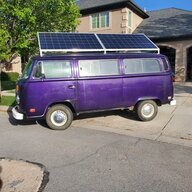
I looked high an low for a off the shelf product to charge my traction pack from my 550 W on my bus project. I ended up with a MPPT solar controller to charge a 5.3 kWh 24 VDC battery and then I use a AC/DC inverter to charge the traction pack. This is not very efficient and I will probably wear out my battery but I can run a table saw from my bus. I can get about 6 miles per day solar miles and have decent back up power a home now. (that is how I justified wasting the money :))

I would love to automate the dumping of power such that I bleed the intermediate battery down to 50% at night, and dump from 90% to 50% a couple times during the day. Anybody have ideas?
 
OP
OP
Tinker71

Tinker71

Well-known member
First Name
Ray
Joined
Aug 8, 2020
Threads
93
Messages
1,610
Reaction score
2,102
Location
Utah
Vehicles
1976 VW EV bus, 2007 Sienna, Tesla M3, Cancelled CT2 rez - holding for $65k
Occupation
Project Manager
Country flag
I am (or was) but that doesn't mean your thought is without merit. I too thought of the existing charger (or at least it's basic architecture) as the solution. Of course we could both be completely off base here.
My 2500W Elcon charger runs puts out either ~1500W or 2500W depending on which plug I am using. If only feed it 120VAC from a mircro inverter it is will see only 400W or so. Would it work? Telsa would have a greater problem since their charger is much more powerful and therefore a larger range. I thought I saw somewhere that it might be up to 11kW.

I think the other problem that Crissa mentioned is the variability of the power from the panels. They fluctuate between 50 and 440 W during the day for many reasons. My friend recommended some capacitors to smooth things out but this is beyond me. I am just a hack after all so I used a battery to smooth things out per my other response.
 

ajdelange

Well-known member
First Name
A. J.
Joined
Dec 8, 2019
Threads
4
Messages
3,203
Reaction score
3,409
Location
Virginia/Quebec
Vehicles
Tesla X LR+, Lexus SUV, Toyota SR5, Toyota Landcruiser
Occupation
EE (Retired)
Country flag
Clearly the way to increase efficiency is to eliminate the intermediate battery and its attendant inverter/rectifier. As before I would think in terms of the Tesla architecture which looks like this

PV ---> DC/DC(MPPT) ---> Inverter --> Transformer --> Rectifier --> Battery

Feedback would be from the battery to the inverter which is the voltage regulation point. If the battery needs to be charged (as sensed by its voltage) a command is sent to the inverter to increase voltage until current flows into the battery (or connected load). If the inverter can't produce enough voltage to do that (because the sun is in) then the battery discharges. You'd have to do some systems and electronic engineering to put this together and program an Arduino or something like to manage it.

The transformer is sort of optional. It does provided isolation (which is probably a good idea) and can, as mentioned in my earlier post, be used for voltage step up or step down if convenient.

An off the shelf solution is something like a Powerwall system. All the systems engineering is done for you. When the sun shines it charges up. When the sun doesn't it runs the premises. The BEV is just another load that you plug into the system bus (in the electrical meaning of the word). This is probably not of interest as I think you want to put something together yourself. And Powerwalls are expensive and you can't get them even if you can stand the cost.
 
Last edited:


ajdelange

Well-known member
First Name
A. J.
Joined
Dec 8, 2019
Threads
4
Messages
3,203
Reaction score
3,409
Location
Virginia/Quebec
Vehicles
Tesla X LR+, Lexus SUV, Toyota SR5, Toyota Landcruiser
Occupation
EE (Retired)
Country flag
My 2500W Elcon charger runs puts out either ~1500W or 2500W depending on which plug I am using. If only feed it 120VAC from a mircro inverter it is will see only 400W or so. Would it work? Telsa would have a greater problem since their charger is much more powerful and therefore a larger range.
I'm a little hazy at this point on what it is you are trying to do. It appears the Elcon charger is designed for direct connection to a battery to charge it from an A/C supply. You will have no direct access to the Tesla battery. If you want to charge a Tesla battery from solar you must have a buffering system (such as a Powerwall or Enphase...) between the PV array and the vehicle. It requires stable 120 or, preferably, 240VAC to charge. The Tesla chargers are capable of up to 11.53 kW but can accept as little as 600W. You will, of course, be charging til Michaelmass at that latter rate. The answer to the question "Can I charge a Tesla from an PV array without a buffering system?" is "No". Can you use an Elcon charger using a microinverter as an A/C source to charge a buffering battery, connect that to an inverter and use the inverter to charge a Tesla? Yes, you can. But 500 W isn't going to do it very fast. If you have 7 hours full sun equivalent per day you are collecting 3500 Wh per day. Calling each conversion (micro inverter, Elco, battery in, battery out, inverter, Tesla charger) 90% efficient the efficiency of the chain will be but 0.9^6 = 0.531441 (53%) and you will deliver less than 2 kWh (good for about 4 mi) to the truck.


I think the other problem that Crissa mentioned is the variability of the power from the panels. They fluctuate between 50 and 440 W during the day for many reasons. My friend recommended some capacitors to smooth things out but this is beyond me. I am just a hack after all so I used a battery to smooth things out per my other response.
Caps (even super caps) won't do the job as they don't hold enough energy. You do indeed need a battery.
 
OP
OP
Tinker71

Tinker71

Well-known member
First Name
Ray
Joined
Aug 8, 2020
Threads
93
Messages
1,610
Reaction score
2,102
Location
Utah
Vehicles
1976 VW EV bus, 2007 Sienna, Tesla M3, Cancelled CT2 rez - holding for $65k
Occupation
Project Manager
Country flag
Clearly the way to increase efficiency is to eliminate the intermediate battery and its attendant inverter/rectifier. As before I would think in terms of the Tesla architecture which looks like this

PV ---> DC/DC(MPPT) ---> Inverter --> Transformer --> Rectifier --> Battery

Feedback would be from the battery to the inverter which is the voltage regulation point. If the battery needs to be charged (as sensed by its voltage) a command is sent to the inverter to increase voltage until current flows into the battery (or connected load). If the inverter can't produce enough voltage to do that (because the sun is in) then the battery discharges. You'd have to do some systems and electronic engineering to put this together and program an Arduino or something like to manage it.

The transformer is sort of optional. It does provided isolation (which is probably a good idea) and can, as mentioned in my earlier post, be used for voltage step uo or step down if convenient.

An off the shelf solution is something like a Powerwall system. All the systems engineering is done for you. When the sun shines it charges up. When the sun doesn't it runs the premises. The BEV is just another load that you plug into the system bus (in the electrical meaning of the word). This is probably not of interest as I think you want to put something together yourself. And Powerwalls are expensive and you can't get them even if you can stand the cost.
Thank you, I appreciate your efforts to educate me and others on the forum. My PV-MPPT-Battery-inverter-charger-battery on my EV Bus works ok. Great for emergency power or running a blender at a close to home tailgate party. Getting 6 miles of solar range is a pain in the _ss. To much to worry about. But I do have that option.

I am installing a switch to isolate my panels this morning so I don't run my battery to 100% charge all the time. I probably won't bother dumping to the traction pack unless I don't have access to a wall charger.

I will definitely reference this post if decide to take it further, so again thanks.
 
OP
OP
Tinker71

Tinker71

Well-known member
First Name
Ray
Joined
Aug 8, 2020
Threads
93
Messages
1,610
Reaction score
2,102
Location
Utah
Vehicles
1976 VW EV bus, 2007 Sienna, Tesla M3, Cancelled CT2 rez - holding for $65k
Occupation
Project Manager
Country flag
I'm a little hazy at this point on what it is you are trying to do. It appears the Elcon charger is designed for direct connection to a battery to charge it from an A/C supply. You will have no direct access to the Tesla battery. If you want to charge a Tesla battery from solar you must have a buffering system (such as a Powerwall or Enphase...) between the PV array and the vehicle. It requires stable 120 or, preferably, 240VAC to charge. The Tesla chargers are capable of up to 11.53 kW but can accept as little as 600W. You will, of course, be charging til Michaelmass at that latter rate. The answer to the question "Can I charge a Tesla from an PV array without a buffering system?" is "No". Can you use an Elcon charger using a microinverter as an A/C source to charge a buffering battery, connect that to an inverter and use the inverter to charge a Tesla? Yes, you can. But 500 W isn't going to do it very fast. If you have 7 hours full sun equivalent per day you are collecting 3500 Wh per day. Calling each conversion (micro inverter, Elco, battery in, battery out, inverter, Tesla charger) 90% efficient the efficiency of the chain will be but 0.9^6 = 0.531441 (53%) and you will deliver less than 2 kWh (good for about 4 mi) to the truck.


Caps (even super caps) won't do the job as they don't hold enough energy. You do indeed need a battery.
Sorry my post was probably a little confusing mixing my hack project with Tesla's well packaged solution.

You are spot on with my losses. I get about 6 miles per day (but I try to stay off the highway) Currently my panels are held to my rack with clamps until I fine tune my tilt mechanism.

I do think there is a lot of opportunity for slow and steady energy collection.

It is a hobby project and definite money pit, I get a lot of compliments out driving because it is a classic VW and the EV solar aspect, so it is still fun. Maybe it gets people thinking a little bit more about the EV revolution.

I can't wait for the real deal and don't worry I won't be hacking Tesla. If have fried enough stuff as it is :).
 

Crissa

Well-known member
First Name
Crissa
Joined
Jul 8, 2020
Threads
138
Messages
19,571
Reaction score
31,475
Location
Santa Cruz
Vehicles
2014 Zero S, 2013 Mazda 3
Country flag
I looked high an low for a off the shelf product to charge my traction pack from my 550 W on my bus project. I ended up with a MPPT solar controller to charge a 5.3 kWh 24 VDC battery and then I use a AC/DC inverter to charge the traction pack. This is not very efficient and I will probably wear out my battery but I can run a table saw from my bus. I can get about 6 miles per day solar miles and have decent back up power a home now. (that is how I justified wasting the money :))

I would love to automate the dumping of power such that I bleed the intermediate battery down to 50% at night, and dump from 90% to 50% a couple times during the day. Anybody have ideas?
Yeah, there is not currently an off the shelf product. Every traction battery pack has a different target voltage and charge curve.

But skipping all those conversions and being able to grab energy from the long tail would be far, far more efficient!

Tesla wouldn't be limited to off the shelf products.

-Crissa
Sponsored


Top