Sponsored
CyberBeast Cybertruck Suspension Deep Dive and RTI Test | Car and Driver
Bill837
Well-known member
- First Name
- Bill
- Joined
- Sep 21, 2023
- Threads
- 5
- Messages
- 264
- Reaction score
- 541
- Location
- Southern Maryland
- Vehicles
- 2020 Z4, 2015 Cherokee Trailhawk, 2008 R1200RT
- Occupation
- Aviation Weapons/Systems

No jack stand, wiping his fingers over the rotor? And wouldn't you check you pressures on the display? I mean maybe you dont trust the sensors, but I've had vehicles with these since 2006 and I dont think I ever seen one off.


JBee
Well-known member
- First Name
- JB
- Joined
- Nov 22, 2019
- Threads
- 18
- Messages
- 4,913
- Reaction score
- 6,362
- Location
- Australia
- Vehicles
- Cybertruck
- Occupation
- . Professional Hobbyist

Checking pressures doesn't put air in the tyres though? So you have to remove the caps for that.No jack stand, wiping his fingers over the rotor? And wouldn't you check you pressures on the display? I mean maybe you dont trust the sensors, but I've had vehicles with these since 2006 and I dont think I ever seen one off.
JBee
Well-known member
- First Name
- JB
- Joined
- Nov 22, 2019
- Threads
- 18
- Messages
- 4,913
- Reaction score
- 6,362
- Location
- Australia
- Vehicles
- Cybertruck
- Occupation
- . Professional Hobbyist
Great Video! Exactly what I wanted to see and from the guy I wanted to see it from as well!

To me this officially confirms my concerns and reasons with the off-road capability of the Cybertruck setup, that I have presented on various threads here on the forum.
There are two main components here that are acting against the full articulation and best possible traction by putting downforce on each tyre here:
1) The airbag suspension is NOT crosslinked to other airbags, either actively or passively.
This means that each airbag tries to maintain it's own air volume whilst being compressed by the suspension travel, and also that air volume in the drooping suspension arm is not increased. This means that the compressed airbag has more downforce (big red arrows) and more traction (big green arrows) and therefore the drooping airbag less downforce 9small red arrows) and traction (small green arrows) on the tyre, because it is not being pushed down very much in comparison. Essentially the CT is teeter tottering on the two highest suspension wheels.
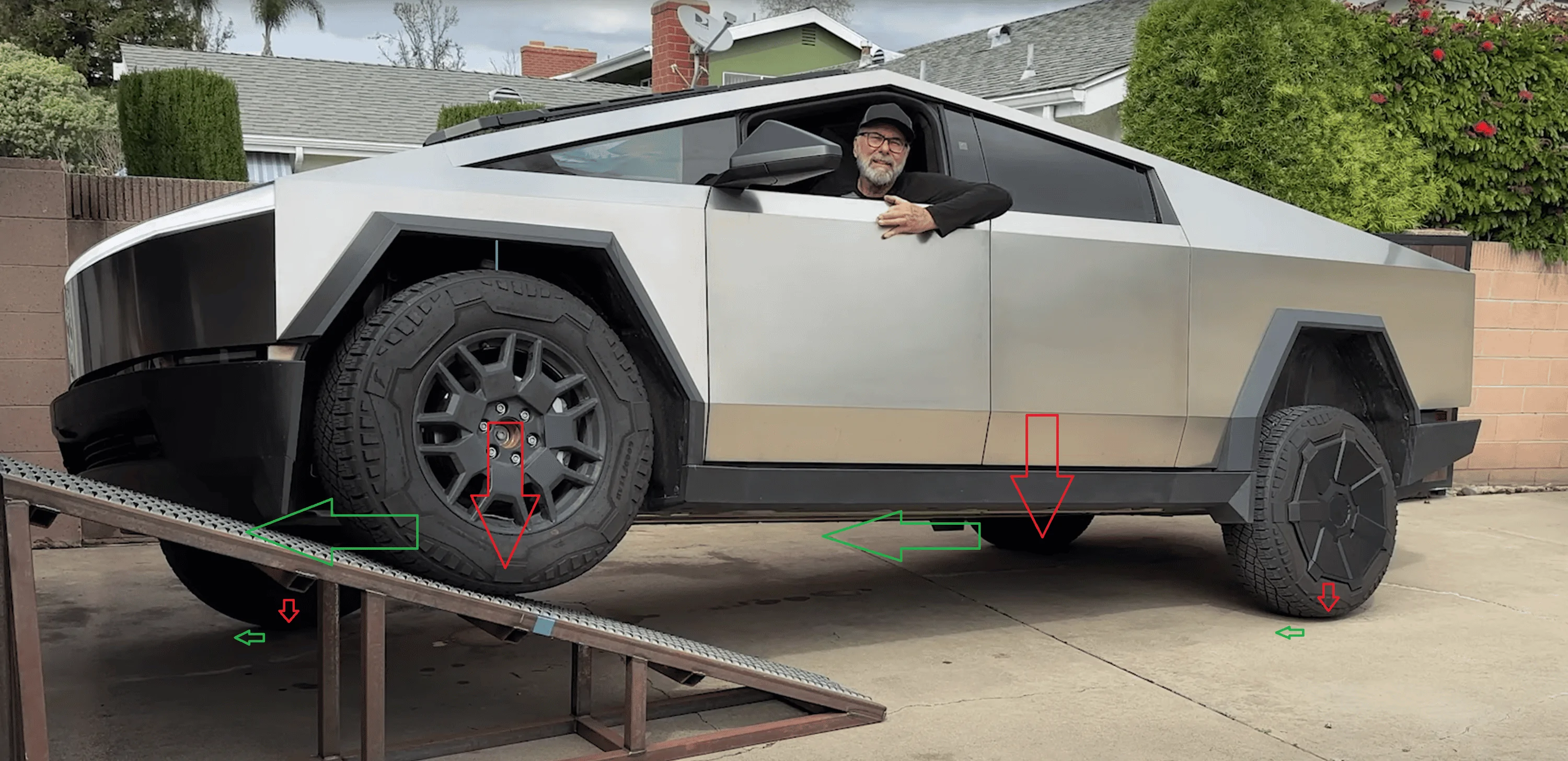
This is not good for overall traction, as ideally you want as much traction on each wheel, which means you will have better forwards motive force overall, which will make it less likely for a single wheel to break traction or dig into a soft surface, that then requires traction control intervention. Diff locks would help here, with the AWD being expected to perform better seeing it has a rear wheel diff lock.
Simply off-road you want the most amount of downforce on each wheel, by distributing the vehicle mass as best possible to each wheel, like it is when it is on a flat road.
A cross linked suspension can do this by simply feeding air from the high side to a low side. There are many off-road, mostly European, SUVs that have this already since decades. Technically, with the help of the suspension position sensors and ideally a 6axis accelerometer/gyro (if the CT has one onboard) you could probably do this with a OTA and some code to ensure the high side doesn't bottom out the vehicle.
As per the video above, the default lowest off-road height setting inflates the airbags up resulting in higher clearance. But this is also means each airbag has more air in it, making it harder to compress when the suspension articulates, which means traction is lost on the drooping suspension wheels.
I mentioned this on numerous occasions, when the first off-road videos were presented as the CT always looked much to stiff and bouncy, when climbing undulating hills and lost traction on every bump with spinning wheels. You don't need traction control nearly as much when the wheels stay planted on the ground, and you lose less forwards momentum, which in turn means more effort is required by the wheels to keep you going.
Having the suspension on high simply reduces traction because of the airbag pressure. The only time it should be high is if it needs underfloor clearance. Hence the need for an active crosslink system as described above, which would resolve all of these issues, and let the CT breeze through any undulating terrain up until it's physical suspension stops, unaffected by airbag pressure pre-sets.
2) The Front and rear stabiliser bars are inhibiting the front and rear articulation as well. The stabiliser bars are there to reduce body roll, which means they limit the suspension from one side travelling more than the other side of the vehicle. This is done by twisting the tube of the roll bar that connects the two sides together, over the small control arms highlighted in the video.
Seeing the rear one is smaller diameter, it will reduce the articulation less, but for full articulation both of these need to be either disengaged, or have a KDSS hydraulic setup, which would make them completely free from the stabiliser bar. There is a manual aftermarket option to release these links for this already, which require you to engage/disengage them by getting out of the vehicle and manipulating them by hand. Rivian also uses automatic version of these and scores much better accordingly.
A KDSS system would not only mean much better offroad performance from better articulation and therefore traction as explained above, but will also allow the CT to have even less body roll in corners and will improve suspension comfort overall, especially for bumpy roads and off road use where the stabiliser bars interfere.
For reference this is the comparative difference detaching the stabiliser bars has on wheel articulation with a passenger Subaru, that do surprisingly well off-road: (disconnected is at 4:48)
Hope this further highlights the importance of wheel articulation and how it benefits traction and off-road use.
Last edited:
Saygmo
Well-known member
- First Name
- Sas
- Joined
- Dec 28, 2023
- Threads
- 2
- Messages
- 83
- Reaction score
- 134
- Location
- Norcql
- Vehicles
- Model 3 awd
Hmmm. Want to see the rut with swaybars disconnected and see how much better it is. There’s also a reason off-roaders don’t generally run air suspension. Wondering if Tesla doesn’t implement it, if the aftermarket could come to the aid with a selectable valve to add to the air tank outlets, allowing us to cross link diagonal front to rear on command when off-road. Given that this isn’t exactly a rock crawler, it would potentially make a huge difference.
CarMan ElecTruck
Well-known member
- Joined
- Feb 13, 2024
- Threads
- 4
- Messages
- 794
- Reaction score
- 886
- Location
- Other Earth
- Vehicles
- LeftFoot RightFoot
I do love the CyberTruck, but the results shown here may sway my ..
I do like to camp and cruise in the trails..
Also interesting where the company who makes ‘Trucks’ ended up… all comes down to which aspects and capabilities takes priority for the project…
I do like to camp and cruise in the trails..
Also interesting where the company who makes ‘Trucks’ ended up… all comes down to which aspects and capabilities takes priority for the project…
Bartman
Well-known member
- First Name
- Bart
- Joined
- Dec 19, 2023
- Threads
- 3
- Messages
- 232
- Reaction score
- 364
- Location
- Ponte Vedra Beach, Florida
- Vehicles
- Model 3, Model Y
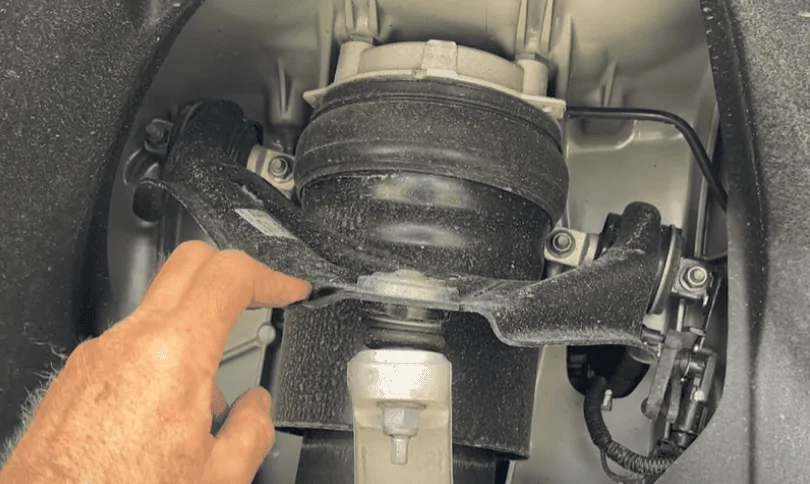
It looks weak, yes. Hope they improve that. The best part is a part that won't fail.Is it just me or does the upper control arm look really thin?


ideaXfactory
Well-known member
He knows his stuff, enjoyed watching the video...
Can't brake and have foot on accelerator at the same time? Didn't know that. Seems that's a technique that should be allowed by software for off-road...
Can't brake and have foot on accelerator at the same time? Didn't know that. Seems that's a technique that should be allowed by software for off-road...
JBee
Well-known member
- First Name
- JB
- Joined
- Nov 22, 2019
- Threads
- 18
- Messages
- 4,913
- Reaction score
- 6,362
- Location
- Australia
- Vehicles
- Cybertruck
- Occupation
- . Professional Hobbyist
Also for onroad it gives you warnings if you two pedal drive in MYP/M3P which isn't helpful on the track.He knows his stuff, enjoyed watching the video...
Can't brake and have foot on accelerator at the same time? Didn't know that. Seems that's a technique that should be allowed by software for off-road...
There should be a crawl mode throttle map to emulate low range. Ideally a force feedback accelerator pedal would be cool, that would give you more resistance to keep you in the sweet spot for traction control and hill decent. Could also be used so you can feel when its coasting, regen braking or accelerating. You could then set a eco throttle map and can feel exactly how much power you are adding or not.
surflkwa
Member
- First Name
- Stephen
- Joined
- Aug 30, 2023
- Threads
- 0
- Messages
- 11
- Reaction score
- 24
- Location
- Seattle
- Vehicles
- Ford F-150, Range Rover, Cyberbeast configured 1/2
- Occupation
- Real Estate Developer
Do we know there isn't a cross-link system? Maybe it's in a software update with lockers?? I have a Land Rover LR3 with amazing air suspension. Off-road articulation is pretty good for full independent suspension. When in off-road modes it allows the cross link system to work. It all happens through the air valve blocks. It will allow air from the tire lifting up to pass to the other side pressing it down. Best of both worlds with an amazing highway ride and decent off-road.
Bill837
Well-known member
- First Name
- Bill
- Joined
- Sep 21, 2023
- Threads
- 5
- Messages
- 264
- Reaction score
- 541
- Location
- Southern Maryland
- Vehicles
- 2020 Z4, 2015 Cherokee Trailhawk, 2008 R1200RT
- Occupation
- Aviation Weapons/Systems
Tis true, but he specifically mentioned "If you want to check your tire pressure" is why I said that. Unless you are airing down or up for off roading, you dont really need to add or remove air all that often. Not that I would be using caps anyway, I dont like the look of them.Checking pressures doesn't put air in the tyres though? So you have to remove the caps for that.
SentinelOne
Well-known member
- First Name
- Jason
- Joined
- Dec 18, 2019
- Threads
- 48
- Messages
- 1,434
- Reaction score
- 1,860
- Location
- Colorado
- Vehicles
- See Sig
- Occupation
- IT
Rock Mode Cross links according to the manualGreat Video! Exactly what I wanted to see and from the guy I wanted to see it from as well!
To me this officially confirms my concerns and reasons with the off-road capability of the Cybertruck setup, that I have presented on various threads here on the forum.
There are two main components here that are acting against the full articulation and best possible traction by putting downforce on each tyre here:
1) The airbag suspension is NOT crosslinked to other airbags, either actively or passively.
This means that each airbag tries to maintain it's own air volume whilst being compressed by the suspension travel, and also that air volume in the drooping suspension arm is not increased. This means that the compressed airbag has more downforce (big red arrows) and more traction (big green arrows) and therefore the drooping airbag less downforce 9small red arrows) and traction (small green arrows) on the tyre, because it is not being pushed down very much in comparison. Essentially the CT is teeter tottering on the two highest suspension wheels.

This is not good for overall traction, as ideally you want as much traction on each wheel, which means you will have better forwards motive force overall, which will make it less likely for a single wheel to break traction or dig into a soft surface, that then requires traction control intervention. Diff locks would help here, with the AWD being expected to perform better seeing it has a rear wheel diff lock.
Simply off-road you want the most amount of downforce on each wheel, by distributing the vehicle mass as best possible to each wheel, like it is when it is on a flat road.
A cross linked suspension can do this by simply feeding air from the high side to a low side. There are many off-road, mostly European, SUVs that have this already since decades. Technically, with the help of the suspension position sensors and ideally a 6axis accelerometer/gyro (if the CT has one onboard) you could probably do this with a OTA and some code to ensure the high side doesn't bottom out the vehicle.
As per the video above, the default lowest off-road height setting inflates the airbags up resulting in higher clearance. But this is also means each airbag has more air in it, making it harder to compress when the suspension articulates, which means traction is lost on the drooping suspension wheels.
I mentioned this on numerous occasions, when the first off-road videos were presented as the CT always looked much to stiff and bouncy, when climbing undulating hills and lost traction on every bump with spinning wheels. You don't need traction control nearly as much when the wheels stay planted on the ground, and you lose less forwards momentum, which in turn means more effort is required by the wheels to keep you going.
Having the suspension on high simply reduces traction because of the airbag pressure. The only time it should be high is if it needs underfloor clearance. Hence the need for an active crosslink system as described above, which would resolve all of these issues, and let the CT breeze through any undulating terrain up until it's physical suspension stops, unaffected by airbag pressure pre-sets.
2) The Front and rear stabiliser bars are inhibiting the front and rear articulation as well. The stabiliser bars are there to reduce body roll, which means they limit the suspension from one side travelling more than the other side of the vehicle. This is done by twisting the tube of the roll bar that connects the two sides together, over the small control arms highlighted in the video.
Seeing the rear one is smaller diameter, it will reduce the articulation less, but for full articulation both of these need to be either disengaged, or have a KDSS hydraulic setup, which would make them completely free from the stabiliser bar. There is a manual aftermarket option to release these links for this already, which require you to engage/disengage them by getting out of the vehicle and manipulating them by hand. Rivian also uses automatic version of these and scores much better accordingly.
A KDSS system would not only mean much better offroad performance from better articulation and therefore traction as explained above, but will also allow the CT to have even less body roll in corners and will improve suspension comfort overall, especially for bumpy roads and off road use where the stabiliser bars interfere.
For reference this is the comparative difference detaching the stabiliser bars has on wheel articulation with a passenger Subaru, that do surprisingly well off-road: (disconnected is at 4:48)
Hope this further highlights the importance of wheel articulation and how it benefits traction and off-road use.
Tightly manages tire slip to maximize grip in rock crawl conditions and sets the Preferred Ride Height to Very High. When the ride height is Very High, the suspension system pneumatically connects the springs on the front and rear axles, increasing suspension articulation for maximum traction.
But he may not have been in Very High / Rock Crawl mode - guessing most don't know this and arent when they're shooting vids.
Hoping the cross link is legit and I plan on getting disconnects for the swaybars!
Sponsored
Similar threads

- Replies
- 0
- Views
- 2,049
- Replies
- 0
- Views
- 1,320
- Replies
- 14
- Views
- 1,158

- Replies
- 14
- Views
- 2,172
