

Sponsored

Let's Talk Exterior Ramps, but first: Vault Load Height in Squat (or Kneel) Mode

wtibbit

Well-known member
First Name
Wayne
Joined
Aug 27, 2020
Threads
12
Messages
819
Reaction score
1,617
Location
DFW
Vehicles
Cybertruck AWD FS, Mercedes sedan, Corvette coupe, 1968 Cougar XR-7
Occupation
Retired Engineering Program Director
Country flag
I'll be regularly hauling equipment that will fill most of the vault volume with items weighing as much as 130 pounds. Most of the heavy items are on casters are will be moved with a two wheel dolly. It would be most helpful if I could use a ramp (or ramps) to get this gear in the vault with minimal lifting.

My question is, "How long must the ramp be to work effectively?"

To answer that question I need to know the Load Height of the vault; the height from the road surface to the rear-most surface of the lowered tailgate.

I tried to answer that question with some estimated dimensions of the truck and estimates of the bed/tailgate height at various estimated ride height settings.
Here are the estimated values:
Wheel base: 142"
Rear overhang (horizontal distance from rear axle to tailgate hinge): 47"
Tailgate length when lowered: 24"
Lowered Tailgate height (Load Height) with both axles at the middle of the variable ride height setting range: 34"
Variable height range: 8"

My first calculation object was to obtain the difference between two Load Heights; one when the truck's ride height is at the middle of the adjustment range for both axles and another with the truck squatting with the rear axle at the minimum of the height adjustment range and the front axle at the maximum. Let's call that difference the Squat Advantage, or SA.

Using simple trigonometry, I arrived at 8.02" for SA if the total range of both axles is 8". So, minimizing the rear height and maximizing the front happens to make the end of the lowered tailgate about 8" closer to the road surface, resulting in a load height of 26" (using my dimension estimates).

If I want the ramp angle to be less than 20Âş at that load height, the ramp must be about 7' long. A 7' ramp will provide an 18Âş ramp angle.
To fit in the vault it would have to fold, and folded could fit stowed under the overhang or on the inside of the tailgate, or along the length of the vault. Here is one example of a folding 7' aluminum ramp with a solid floor that I would require: https://www.northerntool.com/produc...y-ramp-800-lb-capacity-7ft-l-x-30in-w-3303085

You math wizards (or Whizards) out there, please check my math. If anyone sees dimension estimates that are off, provide better ones.
Sponsored
 

Petertsai

Well-known member
First Name
Peter
Joined
Oct 16, 2022
Threads
0
Messages
112
Reaction score
90
Location
44 Indian Clover Drive, 77381
Vehicles
Tesla S, cybertruck reservation
Occupation
Engineer
Country flag
How about a lift that can be attached to hitch? I can think of a design that can work and be removable.
 
OP
OP
wtibbit

wtibbit

Well-known member
First Name
Wayne
Joined
Aug 27, 2020
Threads
12
Messages
819
Reaction score
1,617
Location
DFW
Vehicles
Cybertruck AWD FS, Mercedes sedan, Corvette coupe, 1968 Cougar XR-7
Occupation
Retired Engineering Program Director
Country flag

TyPope

Well-known member
First Name
Ty
Joined
Mar 31, 2020
Threads
33
Messages
3,249
Reaction score
4,980
Location
Chesapeake Beach, MD
Vehicles
'23 MYLR, FS Cyberbeast 280xx
Occupation
Current Operations for... an organization
Country flag
I'll be regularly hauling equipment that will fill most of the vault volume with items weighing as much as 130 pounds. Most of the heavy items are on casters are will be moved with a two wheel dolly. It would be most helpful if I could use a ramp (or ramps) to get this gear in the vault with minimal lifting.

My question is, "How long must the ramp be to work effectively?"

To answer that question I need to know the Load Height of the vault; the height from the road surface to the rear-most surface of the lowered tailgate.

I tried to answer that question with some estimated dimensions of the truck and estimates of the bed/tailgate height at various estimated ride height settings.
Here are the estimated values:
Wheel base: 142"
Rear overhang (horizontal distance from rear axle to tailgate hinge): 47"
Tailgate length when lowered: 24"
Lowered Tailgate height (Load Height) with both axles at the middle of the variable ride height setting range: 34"
Variable height range: 8"

My first calculation object was to obtain the difference between two Load Heights; one when the truck's ride height is at the middle of the adjustment range for both axles and another with the truck squatting with the rear axle at the minimum of the height adjustment range and the front axle at the maximum. Let's call that difference the Squat Advantage, or SA.

Using simple trigonometry, I arrived at 8.02" for SA if the total range of both axles is 8". So, minimizing the rear height and maximizing the front happens to make the end of the lowered tailgate about 8" closer to the road surface, resulting in a load height of 26" (using my dimension estimates).

If I want the ramp angle to be less than 20Âş at that load height, the ramp must be about 7' long. A 7' ramp will provide an 18Âş ramp angle.
To fit in the vault it would have to fold, and folded could fit stowed under the overhang or on the inside of the tailgate, or along the length of the vault. Here is one example of a folding 7' aluminum ramp with a solid floor that I would require: https://www.northerntool.com/produc...y-ramp-800-lb-capacity-7ft-l-x-30in-w-3303085

You math wizards (or Whizards) out there, please check my math. If anyone sees dimension estimates that are off, provide better ones.
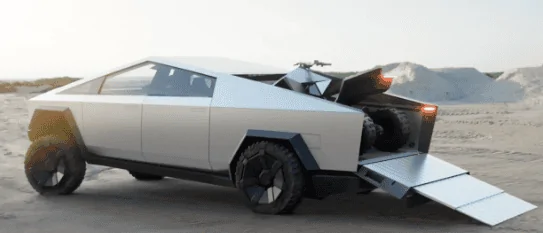
It gets a little more complicated when you realize that the truck can squat the rear.
I believe the ramp calculation needs to go from the extended tailgate to the ground. The tailgate, when the truck is squated in the rear will be lower than the lowest setting on the suspension. We know the tire size and thus the position of the axle. It appears the tailgate is just below the halfway point of the 35" tires. With the tailgate only opening to horizontal, it would still be about at the halfway point. That means tailgate to ground should be about 17 1/2".

Tesla Cybertruck Let's Talk Exterior Ramps, but first: Vault Load Height in Squat (or Kneel) Mode 1696964563693

I'll be regularly hauling equipment that will fill most of the vault volume with items weighing as much as 130 pounds. Most of the heavy items are on casters are will be moved with a two wheel dolly. It would be most helpful if I could use a ramp (or ramps) to get this gear in the vault with minimal lifting.

My question is, "How long must the ramp be to work effectively?"

To answer that question I need to know the Load Height of the vault; the height from the road surface to the rear-most surface of the lowered tailgate.

I tried to answer that question with some estimated dimensions of the truck and estimates of the bed/tailgate height at various estimated ride height settings.
Here are the estimated values:
Wheel base: 142"
Rear overhang (horizontal distance from rear axle to tailgate hinge): 47"
Tailgate length when lowered: 24"
Lowered Tailgate height (Load Height) with both axles at the middle of the variable ride height setting range: 34"
Variable height range: 8"

My first calculation object was to obtain the difference between two Load Heights; one when the truck's ride height is at the middle of the adjustment range for both axles and another with the truck squatting with the rear axle at the minimum of the height adjustment range and the front axle at the maximum. Let's call that difference the Squat Advantage, or SA.

Using simple trigonometry, I arrived at 8.02" for SA if the total range of both axles is 8". So, minimizing the rear height and maximizing the front happens to make the end of the lowered tailgate about 8" closer to the road surface, resulting in a load height of 26" (using my dimension estimates).

If I want the ramp angle to be less than 20Âş at that load height, the ramp must be about 7' long. A 7' ramp will provide an 18Âş ramp angle.
To fit in the vault it would have to fold, and folded could fit stowed under the overhang or on the inside of the tailgate, or along the length of the vault. Here is one example of a folding 7' aluminum ramp with a solid floor that I would require: https://www.northerntool.com/produc...y-ramp-800-lb-capacity-7ft-l-x-30in-w-3303085

You math wizards (or Whizards) out there, please check my math. If anyone sees dimension estimates that are off, provide better ones.
Don't forget that when you squat the rear, you impart a 2.6Âş angle on the tailgate making it 1.06" closer to the ground and that much easier to obtain your 20Âş breakover angle. You'll need 43" of ramp to reach the ground 16.5" down (1/2 tire height - the 1" lower that the tailgate will be at it's end) at an overall angle less than 20Âş.

If the tailgate is 24" tall, you'd think you could get two ramp panels in there to slide out to a total of 43" thus ensuring you have less than 20Âş of breakover angle. That doesn't seem too impossible.

And THAT is assuming the tailgate does not extend beyond parallel to the bed. If it were to go down an additional 5Âş, the ramp would only have to be 36" total.
 

Petertsai

Well-known member
First Name
Peter
Joined
Oct 16, 2022
Threads
0
Messages
112
Reaction score
90
Location
44 Indian Clover Drive, 77381
Vehicles
Tesla S, cybertruck reservation
Occupation
Engineer
Country flag
Part of the design is good, part is not. The platform can tilt as it goes up. The bracing feet will be hard to disengage when load is lifted onto truck bed. The truck suspension will drop and push down on the feet, making them hard to unpin and move out of the way.


OP
OP
wtibbit

wtibbit

Well-known member
First Name
Wayne
Joined
Aug 27, 2020
Threads
12
Messages
819
Reaction score
1,617
Location
DFW
Vehicles
Cybertruck AWD FS, Mercedes sedan, Corvette coupe, 1968 Cougar XR-7
Occupation
Retired Engineering Program Director
Country flag
The ramp slope is pretty steep, but the bed slope is only about 3.25 degrees with the truck fully lowered in the back and raised in the front, assuming an 8 inch height range. That’s enough to cause an item on casters or wheels to roll back, but wouldn’t need much to chock them in place. I don’t think I’d need a wench for my gear, but if I do it would be to pull the load up the ramp.
 
OP
OP
wtibbit

wtibbit

Well-known member
First Name
Wayne
Joined
Aug 27, 2020
Threads
12
Messages
819
Reaction score
1,617
Location
DFW
Vehicles
Cybertruck AWD FS, Mercedes sedan, Corvette coupe, 1968 Cougar XR-7
Occupation
Retired Engineering Program Director
Country flag
It gets a little more complicated when you realize that the truck can squat the rear.
I believe the ramp calculation needs to go from the extended tailgate to the ground. The tailgate, when the truck is squated in the rear will be lower than the lowest setting on the suspension. We know the tire size and thus the position of the axle. It appears the tailgate is just below the halfway point of the 35" tires. With the tailgate only opening to horizontal, it would still be about at the halfway point. That means tailgate to ground should be about 17 1/2".

1696964563693.png


Don't forget that when you squat the rear, you impart a 2.6Âş angle on the tailgate making it 1.06" closer to the ground and that much easier to obtain your 20Âş breakover angle. You'll need 43" of ramp to reach the ground 16.5" down (1/2 tire height - the 1" lower that the tailgate will be at it's end) at an overall angle less than 20Âş.

If the tailgate is 24" tall, you'd think you could get two ramp panels in there to slide out to a total of 43" thus ensuring you have less than 20Âş of breakover angle. That doesn't seem too impossible.

And THAT is assuming the tailgate does not extend beyond parallel to the bed. If it were to go down an additional 5Âş, the ramp would only have to be 36" total.
I did include the squat function, using an 8 inch difference between The height of the front and rear axles. With a 142 wheelbase that results in a 3.223 degree bed angle. The other results, particularly the height of the tailgate lip from the ground, depends on estimates of the bed height at minimum lift, the lift range, rear overhang, tailgate length and so on.
Sponsored


Top