
Sponsored

HaulingAss

Well-known member
Joined
Oct 3, 2020
Threads
28
Messages
10,426
Reaction score
20,966
Location
Western Washington, USA
Vehicles
Cybertruck DM, 2010 F-150, 2018 Performance Model 3, 2024 Performance Model 3
Country flag
I think you are confusing the issue a little that Bill906 was trying to clarify and that several of us replied to.


....and Tim agrees.


The black part is the fender flare. The silver part is the fender/body.

If the fender flare (or even just the charge port door that resides on, or as part of, the fender flare) is torn off, the charge port is now exposed to the outside elements. I would prefer to minimize the chances of the charge port being exposed. Since I think the odds of damage coming to the fender flare are higher than the odds of damage coming to the fender/body, I think it's bad placement. I would prefer the charge port and it's associated door be placed on the truck in a non-protruding place unlikey to take damage, so that that the charge port "nestled inside the body" is less likely to be exposed.
I think anyone concerned about the charge port being exposed to the elements doesn't understand the design parameters of a charge port. It's not a sensitive item. Yes, you don't want to get dirt and mud inside the connectors but that's what the charge port door is for! If you tear off the charge port door, you fix it. If you are in a muddy area before you can replace the door, just put some duct tape or gaffer's tape over it to keep the mud out. Most Cybertruck owners could go a few lifetimes without ever tearing off that charge port door and the charge port is not normally electrically hot, and it doesn't become "hot" until it recieves the proper communication signal from a charge cable that is properly plugged in and ready to go. A lot of people are afraid of electricity because they don't understand how things work and what the design considerations and safety features built into the product are.

My F-150 came without a gas cap, as I believe all modern F-150's do. The little spring-loaded cover that blocks the fuel filler hole is not waterproof. Water or dirt in the gas is a much bigger problem than mud in the charge port (you can just hose the mud out). On a Tesla charge port, the metal contacts are corrosion resistant, and the port is designed with the idea that water is going in there when charging in stormy weather. I've had my Model 3 parked outside for 4 years, plugged in through many feet of fresh wet snow melting into the port, downpours getting blown in while charging, wet leaves, freezing rain, etc. all without noticing a single charging glitch or problem. There are drains on the bottom of the port to let water out and all kinds of safety considerations built in, it works really well, even when actively charging in a downpour with high winds.

I feel like there is a large contingency of people here who just love to criticise everything Tesla does as if they are the only ones who understand the necessary design considerations and Tesla engineers are inexperienced engineers that don't have a clue. When, in reality, the peanut gallery usually only knows a fraction of the considerations that apply to their particular criticism and Tesla is quickly becoming, if not all ready, the most skilled automaker that has ever existed in the history of mankind.

Nobody likes a backseat driver and when they don't have a clue what they are talking about it just makes it that much worse.
Sponsored

 

SpaceYooper

Well-known member
Joined
May 23, 2020
Threads
46
Messages
841
Reaction score
1,500
Location
Colorado Springs
Vehicles
13' F150, 17' Explorer, 13' Cruz, 13' Clubman
Occupation
Retired USSF SNCO, REALTOR®
Country flag
I think anyone concerned about the charge port being exposed to the elements doesn't understand the design parameters of a charge port. It's not a sensitive item. Yes, you don't want to get dirt and mud inside the connectors but that's what the charge port door is for! If you tear off the charge port door, you fix it. If you are in a muddy area before you can replace the door, just put some duct tape or gaffer's tape over it to keep the mud out. Most Cybertruck owners could go a few lifetimes without ever tearing off that charge port door and the charge port is not normally electrically hot, and it doesn't become "hot" until it recieves the proper communication signal from a charge cable that is properly plugged in and ready to go. A lot of people are afraid of electricity because they don't understand how things work and what the design considerations and safety features built into the product are.

My F-150 came without a gas cap, as I believe all modern F-150's do. The little spring-loaded cover that blocks the fuel filler hole is not waterproof. Water or dirt in the gas is a much bigger problem than mud in the charge port (you can just hose the mud out). On a Tesla charge port, the metal contacts are corrosion resistant, and the port is designed with the idea that water is going in there when charging in stormy weather. I've had my Model 3 parked outside for 4 years, plugged in through many feet of fresh wet snow melting into the port, downpours getting blown in while charging, wet leaves, freezing rain, etc. all without noticing a single charging glitch or problem. There are drains on the bottom of the port to let water out and all kinds of safety considerations built in, it works really well, even when actively charging in a downpour with high winds.

I feel like there is a large contingency of people here who just love to criticise everything Tesla does as if they are the only ones who understand the necessary design considerations and Tesla engineers are inexperienced engineers that don't have a clue. When, in reality, the peanut gallery usually only knows a fraction of the considerations that apply to their particular criticism and Tesla is quickly becoming, if not all ready, the most skilled automaker that has ever existed in the history of mankind.

Nobody likes a backseat driver and when they don't have a clue what they are talking about it just makes it that much worse.
You have eased my concerns. Put the charge port anywhere; cover optional. The best part is no part.
 

SpaceYooper

Well-known member
Joined
May 23, 2020
Threads
46
Messages
841
Reaction score
1,500
Location
Colorado Springs
Vehicles
13' F150, 17' Explorer, 13' Cruz, 13' Clubman
Occupation
Retired USSF SNCO, REALTOR®
Country flag
My bumpers get get bumped about as much as my flares. Both are rare. But both happen.
 

charliemagpie

Well-known member
First Name
Charlie
Joined
Jul 6, 2021
Threads
48
Messages
2,982
Reaction score
5,370
Location
Australia
Vehicles
CybrBEAST
Occupation
retired
Country flag
The charge port plate may be strongly reinforced, with crumple zone behind it.

In an accident it may get pushed right in, with little damage and usable.

Easily repaired, with a stock part. The alternative is people who want to drive around with a broken fender... in which case they have found a way to charge it anyway lol


Cybertruck Hawaii

Banned
Well-known member
Banned
First Name
Michael
Joined
Apr 24, 2021
Threads
0
Messages
590
Reaction score
419
Location
Honolulu
Vehicles
Sienna
Occupation
Retired
Country flag
Must be the new generation style. Might be Grimes behind this?
 

SpaceYooper

Well-known member
Joined
May 23, 2020
Threads
46
Messages
841
Reaction score
1,500
Location
Colorado Springs
Vehicles
13' F150, 17' Explorer, 13' Cruz, 13' Clubman
Occupation
Retired USSF SNCO, REALTOR®
Country flag
Statistically damage is more likely catastrophic in the bumpers than the flares.

And that's what matters.

You don't want it dying while you wait for parts.

-Crissa
I don't know what defines catastrophic. I know I'm opposed to putting the charge port up front. I could be convinced that the tailgate and surrounding area could be as good if not better then the the flare.

Again. Not overly concerned.
 

Bill906

Well-known member
Joined
Mar 21, 2020
Threads
4
Messages
1,410
Reaction score
3,298
Location
Wisconsin
Vehicles
Jeep
Country flag
A long time ago, I asked if the car had any control over the power coming into the super charger connections. I assumed there was some disconnect, either mechanical contactor, or possibly semiconductor. People jumped all over me saying that such devices would be to expensive. Ok, fine, but if there isn't a disconnect between the battery and the supercharger connections, there is battery voltage at the charge port connection point at all times. I suppose, if water gets between battery + and - it won't be liquid water for very long. :)

Do we still believe there is no disconnect between battery and charge port? (I'm really asking, I do not know).
 

SwampNut

Banned
Well-known member
Banned
First Name
Carlos
Joined
Jul 26, 2021
Threads
11
Messages
1,168
Reaction score
1,657
Location
Peoria, AZ
Vehicles
Rivian R1T, Zero SR/S, Smart
Occupation
Geek
Country flag
A long time ago, I asked if the car had any control over the power coming into the super charger connections. I assumed there was some disconnect, either mechanical contactor, or possibly semiconductor. People jumped all over me saying that such devices would be to expensive. Ok, fine, but if there isn't a disconnect between the battery and the supercharger connections, there is battery voltage at the charge port connection point at all times. I suppose, if water gets between battery + and - it won't be liquid water for very long. :)

Do we still believe there is no disconnect between battery and charge port? (I'm really asking, I do not know).
There is probably no "connect" at all. I would expect that the input voltage starts into a rectifier and control circuit, which then goes to the BMS. I don't believe there could ever be voltage out at the connector, that would be beyond insane. But, I will go test it myself if it stops raining here.

Electric bicycles do have direct connections, but many also have a disconnect function. It's not great, because some of the high-voltage ones like my 72V could easily kill a person. The "off" function requires you to do it manually in the BMS app. I believe that all of my lower-volt models have no disconnect ability at all.


Bill906

Well-known member
Joined
Mar 21, 2020
Threads
4
Messages
1,410
Reaction score
3,298
Location
Wisconsin
Vehicles
Jeep
Country flag
There is probably no "connect" at all. I would expect that the input voltage starts into a rectifier and control circuit, which then goes to the BMS. I don't believe there could ever be voltage out at the connector, that would be beyond insane. But, I will go test it myself if it stops raining here.

Electric bicycles do have direct connections, but many also have a disconnect function. It's not great, because some of the high-voltage ones like my 72V could easily kill a person. The "off" function requires you to do it manually in the BMS app. I believe that all of my lower-volt models have no disconnect ability at all.
For Level 1 and 2, yes, it would go through a rectifier. But how Superchargers (Level 3) charging works, I was under the impression the car talks to the charger and tells it how much voltage and/or current to provide, and the supercharger connection was a direct connection to the battery. Superchargers supply DC power. DC power does not need to go through a rectifier.
 

SwampNut

Banned
Well-known member
Banned
First Name
Carlos
Joined
Jul 26, 2021
Threads
11
Messages
1,168
Reaction score
1,657
Location
Peoria, AZ
Vehicles
Rivian R1T, Zero SR/S, Smart
Occupation
Geek
Country flag
When you connect a Tesla to a generic charger, does it go through a rectifier? Do you have reason to believe there is a way for the car to choose the path? And if so, wouldn't that mean a "disconnect" has to be employed to switch? The most logical path is connector to charge management, and that should include rectification for protection no matter what. This is based on my electronics knowledge, not in-depth knowledge of Tesla's specific battery management.
 

Bill906

Well-known member
Joined
Mar 21, 2020
Threads
4
Messages
1,410
Reaction score
3,298
Location
Wisconsin
Vehicles
Jeep
Country flag
Damn it! Now I'm gonna have to research it...

I'll post my findings...
 

SwampNut

Banned
Well-known member
Banned
First Name
Carlos
Joined
Jul 26, 2021
Threads
11
Messages
1,168
Reaction score
1,657
Location
Peoria, AZ
Vehicles
Rivian R1T, Zero SR/S, Smart
Occupation
Geek
Country flag
Also, wouldn't the mobile connector be AC? The box seems way too small for anything really smart and it doesn't really heat up like a rectifier would.

Voltmeter will come out later if it stops raining. I bet neither have any voltage until BOTH talk to each other and negotiate the connection. I would also bet that the communications pins make connection last after power, and break first before power, so they can prevent arcing.
 

Bill906

Well-known member
Joined
Mar 21, 2020
Threads
4
Messages
1,410
Reaction score
3,298
Location
Wisconsin
Vehicles
Jeep
Country flag
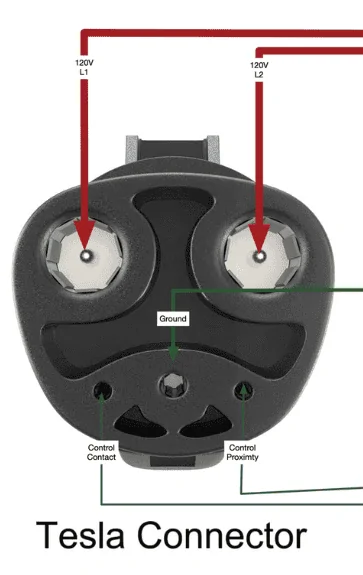
Ok, I've never taken a good look at a Tesla connector until now. I assumed there were multiple power connections, like the CCS connector. But there seems to be only two power connections (maybe three if they use the middle bottom connector as neutral).

Tesla Cybertruck New Cybertruck chargeport picture reveals special Tesla logo 1668031577749


So, yes, their isn't battery voltage at the plug. This makes more sense. The control wires must tell the car that it's connected to L1, L2 or a Supercharger and the car makes adjustments based on that.

I'll keep digging and see if anyone found specifically how.
Sponsored


Top