Sponsored

PCS2 - Just for the record - Tracking

Limes2

Well-known member
Joined
Feb 14, 2025
Threads
1
Messages
320
Reaction score
559
Location
Chicagoland
Vehicles
2025 Cybertruck AWD
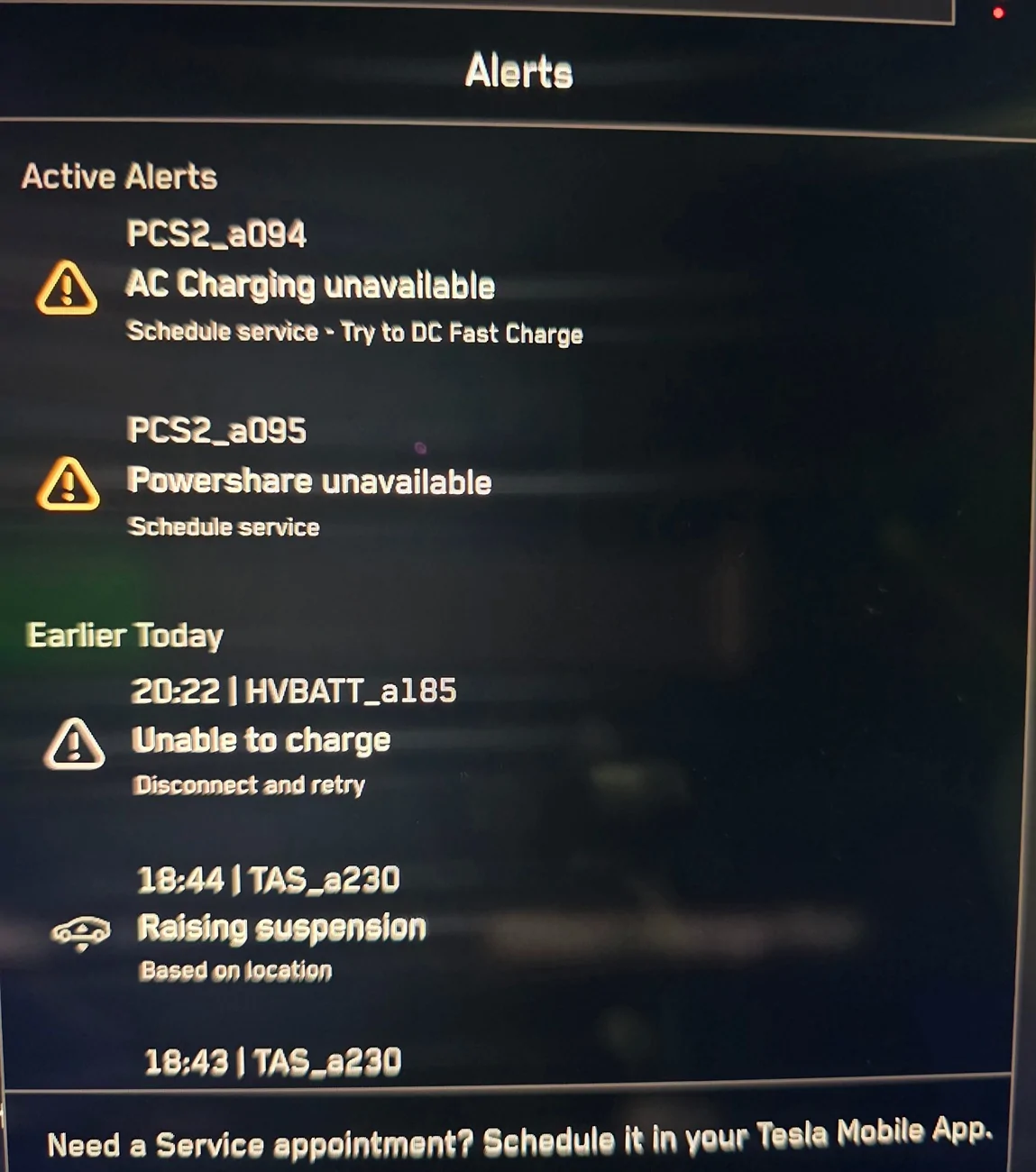
Open a service request and post this screenshot in the app. They do a remote diagnostic check and determine what's next.

I suspect the PCS2 will be a formal recall but right now it's more of a silent recall. And not even a public facing service bulletin yet either.
 

Flynn

Active member
First Name
Kevin
Joined
May 23, 2026
Threads
0
Messages
41
Reaction score
53
Location
Fremont,CA
Vehicles
2026 Cybertruck, 2022 MY
Occupation
Operations/Metrics Lead
Country flag
Disclaimer: This write-up was researched with AI assistance (Anthropic’s Claude Fable 5) using public sources — owner forums, teardown reports, recall filings, and industry news. Treat it as informed correlation, not confirmed root-cause analysis. Verify anything important independently.
With Rev G units now showing up in PCS failure threads, a lot of people are asking the obvious question: why can’t Tesla make this go away? I went looking at how other manufacturers have handled the same class of failure. Short version: nobody has actually solved it. Tesla just has the hardest version of the problem.
The pattern on our trucks. The telltale service-mode code is PCS2_a136_cycloAMosfetHealthCheckFailed — a failed MOSFET health check inside the converter. Owners have tracked hardware revisions E, F, and G, with some trucks failing again after a full replacement, including trucks that received Rev G only months earlier. This is also the Cybertruck’s second MOSFET-related issue; the late-2024 drive inverter recall was one too.
Hyundai/Kia have the same disease. The E-GMP ICCU (Ioniq 5/6/9, EV6, EV9, Genesis) fails when a MOSFET in the DC-DC converter degrades until it shorts and blows the internal fuse. Hyundai claimed vehicles built after April 2024 have an “optimized” ICCU — yet owners are reporting failures on 2025 cars at under 4,000 miles and even on 2026 models within days of delivery. Replacement units with unchanged hardware fail again. Five years and multiple recalls in, there’s still no confirmed permanent fix.
Porsche is the most instructive case. An independent shop tore down failed Taycan 22kW onboard chargers and found the same MOSFET (a 1200V part in the PFC circuit) blown every single time. Their fix: substitute a pin-compatible MOSFET with roughly double the current rating — and the repaired units held. Porsche’s own answer, meanwhile, has effectively been to steer customers to the less aggressive 11kW charger, which rarely fails. Read that again: the reliable fix was more headroom, and the OEM path was derating.
So what’s the likely common thread? These are three unrelated companies with three unrelated designs (Tesla in-house, Hyundai Kefico, MetaSystem for Porsche) all losing the same component class in the same subsystem: the bidirectional OBC/DC-DC converter on 800V-class vehicles. Note what’s not failing at these rates — traction inverters, or the OBCs in conservative 400V vehicles like Tesla’s own Model 3/Y. The engineering consensus forming on the Kia/Hyundai side is that 800V architectures pushed switching MOSFETs very close to their maximum ratings, leaving too little margin for voltage transients and thermal cycling. If that’s right, it’s a design-margin problem, not a bad-parts-batch problem — which would explain why revision after revision fails.
Why a fix is so slow to prove. This is a wear-out failure, not infant mortality. The unit degrades over thousands of miles before the visible “pop.” That means every hardware revision has a 12–18 month feedback loop before anyone knows whether it worked — and it explains why software updates help a little (they slow the degradation curve) without curing anything. Rev G failing now doesn’t even cleanly prove Rev G is bad; it could be the same marginal design, latent stress, or harness interactions.
Why the Cybertruck version is the hardest. Our PCS does a job no other production vehicle asks of one box: bidirectional 11.5kW AC charging plus stepping ~800V down to a 48V architecture, with PowerShare V2L/V2H duty cycles that hammer it in ways a normal OBC never sees. The cycloconverter-style topology hinted at by the error code is an aggressive design choice. New architecture, new failure surface.
What would an actual fix look like? Based on the Taycan precedent: not another letter revision, but a redesigned unit with genuinely higher device margins — better-rated MOSFETs, stronger transient protection, or a topology change. Watch for a new part number or a “PCS3”-style redesign rather than Rev H. Until then, the realistic expectation is that the PCS is a warranty-visit item, and the smart move is knowing your warranty window.
Correlation, not confirmed causation — but when three independent designs fail the same way at the same voltage class, the correlation is worth taking seriously.
 

roadrunner32

Well-known member
First Name
Charles
Joined
Oct 27, 2020
Threads
62
Messages
337
Reaction score
322
Location
houston
Vehicles
'21 model Y, 2025 cybertruck
Occupation
retired electrical engineer
Country flag
Do we need to go back to the future and use SCRs for this application, and would that even work? someone on this owners club knows. I did see in this post by Flynn the phrase "thermal cycling". I will be charging at night from now on until this is solved. And, thank you Flynn for this information.
 

markcybertruck

Well-known member
First Name
Mark
Joined
Mar 11, 2024
Threads
10
Messages
60
Reaction score
60
Location
Mesa, AZ
Vehicles
cybertruck
Country flag
Is this a warranty item only up to 50k miles (I’m almost there)? Has anyone paid outside of warranty to have it replaced? If so what was the cost? We do lots of road trips and of course the biggest fear is being stranded in the middle of nowhere.

A friend was driving his Cybertruck from Nevada to Washington when it broke down. It was $2k+ to have it towed to Las Vegas for repair (lucky for him still under warranty).


SCTesla

Well-known member
Joined
Jun 11, 2024
Threads
6
Messages
2,510
Reaction score
3,731
Location
USA
Vehicles
22 Model S, 24 CT
Country flag
Is this a warranty item only up to 50k miles (I’m almost there)? Has anyone paid outside of warranty to have it replaced? If so what was the cost? We do lots of road trips and of course the biggest fear is being stranded in the middle of nowhere.

A friend was driving his Cybertruck from Nevada to Washington when it broke down. It was $2k+ to have it towed to Las Vegas for repair (lucky for him still under warranty).
Recently Tesla revised this to under 1k for out of warranty (above 50k miles).
 

Flynn

Active member
First Name
Kevin
Joined
May 23, 2026
Threads
0
Messages
41
Reaction score
53
Location
Fremont,CA
Vehicles
2026 Cybertruck, 2022 MY
Occupation
Operations/Metrics Lead
Country flag
More ai based stuff. Sure to piss someone off sooner or later 😂


SCRs (silicon-controlled rectifiers) are the predecessors of this job — thick, slow, nearly indestructible switches that shrug off transients that vaporize a SiC MOSFET in microseconds. Old SCR-based industrial chargers ran for decades. But there’s a fatal catch: an SCR can only turn off when the current through it naturally crosses zero. On 60Hz AC, that happens 120 times a second. On the 800V→48V DC-DC path — half of what the PCS does — it never happens as DC has no zero crossings. An SCR in that role would latch on at first trigger and stay on until the fuse blows. Working around that requires “forced commutation” circuitry (auxiliary caps and inductors that artificially drag the current to zero), which is bulky 1970s inverter tech with its own losses and failure modes.

Could the AC charging side alone be a phase-controlled SCR rectifier, like an old forklift charger? Technically yes — at the cost of a massive line-frequency transformer, poor power factor, audible buzz, and no clean path to bidirectional power. So yes: the honest version of “SCRs instead of MOSFETs” really is a compelling suggestion in terms of reliability, but would require a truck bed full of iron humming at line frequency, and even then still couldn’t run the 48V system.

The fix for the current failure wave, in practicality, isn’t reverting to older tougher tech; it’s giving the new tech proper margin. The Taycan field repair proved or at least strongly supports the point: same circuit, same job, a MOSFET with roughly double the current headroom — and the failures stopped.
 
Last edited:

UberNoob

Well-known member
Joined
Jun 5, 2024
Threads
6
Messages
1,141
Reaction score
1,753
Location
Florida
Vehicles
CyberBeast & M3P
Occupation
Desktop Security Engineer
Country flag
Is this a warranty item only up to 50k miles (I’m almost there)? Has anyone paid outside of warranty to have it replaced? If so what was the cost?
1. Yes, unless you have a recent 2026 purchase where Tesla offers an additional expensive powertrain parts warranty 70k miles and includes PCS.

2. Yes, had mine replaced at 73,001 miles.

3. Cost was reduced to 980$. They replaced more than just PCS. Header cables, anticulary things and cables, AC junction box.

When it goes out, you just loose level 2 charging, for your trips just reserve enough charge to make it back to a supercharger and you should be fine.[/QUOTE]
 
OP
OP

CWiley

Well-known member
First Name
C
Joined
Nov 11, 2020
Threads
22
Messages
168
Reaction score
172
Location
Atlanta, Ga.
Vehicles
2024 CyberBeast
Occupation
Contractor
Open a service request and post this screenshot in the app. They do a remote diagnostic check and determine what's next.

I suspect the PCS2 will be a formal recall but right now it's more of a silent recall. And not even a public facing service bulletin yet either.
Thanks. Will do!
 
OP
OP

CWiley

Well-known member
First Name
C
Joined
Nov 11, 2020
Threads
22
Messages
168
Reaction score
172
Location
Atlanta, Ga.
Vehicles
2024 CyberBeast
Occupation
Contractor
Is this a warranty item only up to 50k miles (I’m almost there)? Has anyone paid outside of warranty to have it replaced? If so what was the cost? We do lots of road trips and of course the biggest fear is being stranded in the middle of nowhere.

A friend was driving his Cybertruck from Nevada to Washington when it broke down. It was $2k+ to have it towed to Las Vegas for repair (lucky for him still under warranty).
That hurts! However, you can still DC charge the vehicle. Supercharger. I read a post that said Tesla paid for or he received free supercharging until Tesla service could get him scheduled in for the repair.


OP
OP

CWiley

Well-known member
First Name
C
Joined
Nov 11, 2020
Threads
22
Messages
168
Reaction score
172
Location
Atlanta, Ga.
Vehicles
2024 CyberBeast
Occupation
Contractor
More ai based stuff. Sure to piss someone off sooner or later 😂


SCRs (silicon-controlled rectifiers) are the predecessors of this job — thick, slow, nearly indestructible switches that shrug off transients that vaporize a SiC MOSFET in microseconds. Old SCR-based industrial chargers ran for decades. But there’s a fatal catch: an SCR can only turn off when the current through it naturally crosses zero. On 60Hz AC, that happens 120 times a second. On the 800V→48V DC-DC path — half of what the PCS does — it never happens as DC has no zero crossings. An SCR in that role would latch on at first trigger and stay on until the fuse blows. Working around that requires “forced commutation” circuitry (auxiliary caps and inductors that artificially drag the current to zero), which is bulky 1970s inverter tech with its own losses and failure modes.

Could the AC charging side alone be a phase-controlled SCR rectifier, like an old forklift charger? Technically yes — at the cost of a massive line-frequency transformer, poor power factor, audible buzz, and no clean path to bidirectional power. So yes: the honest version of “SCRs instead of MOSFETs” really is a compelling suggestion in terms of reliability, but would require a truck bed full of iron humming at line frequency, and even then still couldn’t run the 48V system.

The fix for the current failure wave, in practicality, isn’t reverting to older tougher tech; it’s giving the new tech proper margin. The Taycan field repair proved or at least strongly supports the point: same circuit, same job, a MOSFET with roughly double the current headroom — and the failures stopped.
Seems like a bad application for the part, bad design, or faulty manufacturing. What actually constitutes and initiate a recall, beyond public safety?
 

Flynn

Active member
First Name
Kevin
Joined
May 23, 2026
Threads
0
Messages
41
Reaction score
53
Location
Fremont,CA
Vehicles
2026 Cybertruck, 2022 MY
Occupation
Operations/Metrics Lead
Country flag
Seems like a bad application for the part, bad design, or faulty manufacturing. What actually constitutes and initiate a recall, beyond public safety?
From what I gather it’s a supply-chain quirk; A, B and C are fine individually, but ABC together (no single entity owns) and at their collective spec limit, perhaps in some trucks more than others, have a confluence of interdependent, cumulative degradations that cause failures in a small but significant percentage of units.

Specifically because it’s not a safety issue, it isn’t a required recall. There are any number of perspectives, but at the end of the day here is mine:

The real problem here is the media is so utterly disingenuous. Mountains out of molehills is an understatement. And we’ve all seen it.

If it was my company, what would I do? Exactly what they’re doing, and not as preference but because any other option is so practically disastrous and naive.
 

roadrunner32

Well-known member
First Name
Charles
Joined
Oct 27, 2020
Threads
62
Messages
337
Reaction score
322
Location
houston
Vehicles
'21 model Y, 2025 cybertruck
Occupation
retired electrical engineer
Country flag
More ai based stuff. Sure to piss someone off sooner or later 😂


SCRs (silicon-controlled rectifiers) are the predecessors of this job — thick, slow, nearly indestructible switches that shrug off transients that vaporize a SiC MOSFET in microseconds. Old SCR-based industrial chargers ran for decades. But there’s a fatal catch: an SCR can only turn off when the current through it naturally crosses zero. On 60Hz AC, that happens 120 times a second. On the 800V→48V DC-DC path — half of what the PCS does — it never happens as DC has no zero crossings. An SCR in that role would latch on at first trigger and stay on until the fuse blows. Working around that requires “forced commutation” circuitry (auxiliary caps and inductors that artificially drag the current to zero), which is bulky 1970s inverter tech with its own losses and failure modes.

Could the AC charging side alone be a phase-controlled SCR rectifier, like an old forklift charger? Technically yes — at the cost of a massive line-frequency transformer, poor power factor, audible buzz, and no clean path to bidirectional power. So yes: the honest version of “SCRs instead of MOSFETs” really is a compelling suggestion in terms of reliability, but would require a truck bed full of iron humming at line frequency, and even then still couldn’t run the 48V system.

The fix for the current failure wave, in practicality, isn’t reverting to older tougher tech; it’s giving the new tech proper margin. The Taycan field repair proved or at least strongly supports the point: same circuit, same job, a MOSFET with roughly double the current headroom — and the failures stopped.
yeah, I asked AI that question too and got roughly the same explanation as to why it SCRs would not work. I'm probably wrong about the heat and charging at night too.
 

Jager

Well-known member
First Name
Jeff
Joined
May 25, 2020
Threads
25
Messages
346
Reaction score
1,096
Location
Virginia
Vehicles
2024 Cybertruck AWD, 2022 Model 3 LR AWD
Country flag
I've wondered if AC line transients and/or higher THD (total harmonic distortion) might be contributing factors in PCS2 failures.

Here in Northern Virginia (Dominion Electric) we have quite clean THD numbers - 2.1% the last time I measured (as an aside, the Cybertruck also produces very clean THD numbers - 2.2% the last time I measured). Some utilities/locations, however, have relatively poor THD numbers.

Several years ago, while exploring ways to detect and measure ground currents from lightning strikes, I discovered that utility line transients were far more common than I ever would have expected (often several dozen per day). This even from a utility that held THD and frequency numbers to quite tight standards.

I'd certainly vote for increasing MOSFET margins in any future PCS2 designs. But just as important for future vehicle designs - make the PCS2 physically accessible without tearing half the vehicle apart.
Sponsored


Top