Jager
Well-known member
- First Name
- Jeff
- Joined
- May 25, 2020
- Threads
- 25
- Messages
- 339
- Reaction score
- 1,092
- Location
- Virginia
- Vehicles
- 2024 Cybertruck AWD, 2022 Model 3 LR AWD

- Thread starter
- #1
Those who paid attention in Statistics class will instantly recognize the flaw. All of two – count ‘em, two - data points. Your professor would laugh at you.
But hold that thought. Because it’s plenty.
Spend enough time in the EV world and you quickly find that one thing keeps circling back, time and again, like a deranged boomerang. It’ll come from a bunch of different angles, but ultimately boils down to one thing: how far can I drive before the electrons exhaust themselves, leaving me on the side of the road?
There’s the EPA benchmark, of course, a suite of road tests intended to objectify the matter.
Alas, few drivers hit that bogey. Leading to a legion of complaints as to why not. Everything under the sun gets pointed at, starting with Elon lied to us, and heading south from there.
There was a post here a few weeks ago from a fellow who wondered about maximizing range. After that thread had mostly run its course, the fellow rejoined his own summary of it all… “we will try all season tires, chill, low, comfort, aero caps and see how it goes.”
He remained happily oblivious to the one thing that mattered more than all the rest.
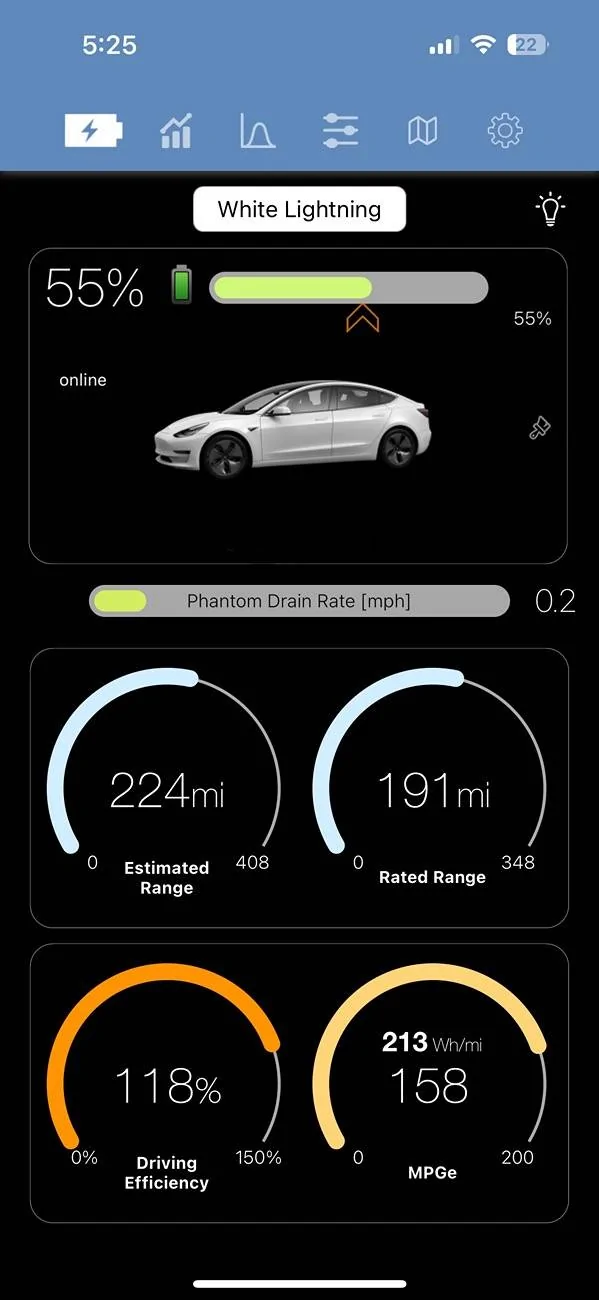
Data point one is a Long Range, AWD, Model 3. Two and a half years old. 35,000 miles.


Here in the mid-Atlantic we’re shortly heading into cold weather. So that Efficiency graph will soon be trending back down. Somewhere close to, or maybe a little bit below, that EPA bogey.
The dip at ~12K miles was the first winter. The dip at ~25K was the second winter.
The dip at ~32K miles, circled in red, was a quick, high-speed road trip – 2,000 miles in three days – to southern Florida to attend the funeral of an old friend.
The conclusion is quick and obvious: he must drive like the proverbial grandma.
Maybe. I’ll leave it to others to judge how fast or slow, how well or poorly, that Model 3 got driven. But I knew as far ago as last winter, when the first production Cybertrucks were finally being delivered to normal people, and we started getting the first reports of mileage and range, how it would go.


To understand the genesis of all this, you first have to understand gasoline. A gallon of gas holds around 121,000,000 joules of energy. With only a few very brief exceptions, it has always been cheap and easy to obtain. And so there has never been a reason, across the more than a century that has defined motorized transport, for people to make any meaningful effort to conserve it.
Come now the EV. And that gallon of gasoline equates to around 33.6 kWh.
In ICE terms, that LR AWD Model 3 of mine ends up with a fuel tank of two gallons and change. And the Cybertruck ends up with a fuel capacity of just over three and a half gallons. You compare that with the 23 gallon fuel tank in a conventional Ford F-150 (let’s don’t even talk about the 36 gallons in a Ford Raptor) and it starts to become clear how prodigiously wasteful an ICE vehicle is relative to its EV brethren.
And because ICE vehicles have always carried that vast abundance of cheap fuel, people did what they have always done when they had an overabundance of something.
I was with Reg Pridmore (American Superbike champion back in the 1970’s) at Mid-Ohio, the iconic midwestern racetrack, in July 2000 when news arrived of Joey Dunlop’s death. Reg was a close friend of Joey and that was a sad, depressing day at the track.
Until this year – when his nephew Michael finally eclipsed him – Joey held the record for the most TT (tourist trophy) victories at the Isle of Man, what many consider the most difficult, most challenging, and deadliest road race in the world. Run over (closed) public roads, with a lap comprising 219 turns over 37 miles… 269 racers have died on the course since the race’s inception in 1907. In 2022, six people died.
The Isle of Man TT underlines a sobering reality: Get it wrong on a motorcycle and you die.
That’s all very interesting, you might ask. But what, pray tell, does any of that have to do with the Cybertruck?
And the answer is that it has to do with how well one manages the machine. Most drivers don’t.
Show up at a racetrack – not an oval, but a true road course… think Road Atlanta or Mid-Ohio or Watkins Glen or Laguna Seca – and throw your leg over the saddle of a modern 600cc sportbike. Or join your pals down at the corner café and head for the local mountain twisties… and you’ll quickly find that that smaller bike you’re on is quickly outmatched by the liter-sized sportbikes all your friends are on.
Because the bigger bikes best you in horsepower, acceleration, and raw speed, they’ll have your number any time the tarmac straightens. Your only hope to stay with them, to be competitive, is to beat them in the corners. To do that, you have to carry more corner speed than they do. And to do that, you have to – not to put too fine a point on it – be a better driver than they are.
You have to be smoother. Your inputs to the machine have to be more thoughtful and engaged. You have to drive with nuance. You have to be able to feel subtleties in your machine and its interactions with the pavement that your pals don’t have a clue about.
It’s the same on four wheels.
The point is that all those things that go into driving a vehicle – two wheels or four – well at speed are the very same things that determine how efficient, or not, your car is. The same skill and knowledge and nuance that allows you to run a quicker lap at Road America than some other fellow are the very same tools that allow you to achieve better efficiency and range in your Cybertruck than your neighbor down the street.
We’ve all known awful drivers. You know, the person who genuinely scared us with their obvious poor vehicle control and questionable judgment and made us never want to ride with them ever again.
What’s less recognized, even at the pedestrian speeds most of us spend most of our time at, is that even drivers we don’t give much thought to are usually pretty bad. Next time you’re riding as a passenger with someone, close your eyes and tune out all the audio and video distractions that are part of most vehicle cabins… and pay attention simply to how smoothly the car is being driven. It’s usually pretty bad. Often shockingly so.
It's sad to say, but most drivers suck.
Okaaay. If we accept that, how does a driver who sucks… get less sucky?
Assuming he doesn’t have the time or motivation to ride a few hundred thousand high speed miles on a motorcycle; or spend lots of time (and money) spinning thousands of miles on a racetrack… is there anything to be done?
Well, yes.
There’s a short list of things one might pay attention to, but first let’s return briefly to the vehicle itself and touch on the easy buttons that everyone wants to be the answer. But aren’t.
Chill mode doesn’t matter. Chill mode softens and elongates the torque curve, and it caps the upper end of power that is available. But it ultimately does not affect how much energy is extracted from the pack. The driver does that.
Suspension setting – Comfort or Sport – doesn’t matter.
TACC, FSD, and Auto Steer are all actual negatives. As convenient as those driver aids often are, they are unable to operate the vehicle as efficiently as a good driver. They will improve the efficiency of a poor driver.
OEM Aero Caps can help a tiny bit. But the amount is so slight that it gets lost in the noise. Which is good news for those of us who think that they are ugly.
All Season tires are the one discretionary choice that will make a notable improvement. But for those of us who periodically go off-road and need the additional traction that All Terrains provide, they’re not a very good option.
Regardless of tire choice, paying strict attention to Tela’s 50 psi recommendation can help.
Vehicle height makes a difference, and so keeping it in Low is important. The times when the extra ground clearance of Medium, High, or Extract are needed usually involve slow, technical, and traction-limited situations, and so there’s not much of a penalty to those higher modes when they are used as intended.
Avoiding use of Tesla’s linked braking feature, where physical braking is introduced - without driver input - whenever regenerative braking is reduced or unavailable is important. More about brakes in a moment.
That’s pretty much it. The bottom line is that vehicle setup exerts at best a modest influence on range and efficiency. Sorry, no, there’s no Easy button. But the good news is that the one factor that does make a difference is already fully within our control. Us. The person driving the vehicle.
There are two key principles necessary for achieving optimum efficiency and range: The first is throttle management. The second is preservation of momentum. Those two things continually intersect and interact with each other. And together they determine how much range we’re going to have and how efficiently our Cybertruck is going to move down the road.
Every one of us is familiar with the old “lead foot” analogy. The notion that being heavy on the throttle - for faster acceleration, greater speed, or both… leads to poor fuel economy. Or poor efficiency and range in an EV context. And that’s true.
But it’s not really about speed. You can optimize efficiency regardless of how fast or how slow you drive. A fast-as-we-can-get-there Cannonball run from one coast to the other, a 500-mile interstate road trip averaging 80 mph, a 25-mile one-way commute averaging 50 mph and gaining 2,000 feet in elevation, and a 5-mile slow ride to the local soft serve ice cream joint after church are all very different rides.
But within each of those buckets, a good driver will always end up with better efficiency, and greater range, than his less skilled counterparts.
We can’t do much about where we live. We don’t usually have a choice in our commute. And our local topography is simply what it is. More often than not we don’t get a choice in the driving bucket we’re handed. But within that bucket, we absolutely do control how well, or not, our vehicle gets driven.
Rather than “lead foot,” I’d suggest that “dead foot” is a more apt analogy. Because most drivers mash down on the accelerator and give it little more thought than that. It has never occurred to them that feeling the throttle – the nearly infinite gradations that are possible – is a thing. But it’s inside those nearly infinite gradations where much of good efficiency and greater range live.
In the gun world, most rifles come out of the factory with a trigger pull weight – the amount of effort required before the sear releases and the gun can fire – measured in pounds. A lot of them are five, six, or seven pounds. A really fine rifle – say, a German-made Anschutz – will come in at two pounds and change.
Attend a Benchrest match, though, where the most accurate rifles in the world, and some of the very best riflemen, compete against one another… and you’ll find Jewell triggers that break at less than two ounces. Subtlety and nuance writ large. Competing at such a level requires a degree of finesse that the average deer hunter does not even know exists.
Tesla has given us a Jewell trigger. One Pedal Driving and Regenerative Braking, together, are the tool which holds the key to not being a dead foot. It is the control that allows us to peer deeply into throttle management and to feel those ever finer gradations of input.
Instead of mashing the accelerator like most people do, measured degrees of pressure – the analog to squeezing that ounce and a half Jewell trigger - will get the job done in a far more thoughtful fashion. We can drive as fast as we like. But we have to learn to feel the throttle. We have to command the vehicle to give us exactly, precisely the amount of power we want… and no more.
It’s important to understand that driving usually involves lots of wasted, thrown away energy. People accelerate off a traffic light harder than they need to, immediately backing out of the throttle and imperceptibly slowing just a hundred feet down the road. People slow down too much while turning, requiring extra throttle just an instant later. They slow too much just before an ascent. They slow too late when approaching a traffic light. Their inputs at the throttle are coarse and overdone.
And that brings us to the second principle: Preservation of momentum.
For the S3XY models, you can buy an app called Scan My Tesla. Along with an interface cable and a Bluetooth transmitter, that app allows you to collect data directly off your vehicle’s CanBus and have it displayed through the app on your phone. I highly recommend it to anyone who has one of those cars and has an interest in, among other things, viewing the exact, precise amount of power being sent to your motor(s), in real time. Beyond everything else it does, that app is an excellent training tool in how to manage our throttle.
It remains unknown whether Scan My Tesla will ever come to the Cybertruck. Amund Borsand, the developer of the app, lives in Europe and, of course, deliveries aren’t happening there. And the totally different network architecture of the Cybertruck – and whether or not the data is encrypted – will significantly affect whether such an app can ever be developed.
In the meantime, Tesla does not provide that information through its own user interface.
Being able to see, millisecond by millisecond, the exact, precise power you are sending to the motor(s) is incredibly helpful. It lets you see changes in pavement grade so tiny they are invisible to the naked eye. It gives you context into every single throttle input you give to the vehicle. And when you ease out of the throttle and transition into regen, it lets you visualize when, how much, and for how long that happens. Drive at what you think is a steady, unchanging speed and the readout will demonstrate that the power output you imagined must also be steady and unchanging… is, in fact, anything but. Roadways are not nearly as straight and level as most of us imagined.
So, yeah, having Scan My Tesla for the Cybertruck would be terrific. But here’s the thing. Even without being able to see, moment by tiny moment, the exact power we are sending to the motor(s), we can still feel it. It just means we have to calibrate our brain and our foot to it.
However we get there, the point is we need to constantly be striving to preserve momentum. Because momentum is expensive – it takes a lot of energy to move a nearly 7,000 pound vehicle - and once we’ve paid for that movement we don’t want to throw it away.
With that in mind, bear in mind that any time we touch the physical brake is a hard fail. After a lifetime of blithely using brakes without so much as a second thought, it can be hard to rewire our brains to thinking that way. But regen braking in the Cybertruck is so powerful and so effective it can easily serve to do the heavy lifting of managing speed. Using the physical brakes can easily be a very occasional occurrence.
In an ICE vehicle, once you’ve paid for momentum via your throttle and the gas that you commanded be burned, that energy is gone forever. You can do things to try and make it last as long as possible, to eke out that momentum for all that it’s worth, but there’s no way to get any of that energy back.
In an EV with an effective regenerative braking system – like all Tesla’s – you are able to transform that momentum back into retained energy. Of my Model 3’s lifetime energy consumption, a stunning 36% has come from regenerative braking. I have no doubt my Cybertruck is similar.
It’s important to remember, though, that regen braking is not perfectly efficient. Drive up a 4,000 foot mountain and it costs a certain amount of energy. Drive back down and regen braking will recapture some of that. But not all. If using physical brakes is a hard fail; think of regen braking as a soft fail. Come to a stop with regular brakes and we’ve simply thrown away all our energy. Come to a stop with regen braking and we’ll get some of it back. But we are still throwing away momentum. So if it’s between regen braking and coasting at neutral throttle, coasting wins.
That brings us to an important inflection point: Neutral throttle. That infinitesimally small place where positive throttle transitions to negative, trailing throttle. On one side of that demarc we’re expending energy, and powering the tiniest bit of forward momentum. On the other side, we’re beginning to recover energy as regen braking starts to exert its anchoring force.
An optimum drive is going to spend as much time as possible at neutral, or very slightly positive, throttle (the positive throttle necessary to overcome frictional and rolling resistance losses). The deeper we reach into the throttle, and the heavier regen braking we allow, the less efficient the ride becomes.
Robert Duvall, the actor, lives just a few miles from me. His farm lies along a beautiful, curving, country road in Virginia’s western Piedmont. The road is descending as you approach his driveway from the north, and then immediately breaks hard left and abruptly begins ascending right at the entrance.
It’s a classic, technical corner.
Most drivers are going to approach that corner holding steady at whatever speed they’re driving. At the apex of the corner, right in the bottom of the bowl where Duvall’s driveway intersects with the roadway and where the road begins its leftward, climbing rise, they’re going to immediately begin losing speed because of the hill. To counteract that they’re going to press harder into the throttle. And because the ascent in front of them continues for several hundred feet, they’re going to press deeper into the throttle as the climb continues.
That corner and the following climb are expensive from an energy standpoint however you cut it. But a more aware driver is going to begin adding throttle just before he arrives at the apex. He is consciously choosing to add speed and momentum at a point – still in the descent – where it is far less costly than it will be in just a couple more heartbeats. He’s not adding a lot of speed, mind you. Probably not enough that a passenger riding with him would even be aware of it. But enough to make a tiny difference.
There are countless such opportunities, on every trip, for a driver to capture a few watts. Or to lose them.
There’s a second inflection point which is important to consider. Both current versions of the Cybertruck come with multiple motors. The AWD has a single permanent magnet motor on the rear axle and a single induction motor on the front axle. The Beast has a single permanent magnet motor on the front axle and dual induction motors on the rear axle.
(As an aside, a topic for another day, the AWD is essentially a rear-wheel drive truck; and the Beast is essentially a front-wheel drive truck).
The two types of electric motors have different strengths and weaknesses, which is why Tesla uses both. Permanent magnet motors cost more, but they produce more torque and they are a few percent more efficient. Induction motors are cheaper to produce, have lower frictional losses, and, most important of all, can be left in an unpowered state even while the axle they are attached to is turning.
The important thing to recognize in terms of our discussion here is that the single, permanent magnet motor in both trucks is the primary motor. The single induction motor in the AWD, and the dual induction motors in the Beast, are not powered most of the time. Those induction motors start receiving power, and begin adding their torque to their respective axles, when power demand reaches a certain level. That’s the inflection point we need to be mindful of.
It's a testament to Tesla’s engineering that that inflection point is not discernible from a driver’s viewpoint. There’s no noticeable change in power delivery. There’s no sound. No feel. Even while watching power sent to the individual motors in Scan My Tesla in one of the S3XY models, there’s simply a clean, seamless increase in power as those secondary induction motor(s) begin to light up.
But that point also represents where overall power consumption goes up dramatically.
Since you can’t see it or hear it or feel it, and since tools like Scan My Tesla are not available for the Cybertruck, how do we know when we’ve crossed that divide?
We don’t.
Just know that if you’re cruising along at a steady state, or using reasonably controlled, reasonably gentle throttle inputs… you’re almost certainly using only your primary, permanent magnet motor. But as soon as you encounter significant elevation, or you press deeply into the throttle for any kind of aggressive acceleration… your secondary induction motor(s) will instantly come online.
It’s an elegant system and it works exceptionally well. When you need additional power it’s going to be there. But it’s going to cost you.
Since Scan My Tesla is not available on the Cybertruck, it begs the question of what tools are?
The Trip Card is very handy. I set mine to display Current Drive, Since Last Charge, and Lifetime watt-hour/mile consumption. A quick glance at Current Drive will let you know what kind of efficiency and range you are currently laying on the road.
But by far the most powerful tool that Tesla gives us for monitoring energy consumption is the aptly named Energy app. I’d recommend that anyone interested in efficiency and range permanently tag that app to the dock on their display, and become intimately familiar with it. You want to be seeing lots of green.
The downside with both those apps is that they are past tense. They give very accurate insight into energy consumption. But they are both looking in the rear-view mirror. Neither tells us what our consumption is right this moment. Until Tesla decides to gives us that data – it’s already collected by the vehicle, it simply isn’t displayed - or until Scan My Tesla or a similar tool shows up, these two apps are the best we’ve got.
To wrap this up, I’ll distill everything down to one word.
In the performance motorcycle world we’ve long had this notion of smoothness. The truism that the very best riders invariably exhibit this almost otherworldly fluidness. Inputs are soft and rounded. And vehicle transitions happen with a kind of measured grace. Manage that, and the machine becomes more than the sum of its parts.
The same is true on four wheels. Being smooth is probably the single best indicator we have of how good a driver is. In how well a vehicle is being driven. Because I’m pretty sure it’s not possible for an unskilled driver to also be smooth. And I think it’s equally improbable for a smooth driver to not be skilled.
And the happy byproduct of all that smoothness… is increased efficiency and greater range.
So. Just. Be. Smooth.
But hold that thought. Because it’s plenty.
Spend enough time in the EV world and you quickly find that one thing keeps circling back, time and again, like a deranged boomerang. It’ll come from a bunch of different angles, but ultimately boils down to one thing: how far can I drive before the electrons exhaust themselves, leaving me on the side of the road?
There’s the EPA benchmark, of course, a suite of road tests intended to objectify the matter.
Alas, few drivers hit that bogey. Leading to a legion of complaints as to why not. Everything under the sun gets pointed at, starting with Elon lied to us, and heading south from there.
There was a post here a few weeks ago from a fellow who wondered about maximizing range. After that thread had mostly run its course, the fellow rejoined his own summary of it all… “we will try all season tires, chill, low, comfort, aero caps and see how it goes.”
He remained happily oblivious to the one thing that mattered more than all the rest.
Data point one is a Long Range, AWD, Model 3. Two and a half years old. 35,000 miles.
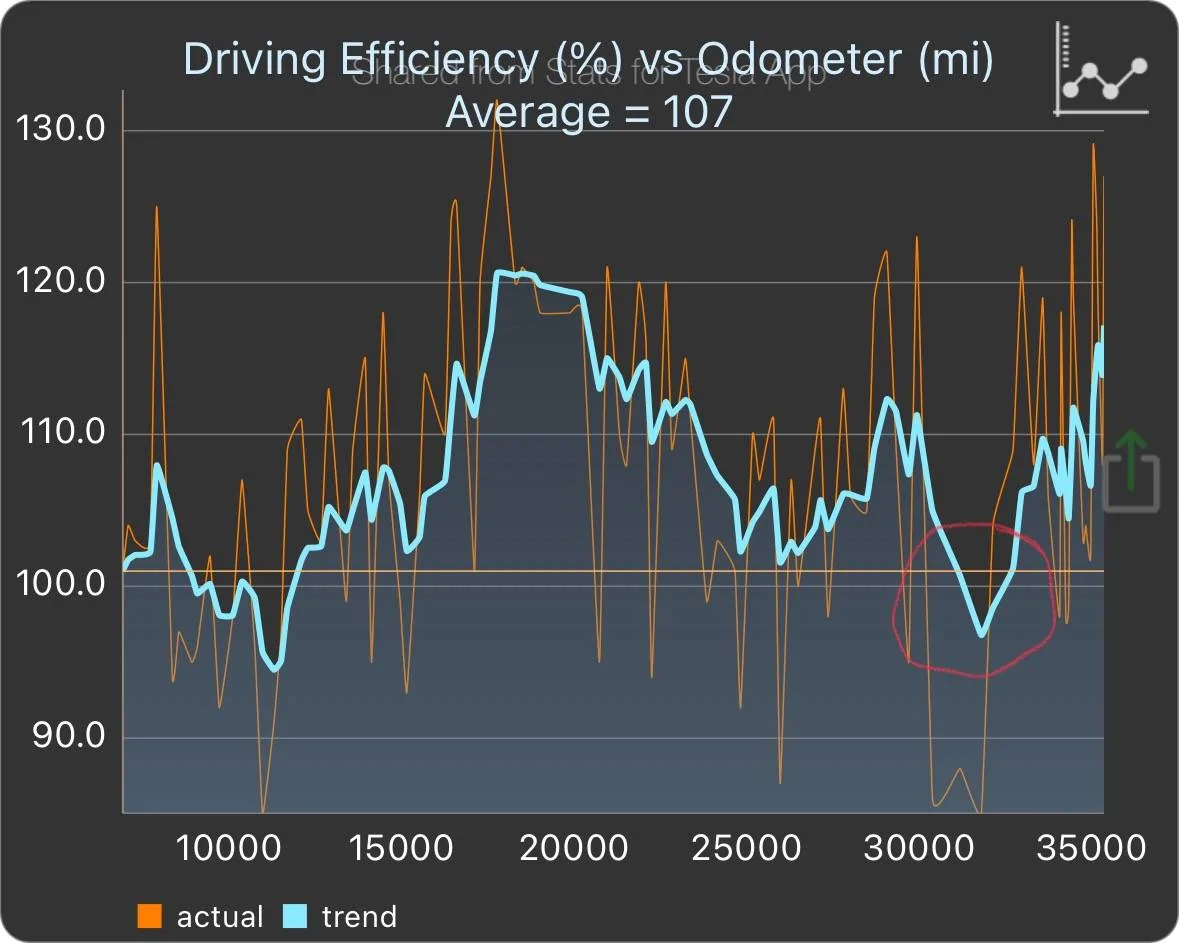
Here in the mid-Atlantic we’re shortly heading into cold weather. So that Efficiency graph will soon be trending back down. Somewhere close to, or maybe a little bit below, that EPA bogey.
The dip at ~12K miles was the first winter. The dip at ~25K was the second winter.
The dip at ~32K miles, circled in red, was a quick, high-speed road trip – 2,000 miles in three days – to southern Florida to attend the funeral of an old friend.
The conclusion is quick and obvious: he must drive like the proverbial grandma.
Maybe. I’ll leave it to others to judge how fast or slow, how well or poorly, that Model 3 got driven. But I knew as far ago as last winter, when the first production Cybertrucks were finally being delivered to normal people, and we started getting the first reports of mileage and range, how it would go.
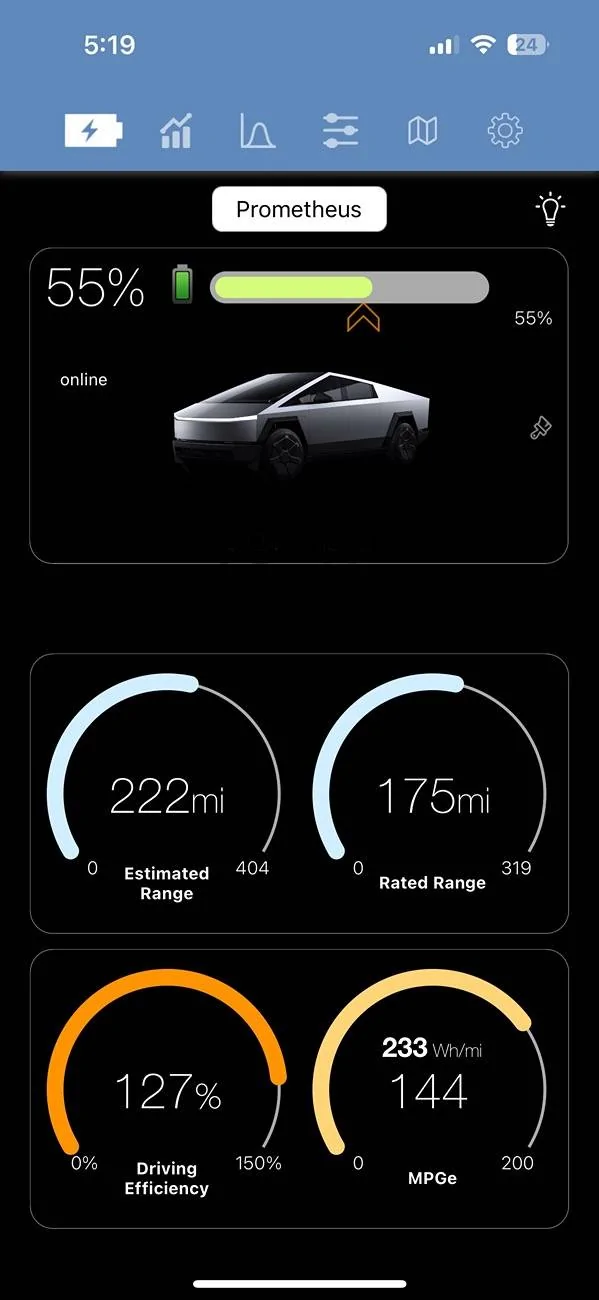
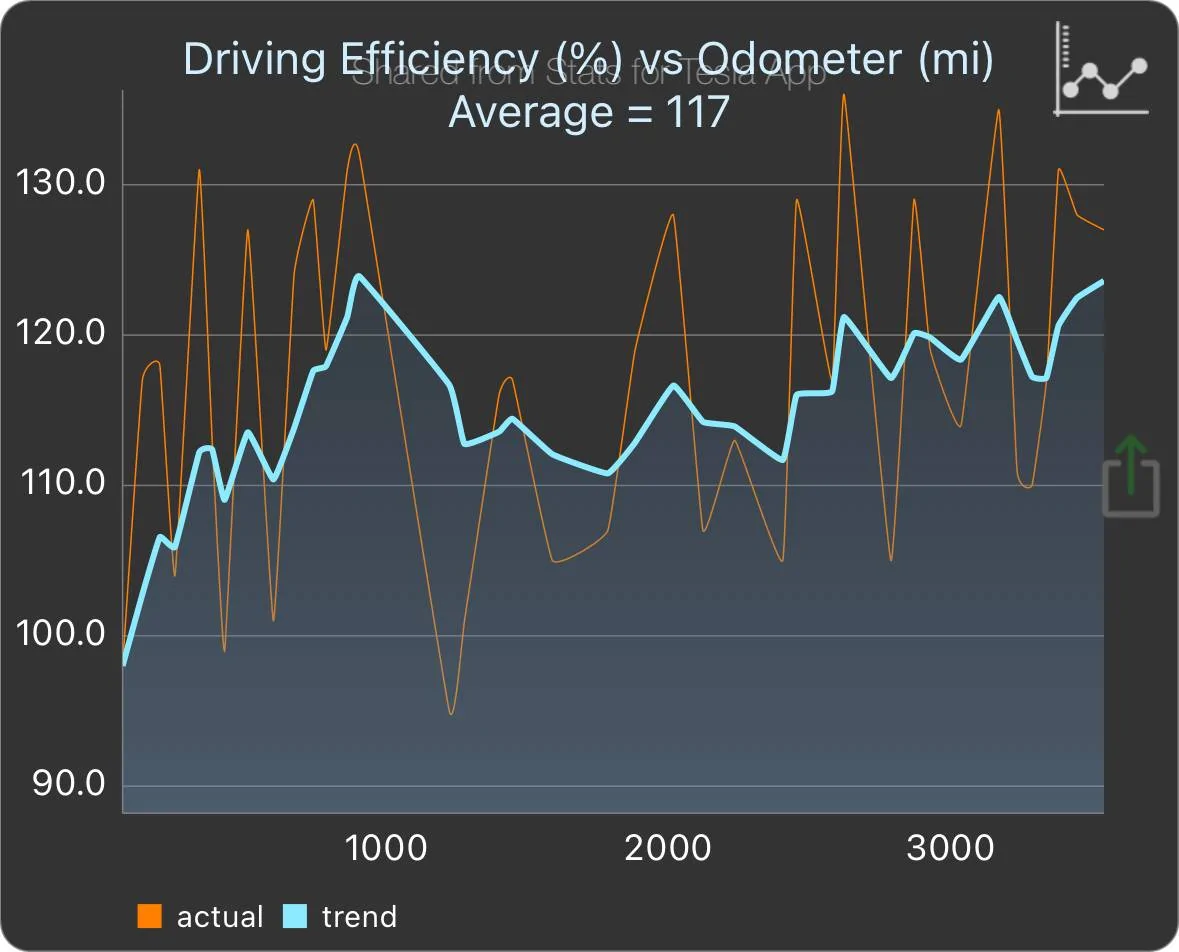
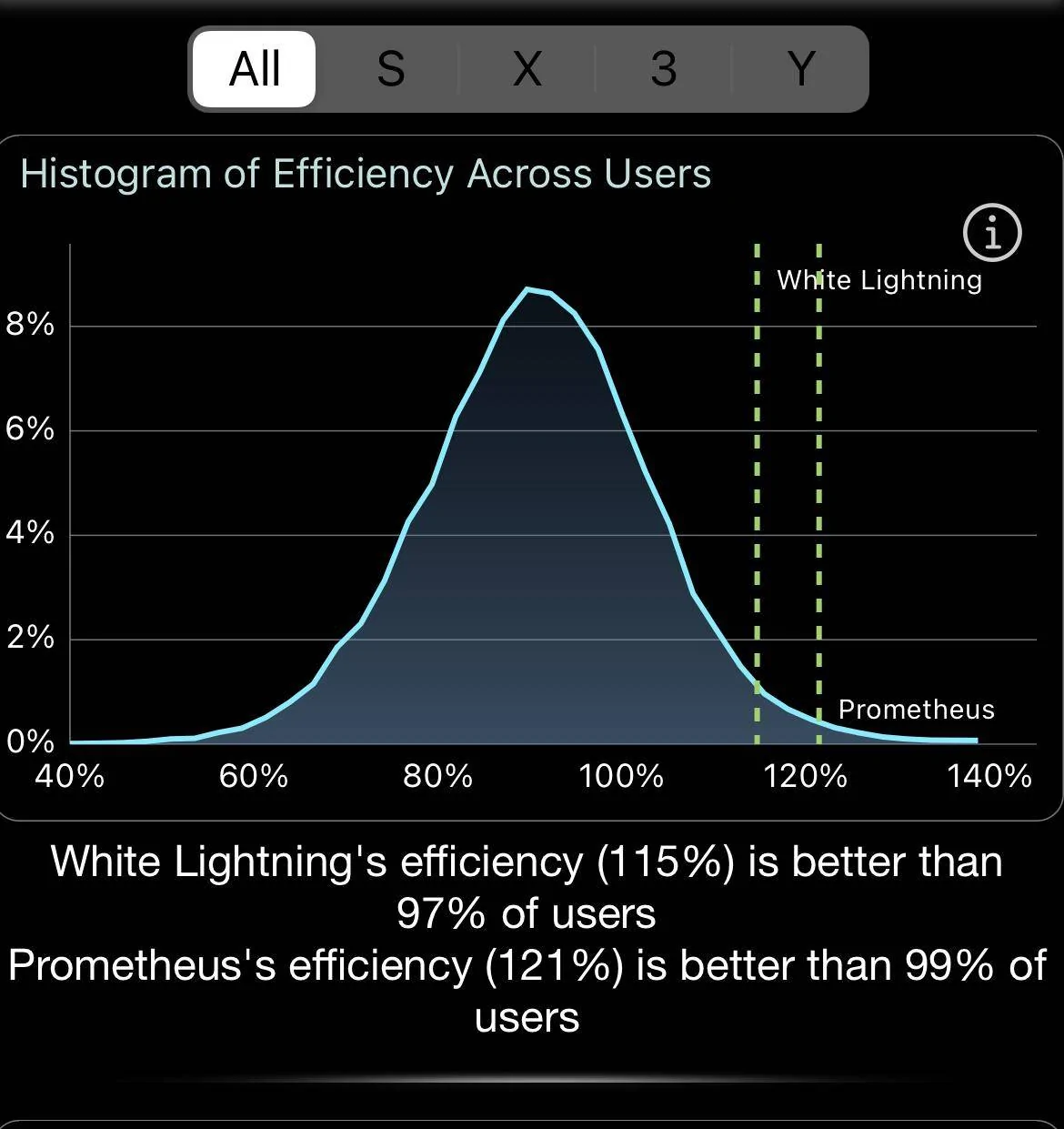
To understand the genesis of all this, you first have to understand gasoline. A gallon of gas holds around 121,000,000 joules of energy. With only a few very brief exceptions, it has always been cheap and easy to obtain. And so there has never been a reason, across the more than a century that has defined motorized transport, for people to make any meaningful effort to conserve it.
Come now the EV. And that gallon of gasoline equates to around 33.6 kWh.
In ICE terms, that LR AWD Model 3 of mine ends up with a fuel tank of two gallons and change. And the Cybertruck ends up with a fuel capacity of just over three and a half gallons. You compare that with the 23 gallon fuel tank in a conventional Ford F-150 (let’s don’t even talk about the 36 gallons in a Ford Raptor) and it starts to become clear how prodigiously wasteful an ICE vehicle is relative to its EV brethren.
And because ICE vehicles have always carried that vast abundance of cheap fuel, people did what they have always done when they had an overabundance of something.
I was with Reg Pridmore (American Superbike champion back in the 1970’s) at Mid-Ohio, the iconic midwestern racetrack, in July 2000 when news arrived of Joey Dunlop’s death. Reg was a close friend of Joey and that was a sad, depressing day at the track.
Until this year – when his nephew Michael finally eclipsed him – Joey held the record for the most TT (tourist trophy) victories at the Isle of Man, what many consider the most difficult, most challenging, and deadliest road race in the world. Run over (closed) public roads, with a lap comprising 219 turns over 37 miles… 269 racers have died on the course since the race’s inception in 1907. In 2022, six people died.
The Isle of Man TT underlines a sobering reality: Get it wrong on a motorcycle and you die.
That’s all very interesting, you might ask. But what, pray tell, does any of that have to do with the Cybertruck?
And the answer is that it has to do with how well one manages the machine. Most drivers don’t.
Show up at a racetrack – not an oval, but a true road course… think Road Atlanta or Mid-Ohio or Watkins Glen or Laguna Seca – and throw your leg over the saddle of a modern 600cc sportbike. Or join your pals down at the corner café and head for the local mountain twisties… and you’ll quickly find that that smaller bike you’re on is quickly outmatched by the liter-sized sportbikes all your friends are on.
Because the bigger bikes best you in horsepower, acceleration, and raw speed, they’ll have your number any time the tarmac straightens. Your only hope to stay with them, to be competitive, is to beat them in the corners. To do that, you have to carry more corner speed than they do. And to do that, you have to – not to put too fine a point on it – be a better driver than they are.
You have to be smoother. Your inputs to the machine have to be more thoughtful and engaged. You have to drive with nuance. You have to be able to feel subtleties in your machine and its interactions with the pavement that your pals don’t have a clue about.
It’s the same on four wheels.
The point is that all those things that go into driving a vehicle – two wheels or four – well at speed are the very same things that determine how efficient, or not, your car is. The same skill and knowledge and nuance that allows you to run a quicker lap at Road America than some other fellow are the very same tools that allow you to achieve better efficiency and range in your Cybertruck than your neighbor down the street.
We’ve all known awful drivers. You know, the person who genuinely scared us with their obvious poor vehicle control and questionable judgment and made us never want to ride with them ever again.
What’s less recognized, even at the pedestrian speeds most of us spend most of our time at, is that even drivers we don’t give much thought to are usually pretty bad. Next time you’re riding as a passenger with someone, close your eyes and tune out all the audio and video distractions that are part of most vehicle cabins… and pay attention simply to how smoothly the car is being driven. It’s usually pretty bad. Often shockingly so.
It's sad to say, but most drivers suck.
Okaaay. If we accept that, how does a driver who sucks… get less sucky?
Assuming he doesn’t have the time or motivation to ride a few hundred thousand high speed miles on a motorcycle; or spend lots of time (and money) spinning thousands of miles on a racetrack… is there anything to be done?
Well, yes.
There’s a short list of things one might pay attention to, but first let’s return briefly to the vehicle itself and touch on the easy buttons that everyone wants to be the answer. But aren’t.
Chill mode doesn’t matter. Chill mode softens and elongates the torque curve, and it caps the upper end of power that is available. But it ultimately does not affect how much energy is extracted from the pack. The driver does that.
Suspension setting – Comfort or Sport – doesn’t matter.
TACC, FSD, and Auto Steer are all actual negatives. As convenient as those driver aids often are, they are unable to operate the vehicle as efficiently as a good driver. They will improve the efficiency of a poor driver.
OEM Aero Caps can help a tiny bit. But the amount is so slight that it gets lost in the noise. Which is good news for those of us who think that they are ugly.
All Season tires are the one discretionary choice that will make a notable improvement. But for those of us who periodically go off-road and need the additional traction that All Terrains provide, they’re not a very good option.
Regardless of tire choice, paying strict attention to Tela’s 50 psi recommendation can help.
Vehicle height makes a difference, and so keeping it in Low is important. The times when the extra ground clearance of Medium, High, or Extract are needed usually involve slow, technical, and traction-limited situations, and so there’s not much of a penalty to those higher modes when they are used as intended.
Avoiding use of Tesla’s linked braking feature, where physical braking is introduced - without driver input - whenever regenerative braking is reduced or unavailable is important. More about brakes in a moment.
That’s pretty much it. The bottom line is that vehicle setup exerts at best a modest influence on range and efficiency. Sorry, no, there’s no Easy button. But the good news is that the one factor that does make a difference is already fully within our control. Us. The person driving the vehicle.
There are two key principles necessary for achieving optimum efficiency and range: The first is throttle management. The second is preservation of momentum. Those two things continually intersect and interact with each other. And together they determine how much range we’re going to have and how efficiently our Cybertruck is going to move down the road.
Every one of us is familiar with the old “lead foot” analogy. The notion that being heavy on the throttle - for faster acceleration, greater speed, or both… leads to poor fuel economy. Or poor efficiency and range in an EV context. And that’s true.
But it’s not really about speed. You can optimize efficiency regardless of how fast or how slow you drive. A fast-as-we-can-get-there Cannonball run from one coast to the other, a 500-mile interstate road trip averaging 80 mph, a 25-mile one-way commute averaging 50 mph and gaining 2,000 feet in elevation, and a 5-mile slow ride to the local soft serve ice cream joint after church are all very different rides.
But within each of those buckets, a good driver will always end up with better efficiency, and greater range, than his less skilled counterparts.
We can’t do much about where we live. We don’t usually have a choice in our commute. And our local topography is simply what it is. More often than not we don’t get a choice in the driving bucket we’re handed. But within that bucket, we absolutely do control how well, or not, our vehicle gets driven.
Rather than “lead foot,” I’d suggest that “dead foot” is a more apt analogy. Because most drivers mash down on the accelerator and give it little more thought than that. It has never occurred to them that feeling the throttle – the nearly infinite gradations that are possible – is a thing. But it’s inside those nearly infinite gradations where much of good efficiency and greater range live.
In the gun world, most rifles come out of the factory with a trigger pull weight – the amount of effort required before the sear releases and the gun can fire – measured in pounds. A lot of them are five, six, or seven pounds. A really fine rifle – say, a German-made Anschutz – will come in at two pounds and change.
Attend a Benchrest match, though, where the most accurate rifles in the world, and some of the very best riflemen, compete against one another… and you’ll find Jewell triggers that break at less than two ounces. Subtlety and nuance writ large. Competing at such a level requires a degree of finesse that the average deer hunter does not even know exists.
Tesla has given us a Jewell trigger. One Pedal Driving and Regenerative Braking, together, are the tool which holds the key to not being a dead foot. It is the control that allows us to peer deeply into throttle management and to feel those ever finer gradations of input.
Instead of mashing the accelerator like most people do, measured degrees of pressure – the analog to squeezing that ounce and a half Jewell trigger - will get the job done in a far more thoughtful fashion. We can drive as fast as we like. But we have to learn to feel the throttle. We have to command the vehicle to give us exactly, precisely the amount of power we want… and no more.
It’s important to understand that driving usually involves lots of wasted, thrown away energy. People accelerate off a traffic light harder than they need to, immediately backing out of the throttle and imperceptibly slowing just a hundred feet down the road. People slow down too much while turning, requiring extra throttle just an instant later. They slow too much just before an ascent. They slow too late when approaching a traffic light. Their inputs at the throttle are coarse and overdone.
And that brings us to the second principle: Preservation of momentum.
For the S3XY models, you can buy an app called Scan My Tesla. Along with an interface cable and a Bluetooth transmitter, that app allows you to collect data directly off your vehicle’s CanBus and have it displayed through the app on your phone. I highly recommend it to anyone who has one of those cars and has an interest in, among other things, viewing the exact, precise amount of power being sent to your motor(s), in real time. Beyond everything else it does, that app is an excellent training tool in how to manage our throttle.
It remains unknown whether Scan My Tesla will ever come to the Cybertruck. Amund Borsand, the developer of the app, lives in Europe and, of course, deliveries aren’t happening there. And the totally different network architecture of the Cybertruck – and whether or not the data is encrypted – will significantly affect whether such an app can ever be developed.
In the meantime, Tesla does not provide that information through its own user interface.
Being able to see, millisecond by millisecond, the exact, precise power you are sending to the motor(s) is incredibly helpful. It lets you see changes in pavement grade so tiny they are invisible to the naked eye. It gives you context into every single throttle input you give to the vehicle. And when you ease out of the throttle and transition into regen, it lets you visualize when, how much, and for how long that happens. Drive at what you think is a steady, unchanging speed and the readout will demonstrate that the power output you imagined must also be steady and unchanging… is, in fact, anything but. Roadways are not nearly as straight and level as most of us imagined.
So, yeah, having Scan My Tesla for the Cybertruck would be terrific. But here’s the thing. Even without being able to see, moment by tiny moment, the exact power we are sending to the motor(s), we can still feel it. It just means we have to calibrate our brain and our foot to it.
However we get there, the point is we need to constantly be striving to preserve momentum. Because momentum is expensive – it takes a lot of energy to move a nearly 7,000 pound vehicle - and once we’ve paid for that movement we don’t want to throw it away.
With that in mind, bear in mind that any time we touch the physical brake is a hard fail. After a lifetime of blithely using brakes without so much as a second thought, it can be hard to rewire our brains to thinking that way. But regen braking in the Cybertruck is so powerful and so effective it can easily serve to do the heavy lifting of managing speed. Using the physical brakes can easily be a very occasional occurrence.
In an ICE vehicle, once you’ve paid for momentum via your throttle and the gas that you commanded be burned, that energy is gone forever. You can do things to try and make it last as long as possible, to eke out that momentum for all that it’s worth, but there’s no way to get any of that energy back.
In an EV with an effective regenerative braking system – like all Tesla’s – you are able to transform that momentum back into retained energy. Of my Model 3’s lifetime energy consumption, a stunning 36% has come from regenerative braking. I have no doubt my Cybertruck is similar.
It’s important to remember, though, that regen braking is not perfectly efficient. Drive up a 4,000 foot mountain and it costs a certain amount of energy. Drive back down and regen braking will recapture some of that. But not all. If using physical brakes is a hard fail; think of regen braking as a soft fail. Come to a stop with regular brakes and we’ve simply thrown away all our energy. Come to a stop with regen braking and we’ll get some of it back. But we are still throwing away momentum. So if it’s between regen braking and coasting at neutral throttle, coasting wins.
That brings us to an important inflection point: Neutral throttle. That infinitesimally small place where positive throttle transitions to negative, trailing throttle. On one side of that demarc we’re expending energy, and powering the tiniest bit of forward momentum. On the other side, we’re beginning to recover energy as regen braking starts to exert its anchoring force.
An optimum drive is going to spend as much time as possible at neutral, or very slightly positive, throttle (the positive throttle necessary to overcome frictional and rolling resistance losses). The deeper we reach into the throttle, and the heavier regen braking we allow, the less efficient the ride becomes.
Robert Duvall, the actor, lives just a few miles from me. His farm lies along a beautiful, curving, country road in Virginia’s western Piedmont. The road is descending as you approach his driveway from the north, and then immediately breaks hard left and abruptly begins ascending right at the entrance.
It’s a classic, technical corner.
Most drivers are going to approach that corner holding steady at whatever speed they’re driving. At the apex of the corner, right in the bottom of the bowl where Duvall’s driveway intersects with the roadway and where the road begins its leftward, climbing rise, they’re going to immediately begin losing speed because of the hill. To counteract that they’re going to press harder into the throttle. And because the ascent in front of them continues for several hundred feet, they’re going to press deeper into the throttle as the climb continues.
That corner and the following climb are expensive from an energy standpoint however you cut it. But a more aware driver is going to begin adding throttle just before he arrives at the apex. He is consciously choosing to add speed and momentum at a point – still in the descent – where it is far less costly than it will be in just a couple more heartbeats. He’s not adding a lot of speed, mind you. Probably not enough that a passenger riding with him would even be aware of it. But enough to make a tiny difference.
There are countless such opportunities, on every trip, for a driver to capture a few watts. Or to lose them.
There’s a second inflection point which is important to consider. Both current versions of the Cybertruck come with multiple motors. The AWD has a single permanent magnet motor on the rear axle and a single induction motor on the front axle. The Beast has a single permanent magnet motor on the front axle and dual induction motors on the rear axle.
(As an aside, a topic for another day, the AWD is essentially a rear-wheel drive truck; and the Beast is essentially a front-wheel drive truck).
The two types of electric motors have different strengths and weaknesses, which is why Tesla uses both. Permanent magnet motors cost more, but they produce more torque and they are a few percent more efficient. Induction motors are cheaper to produce, have lower frictional losses, and, most important of all, can be left in an unpowered state even while the axle they are attached to is turning.
The important thing to recognize in terms of our discussion here is that the single, permanent magnet motor in both trucks is the primary motor. The single induction motor in the AWD, and the dual induction motors in the Beast, are not powered most of the time. Those induction motors start receiving power, and begin adding their torque to their respective axles, when power demand reaches a certain level. That’s the inflection point we need to be mindful of.
It's a testament to Tesla’s engineering that that inflection point is not discernible from a driver’s viewpoint. There’s no noticeable change in power delivery. There’s no sound. No feel. Even while watching power sent to the individual motors in Scan My Tesla in one of the S3XY models, there’s simply a clean, seamless increase in power as those secondary induction motor(s) begin to light up.
But that point also represents where overall power consumption goes up dramatically.
Since you can’t see it or hear it or feel it, and since tools like Scan My Tesla are not available for the Cybertruck, how do we know when we’ve crossed that divide?
We don’t.
Just know that if you’re cruising along at a steady state, or using reasonably controlled, reasonably gentle throttle inputs… you’re almost certainly using only your primary, permanent magnet motor. But as soon as you encounter significant elevation, or you press deeply into the throttle for any kind of aggressive acceleration… your secondary induction motor(s) will instantly come online.
It’s an elegant system and it works exceptionally well. When you need additional power it’s going to be there. But it’s going to cost you.
Since Scan My Tesla is not available on the Cybertruck, it begs the question of what tools are?
The Trip Card is very handy. I set mine to display Current Drive, Since Last Charge, and Lifetime watt-hour/mile consumption. A quick glance at Current Drive will let you know what kind of efficiency and range you are currently laying on the road.
But by far the most powerful tool that Tesla gives us for monitoring energy consumption is the aptly named Energy app. I’d recommend that anyone interested in efficiency and range permanently tag that app to the dock on their display, and become intimately familiar with it. You want to be seeing lots of green.
The downside with both those apps is that they are past tense. They give very accurate insight into energy consumption. But they are both looking in the rear-view mirror. Neither tells us what our consumption is right this moment. Until Tesla decides to gives us that data – it’s already collected by the vehicle, it simply isn’t displayed - or until Scan My Tesla or a similar tool shows up, these two apps are the best we’ve got.
To wrap this up, I’ll distill everything down to one word.
In the performance motorcycle world we’ve long had this notion of smoothness. The truism that the very best riders invariably exhibit this almost otherworldly fluidness. Inputs are soft and rounded. And vehicle transitions happen with a kind of measured grace. Manage that, and the machine becomes more than the sum of its parts.
The same is true on four wheels. Being smooth is probably the single best indicator we have of how good a driver is. In how well a vehicle is being driven. Because I’m pretty sure it’s not possible for an unskilled driver to also be smooth. And I think it’s equally improbable for a smooth driver to not be skilled.
And the happy byproduct of all that smoothness… is increased efficiency and greater range.
So. Just. Be. Smooth.
Sponsored