
Sponsored

Why Cybertruck Should Have a Performance Variant with Very High Regen Capability

CosmicOwl

Member
Joined
Nov 15, 2023
Threads
1
Messages
11
Reaction score
43
Location
USA
Vehicles
Chevy Colorado
Country flag
I've seen a number of posts describing the CyberTruck as a sports car in various ways. I thought it worth putting up a few numbers to show that as currently configured, the CyberTruck is definitely not a sports car and in fact may be one of the most imbalanced vehicles on the road today in terms of performance envelope. Later in the post, I offer some thoughts on how Tesla could improve this.

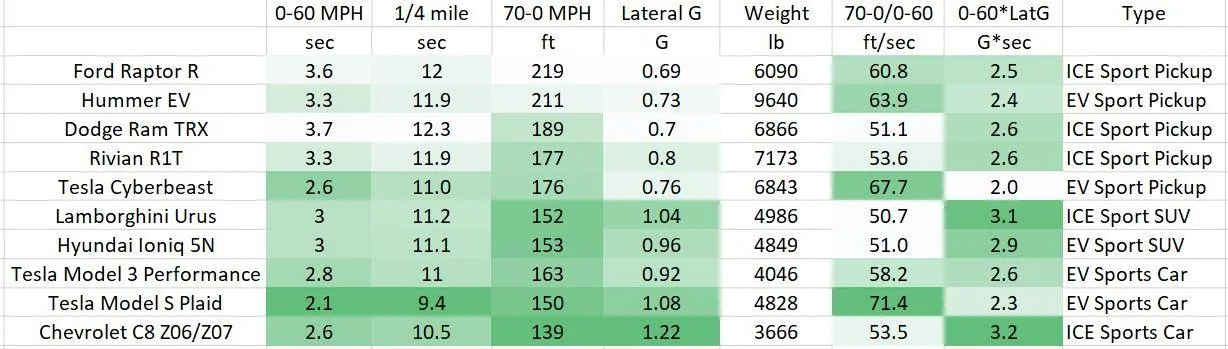
Referencing the table below, that I quickly compiled from various vehicle reviews (mostly Car and Driver), it is plain to see that compared to all types of performance vehicles, the CyberTruck is absolutely outstanding in terms of positive acceleration (increasing speed) however it is poor in both braking and turning. For example, the CyberTruck is the second fastest 0-60, tied with a lightweight ICE sports car wearing R rated pseudo-slicks with carbon wheels yet compared to that same vehicle it has a 27% longer stopping distance from 70 mph and only 62% of the cornering capability. Objectively speaking, the CyberTruck is not a sports car.

Comparing to its peer group (high performance off-road pickups), the CyberTruck shows how well Tesla is doing, taking the shortest distance to stop from 70, having the quickest 0-60 and 1/4, nearly the lightest overall weight and second best on cornering performance. However, the overperformance on positive acceleration is definitely not matched by overperformance on braking or cornering which is easy to see from the last two columns which attempt to balance the two factors (braking over accelerating in the first column and accelerating times cornering in the second). In the first column, lower numbers are more balanced and in the second, higher numbers are more balanced. Cybertruck is the worst of the group on both metrics, especially cornering to accelerating balance and in fact is the worst of the entire table in column 2 and the second worst in column 1 (Model S Plaid is the worst in column 1).

Tesla Cybertruck Why Cybertruck Should Have a Performance Variant with Very High Regen Capability 1730712890367-r


So now the question becomes, is it possible to improve and if so, how?

I think there are three ways as follows (I eliminated the trivial solution of making the CyberTruck slower :) ):

1. Basic car physics that benefits most everything (not towing). This comes down to reducing weight (lower tire loading increases tire coefficient of friction). Obviously Tesla has done well on this so I am not sure what more they can do without comprise beyond leveraging future battery improvements. You could make the truck lighter by changing the aesthetics (steeper windshield for instance) but that seems unlikely or by changing the ratings (lower load and towing rating) but that is a dramatic compromise in the mission of the vehicle.

2. Performance variant of the truck or maybe on-road (Dual Motor) and performance variants (CyberBeast). I think this seems like a good idea that wouldn't require too much effort and would probably better serve the many customers that never take their truck off-road. Basically tweak the suspension geometry, possibly higher rate suspension/shocks, add lower profile performance all seasons and bigger brakes. This should get much closer to the numbers of the Urus or the Ioniq 5N and would measurable improve safety margin for the major CyberTruck use case (on-road). More variants means more sales as well.

3. Dramatically increase regen capability. I think this is something that Tesla should do on all their vehicles. This is the way to unlock substantially better braking performance with the same tires and configuration just as Tesla is consistently able to beat ICE traction control systems in positive acceleration. The idea is to leverage the incredible sensitivity and control of the electric motors to allow better management of wheel slip compared to the ABS controller. In an ideal world, this would also allow elimination of the ABS system thereby reducing cost and weight as well. This would have the additional benefit of capturing of more of the kinetic energy of the vehicle during stopping (especially harder stops). Of course there are technical challenges but I am sure Tesla is up to it and fairly certain it could be done without major cost increases within reason.

Here's hoping that CT 2.0 has super high performance regen, -500 lbs of weight, a performance variant and +200 miles of EPA range.
Sponsored


TickTock

Well-known member
Joined
Jul 27, 2023
Threads
41
Messages
861
Reaction score
1,834
Location
Phoenix, AZ
Vehicles
`11 Nissan Leaf; '18 Model 3; '18 Model S; '24 Beast
Occupation
Electrical Engineer
Country flag
Nice summary. I am surprised we have not seen a CT with negative camber to help with the cornering. Wouldn't be the stupidest thing I've seen. Unless you are racing, I think the bigger issue is the braking (your first point - rightly so). Hoping for a SW update to enable more regen once they have more data on the battery pack. Meanwhile, I am still waiting for a performance brake upgrade with published stopping distances. Don't mind losing energy in an emergency braking situation.
 

CTInProcess

Well-known member
Joined
Feb 25, 2024
Threads
2
Messages
570
Reaction score
1,027
Location
SoCal
Vehicles
Model 3
Country flag
It’s a sports Truck, with the Cyberbeast being the fastest Sports Truck ever.

The Ford Lightning skid pad numbers were better than the Cybertruck despite being Les tech advanced so not sure why everyone bought into the “Sports Car” narrative … first fast car maybe?
 

Outdoors

Well-known member
First Name
Outdoors
Joined
Nov 19, 2019
Threads
18
Messages
1,888
Reaction score
3,477
Location
North West Montana
Vehicles
S,3,Y,CT,CT(holding pattern) Slate is back on
I couldn't imagine more regen. Driving the other Tesla's after the Cybertruck makes me feel like I can't one foot drive.

These items sound interesting. Yet I would doubt Tesla would tackle even a couple. They aren't really good at making Halo cars or trucks. Anyone get information on their Roadster reservation?
 

Hunky Dory

Well-known member
First Name
David
Joined
Jul 31, 2024
Threads
0
Messages
101
Reaction score
233
Location
Wyoming
Vehicles
Buick Encore, Grey Cyberbeast FS
Occupation
Retired
Country flag
Nice writeup.
Lots of trade offs, range, weight, acceleration, regen, braking, cornering, on road & off road performance, seating, cargo capacity, towing capacity etc. I have driven on mountain highways and you can sure feel the inertia going into corners. It is no sports car when it comes to the twisties. Yes it would be interesting to see variants but I respect that they had to compromise on one design for the first generation.

But then then with the S plaid and other models available and the roadster somewhere in the works. There are and will be options.
 
  • Like
Reactions: REM


Tecyber1

Well-known member
First Name
Tony
Joined
Aug 1, 2024
Threads
2
Messages
595
Reaction score
706
Location
Dallas
Vehicles
Cybertruck AWD
Country flag
I couldn't imagine more regen. Driving the other Tesla's after the Cybertruck makes me feel like I can't one foot drive.

These items sound interesting. Yet I would doubt Tesla would tackle even a couple. They aren't really good at making Halo cars or trucks. Anyone get information on their Roadster reservation?
Exactly! The regen on the CT is far better than any other Tesla I have owned and is surprising as hell everytime. Tesla nailed that part 100%!
 

webspeedracer

Well-known member
First Name
Jason
Joined
Dec 17, 2023
Threads
1
Messages
212
Reaction score
246
Location
SLC, UT
Vehicles
FS Cybertruck AWD, Rivian R1s MaxPack, 2016 MS75D
Country flag
Agreed. Very soon after receiving my CT I went looking to see if the Plaid brake kit could be adapted to our trucks, and your #3 is spot-on…I enjoy the stronger regen in my wife’s Rivian and wish Tesla would go back to the days where we could select stronger regen in our Teslas.

I tow a ~5000lb GVWR camper and have been disappointed at the level of regen, can’t imagine towing heavier boats/campers over our mountain passes, and often wish for stronger regen without towing.

i traverse a couple ~3000ft passes near me regularly, winter and summer, and your point about Regen braking being superior to ABS is absolutely on-point. I don’t know why Tesla and Rivian haven’t leveraged this key advantage of electric cars, especially in winter driving, descending a slushy/icy grade the motors/computers could/should be managing grip much better than traditional ABS!! For regular driving I think the one-pedal slip management would work fine, but for performance driving I think Porches method of using the brake pedal for managing Regen would be much better.

Also I’ve noted that Baja mode *feels like dramatically higher Regen than in the non-off-road driving modes, and I’ve used this mode to descend the canyon from our ski area last winter, to good effect (though the suspension is softer even in “Baja Smooth”).

But I think you’re right about the imbalance between acceleration and braking, and it’s catching some newbies unaware (see: salvage CTs). I am going to put some performance AS tires on next summer for my XC roadtrip, for smooth/quiet and for on-road handling (my primary use-case).

I've seen a number of posts describing the CyberTruck as a sports car in various ways. I thought it worth putting up a few numbers to show that as currently configured, the CyberTruck is definitely not a sports car and in fact may be one of the most imbalanced vehicles on the road today in terms of performance envelope. Later in the post, I offer some thoughts on how Tesla could improve this.

Referencing the table below, that I quickly compiled from various vehicle reviews (mostly Car and Driver), it is plain to see that compared to all types of performance vehicles, the CyberTruck is absolutely outstanding in terms of positive acceleration (increasing speed) however it is poor in both braking and turning. For example, the CyberTruck is the second fastest 0-60, tied with a lightweight ICE sports car wearing R rated pseudo-slicks with carbon wheels yet compared to that same vehicle it has a 27% longer stopping distance from 70 mph and only 62% of the cornering capability. Objectively speaking, the CyberTruck is not a sports car.

Comparing to its peer group (high performance off-road pickups), the CyberTruck shows how well Tesla is doing, taking the shortest distance to stop from 70, having the quickest 0-60 and 1/4, nearly the lightest overall weight and second best on cornering performance. However, the overperformance on positive acceleration is definitely not matched by overperformance on braking or cornering which is easy to see from the last two columns which attempt to balance the two factors (braking over accelerating in the first column and accelerating times cornering in the second). In the first column, lower numbers are more balanced and in the second, higher numbers are more balanced. Cybertruck is the worst of the group on both metrics, especially cornering to accelerating balance and in fact is the worst of the entire table in column 2 and the second worst in column 1 (Model S Plaid is the worst in column 1).
1730712890367-rp.webp


So now the question becomes, is it possible to improve and if so, how?

I think there are three ways as follows (I eliminated the trivial solution of making the CyberTruck slower :) ):

1. Basic car physics that benefits most everything (not towing). This comes down to reducing weight (lower tire loading increases tire coefficient of friction). Obviously Tesla has done well on this so I am not sure what more they can do without comprise beyond leveraging future battery improvements. You could make the truck lighter by changing the aesthetics (steeper windshield for instance) but that seems unlikely or by changing the ratings (lower load and towing rating) but that is a dramatic compromise in the mission of the vehicle.

2. Performance variant of the truck or maybe on-road (Dual Motor) and performance variants (CyberBeast). I think this seems like a good idea that wouldn't require too much effort and would probably better serve the many customers that never take their truck off-road. Basically tweak the suspension geometry, possibly higher rate suspension/shocks, add lower profile performance all seasons and bigger brakes. This should get much closer to the numbers of the Urus or the Ioniq 5N and would measurable improve safety margin for the major CyberTruck use case (on-road). More variants means more sales as well.

3. Dramatically increase regen capability. I think this is something that Tesla should do on all their vehicles. This is the way to unlock substantially better braking performance with the same tires and configuration just as Tesla is consistently able to beat ICE traction control systems in positive acceleration. The idea is to leverage the incredible sensitivity and control of the electric motors to allow better management of wheel slip compared to the ABS controller. In an ideal world, this would also allow elimination of the ABS system thereby reducing cost and weight as well. This would have the additional benefit of capturing of more of the kinetic energy of the vehicle during stopping (especially harder stops). Of course there are technical challenges but I am sure Tesla is up to it and fairly certain it could be done without major cost increases within reason.

Here's hoping that CT 2.0 has super high performance regen, -500 lbs of weight, a performance variant and +200 miles of EPA range.
 
  • Like
Reactions: REM

REM

Well-known member
Joined
Dec 9, 2023
Threads
14
Messages
3,582
Reaction score
6,657
Location
NC
Vehicles
2020 Model 3 Standard Range++ & Diet Cybertruck, Dual Motor
Occupation
Professional Retard
Country flag
I think heat rejection is the biggest obstacle to stronger regen. Also, you have to consider the safety aspect of the average driver not understanding or not remembering that regen is completely unavailable when the battery is near full.
 
OP
OP

CosmicOwl

Member
Joined
Nov 15, 2023
Threads
1
Messages
11
Reaction score
43
Location
USA
Vehicles
Chevy Colorado
Country flag
I think heat rejection is the biggest obstacle to stronger regen. Also, you have to consider the safety aspect of the average driver not understanding or not remembering that regen is completely unavailable when the battery is near full.

I would like to understand more about this. I was thinking the main limit is the need for very high power at high speed and then high torque at low speed. Obviously the Cyberbeast can already deliver torque high enough to spin the tires so that should saturate the braking at low speed. Power limit is much sooner, 630 kW (845 hp) at 3181 kg (7000 lbs with driver) means 1G can only be achieved below 20.2 m/s (45 mph). Same point where 1G accleration happens. To reach something like limit braking (1G on this truck) at top speed (130 mph) would need something like 1812 kW (2430 hp!). Clearly that would require a major increase in hardware unless we rely on transient capability for short duty cycles (there isn't a realistic scenario where you would brake at 130 mph for an significant period of time). I don't know enough about the hardware but this doesn't seem crazy. Potentially you might need something to buffer the battery like a special small battery, ultracapacitor or other. Friction brakes do this all the time with only passive air cooling.

On heat rejection, it seems like the total heating shouldn't be that high as I understand but could be wrong. Say the motor is 92% efficient, doesn't that mean ~8% of the energy is heat? So say I am braking at 700 kW, that only means a rejection of 61 kW. Even at 1812 kW that's still only 158 kW. ICE radiators reject much higher amounts than this easily. And if the duty cycle is 5% at 1812 kW, that's 8 kW on average. Worst case you might need to add an active shutter to reduce the drag penalty.
 
OP
OP

CosmicOwl

Member
Joined
Nov 15, 2023
Threads
1
Messages
11
Reaction score
43
Location
USA
Vehicles
Chevy Colorado
Country flag
I would like to understand more about this. I was thinking the main limit is the need for very high power at high speed and then high torque at low speed. Obviously the Cyberbeast can already deliver torque high enough to spin the tires so that should saturate the braking at low speed. Power limit is much sooner, 630 kW (845 hp) at 3181 kg (7000 lbs with driver) means 1G can only be achieved below 20.2 m/s (45 mph). Same point where 1G accleration happens. To reach something like limit braking (1G on this truck) at top speed (130 mph) would need something like 1812 kW (2430 hp!). Clearly that would require a major increase in hardware unless we rely on transient capability for short duty cycles (there isn't a realistic scenario where you would brake at 130 mph for an significant period of time). I don't know enough about the hardware but this doesn't seem crazy. Potentially you might need something to buffer the battery like a special small battery, ultracapacitor or other. Friction brakes do this all the time with only passive air cooling.

On heat rejection, it seems like the total heating shouldn't be that high as I understand but could be wrong. Say the motor is 92% efficient, doesn't that mean ~8% of the energy is heat? So say I am braking at 700 kW, that only means a rejection of 61 kW. Even at 1812 kW that's still only 158 kW. ICE radiators reject much higher amounts than this easily. And if the duty cycle is 5% at 1812 kW, that's 8 kW on average. Worst case you might need to add an active shutter to reduce the drag penalty.
And on the battery, wouldn't the too full option mostly be solved by having a couple of % in the battery that is always reserved for braking? The only scenario this doesn't work for is someone who lives at the top of an enormous mountain and insists on leaving the house fully charged.


TickTock

Well-known member
Joined
Jul 27, 2023
Threads
41
Messages
861
Reaction score
1,834
Location
Phoenix, AZ
Vehicles
`11 Nissan Leaf; '18 Model 3; '18 Model S; '24 Beast
Occupation
Electrical Engineer
Country flag
I think heat rejection is the biggest obstacle to stronger regen. Also, you have to consider the safety aspect of the average driver not understanding or not remembering that regen is completely unavailable when the battery is near full.
You only activate the higher regen with application of the brake pedal. Since we never touch it except in emergency, it will be a rare heat event.
 

REM

Well-known member
Joined
Dec 9, 2023
Threads
14
Messages
3,582
Reaction score
6,657
Location
NC
Vehicles
2020 Model 3 Standard Range++ & Diet Cybertruck, Dual Motor
Occupation
Professional Retard
Country flag
I would like to understand more about this. I was thinking the main limit is the need for very high power at high speed and then high torque at low speed. Obviously the Cyberbeast can already deliver torque high enough to spin the tires so that should saturate the braking at low speed. Power limit is much sooner, 630 kW (845 hp) at 3181 kg (7000 lbs with driver) means 1G can only be achieved below 20.2 m/s (45 mph). Same point where 1G accleration happens. To reach something like limit braking (1G on this truck) at top speed (130 mph) would need something like 1812 kW (2430 hp!). Clearly that would require a major increase in hardware unless we rely on transient capability for short duty cycles (there isn't a realistic scenario where you would brake at 130 mph for an significant period of time). I don't know enough about the hardware but this doesn't seem crazy. Potentially you might need something to buffer the battery like a special small battery, ultracapacitor or other. Friction brakes do this all the time with only passive air cooling.

On heat rejection, it seems like the total heating shouldn't be that high as I understand but could be wrong. Say the motor is 92% efficient, doesn't that mean ~8% of the energy is heat? So say I am braking at 700 kW, that only means a rejection of 61 kW. Even at 1812 kW that's still only 158 kW. ICE radiators reject much higher amounts than this easily. And if the duty cycle is 5% at 1812 kW, that's 8 kW on average. Worst case you might need to add an active shutter to reduce the drag penalty.
The amount of total energy you would need to dissipate from kinetic > electrical > storage/displacement is huge. I suppose you could throw it into a bank of ultracaps as a buffer, but I assume the added cost and weight isn't worth the squeeze.
 

REM

Well-known member
Joined
Dec 9, 2023
Threads
14
Messages
3,582
Reaction score
6,657
Location
NC
Vehicles
2020 Model 3 Standard Range++ & Diet Cybertruck, Dual Motor
Occupation
Professional Retard
Country flag
You only activate the higher regen with application of the brake pedal. Since we never touch it except in emergency, it will be a rare heat event.
Telsa already does this by default unless the battery SoC is too high :)
 

Outdoors

Well-known member
First Name
Outdoors
Joined
Nov 19, 2019
Threads
18
Messages
1,888
Reaction score
3,477
Location
North West Montana
Vehicles
S,3,Y,CT,CT(holding pattern) Slate is back on
I pray after seeing one's tire budgets post doubling regen.
 

TickTock

Well-known member
Joined
Jul 27, 2023
Threads
41
Messages
861
Reaction score
1,834
Location
Phoenix, AZ
Vehicles
`11 Nissan Leaf; '18 Model 3; '18 Model S; '24 Beast
Occupation
Electrical Engineer
Country flag
You only activate the higher regen with application of the brake pedal. Since we never touch it except in emergency, it will be a rare heat event.
I guess track day could be a problem. Emergency braking may be covered in software but to enable the enhanced stopping distance for an autocross event would likely require new hardware.
Sponsored


Top