CosmicOwl
Member

- Thread starter
- #1
I've seen a number of posts describing the CyberTruck as a sports car in various ways. I thought it worth putting up a few numbers to show that as currently configured, the CyberTruck is definitely not a sports car and in fact may be one of the most imbalanced vehicles on the road today in terms of performance envelope. Later in the post, I offer some thoughts on how Tesla could improve this.
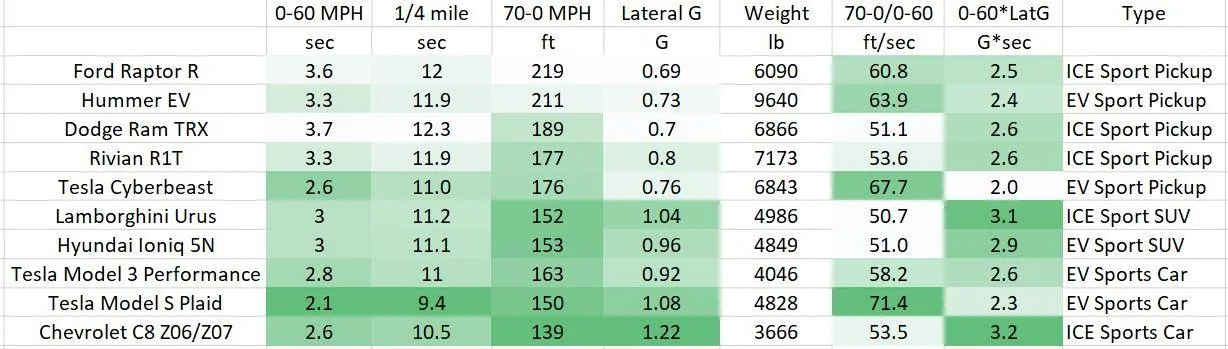
Referencing the table below, that I quickly compiled from various vehicle reviews (mostly Car and Driver), it is plain to see that compared to all types of performance vehicles, the CyberTruck is absolutely outstanding in terms of positive acceleration (increasing speed) however it is poor in both braking and turning. For example, the CyberTruck is the second fastest 0-60, tied with a lightweight ICE sports car wearing R rated pseudo-slicks with carbon wheels yet compared to that same vehicle it has a 27% longer stopping distance from 70 mph and only 62% of the cornering capability. Objectively speaking, the CyberTruck is not a sports car.
Comparing to its peer group (high performance off-road pickups), the CyberTruck shows how well Tesla is doing, taking the shortest distance to stop from 70, having the quickest 0-60 and 1/4, nearly the lightest overall weight and second best on cornering performance. However, the overperformance on positive acceleration is definitely not matched by overperformance on braking or cornering which is easy to see from the last two columns which attempt to balance the two factors (braking over accelerating in the first column and accelerating times cornering in the second). In the first column, lower numbers are more balanced and in the second, higher numbers are more balanced. Cybertruck is the worst of the group on both metrics, especially cornering to accelerating balance and in fact is the worst of the entire table in column 2 and the second worst in column 1 (Model S Plaid is the worst in column 1).

So now the question becomes, is it possible to improve and if so, how?
I think there are three ways as follows (I eliminated the trivial solution of making the CyberTruck slower ):
):
1. Basic car physics that benefits most everything (not towing). This comes down to reducing weight (lower tire loading increases tire coefficient of friction). Obviously Tesla has done well on this so I am not sure what more they can do without comprise beyond leveraging future battery improvements. You could make the truck lighter by changing the aesthetics (steeper windshield for instance) but that seems unlikely or by changing the ratings (lower load and towing rating) but that is a dramatic compromise in the mission of the vehicle.
2. Performance variant of the truck or maybe on-road (Dual Motor) and performance variants (CyberBeast). I think this seems like a good idea that wouldn't require too much effort and would probably better serve the many customers that never take their truck off-road. Basically tweak the suspension geometry, possibly higher rate suspension/shocks, add lower profile performance all seasons and bigger brakes. This should get much closer to the numbers of the Urus or the Ioniq 5N and would measurable improve safety margin for the major CyberTruck use case (on-road). More variants means more sales as well.
3. Dramatically increase regen capability. I think this is something that Tesla should do on all their vehicles. This is the way to unlock substantially better braking performance with the same tires and configuration just as Tesla is consistently able to beat ICE traction control systems in positive acceleration. The idea is to leverage the incredible sensitivity and control of the electric motors to allow better management of wheel slip compared to the ABS controller. In an ideal world, this would also allow elimination of the ABS system thereby reducing cost and weight as well. This would have the additional benefit of capturing of more of the kinetic energy of the vehicle during stopping (especially harder stops). Of course there are technical challenges but I am sure Tesla is up to it and fairly certain it could be done without major cost increases within reason.
Here's hoping that CT 2.0 has super high performance regen, -500 lbs of weight, a performance variant and +200 miles of EPA range.
Referencing the table below, that I quickly compiled from various vehicle reviews (mostly Car and Driver), it is plain to see that compared to all types of performance vehicles, the CyberTruck is absolutely outstanding in terms of positive acceleration (increasing speed) however it is poor in both braking and turning. For example, the CyberTruck is the second fastest 0-60, tied with a lightweight ICE sports car wearing R rated pseudo-slicks with carbon wheels yet compared to that same vehicle it has a 27% longer stopping distance from 70 mph and only 62% of the cornering capability. Objectively speaking, the CyberTruck is not a sports car.
Comparing to its peer group (high performance off-road pickups), the CyberTruck shows how well Tesla is doing, taking the shortest distance to stop from 70, having the quickest 0-60 and 1/4, nearly the lightest overall weight and second best on cornering performance. However, the overperformance on positive acceleration is definitely not matched by overperformance on braking or cornering which is easy to see from the last two columns which attempt to balance the two factors (braking over accelerating in the first column and accelerating times cornering in the second). In the first column, lower numbers are more balanced and in the second, higher numbers are more balanced. Cybertruck is the worst of the group on both metrics, especially cornering to accelerating balance and in fact is the worst of the entire table in column 2 and the second worst in column 1 (Model S Plaid is the worst in column 1).
So now the question becomes, is it possible to improve and if so, how?
I think there are three ways as follows (I eliminated the trivial solution of making the CyberTruck slower
):1. Basic car physics that benefits most everything (not towing). This comes down to reducing weight (lower tire loading increases tire coefficient of friction). Obviously Tesla has done well on this so I am not sure what more they can do without comprise beyond leveraging future battery improvements. You could make the truck lighter by changing the aesthetics (steeper windshield for instance) but that seems unlikely or by changing the ratings (lower load and towing rating) but that is a dramatic compromise in the mission of the vehicle.
2. Performance variant of the truck or maybe on-road (Dual Motor) and performance variants (CyberBeast). I think this seems like a good idea that wouldn't require too much effort and would probably better serve the many customers that never take their truck off-road. Basically tweak the suspension geometry, possibly higher rate suspension/shocks, add lower profile performance all seasons and bigger brakes. This should get much closer to the numbers of the Urus or the Ioniq 5N and would measurable improve safety margin for the major CyberTruck use case (on-road). More variants means more sales as well.
3. Dramatically increase regen capability. I think this is something that Tesla should do on all their vehicles. This is the way to unlock substantially better braking performance with the same tires and configuration just as Tesla is consistently able to beat ICE traction control systems in positive acceleration. The idea is to leverage the incredible sensitivity and control of the electric motors to allow better management of wheel slip compared to the ABS controller. In an ideal world, this would also allow elimination of the ABS system thereby reducing cost and weight as well. This would have the additional benefit of capturing of more of the kinetic energy of the vehicle during stopping (especially harder stops). Of course there are technical challenges but I am sure Tesla is up to it and fairly certain it could be done without major cost increases within reason.
Here's hoping that CT 2.0 has super high performance regen, -500 lbs of weight, a performance variant and +200 miles of EPA range.
Sponsored