
TruckElectric
Well-known member
- First Name
- Bryan
- Joined
- Jun 16, 2020
- Threads
- 772
- Messages
- 2,488
- Reaction score
- 3,280
- Location
- Texas
- Vehicles
- Dodge Ram diesel
- Occupation
- Retired

- Thread starter
- #1
QuantumScape (QS), a battery startup backed by Volkswagen and Tesla cofounder JB Straubel, went public with a bang today.
The stock is already up more than 50%.
QuantumScape is a San Jose-based battery company founded 10 years ago by Jagdeep Singh, a computer scientist and cofounder of Infinera Corporation, a major telecom component supplier, and Tim Holme, a Stanford-educated mechanical engineer.
They are working on solid-state lithium-metal batteries for use in electric vehicles.
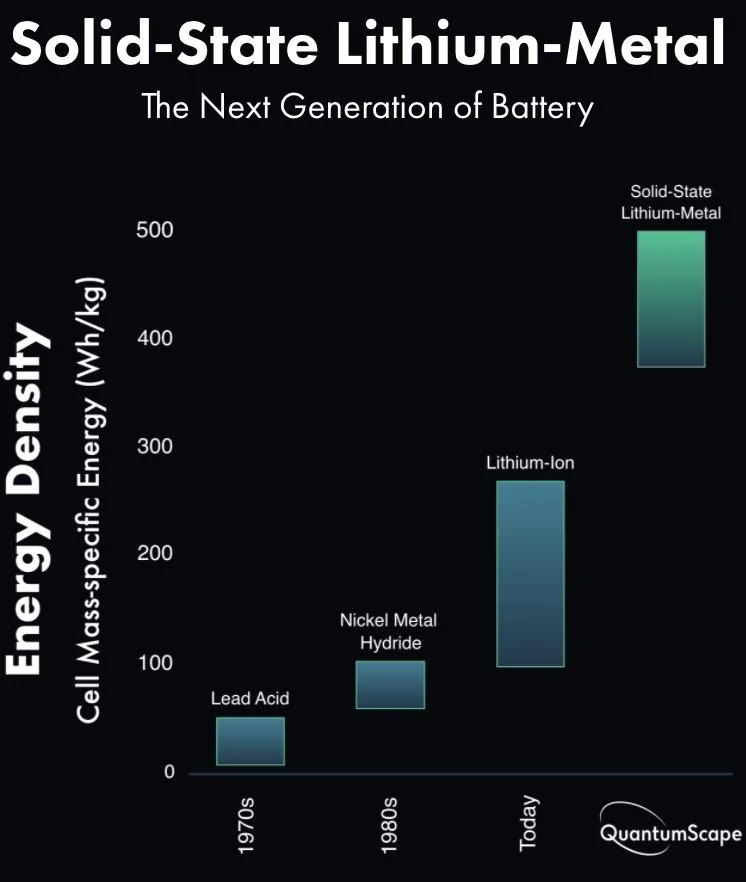
The startup’s next-generation battery cell promises to deliver improvements on all key aspects of battery cells:

The company has delivered cell prototypes that impressed many companies resulting in over $700 million in private investments, including $300 million from Volkswagen.
It is also backed by Bill Gates’ investment fund. Chinese automaker SAIC, tier 1 auto supplier Continental, and several major VCs.
QuantumScape even impressed Tesla cofounder and former CTO JB Straubel who joined the board.
Straubel, who has tested basically every battery cell technology while at Tesla, commented:
Volume production is still a few years away, but if successful, QuantumScape’s batteries could enable a whole new generation of electric vehicles and even enable electric flight.
Electrek’s Take
Full disclosure: I’m long QS.
I’m not a big fan of these SPAC reverse mergers, but QuantumScape really caught my attention.
First off, I am a giant fan of JB, and if he is putting his stamp of approval on the company, that’s a big deal.
I believe he is one of the most knowledgeable person in the world when it comes to batteries, and he is perfectly aware that prototypes don’t mean anything if you can’t bring them to mass production.
The fact that he believes in QuantumScape leads me to believe that the company could become a real player in the battery industry.
Also, Volkswagen, who I think is the legacy automaker most committed to electric vehicles, is heavily backing the company.
Now if their technology is as good as they claim, they won’t have any issue finding buyers, but already having Volkswagen as an early customer is going to facilitate the production ramp with specific electric vehicle programs that they are going to be working on for the German automaker.
SOURCE: ELECTREK
QuantumScape Has Yet To Reveal Key Details About Its Solid-State Batteries but That Has Not Stopped Investors From Doubling Down on Its Imminent Merger With Kensington Capital (KCAC)
QuantumScape, the Bill Gates-backed company trying to develop solid-state batteries, is fast becoming a buzzword on Wall Street given the prevailing market mania that seeks to reward anything related to electric vehicles (EVs) or batteries. However, even as QuantumScape prepares to go public in a matter of days by merging with the Special Purpose Acquisition Company (SPAC), Kensington Capital Acquisition Corp. (NYSE:KCAC 23.5 0.00%), key variables remain regarding the ability of the company to deliver on its hyped promises.
As a refresher, Kensington Capital had filed a Form 424B3 with the SEC on the 12th of November, announcing a special meeting of its shareholders – slated for the 25th of November 2020 – to approve the proposed business combination with QuantumScape. Should the SPAC’s shareholders approve this merger, the shares of the combined company will be listed on the New York Stock Exchange under the ticker symbol – QS.
This brings us to the crux of the matter. Even though conventional lithium-ion batteries rule the energy storage sphere currently, they do pose certain limitations, including the combustibility of the liquid electrolyte that connects the anode to the cathode. However, using a purely lithium metal battery – achieved by eliminating the electrolyte – presents a host of other problems. First of all, any microscopic imperfections are amplified during the charging/discharging process as lithium ions migrate and are then redeposited on the anode. This results in the formation of dendrites that can rupture the battery. Another problem that has been plaguing such solid-state batteries is their rapid degradation over a relatively small number of charging cycles. Given these long-standing challenges, QuantumScape’s battery has naturally garnered tremendous interest. Nonetheless, the company has not been very forthcoming with the specifics of its product formulation.

Bear in mind that QuantumScape claims to have spent over $300 million in R&D to produce a commercially viable lithium-metal solid-state battery. As per the claims of the company, the elimination of anode host materials from these batteries delivers significant cost savings while also increasing the energy density by 88 percent relative to a conventional lithium-ion battery. Crucially, this battery also allows for a 0 to 80 percent fast-charge in 15 minutes. However, we do not know how fast the company’s batteries degrade. As far as the dendrite problem is concerned, the company was purportedly able to eliminate the formation of these structures by utilizing a new material – known as the LLZO – developed by a German chemist, Werner Weppner. Please note though that the LLZO is not completely immune to the dendrite problem and that we do not definitively know whether QuantumScape has indeed employed this solution. However, given the paucity of any other alternative, there is a general consensus that the company has managed to develop a refined approach to using the LLZO.
Of course, QuantumScape is not the only company that claims to have formulated a functional solid-state battery. Samsung has been making waves in this sphere as well:
In a development that is bound to boost confidence in QuantumScape’s technology, Volkswagen increased its stake in the startup by $200 million in June 2020, with much of the investment focused on solid-state battery research. Of course, Volkswagen’s investment makes intuitive sense as a viable solid-state battery would enhance the range of the E-Golf to 750 kilometers while also delivering added safety and faster recharging times. Moreover, QuantumScape also enjoys backing from Microsoft (NASDAQ:MSFT 215.18 0.61%) founder Bill Gates, German auto supplier Continental, Chinese automaker SAIC Motor, and a number of venture capital firms. These high-profile investors have played an important role in boosting the euphoria surrounding QuantumScape and, by extension, the SPAC Kensington Capital. However, the matter of QuantumScape’s penchant for secrecy remains a perennial thorn for the discerning investors who would like to know more about the company’s revolutionary technology. As QuantumScape prepares for the glare that accompanies all public companies, perhaps this is the best time for moving away from the heretofore tight-lipped approach and embrace a more divulgatory attitude.
SOURCE: Wccftech
Kensington Capital Stock Looks Like One of the Best EV Plays Out There
Electric vehicle (EV) stocks generally have been huge winners in 2020, but Kensington Capital (NYSE:KCAC) has been a bit of an exception. Kensington Capital stock soared in early September after announcing its merger with QuantumScape, but has since pulled back some 25% from its highs
It’s a dip that investors, and EV bulls in particular, should consider buying. Electric vehicle adoption is going to accelerate (pardon the pun). But for that to happen, batteries need to improve.
That said, QuantumScape should be one of the companies leading those improvements. The merger with Kensington Capital, a SPAC (special purpose acquisition company), brings the battery supplier to the public markets while also raising a significant amount of capital to fund expansion.
With that capital in hand, and with the merger likely to close in the coming months, Kensington Capital stock looks enormously attractive. As always, investors need to be aware of the risks. But the potential rewards in KCAC stock are as big as those of any stock in the space.
Understanding QuantumScape
QuantumScape is developing solid-state lithium-metal batteries for electric vehicles. If successful, the technology could be revolutionary.
Existing lithium-ion batteries are good — but not great yet. And a core problem is that they’re generally not getting better. As Kensington Capital noted in its merger presentation, lithium-ion batteries have “reached their physical limit.” Energy density simply can’t increase much more, if at all.
For now, lithium-ion batteries can be good enough. But to develop low-cost EVs, as well as pickups, delivery vehicles and even semis, more energy is needed. That’s where QuantumScape aims to come in.
It’s developing a solid-state lithium-metal battery. And if successful, those batteries could represent a huge leap forward.
Costs would come down, since lithium-ion batteries require more materials with anodes as well as higher manufacturing costs. Charging is faster: QuantumScape believes its batteries can get to an 80% charge in less than 15 minutes. Battery life is longer. And as opposed to lithium-ion batteries which use liquids, solid-state batteries are not flammable.
Moreover, it’s worth emphasizing: the technology isn’t proven yet. But QuantumScape has a good shot at getting to that point. An impressive board of directors includes well-known tech executives, venture capitalists, and EV veterans. The company already has spent over $300 million on research and development. The $1 billion-plus raised in the merger (along with a private placement) should fund the company to production.
Thus, there’s a clear path to success here.
Big Potential Upside in Kensington Capital Stock
Overall, if QuantumScape follows that path, the rewards in what is now Kensington Capital stock — and soon will be QuantumScape stock — could be enormous.
In that merger presentation, Kensington and QuantumScape laid out their targets for 2028. The companies expect the sale of 910,000 batteries will lead to revenue of $6.4 billion. EBITDA (earnings before interest, taxes, depreciation and amortization) should clear $1.6 billion, for a healthy 25% margin. And free cash flow at that level of EBITDA would come in around $560 million.
If that scenario played out, QuantumScape likely would be a company worth at least $28 billion, even using conservative 20x EBITDA and 50x free cash flow multiples. Pro forma for the merger, Kensington Capital stock has a market capitalization just over $6 billion.
In other words, if QuantumScape can deliver on its potential, investors in KCAC stock now will at least quadruple their money in about eight years. And if the company outperforms, or multiples are higher (which wouldn’t be a surprise given the company would still have substantial growth ahead), the returns could be even greater.
Mind the Risks
Let’s be clear. Those rewards are not guaranteed. 2028 targets are just that: targets. Advancements in battery technology have been promised since the 19th century. Quite often, they turned out to be disappointments.
Competition will be stiff, as a number of startups are developing their own technologies. Major automakers have entered the market as well. And QuantumScape to some degree will be at the mercy of its customers: no matter how good the battery is, it may not be good enough to generate sales if the vehicle itself isn’t attractive enough.
Also, QuantumScape’s technology remains mostly theoretical. The company has made progress, but it will take years to prove the viability of its products.
Collectively, despite a decade-long history, QuantumScape is still a startup. And investing in startups is a risky endeavor.
But, whether in public or private markets, investors are willing to make those investments because the rewards can be enormous. The same is true of Kensington Capital. The EV revolution is going to need a better battery. And if QuantumScape can deliver that better battery, Kensington Capital stock at $14 will look in retrospect like an absolute steal.
On the date of publication, neither Matt McCall nor the InvestorPlace Research Staff member primarily responsible for this article held (either directly or indirectly) any positions in the securities mentioned in the article.
Matthew McCall left Wall Street to actually help investors — by getting them into the world’s biggest, most revolutionary trends BEFORE anyone else. Click here to see what Matt has up his sleeve now. As of this writing, Matt did not hold a position in any of the aforementioned securities.
The post Kensington Capital Stock Looks Like One of the Best EV Plays Out Thereappeared first on InvestorPlace.
SOURCE: NASDAQ
The stock is already up more than 50%.
QuantumScape is a San Jose-based battery company founded 10 years ago by Jagdeep Singh, a computer scientist and cofounder of Infinera Corporation, a major telecom component supplier, and Tim Holme, a Stanford-educated mechanical engineer.
They are working on solid-state lithium-metal batteries for use in electric vehicles.
The startup’s next-generation battery cell promises to deliver improvements on all key aspects of battery cells:
- Energy: Significantly increases volumetric and gravimetric energy density by eliminating graphite/silicon anode host material.
- Fast Charge: Enables <15 minute fast charge (0 to 80%) by eliminating lithium diffusion bottleneck in anode host material.
- Life: Increased life by eliminating capacity loss at anode interface.
- Safety: Eliminates organic separator. Solid-state separator is nonflammable and noncombustible.
- Cost: Lower cost by eliminating anode host material and manufacturing costs.
The company has delivered cell prototypes that impressed many companies resulting in over $700 million in private investments, including $300 million from Volkswagen.
It is also backed by Bill Gates’ investment fund. Chinese automaker SAIC, tier 1 auto supplier Continental, and several major VCs.
QuantumScape even impressed Tesla cofounder and former CTO JB Straubel who joined the board.
Straubel, who has tested basically every battery cell technology while at Tesla, commented:
Now the company has gone public through a SPAC deal that brought in over $1 billion that they intend to use to bring their battery technology to mass productioin.QuantumScape’s solid-state anode-less design represents the most elegant architecture I’ve seen for a lithium-based battery system, and the company has an opportunity to redefine the battery landscape.
Volume production is still a few years away, but if successful, QuantumScape’s batteries could enable a whole new generation of electric vehicles and even enable electric flight.
Electrek’s Take
Full disclosure: I’m long QS.
I’m not a big fan of these SPAC reverse mergers, but QuantumScape really caught my attention.
First off, I am a giant fan of JB, and if he is putting his stamp of approval on the company, that’s a big deal.
I believe he is one of the most knowledgeable person in the world when it comes to batteries, and he is perfectly aware that prototypes don’t mean anything if you can’t bring them to mass production.
The fact that he believes in QuantumScape leads me to believe that the company could become a real player in the battery industry.
Also, Volkswagen, who I think is the legacy automaker most committed to electric vehicles, is heavily backing the company.
Now if their technology is as good as they claim, they won’t have any issue finding buyers, but already having Volkswagen as an early customer is going to facilitate the production ramp with specific electric vehicle programs that they are going to be working on for the German automaker.
SOURCE: ELECTREK
QuantumScape Has Yet To Reveal Key Details About Its Solid-State Batteries but That Has Not Stopped Investors From Doubling Down on Its Imminent Merger With Kensington Capital (KCAC)
QuantumScape, the Bill Gates-backed company trying to develop solid-state batteries, is fast becoming a buzzword on Wall Street given the prevailing market mania that seeks to reward anything related to electric vehicles (EVs) or batteries. However, even as QuantumScape prepares to go public in a matter of days by merging with the Special Purpose Acquisition Company (SPAC), Kensington Capital Acquisition Corp. (NYSE:KCAC 23.5 0.00%), key variables remain regarding the ability of the company to deliver on its hyped promises.
As a refresher, Kensington Capital had filed a Form 424B3 with the SEC on the 12th of November, announcing a special meeting of its shareholders – slated for the 25th of November 2020 – to approve the proposed business combination with QuantumScape. Should the SPAC’s shareholders approve this merger, the shares of the combined company will be listed on the New York Stock Exchange under the ticker symbol – QS.
This brings us to the crux of the matter. Even though conventional lithium-ion batteries rule the energy storage sphere currently, they do pose certain limitations, including the combustibility of the liquid electrolyte that connects the anode to the cathode. However, using a purely lithium metal battery – achieved by eliminating the electrolyte – presents a host of other problems. First of all, any microscopic imperfections are amplified during the charging/discharging process as lithium ions migrate and are then redeposited on the anode. This results in the formation of dendrites that can rupture the battery. Another problem that has been plaguing such solid-state batteries is their rapid degradation over a relatively small number of charging cycles. Given these long-standing challenges, QuantumScape’s battery has naturally garnered tremendous interest. Nonetheless, the company has not been very forthcoming with the specifics of its product formulation.
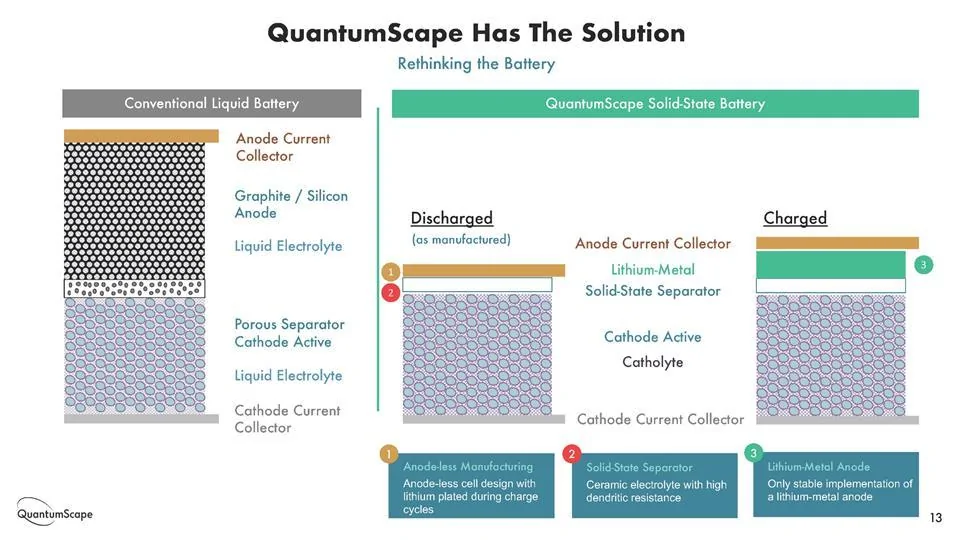
Bear in mind that QuantumScape claims to have spent over $300 million in R&D to produce a commercially viable lithium-metal solid-state battery. As per the claims of the company, the elimination of anode host materials from these batteries delivers significant cost savings while also increasing the energy density by 88 percent relative to a conventional lithium-ion battery. Crucially, this battery also allows for a 0 to 80 percent fast-charge in 15 minutes. However, we do not know how fast the company’s batteries degrade. As far as the dendrite problem is concerned, the company was purportedly able to eliminate the formation of these structures by utilizing a new material – known as the LLZO – developed by a German chemist, Werner Weppner. Please note though that the LLZO is not completely immune to the dendrite problem and that we do not definitively know whether QuantumScape has indeed employed this solution. However, given the paucity of any other alternative, there is a general consensus that the company has managed to develop a refined approach to using the LLZO.
Of course, QuantumScape is not the only company that claims to have formulated a functional solid-state battery. Samsung has been making waves in this sphere as well:
In a development that is bound to boost confidence in QuantumScape’s technology, Volkswagen increased its stake in the startup by $200 million in June 2020, with much of the investment focused on solid-state battery research. Of course, Volkswagen’s investment makes intuitive sense as a viable solid-state battery would enhance the range of the E-Golf to 750 kilometers while also delivering added safety and faster recharging times. Moreover, QuantumScape also enjoys backing from Microsoft (NASDAQ:MSFT 215.18 0.61%) founder Bill Gates, German auto supplier Continental, Chinese automaker SAIC Motor, and a number of venture capital firms. These high-profile investors have played an important role in boosting the euphoria surrounding QuantumScape and, by extension, the SPAC Kensington Capital. However, the matter of QuantumScape’s penchant for secrecy remains a perennial thorn for the discerning investors who would like to know more about the company’s revolutionary technology. As QuantumScape prepares for the glare that accompanies all public companies, perhaps this is the best time for moving away from the heretofore tight-lipped approach and embrace a more divulgatory attitude.
SOURCE: Wccftech
Kensington Capital Stock Looks Like One of the Best EV Plays Out There
Electric vehicle (EV) stocks generally have been huge winners in 2020, but Kensington Capital (NYSE:KCAC) has been a bit of an exception. Kensington Capital stock soared in early September after announcing its merger with QuantumScape, but has since pulled back some 25% from its highs
It’s a dip that investors, and EV bulls in particular, should consider buying. Electric vehicle adoption is going to accelerate (pardon the pun). But for that to happen, batteries need to improve.
That said, QuantumScape should be one of the companies leading those improvements. The merger with Kensington Capital, a SPAC (special purpose acquisition company), brings the battery supplier to the public markets while also raising a significant amount of capital to fund expansion.
With that capital in hand, and with the merger likely to close in the coming months, Kensington Capital stock looks enormously attractive. As always, investors need to be aware of the risks. But the potential rewards in KCAC stock are as big as those of any stock in the space.
Understanding QuantumScape
QuantumScape is developing solid-state lithium-metal batteries for electric vehicles. If successful, the technology could be revolutionary.
Existing lithium-ion batteries are good — but not great yet. And a core problem is that they’re generally not getting better. As Kensington Capital noted in its merger presentation, lithium-ion batteries have “reached their physical limit.” Energy density simply can’t increase much more, if at all.
For now, lithium-ion batteries can be good enough. But to develop low-cost EVs, as well as pickups, delivery vehicles and even semis, more energy is needed. That’s where QuantumScape aims to come in.
It’s developing a solid-state lithium-metal battery. And if successful, those batteries could represent a huge leap forward.
Costs would come down, since lithium-ion batteries require more materials with anodes as well as higher manufacturing costs. Charging is faster: QuantumScape believes its batteries can get to an 80% charge in less than 15 minutes. Battery life is longer. And as opposed to lithium-ion batteries which use liquids, solid-state batteries are not flammable.
Moreover, it’s worth emphasizing: the technology isn’t proven yet. But QuantumScape has a good shot at getting to that point. An impressive board of directors includes well-known tech executives, venture capitalists, and EV veterans. The company already has spent over $300 million on research and development. The $1 billion-plus raised in the merger (along with a private placement) should fund the company to production.
Thus, there’s a clear path to success here.
Big Potential Upside in Kensington Capital Stock
Overall, if QuantumScape follows that path, the rewards in what is now Kensington Capital stock — and soon will be QuantumScape stock — could be enormous.
In that merger presentation, Kensington and QuantumScape laid out their targets for 2028. The companies expect the sale of 910,000 batteries will lead to revenue of $6.4 billion. EBITDA (earnings before interest, taxes, depreciation and amortization) should clear $1.6 billion, for a healthy 25% margin. And free cash flow at that level of EBITDA would come in around $560 million.
If that scenario played out, QuantumScape likely would be a company worth at least $28 billion, even using conservative 20x EBITDA and 50x free cash flow multiples. Pro forma for the merger, Kensington Capital stock has a market capitalization just over $6 billion.
In other words, if QuantumScape can deliver on its potential, investors in KCAC stock now will at least quadruple their money in about eight years. And if the company outperforms, or multiples are higher (which wouldn’t be a surprise given the company would still have substantial growth ahead), the returns could be even greater.
Mind the Risks
Let’s be clear. Those rewards are not guaranteed. 2028 targets are just that: targets. Advancements in battery technology have been promised since the 19th century. Quite often, they turned out to be disappointments.
Competition will be stiff, as a number of startups are developing their own technologies. Major automakers have entered the market as well. And QuantumScape to some degree will be at the mercy of its customers: no matter how good the battery is, it may not be good enough to generate sales if the vehicle itself isn’t attractive enough.
Also, QuantumScape’s technology remains mostly theoretical. The company has made progress, but it will take years to prove the viability of its products.
Collectively, despite a decade-long history, QuantumScape is still a startup. And investing in startups is a risky endeavor.
But, whether in public or private markets, investors are willing to make those investments because the rewards can be enormous. The same is true of Kensington Capital. The EV revolution is going to need a better battery. And if QuantumScape can deliver that better battery, Kensington Capital stock at $14 will look in retrospect like an absolute steal.
On the date of publication, neither Matt McCall nor the InvestorPlace Research Staff member primarily responsible for this article held (either directly or indirectly) any positions in the securities mentioned in the article.
Matthew McCall left Wall Street to actually help investors — by getting them into the world’s biggest, most revolutionary trends BEFORE anyone else. Click here to see what Matt has up his sleeve now. As of this writing, Matt did not hold a position in any of the aforementioned securities.
The post Kensington Capital Stock Looks Like One of the Best EV Plays Out Thereappeared first on InvestorPlace.
SOURCE: NASDAQ
Sponsored