HaulingAss
Well-known member
- Joined
- Oct 3, 2020
- Threads
- 28
- Messages
- 10,298
- Reaction score
- 20,706
- Location
- Western Washington, USA
- Vehicles
- Cybertruck DM, 2010 F-150, 2018 Performance Model 3, 2024 Performance Model 3

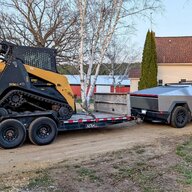
I see it differently. What's really needed in Eastern Montana is a higher density of Superchargers. But, given the very low level of demand (beyond I-90), it's not a priority for Tesla. The only route through Eastern Montana that has ANY Supercharger coverage after I-90 dips south into Wyoming is I-94 which does have some gaps of around 150 miles (which would require some serious compromises pulling a trailer in the winter). I don't know if there are 3rd party DCFCers filling in the gaps, but I really doubt it considering how remote and lonely the route is. And I'm of the mindset that a Tesla driver should only have to use DCFCers that actually appear on the center screen. No adapters, no running multiple apps just to locate power.After driving the speed limit across a couple stretches in eastern Montana I would say it is needed. Some stretches between superchargers are not achievable with a small trailer in winter.
Tesla did not even attempt to cover any of the more northerly routes (south of Canada and north of I-94). That's because Tesla is not trying to be everything to everyone, they are focused on being everything to 95% of the people (for now). Because they can more efficiently meet their goals by encouraging EV adoption amongst the 95% of people who still drive with gasoline and never take the uncovered or lightly covered routes through Eastern Montana.
Those remote locations are very expensive to cover for multiple reasons:
Distance to contruction companies to install the Superchargers
Distance to service techs to keep the Superchargers functional on an ongoing basis
Distance to high tension lines with enough power available
Very low demand (new stations in many of those areas would go all day sometimes without any useage).
In time, as EV adoption passes the 50-75% mark, it will make sense to start covering those lonely roads through the grain fields and grazing lands. In 2010 I drove the most northerly route (US 2, which Tesla hasn't even attempted to service yet) during a sunny but frigid day in January. I was towing a horse trailer with an F-150, and I would go over an hour or more without seeing a single oncoming vehicle. It was always a pickup truck, most often an F-150, and the lone driver would almost always give me a friendly wave as we crossed paths in the middle of the open fields.
But my main point is that, for that use case, gas or diesel still makes more sense than spending millions of dollars installing and maintaining chargers that would barely get used. I-94 is covered to a minimal degree, but only if you are not towing in the middle of winter. That stretch between Billings and Miles City is 140 miles (and that assumes you don't do any exploring in-between). Because it takes so long to charge to 100%, it's really only convenient if you happen to be staying in Miles City or Billings the night before so you can leave with 100% charge (and under adverse wind conditions you might even need to slow down below 75 mph). The fact that the more northerly routes are not covered at all makes me sad too, because I love driving the loneliest roads I can find, especially when I'm cruising along quietly in a futuristic electric vehicle. But it will come with time. Big batteries are probably not the most efficient solution, compared to more DCFCers. To cross some of those Eastern Montana routes in the middle of winter, with a headwind, towing a trailer, you could easly need a 500-kWh battery (more than the payload capacity of the Cybertruck). That's why more DCFCers are the real answer.
Sponsored