
JBee
Well-known member
- First Name
- JB
- Joined
- Nov 22, 2019
- Threads
- 18
- Messages
- 4,913
- Reaction score
- 6,362
- Location
- Australia
- Vehicles
- Cybertruck
- Occupation
- . Professional Hobbyist

There's a few dynamics at play here which I will try to identify and compare to how I expect the CT will work. Just for fun..Both the Suburban and the Jeep had only traction problems.
I think the CT, being no larger than the suburban (which fit the trail), having better clearance than the suburban (which didn’t bottom out), and more powerful than the jeep (which eventually did pull itself up), has to only find better traction than the jeep or suburban.
And as for the traction, while the size and contact patch of the tires will be a big variable, just as important is weight over the tires.
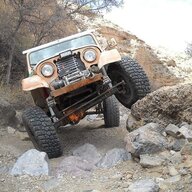
That Cherokee has large, gripping, tires but almost no weight over its rear tires, so they just spun.
The weight and weight distribution of a CT I think let’s it crawl this trail assuming any modestly trail worthy 35” tire.
I await your testing of this!
The wheelbase of some of the vehicles match the terrain undulations better. So for example: instead of having a rise happening both at the same time on the front and rear axle, a shorter wheelbase could get it's front or back axle up first, which then helps get the next axle up etc. The opposite can also be true, giving the longer wheelbase an advantage, by getting more vehicle mass over the top of a ridge on a section where the front could be level.
Then there's tyre pressure that also helps the tyre deform over the rock shape for better grip. The surface was a combination of loose sand in pockets and solid rock, which means picking an ideal tyre type is a bit harder, a smoother tread pattern but low pressure capable tyre would likely work best. I don't think the Suburban tyres were a good fit, and tyre diameter would also play a roll here.
As for overall weight and distribution, the hill incline would naturally push the center of mass backwards, putting more weight on the rear axle. The ICE weight in the front would be beneficial here on the incline sometimes. The problem is here though that it is not always beneficial, for example when the front is clear but the rear still has to climb. In that situation the front needs to pull the rear up, so more front weight would be better. Having weight higher up in the vehicle will also mean the center of mass will shift more on an incline, and make the vehicle more prone to tip sideways.
The alternating steering angle, in particular locking to one direction would have helped put more pressure on the steering wheels by only exposing side of the tyre to the ridge, meaning less surface area, but same force from the vehicle weight. On a hard rock surface less contact patch can be better if it's not wet or covered in dirt. The other issue that can change traction is if the rock is shaped the same as the tyre or has a bump.
The reversing and launching into the ridge or "rocking" helps increase traction by artificially increasing the force on the tyre contact patch by using vehicle momentum. Even doing a burnout on the rock helps in that it deposits some rubber on the rock for extra traction like on a drag strip.
But if we had a CT going up that path, the situation would be significantly different:
- The independent air suspension would distribute the vehicle weight evenly across the 4 wheels until it reaches maximum suspension articulation
- The air suspension could level out the vehicle whilst climbing, placing more weight over the front for better overall traction, and stopping the CT from tilting sideways and slipping down
- With active damping the suspension could stop the suspension from jumping by increasing the damping rate
- The 4WS will help in positioning the CT in the right place to climb, and to change direction in times of low traction and also vary the wheelbase to a certain degree by crab steering, it will also improve rear axle tracking and allow for turning without slip.
- The net effect of the above improved traction, would make it possible for the toque vectoring to apply force up to the traction limit of each of the tyre. This means the maximum possible amount of force can be applied to transverse the incline and terrain. This could be from 2-4times as much tractive force in comparison to a open diff indpendant/live axle steel sprung competitor. Torque vectoring will also help steer.
- Onboard sensors could also be used in conjunction with a CoG calculation to avoid roll-overs, ToF cameras can do terrain mapping and route optimisation, 360 camera for driving even without a spotter etc

Sponsored