
Sponsored

Starlink v2 and T-Mobile to offer global coverage to existing mobiles!

OP
OP
JBee

JBee

Well-known member
First Name
JB
Joined
Nov 22, 2019
Threads
18
Messages
4,913
Reaction score
6,362
Location
Australia
Vehicles
Cybertruck
Occupation
. Professional Hobbyist
Country flag
Something in the commentary of the presentation got me thinking....

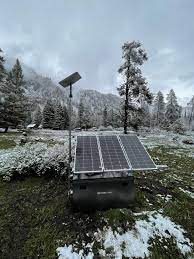
I wonder if T-Mobile would allow individuals or small towns to start pairing a Starlink terminal with a T-mobile cell tower to enable full data connectivity in remote towns. Right now, nearly the whole state of Nebraska has sketchy to completely non-existent cell coverage. But if a single telephone pole could be erected in the center of town, one could have solar cells, attached for power, a Starlink terminal at the top, and cell antennae attached to the sides. For many small towns, a single tower would have enough coverage for the whole town. And with the Starlink level of connectivity, there could be at least some shared internet connectivity too.

For more populous towns, add more towers. Or for remote ranches/farms that want connectivity, a single tower might just do the trick. Imagine a remote luxury resort that had full coverage.

Allowing small operators to install this hardware would give even better coverage for T-Mobile in remote areas but without the high installation and maintenance costs that has been keeping these kinds of installations from happening. And by making it a standardized modular deployment, the various components could be replaced for servicing or upgrades by the tower owner just by ordering the needed components separately.
This is what we do in my sons company as a WISP broadband carrier. Difference is we use the phones wifi calling capabilities instead of a pico cell tower as the mobile frequencies are all licensed to the big mobile carriers. Thats why SpaceX had to team up with TMobile to get access to the C-Band frequencies to do their Starlink cell hack. Typically we try to use our own long range wireless backhaul (5Ghz) though.

Also dabbled in using SDR radios as pico mobile cells from UAV's but that was for SAR.
Sponsored

 

FutureBoy

Well-known member
First Name
Reginald
Joined
Oct 1, 2020
Threads
215
Messages
3,557
Reaction score
6,063
Location
Kirkland WA USA
Vehicles
Toyota Sienna
Occupation
Financial Advisor
Country flag
This is what we do in my sons company as a WISP broadband carrier. Difference is we use the phones wifi calling capabilities instead of a pico cell tower as the mobile frequencies are all licensed to the big mobile carriers. Thats why SpaceX had to team up with TMobile to get access to the C-Band frequencies to do their Starlink cell hack. Typically we try to use our own long range wireless backhaul (5Ghz) though.

Also dabbled in using SDR radios as pico mobile cells from UAV's but that was for SAR.
We should talk sometime.

I can see why you would go to WiFi for signal as there would be no need to use licensed spectrum. Seems like the difficulty though would be in how far the WiFi signal can travel and the possible interference from other WiFi signals in a town. Unless you were able to get a good mesh network set up. (Are there any good mesh networks available yet?)

With the number of tech innovations coming to farms lately, it would seem natural to start using cell networks if they were available because there wouldn't need to be a lot of towers around to get acceptable coverage. But yes, one would have to have a licensed package from one of the cell companies for that to be allowed. I was just thinking that since SpaceX and T-Mobile were already partnering up, perhaps there could be a remote product that further paired the 2 services to modularize access for remote regions.

Additionally, if such a product were demonstrated, perhaps charities could convince cell carriers in other countries to enable a similar product so that remote villages and islands could be serviced as well. There are a number of charities that will dig water wells for remote villages. This could be an additional service the charity could provide for an area. Imagine the ability to suddenly connect a rural town to the internet and allow remote learning, online trading of goods, etc.

WiFi networks can be a step forward. But a cell network would really make things work so much better. Assuming one could get access to the licensed network.
 

FutureBoy

Well-known member
First Name
Reginald
Joined
Oct 1, 2020
Threads
215
Messages
3,557
Reaction score
6,063
Location
Kirkland WA USA
Vehicles
Toyota Sienna
Occupation
Financial Advisor
Country flag
Sure it is. But how many towers and repeaters will be needed? For a small town, a single cell tower can cover the whole town and have enough bandwidth to cover a large number of calls happening simultaneously. Probably more bandwidth than a normal Starlink base station will be able to handle.

If you try to do the same thing with WiFi, how are you going to cover the whole town? A single WiFi base can cover a single house/property well but it will need to be wired into a local network of some sort. And for good coverage, practically every property in town will need to be wired. And each base station will need to be configured. Not to mention electricity hookups.

So sure, if you just want a connection for a single person on a single property, WiFi connected to Starlink is ideal.

If you want to provide access for the whole town to use with as many simultaneous connections as possible, from all locations in town, WiFi will be the death of you or make the project way too expensive to be practical.

But hey, YMMV. If you have a great WiFi based design that actually works, I'd love to see it.

Here are some generic parameters to design for. Town is 1-2 square miles (2-5 square kilometers) in size with a population of 1,000 to 3,000. Terrain is relatively flat. For the non-profit version of this, the population might be up to 20,000 and the terrain might not be so flat.


Top