cvalue13
Well-known member
- Joined
- Aug 17, 2022
- Threads
- 74
- Messages
- 7,153
- Reaction score
- 13,769
- Location
- Austin, TX
- Vehicles
- F150L
- Occupation
- Fun-employed

deep cut thinking, as ever!it claims. no proof. it's BS short selling fud.
Sponsored
deep cut thinking, as ever!it claims. no proof. it's BS short selling fud.
Tesla ignoring potential user errors like tire maintenance is not helpful, sure.Reuters article about range complaints and tactics used to close cases. I get Tesla not wanting to have service centers choked with ghost hunts, but if some of what the article claims is true then I am pretty disappointed in Tesla. Things that can dramatically affect range like a bad alignment or failing tire will not show with remote diagnostics, for example. So closing cases and doing telemetry only diagnostics is not good enough.
https://www.reuters.com/investigates/special-report/tesla-batteries-range


I will absolutely agree that the article is not well balanced vis a vis ICE vs EV range factors, and it's not a scientific or unbiased treatment on range issues on EVs in general.
I really don't care about all that.
I care about Tesla's reaction to customer complaints. Yep, some of em can be "fixed" with customer education on ... physics. Yes, some issues can be identified and/or ruled out via telemetry, and great for Tesla for having the ability to remote diagnose.
But there will be a subset of issues that have nothing to do with customer understanding of cars, or issues that a BMS can measure. If one of those comes up on my Tesla, I do not want to have to cut through layers of red tape to get my car physically checked on and actually fixed. If Tesla is actively stonewalling those legitimate cases to keep them from seeing the light of day, that needs to stop.
Again, I'm pro-EV. I have a 2023 Model Y, and I'm generally pretty satisfied with it so far. I have no FUD-ge to make against either. But I will call a spade a spade, and bad customer service and business practices are definitely going to get called out by yours truly.
The article said nothing of the sort? Maybe you were assuming "mild spring conditions" when the user's complaint was about a trip in March, but they were in Colorado where it's still damn cold then.But that article said the user said a one year old EV had something like 40-50% the range in mild spring conditions.
Something is off. They should be able to replicate that. If not I think the user was lying.
I've read several articles on this case. The last article I read (maybe not the one quoted on this thread) said they drove from Colorado to California in March of 2022. Colorado Arizona and California in spring of 2022 was, in fact, a mild year.The article said nothing of the sort? Maybe you were assuming "mild spring conditions" when the user's complaint was about a trip in March, but they were in Colorado where it's still damn cold then.
Yes, at below-freezing temperatures, range is cut significantly.
Sure.I've read several articles on this case. The last article I read (maybe not the one quoted on this thread) said they drove from Colorado to California in March of 2022. Colorado Arizona and California in spring of 2022 was, in fact, a mild year.

since it's fun to be accurate - just some backup to several of the central claims in the report, which you say doesn't present any "proof" ... these are just some examples, and there are many more independent tests, etc., to back up the general context that Tesla's publicized range estimates are notoriously unreliable on average, as compared to any other OEM's range estimates on average.it claims. no proof. it's BS short selling fud.
Better cancel your CT reservation right away because Tesla are sneaky about their range estimatesReuters article about range complaints and tactics used to close cases. I get Tesla not wanting to have service centers choked with ghost hunts, but if some of what the article claims is true then I am pretty disappointed in Tesla. Things that can dramatically affect range like a bad alignment or failing tire will not show with remote diagnostics, for example. So closing cases and doing telemetry only diagnostics is not good enough.
https://www.reuters.com/investigates/special-report/tesla-batteries-range

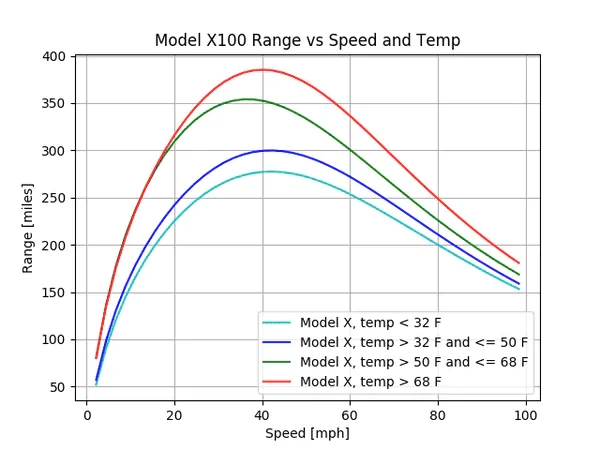
Maybe everyone would be better suited if the EPA tested at posted highway speed limits which, on some parts of some highways, can reach 80 mph. Perhaps they should have a range of tests and placard ratings: 25, 35, 45, 55, 65, and 75 rather than city and highway. And maybe they should reproduce your graph and have temperature ratings. The EPA should ‘not’ be taking guidance from OEMs unless the EPA dictates exact testing protocols and requires documented proof that the protocols were adhered to. Or is that how OEM guidance works now? They do it for SMOG testing so it shouldn’t be hard.
Range is highly variable.
 ?
?
maybe that's trueMaybe everyone would be better suited if the EPA tested at posted highway speed limits which, on some parts of some highways, can reach 80 mph. Perhaps they should have a range of tests and placard ratings: 25, 35, 45, 55, 65, and 75 rather than city and highway.
the EPA needs to revise its BEV-specific ratings tests and procedures.The EPA should ‘not’ be taking guidance from OEMs unless the EPA dictates exact testing protocols and requires documented proof that the protocols were adhered to.
Lol nice tryBetter cancel your CT reservation right away because Tesla are sneaky about their range estimates
This has been well known for years, and it's a non-issue. Not at all worthy of the "big deal" the article makes it out to be.So Tesla is playing in bounds. It just seems to have the philosophy that it wants to be as aggressive as possible in order attract people to BEVs, at an accepted risk of errors tending to cause customer frustration. Conversely, other OEMs have the apparent philosophy of accepting more conservative approach, at the benefit of risk of errors tending to instead cause customer postive surprises.