Sponsored

Not a good look for Tesla: diversion team tactics to deal with range complaints

OP
OP
fhteagle

fhteagle

Well-known member
Joined
Sep 28, 2022
Threads
5
Messages
305
Reaction score
689
Location
Telluride, CO
Vehicles
2013 Volt, CT Res x2
Country flag
I will absolutely agree that the article is not well balanced vis a vis ICE vs EV range factors, and it's not a scientific or unbiased treatment on range issues on EVs in general.

I really don't care about all that.

I care about Tesla's reaction to customer complaints. Yep, some of em can be "fixed" with customer education on ... physics. Yes, some issues can be identified and/or ruled out via telemetry, and great for Tesla for having the ability to remote diagnose.

But there will be a subset of issues that have nothing to do with customer understanding of cars, or issues that a BMS can measure. If one of those comes up on my Tesla, I do not want to have to cut through layers of red tape to get my car physically checked on and actually fixed. If Tesla is actively stonewalling those legitimate cases to keep them from seeing the light of day, that needs to stop.

Again, I'm pro-EV. I have a 2023 Model Y, and I'm generally pretty satisfied with it so far. I have no FUD-ge to make against either. But I will call a spade a spade, and bad customer service and business practices are definitely going to get called out by yours truly.
 

Startreknerd

Well-known member
First Name
Devin
Joined
Apr 14, 2021
Threads
3
Messages
298
Reaction score
303
Location
California
Vehicles
Tesla Model S, Tesla Model 3
Occupation
Medical Clerk
Country flag
Reuters article about range complaints and tactics used to close cases. I get Tesla not wanting to have service centers choked with ghost hunts, but if some of what the article claims is true then I am pretty disappointed in Tesla. Things that can dramatically affect range like a bad alignment or failing tire will not show with remote diagnostics, for example. So closing cases and doing telemetry only diagnostics is not good enough.

https://www.reuters.com/investigates/special-report/tesla-batteries-range
Tesla ignoring potential user errors like tire maintenance is not helpful, sure.

But that article said the user said a one year old EV had something like 40-50% the range in mild spring conditions.

Something is off. They should be able to replicate that. If not I think the user was lying.

40-50% reduction in mild weather is unheard of. Especially if they can't reproduce it.

Perhaps they were speeding at 80-90 mph for hours.

Two hours at 90 mph will get you 180 miles sure, but that 320 mile range might have used up going 25 over the speed limit at those inefficient speeds.

Diminishing returns with air resistance sucks.
 
Last edited:

CyberGus

Well-known member
First Name
Gus
Joined
May 22, 2021
Threads
91
Messages
10,314
Reaction score
34,186
Location
Austin, TX
Vehicles
1981 DeLorean, 2024 Cybertruck
Occupation
IT Specialist
Country flag
I'm going to install hidden cameras in my ICE car, and then take it to the dealer's service center with proof that my MPG is below the advertised EPA rating, and could they fix it plz kthx

Tesla Cybertruck Not a good look for Tesla: diversion team tactics to deal with range complaints popcorn-michael-jackson
 

Startreknerd

Well-known member
First Name
Devin
Joined
Apr 14, 2021
Threads
3
Messages
298
Reaction score
303
Location
California
Vehicles
Tesla Model S, Tesla Model 3
Occupation
Medical Clerk
Country flag
I will absolutely agree that the article is not well balanced vis a vis ICE vs EV range factors, and it's not a scientific or unbiased treatment on range issues on EVs in general.

I really don't care about all that.

I care about Tesla's reaction to customer complaints. Yep, some of em can be "fixed" with customer education on ... physics. Yes, some issues can be identified and/or ruled out via telemetry, and great for Tesla for having the ability to remote diagnose.

But there will be a subset of issues that have nothing to do with customer understanding of cars, or issues that a BMS can measure. If one of those comes up on my Tesla, I do not want to have to cut through layers of red tape to get my car physically checked on and actually fixed. If Tesla is actively stonewalling those legitimate cases to keep them from seeing the light of day, that needs to stop.

Again, I'm pro-EV. I have a 2023 Model Y, and I'm generally pretty satisfied with it so far. I have no FUD-ge to make against either. But I will call a spade a spade, and bad customer service and business practices are definitely going to get called out by yours truly.

The article didn't say he was turned away at a service center. I seriously doubt they would simply turn away a warranty request.

I've never had problems with going in or making an appointment.


CyberGus

Well-known member
First Name
Gus
Joined
May 22, 2021
Threads
91
Messages
10,314
Reaction score
34,186
Location
Austin, TX
Vehicles
1981 DeLorean, 2024 Cybertruck
Occupation
IT Specialist
Country flag
But that article said the user said a one year old EV had something like 40-50% the range in mild spring conditions.

Something is off. They should be able to replicate that. If not I think the user was lying.
The article said nothing of the sort? Maybe you were assuming "mild spring conditions" when the user's complaint was about a trip in March, but they were in Colorado where it's still damn cold then.

Yes, at below-freezing temperatures, range is cut significantly.
 

Startreknerd

Well-known member
First Name
Devin
Joined
Apr 14, 2021
Threads
3
Messages
298
Reaction score
303
Location
California
Vehicles
Tesla Model S, Tesla Model 3
Occupation
Medical Clerk
Country flag
The article said nothing of the sort? Maybe you were assuming "mild spring conditions" when the user's complaint was about a trip in March, but they were in Colorado where it's still damn cold then.

Yes, at below-freezing temperatures, range is cut significantly.
I've read several articles on this case. The last article I read (maybe not the one quoted on this thread) said they drove from Colorado to California in March of 2022. Colorado Arizona and California in spring of 2022 was, in fact, a mild year.
 

CyberGus

Well-known member
First Name
Gus
Joined
May 22, 2021
Threads
91
Messages
10,314
Reaction score
34,186
Location
Austin, TX
Vehicles
1981 DeLorean, 2024 Cybertruck
Occupation
IT Specialist
Country flag
I've read several articles on this case. The last article I read (maybe not the one quoted on this thread) said they drove from Colorado to California in March of 2022. Colorado Arizona and California in spring of 2022 was, in fact, a mild year.
Sure.

https://world-weather.info/forecast/usa/denver/march-2022/

The historical chart shows temperatures from 70ºF to 1ºF. Do you know which days they drove, or at what times? Colorado is also mountainous, with many elevation changes and weather patterns. Do you know which route they took?

I ask these rhetorical questions only to point out that you are assuming things not claimed by the driver in question, nor presented in the article. ?‍♂
 

cvalue13

Well-known member
Joined
Aug 17, 2022
Threads
74
Messages
7,153
Reaction score
13,769
Location
Austin, TX
Vehicles
F150L
Occupation
Fun-employed
Country flag
it claims. no proof. it's BS short selling fud.
since it's fun to be accurate - just some backup to several of the central claims in the report, which you say doesn't present any "proof" ... these are just some examples, and there are many more independent tests, etc., to back up the general context that Tesla's publicized range estimates are notoriously unreliable on average, as compared to any other OEM's range estimates on average.

This isn't FUD. This is being a fan of Tesla and wanting it to do better, or do different. Taking any critique of the company, screaming "FUD" reactively, is the equivalent of "patriots" who cling to "love it or leave it" as though the system doesn't require and welcome critique and correction.

and so that people are a *little* bit slower to just blabber "MSM" repetitively, I'll only use Electrek reporting:

Tesla fined $2.2 million by the Korea Fair Trade Commission (KFTC) for false advertising regarding its range. "KFTC has announced that it is imposing a 2.85 billion won ($2.2 million) fine on Tesla for not clearly stating that its range might drop significantly in cold weather. Following the decision, Tesla has now remedied the situation by adding fine print where the range is displayed on its website."​

Based on the above, an initially good critique of the Reuters report would be essentially "of course range decreases in cold weather, and Tesla does better than other manufactures in this cold weather drop" - but notice that the result of such a response undercuts the argument that Tesla's generally underperforming EPA range results is often primarily a result cold weather conditions; for Tesla to both perform best in cold weather and under-perform wrt EPA range, it begs the original question being asked.

SAE (Society of Automotive Engineers): three Tesla models post worst performance of all automakers in range vs. EPA estimates, falling short of advertised ranges by an average of 26%. "The EV pioneer pushes the limits of government testing regulations that govern the claims automakers put on window stickers."​

Tesla range estimates called into question in independent tests. "There are no good range estimates for electric vehicles. There are just bad ones, with some being not as bad as others. To be fair, that’s also the case for gasoline-powered vehicles.... Tesla is more aggressive in its advertised range while other automakers tend to be more conservative. Edmunds was unable to achieve the EPA range on any of the Tesla vehicles, while they beat the EPA range by some decent margins in other electric vehicles."​

This last one I'll share below, to me, REALLY demonstrates Tesla's willingness to use reported range not as a reliable expectation of customers but instead as a market manipulation - because in the below case Tesla actively REDUCED a cheaper model's EPA range in order to create the appearance of range parity with a more expensive model]
"according to the EPA test results, the Dual Motor Model 3 vehicles officially have an efficiency of 29 kWh per 100 miles versus 26 kWh per 100 miles for the single motor version despite both being rated at 310 miles of range... Tesla changed the range multiplier of the Model 3 Dual Motor versions, something they are allowed to do, in order to get the same 310-mile range. Otherwise, they would have ended up with 308 miles of range. [Tesla] reduced the EPA range of the Long Range rear-wheel-drive Model 3 in order to also get 310 miles [because] ... Tesla didn’t want to advertise the range of the more expensive Dual Motor version as being less than the rear-wheel-drive single motor version."​

Taking the Reuters report on its face, together with the widely recognized and reported history of Tesla on this topic, applying the standard critical thinking and assessment of journalism, I think at the very least the fair take-away can be summarized by the following take from Electrek (from the last cited story above):

Electrek’s Take​
Let’s give Tesla the benefit of the doubt and say that the multiplier they used for the Model 3 Dual Motor versions is actually more accurate and therefore, it makes sense for them to have a 310-mile EPA rating and advertised range.​
I have no problem with that, but I don’t like that they reduced the EPA range of the Long Range rear-wheel-drive Model 3 in order to also get 310 miles.​
At that point, the only explanation that makes sense is that Tesla didn’t want to advertise the range of the more expensive Dual Motor version as being less than the rear-wheel-drive single motor version.​
I assume that the automaker approached this from a marketing standpoint, but I think it is not the right approach from a consumer standpoint.​
It’s best for an automaker to try to advertise a range that is as close as possible to real-world range under average conditions.​
Of course, the range can be affected by plenty of factors unrelated to the actual vehicle, like the driving style and the environmental conditions, but you still want a point of comparison and I don’t think we have a good one advertised by Tesla for the different versions of the Model 3 right now.​
An unaware consumer would be led to believe that you would get the same range on average in all versions of the Model 3, but it is clearly not the case based on the data at this point.​
I think Tesla should own it and advertise the most accurate range possible for the Model RWD, which at this point appears to be higher than 310 miles, and if they want to sell the AWD versions, they should focus on the other benefits of the different powertrain and let consumers make more educated decisions."​
 

Jhodgesatmb

Well-known member
First Name
Jack
Joined
Dec 1, 2019
Threads
90
Messages
6,512
Reaction score
9,055
Location
San Francisco Bay area
Website
www.arbor-studios.com
Vehicles
Tesla Cybertruck FS AWD, Tesla Model Y LR
Occupation
Retired AI researcher
Country flag
Reuters article about range complaints and tactics used to close cases. I get Tesla not wanting to have service centers choked with ghost hunts, but if some of what the article claims is true then I am pretty disappointed in Tesla. Things that can dramatically affect range like a bad alignment or failing tire will not show with remote diagnostics, for example. So closing cases and doing telemetry only diagnostics is not good enough.

https://www.reuters.com/investigates/special-report/tesla-batteries-range

Better cancel your CT reservation right away because Tesla are sneaky about their range estimates :)


Jhodgesatmb

Well-known member
First Name
Jack
Joined
Dec 1, 2019
Threads
90
Messages
6,512
Reaction score
9,055
Location
San Francisco Bay area
Website
www.arbor-studios.com
Vehicles
Tesla Cybertruck FS AWD, Tesla Model Y LR
Occupation
Retired AI researcher
Country flag
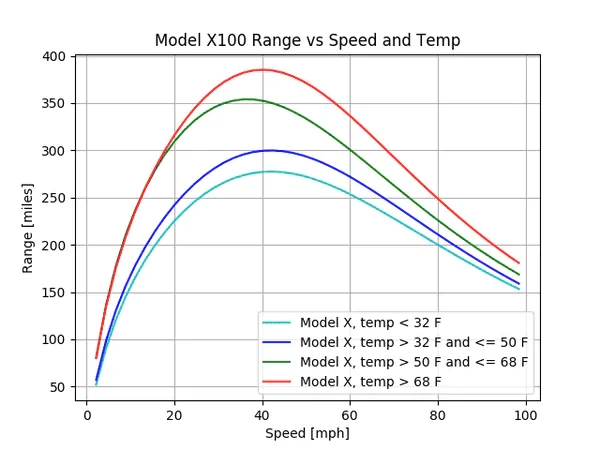
p-40-when-driving-at-90-mph-vs-60-v0-l41h0l9unru91.png


Range is highly variable.
Maybe everyone would be better suited if the EPA tested at posted highway speed limits which, on some parts of some highways, can reach 80 mph. Perhaps they should have a range of tests and placard ratings: 25, 35, 45, 55, 65, and 75 rather than city and highway. And maybe they should reproduce your graph and have temperature ratings. The EPA should ‘not’ be taking guidance from OEMs unless the EPA dictates exact testing protocols and requires documented proof that the protocols were adhered to. Or is that how OEM guidance works now? They do it for SMOG testing so it shouldn’t be hard.
 

COLAB

Well-known member
First Name
Bruno
Joined
Jul 17, 2023
Threads
9
Messages
267
Reaction score
373
Location
Carignan
Website
colabconcept.org
Vehicles
Nissan Frontier
Occupation
Product manager IT services
Country flag
The problem with the new electrical technology with regard to the lack of knowledge of buyers and users (as in IT..), there are people who panic and overuse the services and often clutter it for nothing in a large proportion.

Always the same things are repeated from new technologies to new technologies and it is natural, but we often forget the past, and yet it is always a perpetual movement according to the time, we really have a short memory.

All that to say that we can understand why Tesla is trying to protect itself from false positives!!!!!!

;) ?
 

cvalue13

Well-known member
Joined
Aug 17, 2022
Threads
74
Messages
7,153
Reaction score
13,769
Location
Austin, TX
Vehicles
F150L
Occupation
Fun-employed
Country flag
Maybe everyone would be better suited if the EPA tested at posted highway speed limits which, on some parts of some highways, can reach 80 mph. Perhaps they should have a range of tests and placard ratings: 25, 35, 45, 55, 65, and 75 rather than city and highway.
maybe that's true

but wouldn't that just move the goalpost to the same outcome still being available, just in a more parsed fashion?

keeping it to a single number is why the EPA tests at self-acknowledged 'low' speeds, but then performs a flat deduct factor of 30% (essentially adjusting toward real-world results).

which is why I agree:

The EPA should ‘not’ be taking guidance from OEMs unless the EPA dictates exact testing protocols and requires documented proof that the protocols were adhered to.
the EPA needs to revise its BEV-specific ratings tests and procedures.

however, the 'allowance' for OEM's to submit counter-data is in effect a safety release valve for OEM's to have a process for disputing EPA results. it's essentially the equivalent of an appeal, like being able to protest your property taxes.

such an appeals process is always a double-edged sword. on one hand, it is rightfully intended to keep the regulating body checked. on the other hand, it permits of some gamifying the system. see again, property tax appeals.

this appeals system in operation can be seen by what's happened between the EPA and Tesla: the EPA has several times taken Tesla's data, and adjudicated it nonetheless must be further down-rated 3-5.5%

So Tesla is playing in bounds. It just seems to have the philosophy that it wants to be as aggressive as possible in order attract people to BEVs, at an accepted risk of errors tending to cause customer frustration. Conversely, other OEMs have the apparent philosophy of accepting more conservative approach, at the benefit of risk of errors tending to instead cause customer postive surprises.

tough nut to crack, if it comes down to corporate philosophy of how to approach a testing system, and differing risk appetites.
 
OP
OP
fhteagle

fhteagle

Well-known member
Joined
Sep 28, 2022
Threads
5
Messages
305
Reaction score
689
Location
Telluride, CO
Vehicles
2013 Volt, CT Res x2
Country flag
Better cancel your CT reservation right away because Tesla are sneaky about their range estimates :)
Lol nice try :)

I mean I have two CT reservations in the low 5 digits, and I'm definitely weighing the options against what's out now, what's going to be out in the near future. But when it comes to range claims yeah I'm going to be salting Tesla's claims downwards a bit, same as I did when comparing other models against the Y. It's pretty sad that a few YouTubers are more trustworthy on range exemplifying than the company, but it's the world we live in until the EPA and or FTC gets their head on straight.

All I'm asking for is people to be aware that some have claimed Tesla is intentionally trying to make it harder to get a service tech to do a proper investigation. It's a claim, not proven in my mind by one article. But daylight is the best sanitizer, so to speak. If it's actually happening we'll definitely hear more about it from the usual suspect sources. If it's happening enough that people report it on a pro-Tesla forum like this one, then we definitely need to hold Tesla accountable. If it's not happening, okay great, we just had a lil debate and people shared some opinions and it blew over, no big deal.

Ball is in Tesla's court here. Do right by customers and this Diversion Team thing is a non event. If that's how it shakes out I'll be happy to say so. If anyone is done wrong by Tesla (or any other company for that matter), don't be afraid to speak up, even in a place that's heavily pro-Tesla. Simple as that.
 

electricAK

Well-known member
Joined
Mar 5, 2020
Threads
13
Messages
321
Reaction score
944
Location
Haines, Alaska
Vehicles
Cybertruck dual-motor
Country flag
So Tesla is playing in bounds. It just seems to have the philosophy that it wants to be as aggressive as possible in order attract people to BEVs, at an accepted risk of errors tending to cause customer frustration. Conversely, other OEMs have the apparent philosophy of accepting more conservative approach, at the benefit of risk of errors tending to instead cause customer postive surprises.
This has been well known for years, and it's a non-issue. Not at all worthy of the "big deal" the article makes it out to be.

Put yourself in Tesla's shoes. You're the engineer in charge of deciding how the on-screen range meter calculates range. You have an infinite array of possibilities as to how that range meter ticks down as a person drives. You state it would be best to use the "average" actual efficiency to calculate future range, but there's a major problem there. What the hell is average? And under what conditions?

I think it's completely reasonable to assume the driver will be driving conservatively, and in good conditions to start the journey. Many people beat the EPA range in their Teslas in these conditions. So calculate the range based on this possibility. Let the driver know what they can expect if they're a good driver in good conditions. Then, as the drive goes on, use the real data from the current drive to reduce the range at a faster rate if needed.

There's nothing wrong or misleading about this approach. But the Reuter's article is clearly trying to spin it as a major scandal. Why would they do that?
Sponsored


Top