Sponsored

HaulingAss

Well-known member
Joined
Oct 3, 2020
Threads
28
Messages
10,355
Reaction score
20,820
Location
Western Washington, USA
Vehicles
Cybertruck DM, 2010 F-150, 2018 Performance Model 3, 2024 Performance Model 3
Country flag
For several reasons, off-road driving is more energy intensive (uses more fuel). One reason is there's an optimum speed to get the most MPG in all vehicles. Which is generally thought of as between 40-55mph. Off-roading/driving on rough dirt roads, an average speed is about 15mph. When a vehicle is on, even though it's not moving it's consuming fuel. In addition to that, wheel spin and lots of loss of traction also causes more fuel usage.

Here's an article on optimum speeds. https://www.makeuseof.com/what-is-most-fuel-efficient-speed-to-drive/
What the heck? That's an article based on internal combustion engines and multi-speed transmissions. An electric car has a most efficient speed much lower than that, assuming you don't have the heat cranked or other atypical usage.

ICE engines are very inefficient at low power outputs. More recent technologies have addressed this somewhat, but I remember back during the 55 mph national speed limit debates, it was pointed out that some big road cars, with big V-8's, returned their best MPG around 65-70 mph. Nowdays it's probably 45-50 for ICE cars with smaller engines and less than that for most EV's.
Sponsored
 

cvalue13

Well-known member
Joined
Aug 17, 2022
Threads
74
Messages
7,153
Reaction score
13,769
Location
Austin, TX
Vehicles
F150L
Occupation
Fun-employed
Country flag
What the heck? That's an article based on internal combustion engines and multi-speed transmissions. An electric car has a most efficient speed much lower than that, assuming you don't have the heat cranked or other atypical usage.
efficient speed?

that’s a weird way to talk about drag
 

Gurule92

Well-known member
Joined
Sep 2, 2021
Threads
201
Messages
3,825
Reaction score
7,373
Location
Colorado Springs
Vehicles
MYP
Occupation
"Cyber" stuff
Country flag

FutureBoy

Well-known member
First Name
Reginald
Joined
Oct 1, 2020
Threads
215
Messages
3,556
Reaction score
6,062
Location
Kirkland WA USA
Vehicles
Toyota Sienna
Occupation
Financial Advisor
Country flag
A 500 mile tape measure? You’d need a CT or Semi to haul it.
 

GuyV

Well-known member
First Name
Guy
Joined
Aug 17, 2023
Threads
1
Messages
814
Reaction score
1,073
Location
St. Louis, MO
Vehicles
Tesla Model S, FS Cybertruck AWD
Occupation
Retired
Country flag
I can get excited about 500 miles of EPA range because I know what 500 miles of EPA combined City/Hwy range means. It's 500 miles as measured by the prescribed EPA drive cycles, a mix of urban and highway driving. It's a more accurate indicator of most people's typical usage than the wildly optimistic WLTP range used by many EV's sold outside N. America.

500 miles is many hours of non-stop driving, most or all of the day for many people not driving "Canonball Run" style, must get there ASAP, style. This means relaxing cross-country tours could be done without ever stopping to charge, except at hotels at night with free Tesla destination chargers. In actual use, most people would want to throw in a couple of 15-20 minute Supercharger breaks each day, if not stopping to see the sights along the way, and wanting to cover more than 400 miles each day. Destination chargers are a real game-changer in terms of keeping charging stops to a minimum and saving on Supercharging costs. A 500-mile Cybertruck could make very good use of a 48-amp Tesla destination charger if arriving at your accomodations at 5 or 6 pm and not leaving until 7 or 8 the next morning.

Pretty much any EV can exceed it's EPA combined range by driving at a steady speed of 50 mph in normal weather and road conditions while I don't think there is a single EV that can exceed it's EPA combined range by driving at a steady 75 mph. Our 2018 Long-Range Model 3 matches it's 310 mile EPA range going 60-65 mph, as long as the pavement is the smoother blacktop or concrete, and not the more abrasive chip seal with exposed sharp-edged rocks embedded in tar. At a steady 37 mph, the 2018 Model 3 with 310 miles of EPA range demonstrated multiple times it could go over 600 miles on a single charge. There is no such thing as "real-world" range, because the "real world" varies so much.

My point here, is that people tend to use "real world" to mean the range you can count on in the worst 25% of conditions, or the range you can expect at 75 or 80 mph.

The single most under-recognized factor affecting range is the texture of the road. Everyone knows that speed has a dramatic effect on range, but many don't know how much the road texture can impact range, particularly at 60 mph and under. Smooth-textured highways are much better than coarse country roads.

The biggest advantage of a battery big enough to go 500 miles is that it has a bigger "sweet spot" in terms of fast charging. That is, the battery will accept the higher fast charging levels for more minutes. That can get you back on the road a couple of minutes faster or reduce the number of charging stops or allow travel to more remote locations. But, with a high enough density of Supercharger stations, or for normal local use where it's plugged in every night, there is very little advantage to carrying around all that extra weight. And the density of the Supercharger Network has increased massively while we have been waiting to take delivery of our Cybertrucks. The Supercharger network of late 2019 bears little resemblance to the Supercharger Network at the end of 2023.
CT will also have the 800V architecture.


GuyV

Well-known member
First Name
Guy
Joined
Aug 17, 2023
Threads
1
Messages
814
Reaction score
1,073
Location
St. Louis, MO
Vehicles
Tesla Model S, FS Cybertruck AWD
Occupation
Retired
Country flag
What the heck? That's an article based on internal combustion engines and multi-speed transmissions. An electric car has a most efficient speed much lower than that, assuming you don't have the heat cranked or other atypical usage.

ICE engines are very inefficient at low power outputs. More recent technologies have addressed this somewhat, but I remember back during the 55 mph national speed limit debates, it was pointed out that some big road cars, with big V-8's, returned their best MPG around 65-70 mph. Nowdays it's probably 45-50 for ICE cars with smaller engines and less than that for most EV's.
I don't know about efficiency but I had a BMW that was all around far more calm and tranquil at 90+
 

SSonnentag

Well-known member
First Name
Shawn
Joined
Feb 24, 2020
Threads
12
Messages
623
Reaction score
1,229
Location
Arizona
Vehicles
2018 MX and 2023 MYP
Occupation
IT Specialist
Country flag
what this discussion among others is ignoring, is that Tesla is notorious and documented to achieve less than EPA range than other manufacturers.
i’ve never had any trouble getting the rated range out of either of our Teslas. Just drive 65 or less at a constant speed and you can easily exceeded the rated range.
 

charliemagpie

Well-known member
First Name
Charlie
Joined
Jul 6, 2021
Threads
48
Messages
2,982
Reaction score
5,369
Location
Australia
Vehicles
CybrBEAST
Occupation
retired
Country flag
"The truck 'WILL' be able to do 500 miles'

They did not say 'DOES' 500 miles. I guess Baja is not the ideal real world conditions to achieve 500 miles on a single charge anyway.

No real new news here.. just fun.
 

Stuck4ger

Well-known member
Joined
Dec 6, 2019
Threads
54
Messages
1,373
Reaction score
2,548
Location
Cape Canaveral, FL
Vehicles
Cyberbeast
Occupation
Aerospace
Country flag
I did not think they said 500 miles between charges, right, just in one day (but I could be misremembering and then there is the source of said statement….)
Of course they meant between charges, that’s the metric that everyone really cares about!
 

HaulingAss

Well-known member
Joined
Oct 3, 2020
Threads
28
Messages
10,355
Reaction score
20,820
Location
Western Washington, USA
Vehicles
Cybertruck DM, 2010 F-150, 2018 Performance Model 3, 2024 Performance Model 3
Country flag
i’ve never had any trouble getting the rated range out of either of our Teslas. Just drive 65 or less at a constant speed and you can easily exceeded the rated range.
You will get less than EPA range fighting a strong headwind, uphill or with the heater blasting in cold weather. But, yeah, there seems to be a false narrative being propogated over the last couple of years that somehow Tesla's EPA range numbers are not as realistic as other car makers numbers. And the false narrative is supposedly backed up by real world testing. But none of the testing is scientific or controlled like the EPA testing is.
 
Last edited:


JBee

Well-known member
First Name
JB
Joined
Nov 22, 2019
Threads
18
Messages
4,913
Reaction score
6,362
Location
Australia
Vehicles
Cybertruck
Occupation
. Professional Hobbyist
Country flag
It's physics that dictate the EPA range differences between vehicle types.

A less aerodynamic but larger battery pack vehicle will have less range reduction than a more aerodynamic but smaller pack vehicle. It is just air displacement versus energy available to displace air. That's just math. Tesla heads towards the more aerodynamic and less battery pack, in search of more efficiency to achieve their range, hence the variability increases because its more sensitive to changes.

It needs to be understood that condition changes are also non-trivial.

For example driving one way with a 15mph headwind uses 20kW, and then the other way with a 15mph tailwind just 6kW, both at a 60mph average which would be 12kW with no wind.

You can take this a step further, in that those that live on the west coast and commute to the west in the morning and east in the afternoon to go home, will have better range than the other way around because west coasts tend to have stronger sea breezes and morning easterlies because of the direction of movement of the sun. On the east coast this effect is less pronounced.

But if you are like hauling-ass, you always have wind in your favour, so you always get more range. No question. It's just a question of beans. :unsure: ?
 

cvalue13

Well-known member
Joined
Aug 17, 2022
Threads
74
Messages
7,153
Reaction score
13,769
Location
Austin, TX
Vehicles
F150L
Occupation
Fun-employed
Country flag
i’ve never had any trouble getting the rated range out of either of our Teslas. Just drive 65 or less at a constant speed and you can easily exceeded the rated range.
that’s the trouble with anecdotal evidence

But, yeah, there seems to be a false narrative being propogated over the last couple of years that somehow Tesla's EPA range numbers are not as realistic as other car makers numbers. And the false narrative is supposedly backed up by real world testing. But none of the testing is scientific or controlled like the EPA testing is.
Let me cure you of your ignorance here.

It’s well documented that Tesla engages with the EPA in a way unlike any other OEMs - basically, there’s no cheating, but Tesla uses EPA proceeddures To JUICE it’s EPA rating where all other OEMs take the EPAs most conservative estimate.

(only once has Tesla not done this for a model, and it was when Tesla worked to have the range of a specific model’s trim DOWNWARD adjusted, because Tesla didn’t want a lower-priced trim to out-range the higher-priced trim of the same model.)

The Society of Automotive Engineers is the same society that sets standards for autonomous driving, towing ratings, and the SAE's 32-page J1634 standard that governs range and efficiency testing.

The SAE conducted a multi-n test of 21 models of BEV’s (‘Comparison of On-Road Highway Fuel Economy and All-Electric Range to Label Values: Are the Current Label Procedures Appropriate for Battery Electric Vehicles?’)

SAE found that on average EVs fall short of advertised range by 12.5 percent in highway driving, while Tesla vehicles fell short by an average of 26 percent.

This observed discrepancy is due to how Tesla works the EPA proceedures differently than other OEMs.

Here’s a vid, from Engineering Explained. that details part of how Tesla juices its epa figures while other OEMs accept the conservative estimate


But at the end of the day, the result is this:

at sustained 75mph highway speeds, the real world results of a Tesla with an 400mi EPA rating is essentially identical to the 75mph
real world results of a non-Tesla with an 300mi EPA rating.


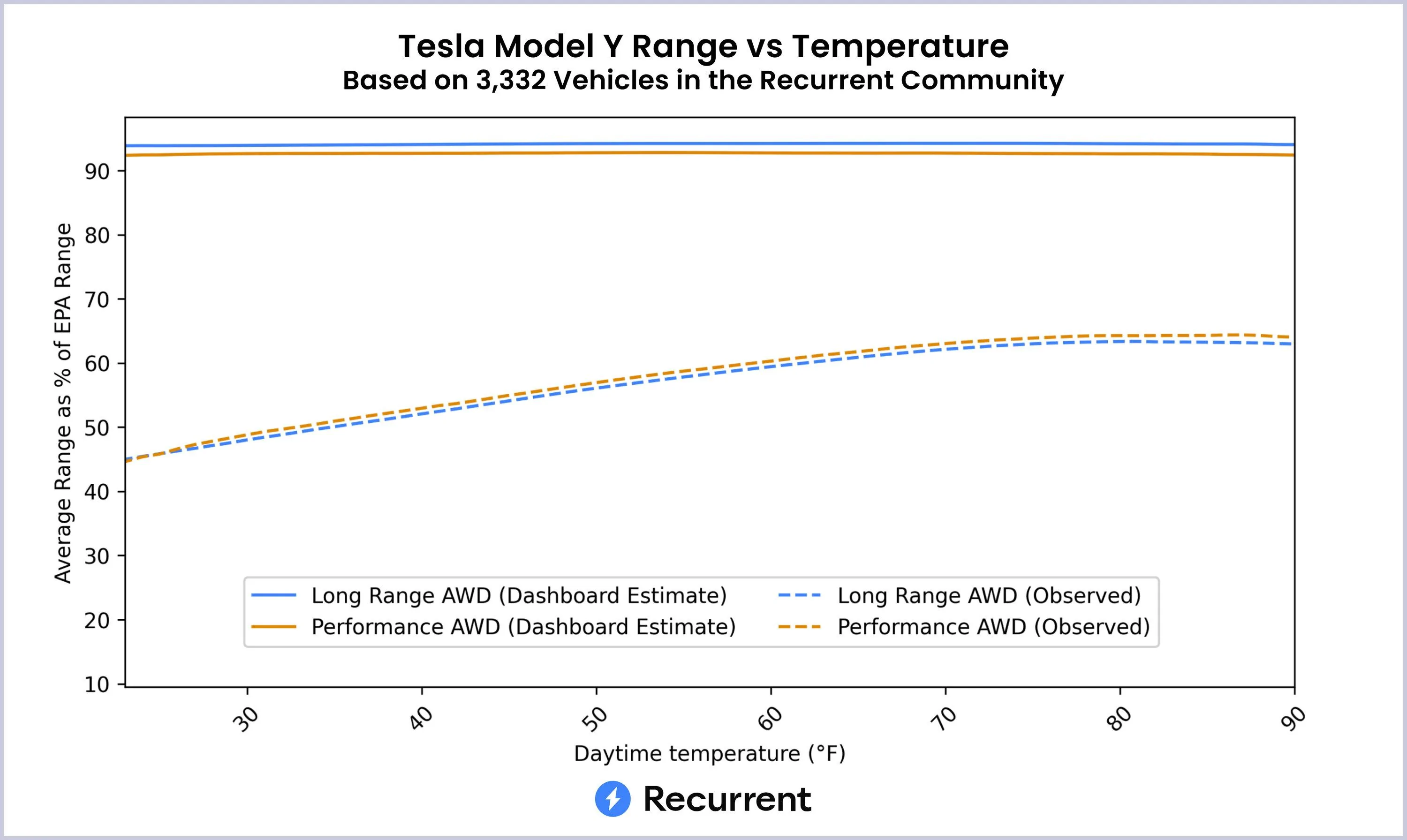
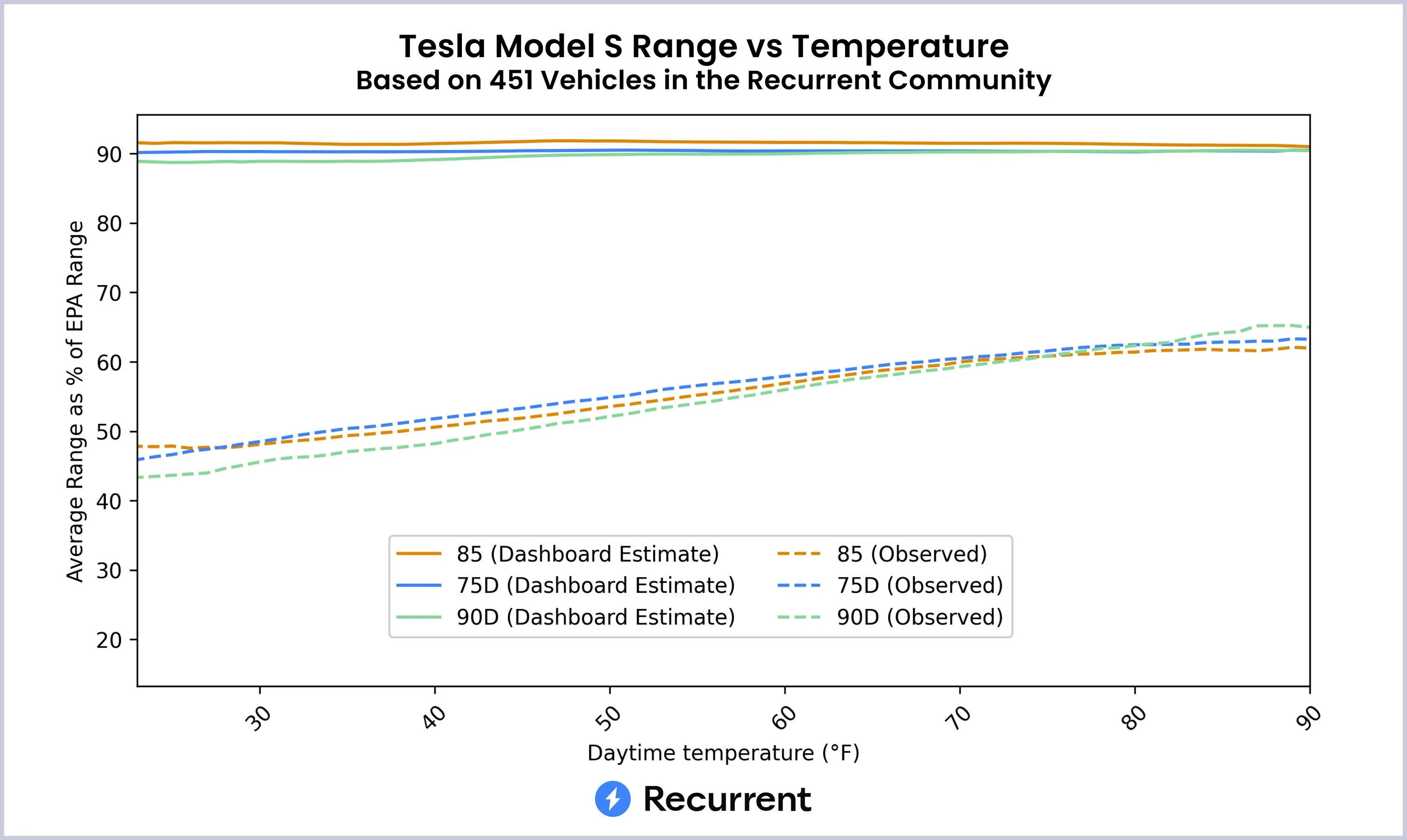
Meanwhile, here’s Recurrent, which offers a Real-World Range feature that allows any Tesla driver that signs up for the platform to better understand variances in reality. It has data on over 360,000 charging cycles from over 12,000 Teslas on the road.

note the X-axis, which is the % of EPA range achieved (Y-axis is at varying temps)

Tesla Cybertruck Baja Cybertruck returns to US. Parked for viewing in Orange County! 1697339661000

Tesla Cybertruck Baja Cybertruck returns to US. Parked for viewing in Orange County! 1697339689895


Electrek (not exactly a biased source), recommending the above Recurrent tool, sums it up nicely:

“Tesla needs to come up with real-world estimates, or better yet, the EPA, which should be regulating better, needs to test these vehicles against each others directly instead of relying on the automakers’ data.”
 

JBee

Well-known member
First Name
JB
Joined
Nov 22, 2019
Threads
18
Messages
4,913
Reaction score
6,362
Location
Australia
Vehicles
Cybertruck
Occupation
. Professional Hobbyist
Country flag
The problem is that the EPA rating is not so much a independent test rating, rather more a affirmation of manufacturer data. Their test is on a dyno, and drag is calculated and not even simulated so unless they compensate for wind conditions, more aerodynamic vehicles will be at a disadvantage, as they will not perform as well in real life. Tesla vehicles efficiency makes them more sensitive to conditions, and just makes it worse. I'm not saying efficiency is bad, I'm just saying efficiency makes it more sensitive.The EPA needs to add a sensitivity analysis to make comparisons.

It's similar to the HP numbers they use, in that they are only the peak HP which are limited by temperature and not the rated continuous HP of the motor after the motors and drive-train have warmed up. This is why they needed to upgrade the cooling for the Nurburgring, because it couldn't put the same power down throughout the whole track, and was only fast in the beginning of the lap. But in saying that though, performance is more than adequate for most non-track users, so they aren't called out on it. Likewise most people don't run the battery low, and so never experience the vehicle stop moving from lack of juice. Similarly, towing will be revealing when a non-aerodynamic trailer is used.

Essentially, the quest for efficiency will expose the full width and breadth of current inefficiency. That's not a bad thing in itself, but it will highlight how inaccurate our previous experiences and test methods were.
 

Rutrow

Well-known member
First Name
Dan
Joined
May 25, 2021
Threads
8
Messages
1,031
Reaction score
2,441
Location
Little Rock, Arkansas
Vehicles
Model S, Model 3, CyberTruck Tri-motor reservation
Occupation
Firefighter
Country flag
Don’t get too excited about the 500 mile battery range. I have owned a Model Y for 2.5 years. The battery range is consistently 15% below the EPA estimate.
I drive mine like that too! ??️

Vroom Vroom
Sponsored


Top