Sponsored

10,000+ Miles Driving a Cybertruck – Things learned: range, great sound and full love/hate list after 10k miles

Tony Roe

Well-known member
Joined
Nov 26, 2023
Threads
2
Messages
66
Reaction score
57
Location
Putnam Valley NY
Vehicles
Cybertruck
Occupation
retired
Country flag
Insurance - $465/mo ????? Is this for real ? I am retired and ordered a Trimotor when the original specs came out (500 mi) & 60K. Now that the Trimotor is now $120k that's out the window. I will be changing my order to a Duel AWD if they don't jack up the price anymore. I placed my order Feb of 2021 so I think I have 2+ years to go. But if insurance is going to be $500/m, IDK !!!! I'm just a retired working Guy.
Sponsored

 

Woodrick

Well-known member
First Name
Ed
Joined
Dec 30, 2023
Threads
6
Messages
4,786
Reaction score
4,762
Location
Gainesville Ga
Vehicles
Model 3, Model Y, Cybertruck AWD
Occupation
Consultant
Country flag
Insurance - $465/mo ????? Is this for real ? I am retired and ordered a Trimotor when the original specs came out (500 mi) & 60K. Now that the Trimotor is now $120k that's out the window. I will be changing my order to a Duel AWD if they don't jack up the price anymore. I placed my order Feb of 2021 so I think I have 2+ years to go. But if insurance is going to be $500/m, IDK !!!! I'm just a retired working Guy.
I don't see the tri-motor costing $120k.

Tesla Cybertruck 10,000+ Miles Driving a Cybertruck – Things learned: range, great sound and full love/hate list after 10k miles 1705511589986


Insurance is different from person to person.
And if retired, keep on the lookout for your rates to rise anyway. And don't forget the truck may cost a lot more than your other vehicles, just like any new vehicles costs more.
 
Last edited:

Cybergirl

Well-known member
Joined
Jul 3, 2020
Threads
40
Messages
873
Reaction score
2,934
Location
Illinois and Arizona
Vehicles
Tesla Model Y LR, Model Y SR, Cybertruck AWD FS
Country flag
Personally, I wouldn't put much stock the information in the OP's post. What constitutes "real world" range is different for every owner.

I trust Out of Spec Review's range test of the AWD CT FS which was done with some rigor. That range test showed that CT can go 254 miles on FULL charge at 70 mph to empty (124 kWh) at ambient temperatures that began at 46F and fell to 41F during the course to the test. The efficiency at those temperatures was just over 2 miles/kWh.

By comparison, Out of Spec Reviews tested the range of the Rivian R1T quad motor with all terrain tires, testing from 52F to 59F ambient in Conserv mode (1.e., two motor drive). The R1T was charged from 43% SOC to 100% in 1 hr and 25 minutes at the start of the test. Kyle drove 289.3 miles, consuming 124 kWh for an efficiency of 2.33 mi/kWh.

We know that the Tesla battery suffered about 10% more loss of capacity than the Rivian given the ambient temperatures in each test case. Adjusting for that temperature difference, the CT would have traveled 254 x 1.10 = 279 miles on 124 kWh for an efficiency of 2.25 mi/kWh. That's virtually the same efficiency and range as the R1T under equal driving conditions.

Based on these range test results, I see no reason to be concerned about taking road trips in my Cybertruck, and I would advise ignoring all the dire predictions of CT range anxiety that are circulating on the internet.
 

Saygmo

Well-known member
First Name
Sas
Joined
Dec 28, 2023
Threads
2
Messages
83
Reaction score
134
Location
Norcql
Vehicles
Model 3 awd
Country flag
I don't see the tri-motor costing $120k.

View attachment 35256

Insurance is different from person to person.
And if retired, keep on the lookout for your rates to rise anyway. And don't forget the truck may cost a lot more than your other vehicles, just like any new vehicles costs more.
Really?! Just took this screenshot of my order page

Tesla Cybertruck 10,000+ Miles Driving a Cybertruck – Things learned: range, great sound and full love/hate list after 10k miles IMG_1626
 

Attachments

  • 0 bytes Views: 0

Woodrick

Well-known member
First Name
Ed
Joined
Dec 30, 2023
Threads
6
Messages
4,786
Reaction score
4,762
Location
Gainesville Ga
Vehicles
Model 3, Model Y, Cybertruck AWD
Occupation
Consultant
Country flag
Really?! Just took this screenshot of my order page
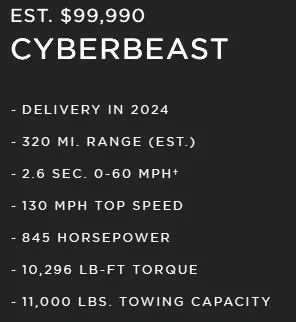
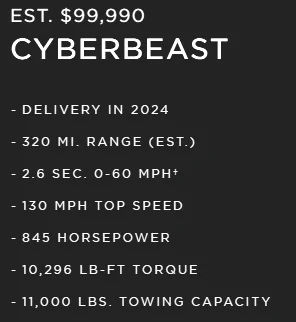
That's not the CyberBeast, that's the Foundation Series CyberBeast that comes with extra items like Powershare and FSD.
Nothing is forcing you to get the Foundation Series version of it.

You can still get the CyberBeast for:
Tesla Cybertruck 10,000+ Miles Driving a Cybertruck – Things learned: range, great sound and full love/hate list after 10k miles 1705511661893


(yeah I know, I keep accidentally posting the "with savings" number)


HaulingAss

Well-known member
Joined
Oct 3, 2020
Threads
28
Messages
10,334
Reaction score
20,752
Location
Western Washington, USA
Vehicles
Cybertruck DM, 2010 F-150, 2018 Performance Model 3, 2024 Performance Model 3
Country flag
Can you explain that a little further by wiring directly? I know little about electrical power generally and even less about household electrical power. I work in medicine/mental health. It’s far from my wheelhouse. Thanks.
Sure, there are a bunch of factors that all point to the superiority of a hard-wired solution vs. a wall outlet. I'll cover them in no real order.

Much of the resistance in a charging circuit is at the terminal connections. Resistance means heat and almost all electrical fires happen at these terminal connections. The screw terminals on the breaker to the distribution wire and the distribution wire to the terminal on the Wall Connector. The Wall Connector has higher quality terminals than a typical NEMA 14-50 outlet, But the real problem is the oxidation of the outlet (where it recieved the plug blades) and oxidation of the blades themselves. Copper forms an oxidized layer which is non-conductive. Wherever there is resistance, heat builds. The reason the outlet is problematic is that it has two sources of heat in close proximity, the terminals and the blades. It is quite common for these to melt down. Most of the time this happens a fire doesn't happen, you just have a melted NEMA 14-50. But it certainly can and does burn down garages and attached houses often enough that Sandy Munro did an entire video focused just on this problem.

An unrelated disadvantage of NEMA 14-50 outlets is that they require one more copper conductor be run from the charge station to the breaker panel (compared to a hard-wired charging station). If the run only requires a few feet of wire this is not a big deal, but many installs involve runs of more than a few feet. Copper wire costs time and money to install, yet it goes unused.

The additional cost of the NEMA 14-50 oulet is around $80. If you go with an outlet for EV charging, you definitely don't want one of the inexpensive ones! A Wall Connector attaches directly to the power feed wires and avoids the intermediate outlet. Also, a flush mount outlet requires a square hole be cut in the wall for it to mount into and a faceplate. A Wall connector covers up the small round hole required for the power feed.

Another cost of using a NEMA 14-50 is that code requires an expensive GFCI breaker that the hardwired solution doesn't (even though the both the Wall Connector and the Mobile Connector have their own GFCI protection). Having two GFCI on the same circuit has been known to cause nuisance tripping yet code still requires a GFCI breaker for a NEMA 14-50 outlet. Nothing worse than waking up to an uncharged car when you have a big day planned. The additional cost of a GFCI 60-amp breaker vs. non-GFCI 60-amp breaker can be $70 or more, depending upon the brand of distribution panel you have.

If you have a NEMA 14-50, it can only charge one EV at a time from that power feed. If you have a Wall Connector, a Second Wall Connector can be wired to the same power feed, using an electrical junction box, and two vehicles can be charged simultaneously by sharing the available power using the built-in intelligent load sharing of the Wall Connectors. The 24-foot cord of the Wall Connector can reach 4 feet further than the Mobile Connector which could be handy if you need to charge an EV parked away from the charging station.

The Mobile Connector has additional points of potential resistance where the wall adapter pigtail plugs into the body of the Mobile Connector. And it can come unplugged accidently if the 20 feet isn't quite enough, and the cord must be stretched to reach the car.

Finally, the Cybertruck can benefit from having 48 amps of charging speed, vs the 32 amps of the Mobile Connector. I will always feel more comfortable keeping my EV's at lower states of charge, thus minimizing battery degradation, when I know I have the full 48 amps available to quickly bring it up to 90% SOC before I leave on a longer than normal day trip. It seems like it can take forever if all I have is 32 amps.

Finally, the Foundation Edition comes with both a Mobile Connector and a Wall Connector. Put the Mobile Connector where it belongs, in the Cybertruck, and mount the Wall Connector where it belongs, to the wall. You will save time and money and have a safer, more convenient, more adaptable and slightly more efficient charging solution because that small amount of additional resistance in the Mobile Connector pigtail and the NEMA 14-50 plug blades adds up over years of charging.

To be clear, each of these advantages of using a Wall Connector over a NEMA 14-50 plug tend to be minor, or even inconsequential in some use cases, but reducing the risk of fire is not something to be discounted and the added power, conveniece and flexibility is nice, and it may even save a bit of expense over the inferior solution.

Don't be surprised though to see people claim the 14-50 is the cheaper solution. In most cases the cost and level of effort required is about the same. Go with the superior solution.
 
Last edited:

Cybertruck Dude

Well-known member
First Name
Ed
Joined
Nov 29, 2023
Threads
0
Messages
160
Reaction score
156
Location
Illinois
Vehicles
Cybertruck
Occupation
OperatingEngineer
Country flag
The limited range of the vehicle isn't a significant concern for me, as it offers a slight improvement over a standard-range car. However, the issue arises with its large 123kWh battery, which is necessary to achieve what a regular Tesla can with a smaller 50-75kWh battery. This becomes a particular challenge for home charging, especially for those with multiple Teslas and only one charger. If the Cybertruck is used as frequently as our other Teslas, it's likely to take up most of the charging capacity overnight due to its larger battery needs.
How many cars can you drive at a time?? You can always install another charger if you need to.?
 

HaulingAss

Well-known member
Joined
Oct 3, 2020
Threads
28
Messages
10,334
Reaction score
20,752
Location
Western Washington, USA
Vehicles
Cybertruck DM, 2010 F-150, 2018 Performance Model 3, 2024 Performance Model 3
Country flag
You are generally correct, however it deserves to be said that the first Model 3 Tesla ever sold, the M3 LR RWD, was likely the best single motor M3 they ever made. So not everything gets better with time.
That's why we have three 2018 Model 3s, two Long-Range RWD and one Performance. All three cars have one of those motors in it.

But make no mistake, the Model 3 you can buy now is, overall, a far superior car, with a better suspension, quieter cabin, heatpump, and many other upgrades.
 

Wraven

Well-known member
First Name
Doug
Joined
Oct 19, 2023
Threads
14
Messages
372
Reaction score
798
Location
San Antonio Texas
Vehicles
Foundations CyberBeast, M3P
Country flag
I am anxiously awaiting a real-world test that shows the Cybertruck can get close to 385Wh/mi on the highway. This would equal the 319 mile range and my understanding is the EPA estimate. So far no range test has come anywhere close to this estimate. I have not even seen 450Wh/mi which would be the promised 16% improvement in v2 4860.

The CT is awesome and I have been defending it for 4 years, but I will cancel my FS order and eat the $1000 if the real world range reports are not improved.
Can you point me to the EPA rating that shows pure *highway* mile range for the Cybertruck you are referring too?


HaulingAss

Well-known member
Joined
Oct 3, 2020
Threads
28
Messages
10,334
Reaction score
20,752
Location
Western Washington, USA
Vehicles
Cybertruck DM, 2010 F-150, 2018 Performance Model 3, 2024 Performance Model 3
Country flag
I am anxiously awaiting a real-world test that shows the Cybertruck can get close to 385Wh/mi on the highway. This would equal the 319 mile range and my understanding is the EPA estimate. So far no range test has come anywhere close to this estimate. I have not even seen 450Wh/mi which would be the promised 16% improvement in v2 4860.
Why do I have to keep explaining this to newbies?

The EPA combined range is not the Freeway range at 70 mph. Anyone with their eyes open knows this by now. Anyone else is purposefully ignorant of how it works.

Yes, the Cybertruck will return it's EPA range when driven on the EPA drive cycles or at a constant speed of somewhere around 50 -55 mph. But the latter is just a coincidental cross-over, a speed at which the steady-state efficiency happens to match the EPA City/Hwy combined range.

We knew this before the Cybertruck was released because it's mostly simple physics. People who are making a big deal about the disparity between the EPA range and the 70 mph range are simply displaying how ignorant they are of EPA ratings and physics of a vehicle the size and shape of the Cybertruck. It's all very predictable.
 

Saygmo

Well-known member
First Name
Sas
Joined
Dec 28, 2023
Threads
2
Messages
83
Reaction score
134
Location
Norcql
Vehicles
Model 3 awd
Country flag
That's not the CyberBeast, that's the Foundation Series CyberBeast that comes with extra items like Powershare and FSD.
Nothing is forcing you to get the Foundation Series version of it.

You can still get the CyberBeast for:
1705511661893.webp


(yeah I know, I keep accidentally posting the "with savings" number)
Other than, you know, indeterminate availability and the fact they may change the price on the cyberbeast when they actually end up letting people order a non FS truck. Therefore, as of this time, the cyberbeast costs $119k.
 

Celiboy

Well-known member
First Name
Marcel
Joined
May 3, 2023
Threads
8
Messages
983
Reaction score
1,514
Location
Clovis, California
Vehicles
2018 Model 3, 2022 Model Y, 2024 AWD Cybertruck
Occupation
Family Nurse Practitioner, Psychiatric Mental Health Nurse Practitioner
Country flag
Sure, there are a bunch of factors that all point to the superiority of a hard-wired solution vs. a wall outlet. I'll cover them in no real order.

Much of the resistance in a charging circuit is at the terminal connections. Resistance means heat and almost all electrical fires happen at these terminal connections. The screw terminals on the breaker to the distribution wire and the distribution wire to the terminal on the Wall Connector. The Wall Connector has higher quality terminals than a typical NEMA 14-50 outlet, But the real problem is the oxidation of the outlet (where it recieved the plug blades) and oxidation of the blades themselves. Copper forms an oxidized layer which is non-conductive. Wherever there is resistance, heat builds. The reason the outlet is problematic is that it has two sources of heat in close proximity, the terminals and the blades. It is quite common for these to melt down. Most of the time this happens a fire doesn't happen, you just have a melted NEMA 14-50. But it certainly can and does burn down garages and attached houses often enough that Sandy Munro did an entire video focused just on this problem.

An unrelated disadvantage of NEMA 14-50 outlets is that they require one more copper conductor be run from the charge station to the breaker panel (compared to a hard-wired charging station). If the run only requires a few feet of wire this is not a big deal, but many installs involve runs of more than a few feet. Copper wire costs time and money to install, yet it goes unused.

The additional cost of the NEMA 14-50 oulet is around $80. If you go with an outlet for EV charging, you definitely don't want one of the inexpensive ones! A Wall Connector attaches directly to the power feed wires and avoids the intermediate outlet. Also, a flush mount outlet requires a square hole be cut in the wall for it to mount into and a faceplate. A Wall connector covers up the small round hole required for the power feed.

Another cost of using a NEMA 14-50 is that code requires an expensive GFCI breaker that the hardwired solution doesn't (even though the both the Wall Charger and the Mobile Connector have their own GFCI protection). Having two GFCI on the same circuit has been known to cause nuisance tripping yet code still requires a GFCI breaker for a NEMA 14-50 outlet. Nothing worse than waking up to an uncharged car when you have a big day planned. The additional cost of a GFCI 60-amp breaker vs. non-GFCI 60-amp breaker can be $70 or more, depending upon the brand of distribution panel you have.

If you have a NEMA 14-50, it can only charge one EV at a time from that power feed. If you have a Wall Connector, a Second Wall Connector can be wired to the same power feed, using an electrical junction box, and two vehicles can be charged simultaneously by sharing the available power using the built-in intelligent load sharing of the Wall Connectors. The 24-foot cord of the Wall Connector can reach 4 feet further than the Mobile Connector which could be handy if you need to charge an EV parked away from the charging station.

The Mobile Connector has additional points of potential resistance where the wall adapter pigtail plugs into the body of the Mobile Connector. And it can come unplugged accidently if the 20 feet isn't quite enough, and the cord must be stretched to reach the car.

Finally, the Cybertruck can benefit from having 48 amps of charging speed, vs the 32 amps of the Mobile Connector. I will always feel more comfortable keeping my EV's at lower states of charge, thus minimizing battery degradation, when I know I have the full 48 amps available to quickly bring it up to 90% SOC before I leave on a longer than normal day trip. It seems like it can take forever if all I have is 32 amps.

Finally, the Foundation Edition comes with both a Mobile Connector and a Wall Connector. Put the Mobile Connector where it belongs, in the Cybertruck, and mount the Wall Connector where it belongs, to the wall. You will save time and money and have a safer, more convenient, more adaptable and slightly more efficient charging solution because that small amount of additional resistance in the Mobile Connector pigtail and the NEMA 14-50 plug blades adds up over years of charging.

To be clear, each of these advantages of using a Wall Connector over a NEMA 14-50 plug tend to be minor, or even inconsequential in some use cases, but reducing the risk of fire is not something to be discounted and the added power, conveniece and flexibility is nice, and it may even save a bit of expense over the inferior solution.

Don't be surprised though to see people claim the 14-50 is the cheaper solution. In most cases the cost and level of effort required is about the same. Go with the superior solution.
Man thank you for this detailed explanation. We currently have the first gen wall connector installed but never realized adding the universal wall connector to charge both independently was an option. Explaining the different areas of possible issues/failure was really helpful. I used some referral points to get the wall connector with the 24’ cable before I got the invite so now I have 2 and waiting on the third. I really appreciate you taking the time to share.
 

JPRIVER

Active member
First Name
JP
Joined
Jan 13, 2024
Threads
1
Messages
40
Reaction score
37
Location
Colorado mountains
Vehicles
2016.5 s 75d
Occupation
Engineer
Country flag
FYI I am not a newbie, I have owned multiple teslas and used them has my primary vehicle, including significant long distance super charging trips, since 2016 (over 7 years). I am also a hydraulic engineer with a degree in physics that included significant E&M theory and application. I started designing and building celled powerpacks in 1994. I am fully aware of drag force and how to calculate it and apply it to loss of potential energy. I also know that zealots rarely apply the science that they so deeply believe in.
 

Giggleswitcher

New member
First Name
Frank
Joined
Jan 9, 2024
Threads
0
Messages
1
Reaction score
3
Location
London Canada
Vehicles
Chevrolet
Occupation
Retired
Country flag
Agree. The CT is Tesla's Model X 2.0, and the rollout has not been great up to this point. Instead of making a practical truck with good range and sufficient performance, they made an overdone "technology bandwagon" that goes from pseudo truck to a bastardized sport utility vehicle once you put a "range extender" in it.

I believe they can fix this, at least to a sufficient degree. Get rid of the leaky rolling tonneau, add a fix/folding/removable tonneau, use the space under the rear seat and in the tonneau box to stuff more batteries, reach a minimum of 400 real-world/non-aspirational miles, ditch the RWS (if beneficial), and call the damn thing good. Don't sell something to truck buyers that they didn't ask for, and then tell them it is good enough. It wreaks of tone-def arrogance and pretentiousness. Then again, this probably all comes down to keeping this from being rated a Class 3 truck, and ultimately, giving people what they want would hurt their bottom line from the loss of carbon credits, so they won't f'n do it.

Just like many of you, I was dying to get this truck, but am not so sure at this point. We'll see how much better it gets. Sadly, I've had to think about getting a Tundra or waiting for Ford to develop their T3 project. It's back to wait and see lol
Most owners aren't gonna use for towing 11,000 lbs uphill across state lines in a cold climate. There's the range extension to serve those. For day to day in town commercial uses or the 90% regular folk that will never need it won't be dragin' around an energy draining heavy battery for next 20 years
Sponsored


Top