Dazureus
Well-known member
- Joined
- Sep 1, 2023
- Threads
- 7
- Messages
- 264
- Reaction score
- 589
- Location
- US
- Vehicles
- '21 Model Y, '24 Cyberbeast
- Occupation
- Software Engineer - Steering Systems

- Thread starter
- #1
Caveat: I'll be keeping this post a little vague to preserve some anonymity but I'm sure if you want to put energy into snooping you can discover specific details.
I'm an embedded software engineer at one of the largest OEM parts provider that engineers and manufactures steering systems for multiple automotive companies. I've been in steering systems for 4 years and previously worked in software for IPC at another large OEM parts provider company for 9 years.
I received my Cyberbeast a few weeks back and I guess word spread so someone from R&D contacted me to request a day for evaluation. I've been wondering how the Tesla SbW and rear wheel steering stacks up so of course I jumped on the chance to get some professional opinions. I'm not a steer feel guy and our dedicated steer feel guy wasn't onsite for the day so I didn't get his opinion, which would have been nice since they're super picky. Whether it's legit or not, they say they can feel a handwheel difference of 0.1 N*m.
What we did have was a bunch of Mech E from R&D who were interested in driving around the track to observe how the Tesla SbW and rear steer feels. Lots of forward and reverse figure 8s, lock to lock turning, parallel park testing, laps around the steer feel track and road conditions course, and of course, multiple launches on the straight track (for fun). Here's a general list of the comments:
The steering felt completely natural and balanced. Road feedback was very well executed and minds were blown with the turning radius. Mulitple comments like "My car can't make this tight of a u-turn in this pad" and "Other full sized trucks take the entire radius of this curve to complete". The driving ergonomics engineer liked the squircle, especially the little diagonal parts at 10 and 2. Others thought the over all size of the squircle looked small, but drove and felt fine and completely appropriate.
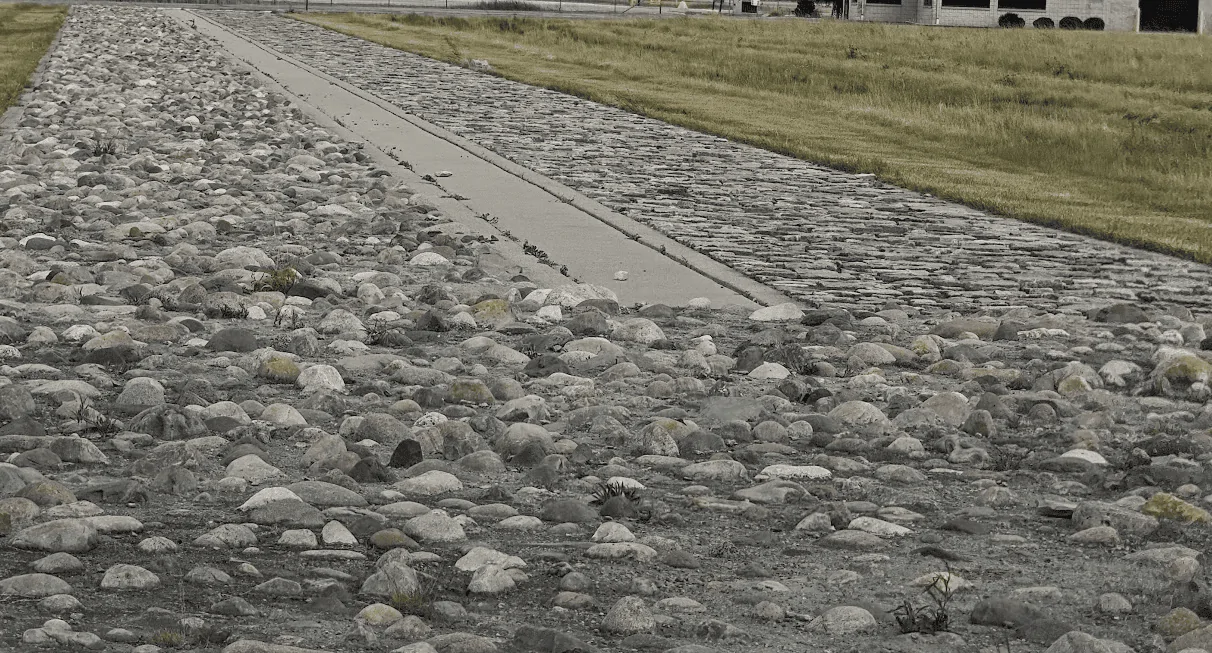
The road conditions course consisted of multiple road surface roughnesses. Asphalt rumble strips, washboard, swells, rough stone road (right), and cobble (left). These surfaces are used to test steering mechanical systems for gear lash, belt slip, etc. Basically you drive over these surfaces to rattle everything and make sure the mechanics of the steering aren't being jostled enough to slip and cause sensor errors. There's also a round area filled with those cobbles that you turn around in at full lock to test additional external torque forces of the steering system to see if scrubbing the wheels at full lock will cause any issues. I put it in off-road mode for this part. The test driver was very happy with how the Tesla SbW felt on these surfaces and was amazed how the suspension acted on the straight cobble portion. He was a bit giddy when he got it up to 27 mph at the end and the ride really smoothed out a bit, which isn't unexpected.
The only not positive comment was that the braking wasn't spectacular, but the regenerative breaking was great. It's not a sports car and you shouldn't expect sports car braking. One engineer that I let drive for an extended time (~2 hrs) commented that it was "... the best driving vehicle I have ever piloted"
Of course everyone was giddy when I launched in Beast mode and I was surprised to lay down some rubber because I could never get my Model X to break traction on launch.
There were some visual inspections but no disassembly and a few of the bosses heard the Cybertruck was on-site so of course they had to get some wheel time. They were looking into aquiring one but the only options were Turo at $1000/day with no gauaruntee on when it would be available, or waiting just like everyone else to purchase one. In all a fun (paid) workday for me and some intersting insight on how the people developing the tech feels about it.

I'm an embedded software engineer at one of the largest OEM parts provider that engineers and manufactures steering systems for multiple automotive companies. I've been in steering systems for 4 years and previously worked in software for IPC at another large OEM parts provider company for 9 years.
I received my Cyberbeast a few weeks back and I guess word spread so someone from R&D contacted me to request a day for evaluation. I've been wondering how the Tesla SbW and rear wheel steering stacks up so of course I jumped on the chance to get some professional opinions. I'm not a steer feel guy and our dedicated steer feel guy wasn't onsite for the day so I didn't get his opinion, which would have been nice since they're super picky. Whether it's legit or not, they say they can feel a handwheel difference of 0.1 N*m.
What we did have was a bunch of Mech E from R&D who were interested in driving around the track to observe how the Tesla SbW and rear steer feels. Lots of forward and reverse figure 8s, lock to lock turning, parallel park testing, laps around the steer feel track and road conditions course, and of course, multiple launches on the straight track (for fun). Here's a general list of the comments:
The steering felt completely natural and balanced. Road feedback was very well executed and minds were blown with the turning radius. Mulitple comments like "My car can't make this tight of a u-turn in this pad" and "Other full sized trucks take the entire radius of this curve to complete". The driving ergonomics engineer liked the squircle, especially the little diagonal parts at 10 and 2. Others thought the over all size of the squircle looked small, but drove and felt fine and completely appropriate.
The road conditions course consisted of multiple road surface roughnesses. Asphalt rumble strips, washboard, swells, rough stone road (right), and cobble (left). These surfaces are used to test steering mechanical systems for gear lash, belt slip, etc. Basically you drive over these surfaces to rattle everything and make sure the mechanics of the steering aren't being jostled enough to slip and cause sensor errors. There's also a round area filled with those cobbles that you turn around in at full lock to test additional external torque forces of the steering system to see if scrubbing the wheels at full lock will cause any issues. I put it in off-road mode for this part. The test driver was very happy with how the Tesla SbW felt on these surfaces and was amazed how the suspension acted on the straight cobble portion. He was a bit giddy when he got it up to 27 mph at the end and the ride really smoothed out a bit, which isn't unexpected.
The only not positive comment was that the braking wasn't spectacular, but the regenerative breaking was great. It's not a sports car and you shouldn't expect sports car braking. One engineer that I let drive for an extended time (~2 hrs) commented that it was "... the best driving vehicle I have ever piloted"
Of course everyone was giddy when I launched in Beast mode and I was surprised to lay down some rubber because I could never get my Model X to break traction on launch.
There were some visual inspections but no disassembly and a few of the bosses heard the Cybertruck was on-site so of course they had to get some wheel time. They were looking into aquiring one but the only options were Turo at $1000/day with no gauaruntee on when it would be available, or waiting just like everyone else to purchase one. In all a fun (paid) workday for me and some intersting insight on how the people developing the tech feels about it.
Sponsored