
Sponsored
SESHBE
Member
- First Name
- James
- Joined
- Jul 2, 2024
- Threads
- 0
- Messages
- 19
- Reaction score
- 9
- Location
- California
- Vehicles
- 2015 Tundra, CT on reservation
- Occupation
- Solar/Electrical Contractor

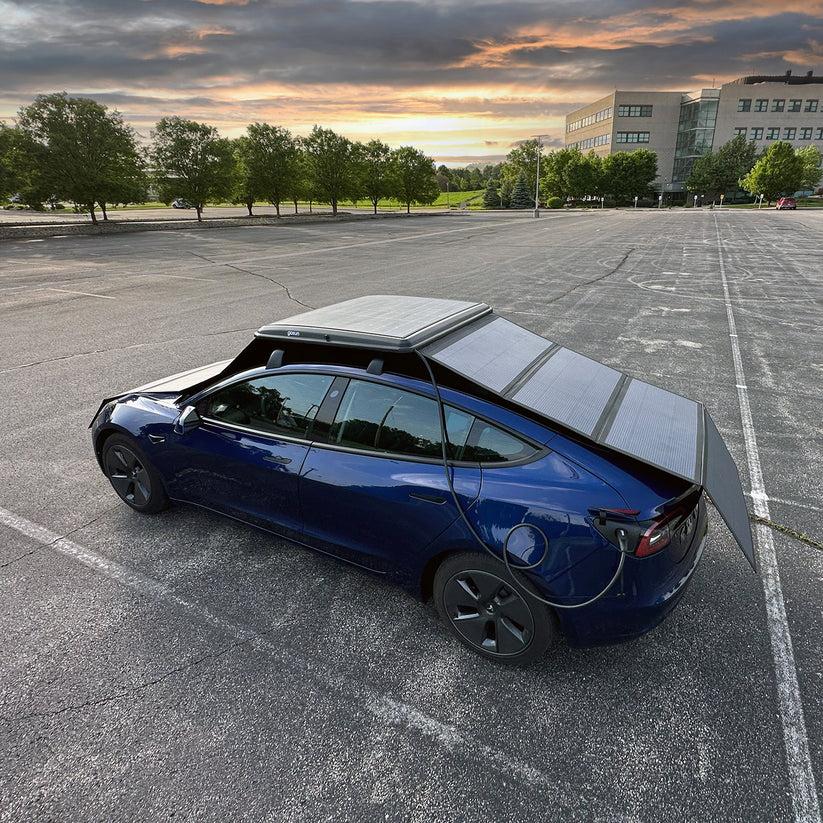
https://gosun.co/products/ev-solar-charger-depositAnyone have a solar panel solution to main sentry while parked at airport for a few weeks?
They are not available yet, but it is probably what you are looking for.
Last edited:
mbbaumer
Member
- First Name
- Michael
- Joined
- Jul 26, 2024
- Threads
- 3
- Messages
- 7
- Reaction score
- 3
- Location
- Anchorage
- Vehicles
- Toyota Tundra
- Thread starter
- #3
Thanks, that looks like a great idea! All I need is just to maintain what I have while parked. I was thinking of something that would sit on dashboard.
Woodrick
Well-known member
- First Name
- Ed
- Joined
- Dec 30, 2023
- Threads
- 6
- Messages
- 4,786
- Reaction score
- 4,765
- Location
- Gainesville Ga
- Vehicles
- Model 3, Model Y, Cybertruck AWD
- Occupation
- Consultant
Turn Sentry off, as well as Cabin Overheat as well as third-party apps and it should last for a couple of weeks.Thanks, that looks like a great idea! All I need is just to maintain what I have while parked. I was thinking of something that would sit on dashboard.


CyberGus
Well-known member
- First Name
- Gus
- Joined
- May 22, 2021
- Threads
- 91
- Messages
- 10,381
- Reaction score
- 34,451
- Location
- Austin, TX
- Vehicles
- 1981 DeLorean, 2024 Cybertruck
- Occupation
- IT Specialist

I feel like this violates Forum Rules on advertising.

No-ICE
Member
- First Name
- Ron
- Joined
- Oct 19, 2021
- Threads
- 3
- Messages
- 19
- Reaction score
- 50
- Location
- San Diego
- Vehicles
- 2002 Tundra
Place a min. 200w flexible RV solar panel on the dash.
Connect to a 48v MPPT controller to the panel.
Connect 48v controller to the 48v battery in the frunk.
Let us know how it work for you.
N.ICE
Connect to a 48v MPPT controller to the panel.
Connect 48v controller to the 48v battery in the frunk.
Let us know how it work for you.
N.ICE
Woodrick
Well-known member
- First Name
- Ed
- Joined
- Dec 30, 2023
- Threads
- 6
- Messages
- 4,786
- Reaction score
- 4,765
- Location
- Gainesville Ga
- Vehicles
- Model 3, Model Y, Cybertruck AWD
- Occupation
- Consultant
You mean connect it to the circuit that gets turned off?Place a min. 200w flexible RV solar panel on the dash.
Connect to a 48v MPPT controller to the panel.
Connect 48v controller to the 48v battery in the frunk.
Let us know how it work for you.
N.ICE
Tesla doesn't use fuses, they you MOSFETs which generally don't even allow two-way current flow.
And trust me, if a Tesla vehicle sees something that it doesn't like or know about, it WILL turn it off.
Prime example is any of the cars with a cigarette plug. Plug a radar detector or anything in there which stays on all the time. First, as the car starts to go to sleep, it will turn off the plug. Second, once you get back into the car, it knows that something is still plugged in, you have to unplug it before it will apply power.
No-ICE
Member
- First Name
- Ron
- Joined
- Oct 19, 2021
- Threads
- 3
- Messages
- 19
- Reaction score
- 50
- Location
- San Diego
- Vehicles
- 2002 Tundra
The CT frunk has a (+) & (-) terminal points that connect directly to the mid voltage 48v lithium battery. These are the terminals Tesla Service use to jump the 48v battery when it goes dead.
Check the terminals with a Voltmeter to verify the proper voltage to set your MPPT controller too.
N.ICE
Check the terminals with a Voltmeter to verify the proper voltage to set your MPPT controller too.
N.ICE

CyberTrk
Well-known member
Do not run Sentry for a long period of time, this will keep your vehicle running and will not to to sleep, unless the SoC is going below 20%.Anyone have a solar panel solution to main sentry while parked at airport for a few weeks?
- Use a separate dash cam with its own battery instead.
Basically the only thing you can do is to have a solar tender connected to the 48V battery.
This would avoid to have the vehicle to wake up to run the DC High Voltage to DC Low voltage inverter. I assume that the inverter get activated for about one or two hours every two days.
From my experience with my Model 3, the high voltage battery get discharge is about 1% a week,
when not driving, so this might be very similar for the Cybertruck.
Those solar panels covering all over the car can only be used to charge a separate 48V battery.https://gosun.co/products/ev-solar-charger-deposit
They are not available yet, but it is probably what you are looking for.
Then this 48V battery can be used to run an inverter to get 120V or 240V AC.
This inverter will then be connected to a portable Tesla AC charger using the Tesla charging plug.
Since the 48V battery is easy to access using the connector mentioned by @No-ICE , what I would recommend is to install a Bluetooth Battery Monitor for your 48V battery. So you will be able to monitor when the vehicle is sleeping or weak up to charge the 48V battery. The following monitor can be connected to a WiFi hotspot, so you could remotely access it.The CT frunk has a (+) & (-) terminal points that connect directly to the mid voltage 48v lithium battery. These are the terminals Tesla Service use to jump the 48v battery when it goes dead.
Victron Energy Smart Battery Sense, Voltage and Temperature Sensor
GL-SFT1200 Secure Travel WiFi Router
DC-DC Converter 48V Step-Down to 5V 2A Buck Converter
Note: The above Amazon links are just for information, I'am not affiliated.
Last edited:
mongo
Well-known member
- Joined
- May 27, 2024
- Threads
- 8
- Messages
- 4,739
- Reaction score
- 5,806
- Location
- SE Michigan
- Vehicles
- Cyberbeast
Those do not direct connect, at least positive doesn't. It runs to the left vehicle controller node which then boosts it up to 48ish volts when jumping from a 12ish volt vehicle.The CT frunk has a (+) & (-) terminal points that connect directly to the mid voltage 48v lithium battery. These are the terminals Tesla Service use to jump the 48v battery when it goes dead.
Check the terminals with a Voltmeter to verify the proper voltage to set your MPPT controller too.
N.ICE
https://www.tesla.com/ownersmanual/cybertruck/en_us/GUID-2C9FAB79-5A7B-40BB-B572-D10CDF7661E6.htmlIf you are using a variable power supply, set the supplied voltage to a value between 12V and 16.5V or between 30V and 50V.
Unclear how it will act if the MV battery isn't depleted.
SESHBE
Member
- First Name
- James
- Joined
- Jul 2, 2024
- Threads
- 0
- Messages
- 19
- Reaction score
- 9
- Location
- California
- Vehicles
- 2015 Tundra, CT on reservation
- Occupation
- Solar/Electrical Contractor
This has a built in 12V inverter and is only a level 1 charger. Possibly a small battery and charger controller too but not sure though.Do not run Sentry for a long period of time, this will keep your vehicle running and will not to to sleep, unless the SoC is going below 20%.
- Use a separate dash cam with its own battery instead.
Basically the only thing you can do is to have a solar tender connected to the 48V battery.
This would avoid to have the vehicle to wake up to run the DC High Voltage to DC Low voltage inverter. I assume that the inverter get activated for about one or two hours every two days.
From my experience with my Model 3, the high voltage battery get discharge is about 1% a week,
when not driving, so this might be very similar for the Cybertruck.
Those solar panels covering all over the car can only be used to charge a separate 48V battery.
Then this 48V battery can be used to run an inverter to get 120V or 240V AC.
This inverter will then be connected to a portable Tesla AC charger using the Tesla charging plug.
Since the 48V battery is easy to access using the connector mentioned by @No-ICE , what I would recommend is to install a Bluetooth Battery Monitor for your 48V battery. So you will be able to monitor when the vehicle is sleeping or weak up to charge the 48V battery. The following monitor can be connected to a WiFi hotspot, so you could remotely access it.
Victron Energy Smart Battery Sense, Voltage and Temperature Sensor
GL-SFT1200 Secure Travel WiFi Router
DC-DC Converter 48V Step-Down to 5V 2A Buck Converter
Note: The above Amazon links are just for information, I'am not affiliated.
Last edited:
Woodrick
Well-known member
- First Name
- Ed
- Joined
- Dec 30, 2023
- Threads
- 6
- Messages
- 4,786
- Reaction score
- 4,765
- Location
- Gainesville Ga
- Vehicles
- Model 3, Model Y, Cybertruck AWD
- Occupation
- Consultant
Yes, if it detects 12V, it will engage a boost inverter. But AFAIK, if it detects 48V, it doesn't.Those do not direct connect, at least positive doesn't. It runs to the left vehicle controller node which then boosts it up to 48ish volts when jumping from a 12ish volt vehicle.
https://www.tesla.com/ownersmanual/cybertruck/en_us/GUID-2C9FAB79-5A7B-40BB-B572-D10CDF7661E6.html
Unclear how it will act if the MV battery isn't depleted.
pricedm
Well-known member
- First Name
- Adam
- Joined
- Feb 17, 2022
- Threads
- 2
- Messages
- 954
- Reaction score
- 1,880
- Location
- Denver, Colorado, USA
- Vehicles
- 2026 Tesla Model Y LR. 2025 Cybertruck AWD. 2023 MY and 2018 M3: retired
- Occupation
- IT
That's "cute" but (1) solar panels will blow away in the wind (2) subject to theft.This has a built in 12V inverter and is only a level 1 charger. Possibly a small battery and charger controller too but not sure though.

@tripzero has a very interesting solution; link below. #2 above unfortunately still is a concern.
https://www.cybertruckownersclub.com/forum/threads/diy-range-extender-charging-solution.21071/
SESHBE
Member
- First Name
- James
- Joined
- Jul 2, 2024
- Threads
- 0
- Messages
- 19
- Reaction score
- 9
- Location
- California
- Vehicles
- 2015 Tundra, CT on reservation
- Occupation
- Solar/Electrical Contractor
Yes, definitely.That's "cute" but (1) solar panels will blow away in the wind (2) subject to theft.
@tripzero has a very interesting solution; link below. #2 above unfortunately still is a concern.
https://www.cybertruckownersclub.com/forum/threads/diy-range-extender-charging-solution.21071/
I would only use it camping or if you had to leave the vehicle in a secure location for a long period of time. I definitely would not leave anything like that long term at an airport.
Sponsored
Similar threads

- Replies
- 9
- Views
- 6,600


- Replies
- 0
- Views
- 1,010


