Edphonse
Well-known member
- Joined
- Mar 23, 2022
- Threads
- 11
- Messages
- 107
- Reaction score
- 178
- Location
- Washington
- Vehicles
- 2021 Ford F-350 4x4 CC SRW 6.7L Powerstroke Diesel, 2024 Cyberbeast

- Thread starter
- #1
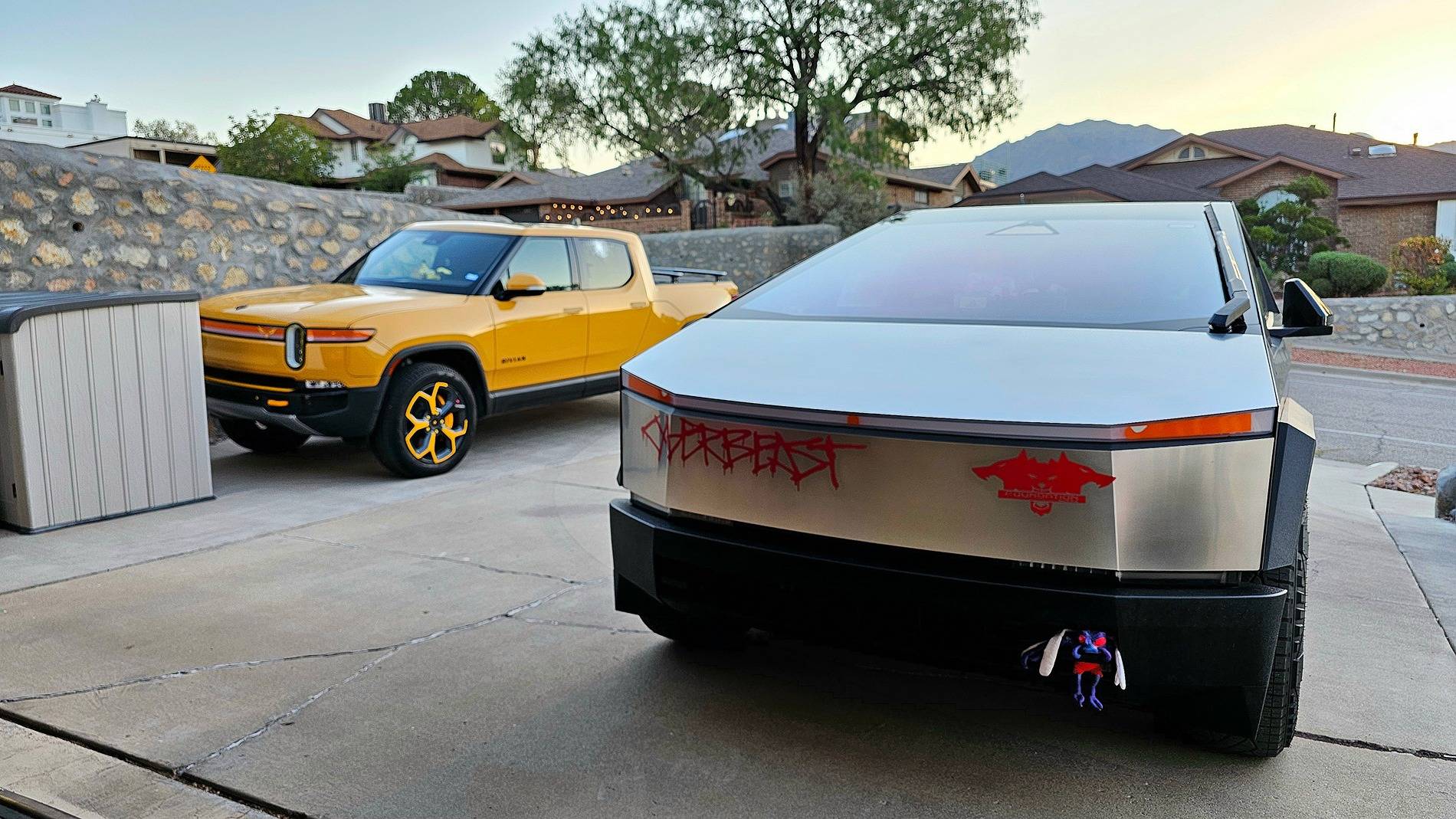
For a little background, I have owned several trucks through my life and currently own my Cyberbeast and a F-350 4x4 SRW CC Long Bed with the 6.7L Diesel, so I will be comparing my experience with my CT to those. I bought my CT on Sept 12 and left to South Carolina on the 13th. I was already planning on making the trip in my MY but Tesla told me my CT was here and only gave me a 1 week window in the APP to go pick it up. So I traded in my MY and repacked my stuff in the CT to head to SC for my sister-in-laws wedding. So here is the good, the ok, and the ugly grouped as conveniently as I can make it. Our CT did come with the aero covers.
The good:
-The ride on the CT is very smooth, fairly quiet (though you can here to electric motors hum gently while cruising) even on the ATs that came with the vehicle. I routinely had to drive with the radio off or very low so my family could sleep
-Tesla Navigation (with occasional optimization with A Better Route Planner) basically made sure I had no range anxiety the whole trip with one exception. The one time I got a little worried was the day we left South Carolina. It was the day after Hurricane Helene passed through and we still didn't have a whole lot of information of what was going on where. 40% of South Carolina was without power so I used Tesla Navigation and A Better Route planner to plan my trip to Omaha, NE (my wife and I wanted to stop there to visit someone) and had a route planned that took us essentially through Asheville (we had no idea the damage that we were about to see). The day before we left we Supercharged in Charleston to get up to 85% and then used our in-laws 120v to charge up to about 97% by the morning when we left. Of note, we did have our 3kw gas generator with us because we were planning on doing some camping as well so I wanted to make sure that we weren't going to be stranded anywhere. When we left in the morning, Tesla Navigation updated its route and was now telling us to go through Atlanta instead of through Asheville, but we already had out stops planned out so I typed in the points manually. As we went north, Superchargers started shutting down and we got routed to the only one power in NW SC, which was an 8 stall 150KW charger, that everyone within 100 miles was now getting routed to for charging. We had to wait in a line for 3 hours to charge and the charger was basically at 100% duty cycle being split between a lot of people. I charged at an average rate of 93 kw (per Tessie) for 35 min (after waiting 3 hours to get into a stall) to only get ~40% of my battery back. We left Greenville, SC at 75% SOC and headed towards TN on I-40. Shortly after we got out of Greenville, we lost our cell phone signal (both on our phones and on the truck). We drove almost 2 hours north when we were greeted with a sign saying I-40 in to TN was closed. We got off at the next exit and stopped at a gas station that had hundreds of people sitting and waiting. Talking to a few of the people, they said that the nearest known gas station that has power that could power the pumps was over 150 miles away. We were at 33% SOC with still no reception so I set up my Starlink and got a new route from Tesla Navigation that would get me into Knoxville. It said I had to drive 110 miles and I would arrive with 8% charge. We set off on the new path knowing we had our generator and enough fuel for a full recharge (though that would have taken roughly 1.5 days to do). This is where we saw our best range. We went through the destroyed roads of the Appalachians with an average speed of 35 MPH and we were getting 200-240 wh/mi allowing us to drive 70 miles and only utilize 9% charge. As we got closer to TN, we encountered bridge after bridge that had been washed out and still no cell phone reception. We got down to 20% SOC and we made the trek for a 3rd bridge and if it was washed out we were going to go back the 75 some odd miles and stay at that gas station while we re-charged on the generator. We found a bridge that wasn't washed out and made it into TN with 8% SOC when we plugged in. We drove a total of about 140 miles on roughly 25% SOC. So from now own, is the Tesla Navigation is doing a major re-route for me, I will be taking it.
-Power outlets in bed came in handy when we lost power during Hurricane Helene. We able to run an extension cord into the house and run our cooking stuff (coffee, microwave, toaster) to make food during the day we had no power. My F-350 would have been able to do that with once of my high power inverters, but that is an extra cost and requires the hood up/engine running to utilize that set up.
-All the storage everywhere is great, though I would have gladly opted to remove the under-bed storage for a bigger battery pack (say 150kwh at a min) or a spare tire.
The OK:
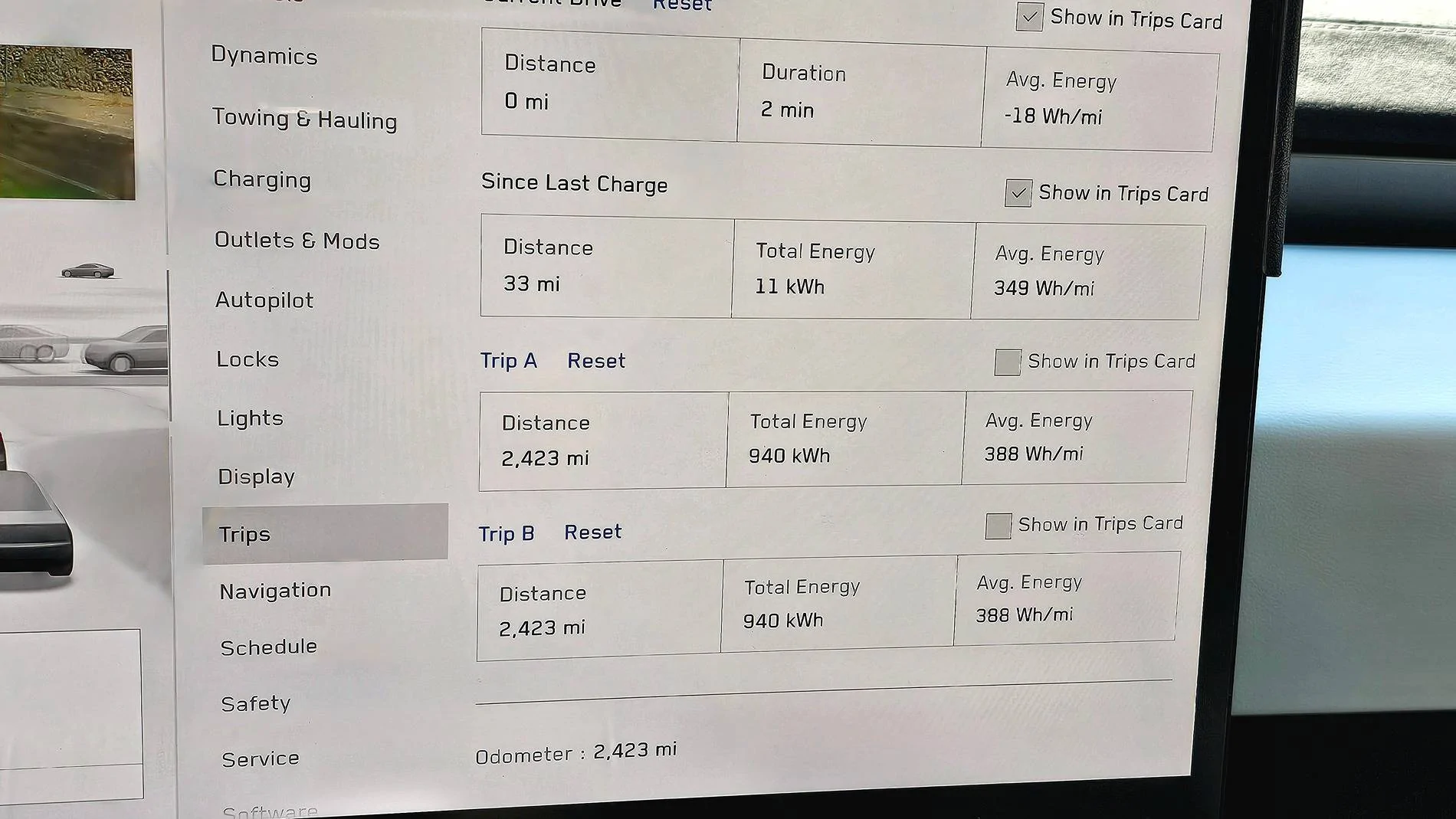
-Energy usage is HEAVILY penalized at speed for this vehicle due to it being so much larger than the rest of the tesla fleet. Of note, I did have over 1000 lbs of cargo. My best efficiency, as stated above was 208 wh/mi before I got on the freeway in NC/TN. my worst was traveling at 80 mph (speed limit and I was still getting passed), with a slow but consistent elevation gain of about 4000 ft. (I believe in was SD) over the course of the drive, and the weather/wind socks on the road showing a headwind of over 20 mph. I got 710wh/mi for that leg. My total trip to SC and back, along with 1.5 weeks of driving in SC, resulted in 3109kwh used over the 6788 mi I drove resulting in 458wh/mi. I feel my average speed on the freeway was probably 70-75 with my top speed cruising speed of 83 mph. All large vehicles suffer from the laws of physics. My F-350 (it is not a deleted diesel, it has the 10 spd) can get 22-24mpg at 63mph, 20-22 mpg at 70, and about 18-19mpg at 80.
-Charging is very reliable spaced that we were always able to make it to chargers, though, Tesla Navigation would not prioritize utilizing 250kw chargers and would simple plan for about 2 hour long legs at a time, so I would have to manually pick 250kw to change the stopping points in the navigation software to charge at the higher speed chargers. In all (except Greenville) our charge stops average about 20-30 minutes with our longest being 1 hour and our shortest being 10 minutes. The 2 hour legs worked fine for my family because someone always needed to go to the bathroom after that time but the time does add up. Our total time charging was roughly 20% of our trip. Compare that to if I road tripped in my F350 which gets between 1000-1200 miles on a tank, I would only need to stop twice for about 15 minutes for fill ups and then everything else would be by choice for food, sleep, or bathroom.
-FSD came to me 2 days before the end of the trip and was great, for the most part, on highway driving. It LOVES to ride on one of the paint lines which will routinely touch the rumble strips and those send my dog into a panic, so I had to intervene a lot to keep it center of the lane.
-Still an oddity. Some people don't know this thing exists. Some people have their fragile emotions hurt by it and express that with a middle finger, thumbs down, intentionally roll coal from deleted diesels (would be funny is there was a way to upload the Teslacam clips to an EPA website of people doing rolling coal), or the finger in the throat (sick signal). Most people I have encountered actually like it.
The bad:
-Charging cost. This is ridiculous in my honest opinion. We chose to drive our Tesla across country hoping it would save a little bit on fuel cost (diesel is about $5/gal where I live and superchargers are like $0.33/kwh). Once we get past Idaho, SC costs raged from $0.37/kwh to $0.48/kwh. The whole trip used 3.1mwh and cost me about $1300 in electricity. But, also as I got past Idaho, cost of gas and diesel fell significantly. The cheapest we saw gas was at buc-ees in NE TN. Gas was just over $2/gal and diesel was about $2.30/gal (or $1.67/gal gas $2.06/gal diesel if you bought a car wash) and the average cost of diesel through the US was about $3/gal. MY F-350 at its worst of 18 mpg when not towing over 7000 miles results in 390 gals of diesel, it probably would have used closer to 325-350 gals of diesel for the whole trip. At an average cost of $3/gal, it means I spent MORE to drive my Tesla as compared to my F-350 which is about twice the size (long bed crew cab) and weighs almost 2,000lbs more than the CT. The higher cost and the longer wait to charge will kill the potential of any mass adoption for EVs outside of commuting.
-Firmware/Software/Rear Steer? I am not sure what to section this, but twice through the trip I experienced a "critical steering issue pull over immediately" and being sent into 4 mph limp mode. Both times happened after I supercharged to over 90% (because that is what Tesla Navigation was having me do to make it to the next supercharger). So it appears when the battery goes from split packing DC charging (400v) to series pack driving mode (800v) that the voltage spikes the PCS past its limits, throws a fault, and shuts the systems down. (I developed LiFePO4 batteries in college and immediately after finish a high SOC on Li-Ion batteries, the voltage stays higher than its nominal 100% SOC voltage for a short period of time which is further exacerbated when you do a high C charge vs a low C charge ) So while the split pack 400v is still within the spec at a high SOC for the PCS, once the system re-aligns the 2x400VDC packs go into series and creates a voltage spike that shuts down the PCS. This is all speculation as to what I think it happening because I could only replicate at high SOCs. The fault would clear once the HV Battery was <90% and the car had been left idle/asleep for >30 min. The first time this happened, we were in Boise on a Saturday. We supercharged to 94% Roadside towed us to the nearest Service Center and the sales floor said that service would not be in until Monday morning. Once I dug through the service menu and believe I found the voltage issue previously discussed as the probably cause, we elected to not stay for 2 days and wait for Tesla to simply "look" at our vehicle. It came in again on our way back because we needed to charge to 92%, so we risked it. We did the same process and the fault cleared.
-The slanted tailgate is a PITA. Climbing over the tailgate into/out of the bed is a huge pain to get your footing due to the tail gate not going straight up and down.
-Power outlets not usable while AC charging is a big cop out in my opinion. I have 2x Victron Energy Multiplus inverters set up in a 120/240VAC fashion on my RV that can run loads in the RV (120v or 240v) regardless of the grid voltage that is plugged into the RV. The inverters can take power from the grid (120v or 240v) and pass that through to the RV and still charge its DC side at the same time. If 120VAC is all it is plugged into, it will accept that on a single leg, pass that through, convert to DC to charge/run the opposite inverter, and still output 240VAC to the RV. And these inverters are 5 years old. So it is possible but Tesla elected to go the cheaper?Easier? I don't even know because these inverters have been around for a WHILE.
I am a motorhead and I love vehicles so I don't feel I bias to either power train but objectively speaking, diesel/gas will remain king on the roads for long distance trips/hauling/towing based on the comparison for my vehicles. That being said, the CB has ~2200 lbs. of payload which is close to 3/4 ton territory. My F-350 only had 4,000 lbs. of payload so it won't be to badly impacted for moving weight around, but towing will remain with diesel (maybe we can get some good diesel electrics like Edison motors) for a long time. If I could mod my CT to charge while drive from a like 24kw diesel/gas/lpg generator, it would most like outperform my F-350 when towing <11k. Even with the range extender that is right now advertised at like 50kwh or something like that, it still will just pale in comparison.
I love both my trucks, the CT will do fine for commuting and trips to things like Lowes/Home Deport and hauling stuff around town, but I wouldn't want to try towing long distance with the CT. I feel the Cybertruck is more akin to a CyberSUV.
The good:
-The ride on the CT is very smooth, fairly quiet (though you can here to electric motors hum gently while cruising) even on the ATs that came with the vehicle. I routinely had to drive with the radio off or very low so my family could sleep
-Tesla Navigation (with occasional optimization with A Better Route Planner) basically made sure I had no range anxiety the whole trip with one exception. The one time I got a little worried was the day we left South Carolina. It was the day after Hurricane Helene passed through and we still didn't have a whole lot of information of what was going on where. 40% of South Carolina was without power so I used Tesla Navigation and A Better Route planner to plan my trip to Omaha, NE (my wife and I wanted to stop there to visit someone) and had a route planned that took us essentially through Asheville (we had no idea the damage that we were about to see). The day before we left we Supercharged in Charleston to get up to 85% and then used our in-laws 120v to charge up to about 97% by the morning when we left. Of note, we did have our 3kw gas generator with us because we were planning on doing some camping as well so I wanted to make sure that we weren't going to be stranded anywhere. When we left in the morning, Tesla Navigation updated its route and was now telling us to go through Atlanta instead of through Asheville, but we already had out stops planned out so I typed in the points manually. As we went north, Superchargers started shutting down and we got routed to the only one power in NW SC, which was an 8 stall 150KW charger, that everyone within 100 miles was now getting routed to for charging. We had to wait in a line for 3 hours to charge and the charger was basically at 100% duty cycle being split between a lot of people. I charged at an average rate of 93 kw (per Tessie) for 35 min (after waiting 3 hours to get into a stall) to only get ~40% of my battery back. We left Greenville, SC at 75% SOC and headed towards TN on I-40. Shortly after we got out of Greenville, we lost our cell phone signal (both on our phones and on the truck). We drove almost 2 hours north when we were greeted with a sign saying I-40 in to TN was closed. We got off at the next exit and stopped at a gas station that had hundreds of people sitting and waiting. Talking to a few of the people, they said that the nearest known gas station that has power that could power the pumps was over 150 miles away. We were at 33% SOC with still no reception so I set up my Starlink and got a new route from Tesla Navigation that would get me into Knoxville. It said I had to drive 110 miles and I would arrive with 8% charge. We set off on the new path knowing we had our generator and enough fuel for a full recharge (though that would have taken roughly 1.5 days to do). This is where we saw our best range. We went through the destroyed roads of the Appalachians with an average speed of 35 MPH and we were getting 200-240 wh/mi allowing us to drive 70 miles and only utilize 9% charge. As we got closer to TN, we encountered bridge after bridge that had been washed out and still no cell phone reception. We got down to 20% SOC and we made the trek for a 3rd bridge and if it was washed out we were going to go back the 75 some odd miles and stay at that gas station while we re-charged on the generator. We found a bridge that wasn't washed out and made it into TN with 8% SOC when we plugged in. We drove a total of about 140 miles on roughly 25% SOC. So from now own, is the Tesla Navigation is doing a major re-route for me, I will be taking it.
-Power outlets in bed came in handy when we lost power during Hurricane Helene. We able to run an extension cord into the house and run our cooking stuff (coffee, microwave, toaster) to make food during the day we had no power. My F-350 would have been able to do that with once of my high power inverters, but that is an extra cost and requires the hood up/engine running to utilize that set up.
-All the storage everywhere is great, though I would have gladly opted to remove the under-bed storage for a bigger battery pack (say 150kwh at a min) or a spare tire.
The OK:
-Energy usage is HEAVILY penalized at speed for this vehicle due to it being so much larger than the rest of the tesla fleet. Of note, I did have over 1000 lbs of cargo. My best efficiency, as stated above was 208 wh/mi before I got on the freeway in NC/TN. my worst was traveling at 80 mph (speed limit and I was still getting passed), with a slow but consistent elevation gain of about 4000 ft. (I believe in was SD) over the course of the drive, and the weather/wind socks on the road showing a headwind of over 20 mph. I got 710wh/mi for that leg. My total trip to SC and back, along with 1.5 weeks of driving in SC, resulted in 3109kwh used over the 6788 mi I drove resulting in 458wh/mi. I feel my average speed on the freeway was probably 70-75 with my top speed cruising speed of 83 mph. All large vehicles suffer from the laws of physics. My F-350 (it is not a deleted diesel, it has the 10 spd) can get 22-24mpg at 63mph, 20-22 mpg at 70, and about 18-19mpg at 80.
-Charging is very reliable spaced that we were always able to make it to chargers, though, Tesla Navigation would not prioritize utilizing 250kw chargers and would simple plan for about 2 hour long legs at a time, so I would have to manually pick 250kw to change the stopping points in the navigation software to charge at the higher speed chargers. In all (except Greenville) our charge stops average about 20-30 minutes with our longest being 1 hour and our shortest being 10 minutes. The 2 hour legs worked fine for my family because someone always needed to go to the bathroom after that time but the time does add up. Our total time charging was roughly 20% of our trip. Compare that to if I road tripped in my F350 which gets between 1000-1200 miles on a tank, I would only need to stop twice for about 15 minutes for fill ups and then everything else would be by choice for food, sleep, or bathroom.
-FSD came to me 2 days before the end of the trip and was great, for the most part, on highway driving. It LOVES to ride on one of the paint lines which will routinely touch the rumble strips and those send my dog into a panic, so I had to intervene a lot to keep it center of the lane.
-Still an oddity. Some people don't know this thing exists. Some people have their fragile emotions hurt by it and express that with a middle finger, thumbs down, intentionally roll coal from deleted diesels (would be funny is there was a way to upload the Teslacam clips to an EPA website of people doing rolling coal), or the finger in the throat (sick signal). Most people I have encountered actually like it.
The bad:
-Charging cost. This is ridiculous in my honest opinion. We chose to drive our Tesla across country hoping it would save a little bit on fuel cost (diesel is about $5/gal where I live and superchargers are like $0.33/kwh). Once we get past Idaho, SC costs raged from $0.37/kwh to $0.48/kwh. The whole trip used 3.1mwh and cost me about $1300 in electricity. But, also as I got past Idaho, cost of gas and diesel fell significantly. The cheapest we saw gas was at buc-ees in NE TN. Gas was just over $2/gal and diesel was about $2.30/gal (or $1.67/gal gas $2.06/gal diesel if you bought a car wash) and the average cost of diesel through the US was about $3/gal. MY F-350 at its worst of 18 mpg when not towing over 7000 miles results in 390 gals of diesel, it probably would have used closer to 325-350 gals of diesel for the whole trip. At an average cost of $3/gal, it means I spent MORE to drive my Tesla as compared to my F-350 which is about twice the size (long bed crew cab) and weighs almost 2,000lbs more than the CT. The higher cost and the longer wait to charge will kill the potential of any mass adoption for EVs outside of commuting.
-Firmware/Software/Rear Steer? I am not sure what to section this, but twice through the trip I experienced a "critical steering issue pull over immediately" and being sent into 4 mph limp mode. Both times happened after I supercharged to over 90% (because that is what Tesla Navigation was having me do to make it to the next supercharger). So it appears when the battery goes from split packing DC charging (400v) to series pack driving mode (800v) that the voltage spikes the PCS past its limits, throws a fault, and shuts the systems down. (I developed LiFePO4 batteries in college and immediately after finish a high SOC on Li-Ion batteries, the voltage stays higher than its nominal 100% SOC voltage for a short period of time which is further exacerbated when you do a high C charge vs a low C charge ) So while the split pack 400v is still within the spec at a high SOC for the PCS, once the system re-aligns the 2x400VDC packs go into series and creates a voltage spike that shuts down the PCS. This is all speculation as to what I think it happening because I could only replicate at high SOCs. The fault would clear once the HV Battery was <90% and the car had been left idle/asleep for >30 min. The first time this happened, we were in Boise on a Saturday. We supercharged to 94% Roadside towed us to the nearest Service Center and the sales floor said that service would not be in until Monday morning. Once I dug through the service menu and believe I found the voltage issue previously discussed as the probably cause, we elected to not stay for 2 days and wait for Tesla to simply "look" at our vehicle. It came in again on our way back because we needed to charge to 92%, so we risked it. We did the same process and the fault cleared.
-The slanted tailgate is a PITA. Climbing over the tailgate into/out of the bed is a huge pain to get your footing due to the tail gate not going straight up and down.
-Power outlets not usable while AC charging is a big cop out in my opinion. I have 2x Victron Energy Multiplus inverters set up in a 120/240VAC fashion on my RV that can run loads in the RV (120v or 240v) regardless of the grid voltage that is plugged into the RV. The inverters can take power from the grid (120v or 240v) and pass that through to the RV and still charge its DC side at the same time. If 120VAC is all it is plugged into, it will accept that on a single leg, pass that through, convert to DC to charge/run the opposite inverter, and still output 240VAC to the RV. And these inverters are 5 years old. So it is possible but Tesla elected to go the cheaper?Easier? I don't even know because these inverters have been around for a WHILE.
I am a motorhead and I love vehicles so I don't feel I bias to either power train but objectively speaking, diesel/gas will remain king on the roads for long distance trips/hauling/towing based on the comparison for my vehicles. That being said, the CB has ~2200 lbs. of payload which is close to 3/4 ton territory. My F-350 only had 4,000 lbs. of payload so it won't be to badly impacted for moving weight around, but towing will remain with diesel (maybe we can get some good diesel electrics like Edison motors) for a long time. If I could mod my CT to charge while drive from a like 24kw diesel/gas/lpg generator, it would most like outperform my F-350 when towing <11k. Even with the range extender that is right now advertised at like 50kwh or something like that, it still will just pale in comparison.
I love both my trucks, the CT will do fine for commuting and trips to things like Lowes/Home Deport and hauling stuff around town, but I wouldn't want to try towing long distance with the CT. I feel the Cybertruck is more akin to a CyberSUV.
Sponsored