Sponsored

10,000+ Miles Driving a Cybertruck – Things learned: range, great sound and full love/hate list after 10k miles

BannedByTMC

Well-known member
Joined
Dec 19, 2023
Threads
22
Messages
813
Reaction score
1,141
Location
NYS
Vehicles
Model 3
Country flag
I wouldn't call this stretching the band at this point, people are getting 190-210 miles out of something that is advertising 320.
Because they aren't driving it like the EPA test cycle. EV's are highly sensitive to conditions and use cases, a simple fact that many people don't understand. Do 65mph in 70F weather on relatively flat roads and you'll probably get EPA range, maybe more.
Sponsored


Woodrick

Well-known member
First Name
Ed
Joined
Dec 30, 2023
Threads
6
Messages
4,786
Reaction score
4,762
Location
Gainesville Ga
Vehicles
Model 3, Model Y, Cybertruck AWD
Occupation
Consultant
Country flag
I wouldn't call this stretching the band at this point, people are getting 190-210 miles out of something that is advertising 320. That's minimum about 35% less range. Something is legitimate broken here. Bigger battery, shelf off 400-500 lbs or both
Where is it being advertised as 320 Highway?

What you are seeing is the EPA blended. And that's not measured at 75 mph.
 

maddass98

Member
Joined
Jan 20, 2024
Threads
0
Messages
6
Reaction score
9
Location
USA
Vehicles
all Tesla
Country flag
It looks like you joined the forum today, and this is your first post, so first off welcome.
zimage7293.png

Secondly, incorrect.
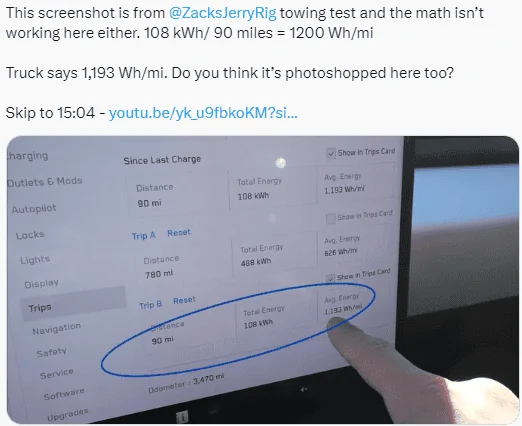
As a really easy example take one of the many posts from X / Twitter like the one below.
You think Zack with JRE is CGIing his trip report in real time to someone make the CT look bad?
Also there are tons of other SS out there with the same minor discrepancies due to rounding in the software, along with a ton of other range reports that have similar results.

So not trying to totally put you on blast, but with others including JRE there is a possibility that the CT software rounds slightly different than other Teslas?


1705859526646.png
[/QUOTE]
[/QUOTE]
By using Jerryrig's numbers you already show you have lack much understanding of what you are actually looking at. 90Mi is not 90 exactly. same for 108kWh. These number don't show the fractions so using such a small sample size give you the so called wrong number of 1,193wh/m. Try 90.7mi and 108.2kwh, you get 1,193 wh/m exactly.

My question is who gave you doctored screenshot you posted? If you knew and posted it, you have some bad motives to make Tesla look bad. If you were given it and the math escapes you, you look like an idiot being used.

You tried to challenge Wes one of the lead engineer's for Tesla when you have demonstrated you haven't a clue about what the numbers mean. Take a large sample size like your doctored numbers and add one to simulate what tesla is doing which is not showing the decimal and the wh/m number doesn't change same for the large sample I showed.

Math isn't your strong suit, I completely understand and neither is it for most here as they seem to believe the photoshopped numbers completely.
 

evazquezcu

Well-known member
First Name
Eric
Joined
Jan 1, 2020
Threads
3
Messages
107
Reaction score
121
Location
Miami
Vehicles
2016 Chevy Silverado LT
Country flag
Where is it being advertised as 320 Highway?

What you are seeing is the EPA blended. And that's not measured at 75 mph.
That's the estimated number straight from Tesla website for the Cyberbeast


Crissa

Well-known member
First Name
Crissa
Joined
Jul 8, 2020
Threads
138
Messages
19,571
Reaction score
31,477
Location
Santa Cruz
Vehicles
2014 Zero S, 2013 Mazda 3
Country flag
I wouldn't call this stretching the band at this point, people are getting 190-210 miles out of something that is advertising 320. That's minimum about 35% less range. Something is legitimate broken here. Bigger battery, shelf off 400-500 lbs or both
What's broken is your response.

You drive faster than EPA, you get less range. It's simple physics that any trucker would know. These losses are additive and exponential. And cold air is more dense than warm, making this worse.

-Crissa
 

CyberExperience

Well-known member
First Name
Bruce
Joined
Mar 27, 2023
Threads
1
Messages
45
Reaction score
46
Location
Bluffton
Website
flyingmpartners.com
Vehicles
Jeep Rubicon, Chevy, Porsche , BMW GS, SeaBreezeLX
Occupation
Analyst
Country flag

Ward L

Well-known member
First Name
Ward
Joined
Dec 17, 2023
Threads
9
Messages
408
Reaction score
570
Location
Camarillo, CA
Vehicles
Model Y, FS CT AWD
Country flag
I wonder what is going on to not have the EPA ratings on the website. I’ve seen where the crash stats are not available, but how does Tesla have the “EPA” numbers and the EPA does not?

BayouCityBob says Tesla could have fixed the range but didn’t. I don’t believe that. Range is hard to change. I’ve mentioned a couple of times that I suspect the battery performance is not as good as planned. The range has to be proportional and heavily dependent to weight, battery capacity, rolling resistance, and CD/Frontal area. How is that easy to change?

Since so many posts here are way off topic, I’ll add another point. Wind resistance is proportional to the square of the speed. For example, 50 MPH has a wind resistance factor of 2,500. Going 80 MPH has a factor of 6,400. A speed of 80 has over 2.5 times more drag than going 50 MPH.
 

Deleted member 17810

Guest
I wonder what is going on to not have the EPA ratings on the website. I’ve seen where the crash stats are not available, but how does Tesla have the “EPA” numbers and the EPA does not?

BayouCityBob says Tesla could have fixed the range but didn’t. I don’t believe that. Range is hard to change. I’ve mentioned a couple of times that I suspect the battery performance is not as good as planned. The range has to be proportional and heavily dependent to weight, battery capacity, rolling resistance, and CD/Frontal area. How is that easy to change?

Since so many posts here are way off topic, I’ll add another point. Wind resistance is proportional to the square of the speed. For example, 50 MPH has a wind resistance factor of 2,500. Going 80 MPH has a factor of 6,400. A speed of 80 has over 2.5 times more drag than going 50 MPH.
The test data used to determine fuel economy estimates is derived from vehicle testing done at EPA's National Vehicle and Fuel Emissions Laboratory in Ann Arbor, Michigan, and by vehicle manufacturers who submit their own test data to EPA.
https://www.epa.gov/compliance-and-fuel-economy-data/data-cars-used-testing-fuel-economy#:~:text=The test data used to,own test data to EPA.

They just have to validate it basically.
 

Ward L

Well-known member
First Name
Ward
Joined
Dec 17, 2023
Threads
9
Messages
408
Reaction score
570
Location
Camarillo, CA
Vehicles
Model Y, FS CT AWD
Country flag
This EPA site shows no Teslas for 2024. 2023 info is there for Tesla. All other manufacturers are shown in 2024.


cvalue13

Well-known member
Joined
Aug 17, 2022
Threads
74
Messages
7,153
Reaction score
13,769
Location
Austin, TX
Vehicles
F150L
Occupation
Fun-employed
Country flag
Just for reference, here is how the EPA conducts it tests. Make sure you read the entire article so you understand some of the testing is done with no heat or A/C running.

but this and other "real world" effects is why the EPA then applies a adjustment factor to the outcomes.

if in the controlled environment of the dyno test the vehicle gets 100mi, then to simulate eg the use of HVAC, aggressive driving, etc., the EPA default adjustment factor is 0.70, resulting in a stated EPA range of not 100mi (per dyno) but instead 70 miles.


meanwhile and separately, completely within the permitted rules of the EPA, basically OEMs can choose to and apply for using a different adjustment factor than the default 0.70.

Basically the only OEM who consistently looks for and uses a better adjustment factor is Tesla. And in the case of the Cybertruck, they've asked for the most aggressive adjustment factor they've ever sought: 0.82

which means that if a Lightning were on the dyno and achieved 100mi, because Ford uses the EPA's default adjustment factor, it would spit out an EPA rating of 70mi

whereas if a Cybertruck on the dyno got an identical 100mi, if Tesla has its way it will spit out an EPA rating of 82 miles


for these reasons, when talking about the Cybertruck/Tesla, it seems to me a bit misleading to suggest that the EPA figures being questionable comes down to the EPA alone. Is what Tesla is doing with the EPA permitted? Sure. Do other OEMs feel it's in *their* best interests and prudent to achieve the most aggressive EPA figures possible? No.

The result, in cartoon form, is the very real possibility that a "70mi Lightning" is in effect identical to an "82mi Cybertruck," under EPA test conditions.
 

cvalue13

Well-known member
Joined
Aug 17, 2022
Threads
74
Messages
7,153
Reaction score
13,769
Location
Austin, TX
Vehicles
F150L
Occupation
Fun-employed
Country flag
They just have to validate it basically.
yeah i suspect, but dont know, that the reason we HAVENT seen EPA final numbers but HAVE months ago seen Tesla's applications, is that the EPA and Tesla are still in some iterative process of arguing over whether the 0.82 adjustment factor is reasonable/valid

it wouldn't be the first time the EPA has pushed back on Tesla's proposed adjustment factors
 

tagreene

New member
First Name
Terrence
Joined
Nov 2, 2021
Threads
0
Messages
1
Reaction score
3
Location
Navarre, Florida
Vehicles
TM3 LR RWD (2019) and order for Cyber Truck
Occupation
Retired
Country flag
All of the above tells me there is a critical failure warning light flashing at Tesla. I am a long-time Tesla shareholder, owner of three Teslas, huge advocate of the company and all around fan. (I recently and reluctantly cancelled the CT FS because the range would not meet my needs.) But I am calling it: something is deeply broken.

We now have enough data to definitively say that Tesla blew it on the Cybertruck range (not least this post which is consistent with previous data). There is no way - with all of the very public testing done by Tesla - that the engineering team did not know (long ago) that the real-world range would suck. They knew. And Tesla has an incredible engineering and manufacturing team so they could have fixed this. No question. So it seems to me that we can conclude:
1) Range sucks
2) Team knew long before release that range sucks
3) It is a big deal for customers
4) They could have fixed it but didn't

With these facts on the table (I think they are facts at this point) one has to ask why did Tesla get this so wrong? We have seen this before. It is a symptom of an organization where everyone is afraid to tell the emperor that he is not wearing clothes. It is a symptom of a company where bad news is hidden and bad data is reformulated until it fits a pre-ordained internal narrative. If that diagnosis is correct, Tesla is in serious trouble. For all of its accomplishments and incredibly talented staff, it will collapse in on itself unless this gets fixed. I hope it is a wake-up call to the board and the leadership. Warning light flashing IMO.
I seriously doubt there is a leadership issue at Tesla where employees are afraid to bring up issues. Read Elon's biography by Isaacson and you will be enlightened. I believe this is an engineering challenge where battery density is not where they hoped it would be and they absolutely had to get the vehicle out after years of delays. I agree 100% that range is and will be a big issue for many, including myself, where trips would require charging every 1.5-2.0 hrs and take twice as long as other Teslas until the V4 chargers come on line.
Sponsored


Top