
Sponsored

greggertruck

Well-known member
First Name
g
Joined
Mar 30, 2022
Threads
228
Messages
2,628
Reaction score
7,655
Location
Zimbabwe
Website
www.twitter.com
Vehicles
Dual-CT
Occupation
I post Cybertruck stuff on the Internet and people like it.
Country flag
Last edited:

cvalue13

Well-known member
Joined
Aug 17, 2022
Threads
74
Messages
7,153
Reaction score
13,769
Location
Austin, TX
Vehicles
F150L
Occupation
Fun-employed
Country flag
Pretty sure this slide is not describing what CT will use.

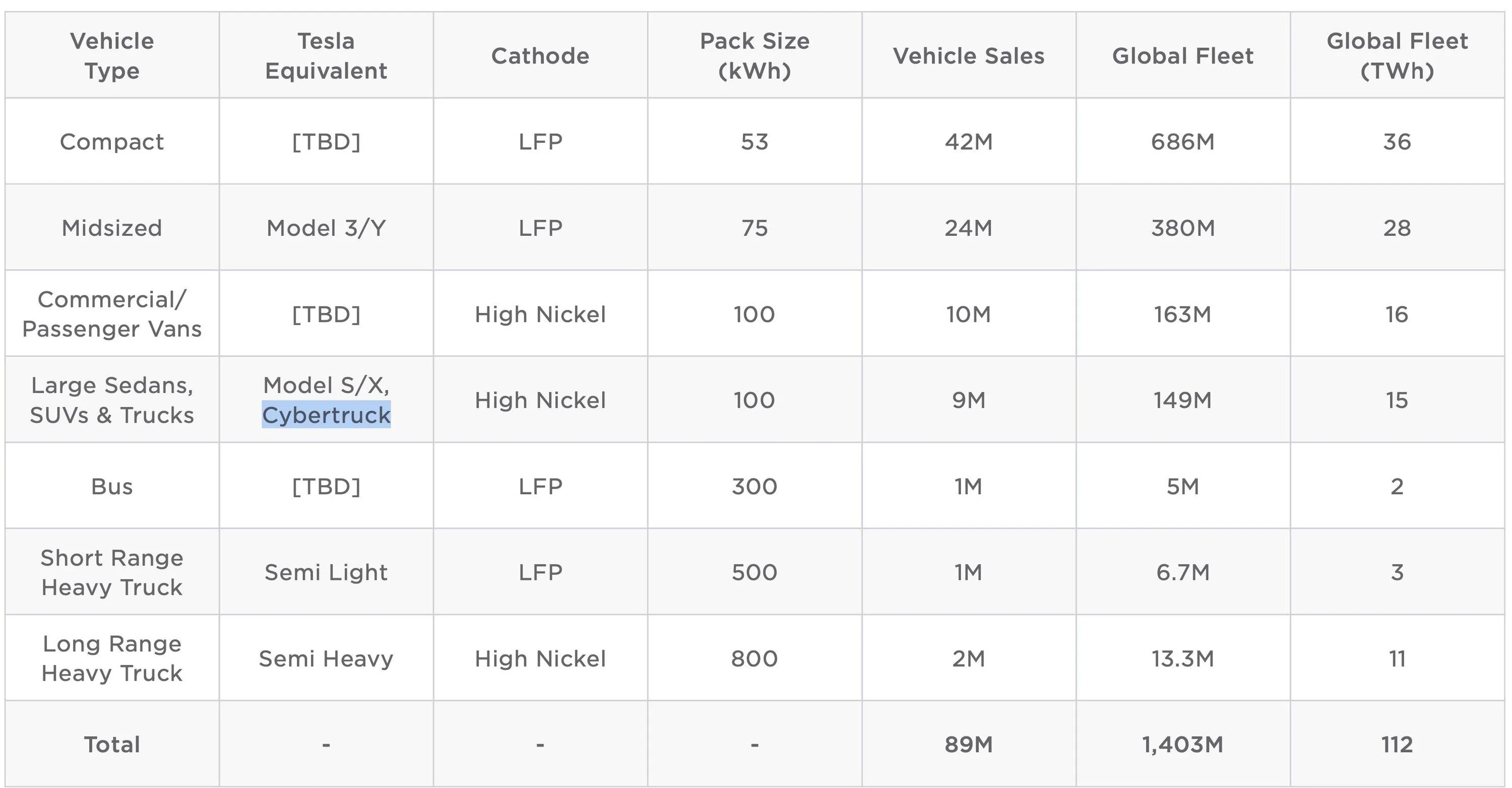
the chart is within a section describing how transition to green will require, amongst other things, conversion to BEVs - and providing estimates of what that future may look like or require.

This slide is then attempting to make an estimation of the TWh of batteries that would be needed for complete BEV conversion globally. To arrive at that TWh estimate, it assumes that larger vehicles will need more energy-dense batteries, and will on average need about a 100kWh pack of those high density batteries.

This chart simply gives a “Tesla equivalent” example of the sizes of vehicles likely to need various energy-density packs, and on average what those pack sizes would be, in order to come up with a loosely accurate estimation of global TWhs needed.

It does not say that the CyberTruck itself will use a Nickle battery, or have a 100kWh pack, when releases. Maybe it will or won’t, but this chart isn’t taking a position on that

Here’s the operative description of the chart (and it’s FN):

“Vehicles

Today there are 1.4B vehicles globally and annual passenger vehicle production of ~85M vehicles, according to OICA. Based on pack size assumptions, the vehicle fleet will require 112 TWh of batteriesaa. Autonomy has potential to reduce the global fleet, and annual production required, through improved vehicle utilization.

Standard-range vehicles can utilize the lower energy density chemistries (LFP), whereas long-range vehicles require higher energy density chemistries (high nickel). Cathode assignment to vehicle segment is listed in the table below. High Nickel refers to low to zero cobalt Nickel Manganese cathodes currently in production, under development at Tesla, Tesla’s suppliers and in research groups.

[FN:]
To approximate the battery storage required to displace 100% of road vehicles, the global fleet size, pack size (kWh)/ Global passenger fleet size and annual production (~85M vehicles/year) is based on data from OICA. The number of vehicles by segment is estimated based on S&P Global sales data. For buses and trucks, the US-to-global fleet scalar of ~5x is used as global data was unavailable.”
 

TheLastStarfighter

Well-known member
Joined
Jul 6, 2020
Threads
9
Messages
1,663
Reaction score
4,312
Location
Canada
Vehicles
Dodge Challenger, Tesla Model 3
Occupation
Industrial Engineer
Country flag
Pretty sure this slide is not describing what CT will use.

the chart is within a section describing how transition to green will require, amongst other things, conversion to BEVs - and providing estimates of what that future may look like or require.

This slide is then attempting to make an estimation of the TWh of batteries that would be needed for complete BEV conversion globally. To arrive at that TWh estimate, it assumes that larger vehicles will need more energy-dense batteries, and will on average need about a 100kWh pack of those high density batteries.

This chart simply gives a “Tesla equivalent” example of the sizes of vehicles likely to need various energy-density packs, and on average what those pack sizes would be, in order to come up with a loosely accurate estimation of global TWhs needed.

It does not say that the CyberTruck itself will use a Nickle battery, or have a 100kWh pack, when releases. Maybe it will or won’t, but this chart isn’t taking a position on that

Here’s the operative description of the chart (and it’s FN):

“Vehicles

Today there are 1.4B vehicles globally and annual passenger vehicle production of ~85M vehicles, according to OICA. Based on pack size assumptions, the vehicle fleet will require 112 TWh of batteriesaa. Autonomy has potential to reduce the global fleet, and annual production required, through improved vehicle utilization.

Standard-range vehicles can utilize the lower energy density chemistries (LFP), whereas long-range vehicles require higher energy density chemistries (high nickel). Cathode assignment to vehicle segment is listed in the table below. High Nickel refers to low to zero cobalt Nickel Manganese cathodes currently in production, under development at Tesla, Tesla’s suppliers and in research groups.

[FN:]
To approximate the battery storage required to displace 100% of road vehicles, the global fleet size, pack size (kWh)/ Global passenger fleet size and annual production (~85M vehicles/year) is based on data from OICA. The number of vehicles by segment is estimated based on S&P Global sales data. For buses and trucks, the US-to-global fleet scalar of ~5x is used as global data was unavailable.”
There's a few assumption issues with what you're saying here... just kidding, I believe that's all this is.


OP
OP
greggertruck

greggertruck

Well-known member
First Name
g
Joined
Mar 30, 2022
Threads
228
Messages
2,628
Reaction score
7,655
Location
Zimbabwe
Website
www.twitter.com
Vehicles
Dual-CT
Occupation
I post Cybertruck stuff on the Internet and people like it.
Country flag
Franz said recently it would best competitors on range. 100kWh would struggle to top 300 miles in the CT.
Wonder if there is anything he doesn’t know about it

seriously but also kidding
 

Baldey

Well-known member
First Name
Jenia
Joined
Feb 24, 2023
Threads
10
Messages
387
Reaction score
666
Location
Colorado
Vehicles
tesla M3, 2025 CT
Occupation
QA automation
Country flag
These are obviously estimates. battery packs range +- ~30% or more, depending on trim options. Lumping three vehicles into the "Large" category is gonna do that. Highly doubtfull these are remotely accurate.. Looks like just an average for global capacity claculations for the investor crowd. I would not go off these numbers, lol.

Also my M3's pack is barely 50kwh.. Wonder if they plan to bump it for Part 3?
 

MonkeyDeLuffy

Well-known member
Joined
Mar 7, 2023
Threads
3
Messages
232
Reaction score
368
Location
BayArea
Vehicles
Maverick
Occupation
Math In-and-Out
Country flag
All LFP models will lose credit more or less.
CT with 100kWh will not be too bad for daily driving. R1T has about 2.25 miles per kWh efficiency vs 3.3-3.5 miles per kWh of Model X. CT dual motor version should sit around 3 miles per kWh. So not so hyped about the release date of long-range CT. 300 miles+ version may come out first then 500 miles(with additional structural battery pack) then 250 miles with the same 100 kWh pack but software spayed.


Ogre

Well-known member
First Name
Dennis
Joined
Jul 3, 2021
Threads
166
Messages
10,735
Reaction score
27,050
Location
Ogregon
Vehicles
Model Y
Country flag
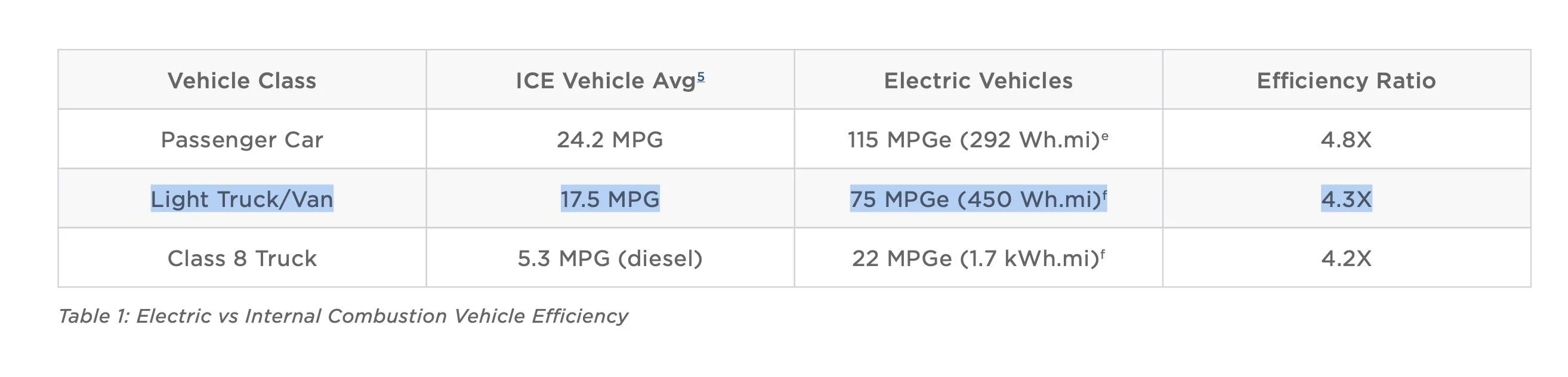
These are broad categories, and you shouldn’t read too much into them. For example the passenger cars estimates seem to be less efficient than a Model Y. Based on the numbers, it’s possible this is an estimate of observed real world mileage or just meant to represent a conservative estimate over the life of the vehicles.

There may be other SUVs, and it may be including fleets of single motor Cybertrucks, or even non-Tesla vehicles. This is not a guide to Cybertruck performance.


Top