
Sponsored

Ogre

Well-known member
First Name
Dennis
Joined
Jul 3, 2021
Threads
166
Messages
10,735
Reaction score
27,050
Location
Ogregon
Vehicles
Model Y
Country flag
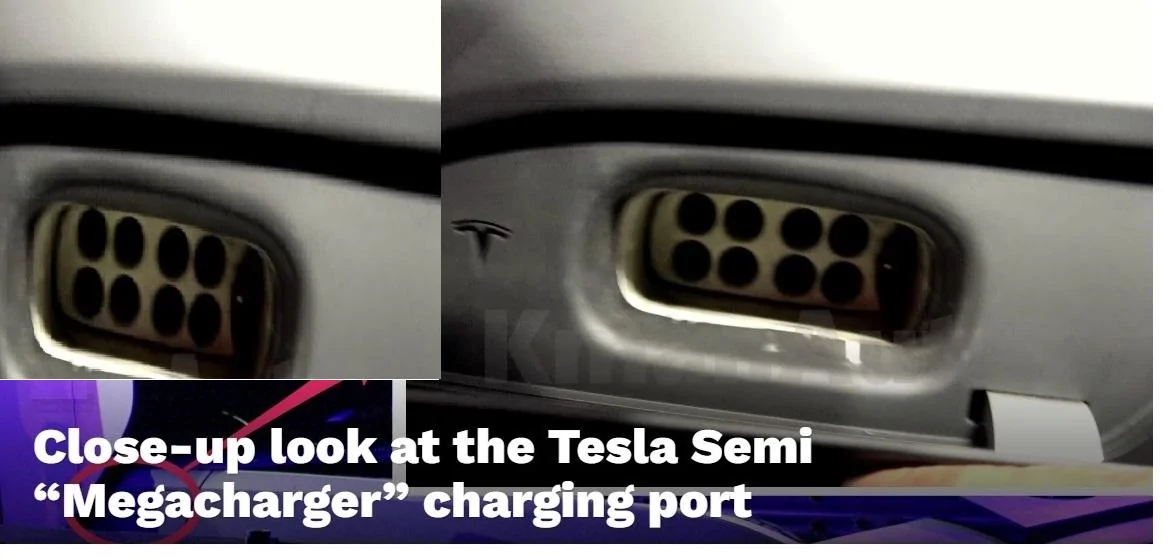
That charge port is what megacharger are today.

I did No photo edit No con to mislead the public

MegaChargers are only for this connector only
Not for
EvCars EvTrucks
I would suggest anyone to Twitter Musk on this.
OK
My suggestion is Twitter Musk on this

Crazy EvPlugs Semi.webp
Tesla said they were using v4 Supercharger to charge the semi. I don’t recall the word Megacharger being used at all at the event (going from memory).

In the clips higher up in the thread, they seem pretty clear on this. Also check the linked images of the charging standard where they show 1000v and 500v being pumped through the same cable. It’s all upthread, not going to relink it.

The connector you are showing was an interim measure so they could plug in to multiple superchargers from one truck.
Sponsored


 

Crissa

Well-known member
First Name
Crissa
Joined
Jul 8, 2020
Threads
138
Messages
19,571
Reaction score
31,477
Location
Santa Cruz
Vehicles
2014 Zero S, 2013 Mazda 3
Country flag

Ogre

Well-known member
First Name
Dennis
Joined
Jul 3, 2021
Threads
166
Messages
10,735
Reaction score
27,050
Location
Ogregon
Vehicles
Model Y
Country flag
Musk or any Tesla engineers go to Twitter ask for a photo
and then
Attach the Charging photo.
All you need to do is watch the video. They were extremely clear semi would use v4 Supercharger at 1000v. People higher in this thread queued it to the exact spot.

Rather than posting 4+ year old dates info and doubling down on old rumors, maybe watch the event video? Or you have seen it, at least explain why you feel we are mistaken in our understanding of the most recent Semi technical breakdown done by Musk himself on stage?
 

GlockandRoll

Banned
Well-known member
Banned
Joined
Aug 19, 2022
Threads
3
Messages
303
Reaction score
302
Location
Area S4: Papoose Lake
Vehicles
Porsche on the weekends, diesel truck mon-fri
Occupation
Arms dealer and musician
Country flag
I too reserved the Tri-motor CyberTruck the night of the reveal. It was the right choice for me because of the 14,000 lb tow rating Tesla pitched, as well as the 500 mile range. My plan for my CyberTruck is pulling my retirement RV trailer. The $69,900 plus the $7000 locked in price for FSD would have been the most money I had paid for ANYTHING in my life!!! (I paid $76,000 for my house in 1992 ?)

When I signed the reservation agreement it was clear that that price wasn't guaranteed, and although I hoped, I didn't really expect that that price would hold (I know about Elon time ?) I didn't need, and don't care about, a 0-60 time <3 seconds, but I would have taken family and friends for a launch. It was the towing and range that I was after. I was hoping that a full battery while pulling a full timer's trailer would get me at least 150ish miles. Prudent RVers have a "3/3/3 rule" Drive no further than 300 miles in a day. Stop every 3 hours. And arrive no later than 3:00. THAT is the perfect routine for an Electric RV towing truck!!! and I thought the Tri-Motor CyberTruck with a 500 mile range would be the ONLY way to accomplish that.

Then came the Tweet from Elon indicating that Tesla was considering a QUAD-MOTOR CyberTruck!(QMCT)?! I had to ask myself if this QMCT was the route I needed to go. I don't really want to flirt with the absolute maximum towing capacity, so should I step up to the QMCT just to be on the safe side?!? I had resigned myself to the possibility that the Tri-Motor price surely would have increased to $80-$90,000 or MORE, how much was this Quad-motor version gonna cost me?!? ?

Now I come to find out that a Tesla Semi Truck can tow over 50,000 lbs of payload with ONLY THREE MOTORS ?. Is there any real reason I even need the Tri-Motor version? It sounds like each motor of the Semi is capable of propelling over 27,000 lbs (27k X 3 = 81k) I see no reason I need anything more than a Dual-Motor?!? (27k X 2 = 54k)

Elon is fond of saying "The best part is no part". If two motors can handle more weight than any pick-up truck will EVER be expected to haul, WHY wouldn't Tesla eliminate a unneeded, superfluous part like an extra carbon wrapped rotor motor. I'm thinking about downgrading to the DMCT with the unstated knowledge that it will more than handle any load I throw at it. ??
A dual motor is more than enough, that's what I'm getting. Question is, will it be a plaid motor in the rear and a legacy motor in the front, or two legacy motors? But even with 2 legacy motors, it's going to be peppy at over 600hp.


Sgt. Glenn

Well-known member
First Name
Scott
Joined
Sep 24, 2020
Threads
5
Messages
56
Reaction score
127
Location
Utah
Website
www.cybertruckphotography.com
Vehicles
2012 JKU Call of Duty/ Modern Warfare Edition
Occupation
Aerospace Photographer
Country flag
That was my thinking when I put in 100amps just for the truck.

I wonder if they are going to offer a newer version of the at home chargers. My guess is the Cybertruck battery is going to be a little larger than we thought. I wonder how long it will take to charge at home.
 

chlpat

Member
First Name
Chris
Joined
May 28, 2020
Threads
0
Messages
13
Reaction score
14
Location
Fairfax Virginia
Vehicles
Cybertruck
Occupation
Patent Attorney
Country flag
I am not sold yet at this time that battery swapping is the solution. Battery chemistries, the electronics that control them, thermal management systems (key item) and such are all interconnected. Add in other items such as structural packs plus the shear weight of the packs , the footprint of a swap facility (high cost) and the need for thousands of them. I think once the industries matures more it may very well make sense to eventually go this route *IF* we don't already get to the point of charging being so fast is it to not even matter anymore. This is the big catch and risk, can you recoup the costs of doing a wide spread swap system before it becomes obsolete by the advancements of charge rates? I personally do not believe so.
I believe that standardization of battery technology will, and should, eventually come as the industry matures, as you put it. Gasoline octane rating/grades are standard. The auto industry has adapted their engines and the size of their gas tanks for example, to adapt.

Yes Tesla has resisted standardization in the past and may in the future given the idiosynchrities of their management.

I look at what happened in the personal computer industry when standardization became prevalent during the 1980's. Those who went their own way and didn't standardize (Apple), lost market share in the personal computer arena to the point of bankruptcy or near bankruptcy.

Standardization of battery sizes has occurred in other areas over time - AAA, AA, B, C, D, 9V, etc.
It would be a big benefit to consumers to have EV battery standardization.
Once a standard has been agreed upon, battery swapping, replacement, etc., should eliminate some of the issues holding back the EV market, such as range anxiety and battery lifetime.

Fast charging technology can also exist and be improved in parallel, they are not mutually exclusive.

Regarding the costs of swap facilities, one should note that the costs involved with building, installing and maintaining fast charging equipment is pretty pricey too. And they have to be configured to handle each of the EV manufacturer's requirements.

Lately there have been reports of some commercial fast charging stations bricking the batteries in a variety of different EV's (Leaf's and Lightnings etc.) which can be a very expensive and inconvenient problem.

Swapping out batteries can also be done as a road-side service according to some articles I've seen. So could some degree of fast charging I imagine although that can still take longer.

Some of the electric scooter companies are switching to battery swapping so they do not have to go find the scooters and return them to the shop to recharge - they just take a tuck load of fully charged batteries on a run and swap them for the 'dead' ones in a few seconds.

Fast charging in theory shortens the life of an EV battery, although perhaps that issue can be solved. If a battery is swapped out of a vehicle, the low charge one can be refilled slowly eliminating the risk of shortened battery life.

While the very high voltage (1000V) of the fast charger at issue reduces the current required to deliver the same amount of energy (power and time in Kwh) from what I have read it seems that, besides heat (current x resistance) issues with fast charging, there is also a high-voltage 'plating' effect that occurs on graphite anodes at least. This may be overcome as the technology advances and methodologies are developed, but it seems to be a limitation at present, though I am not aware of the latest developments (see: https://www.osti.gov/pages/biblio/1774941 ).

However, there is likely to be some upper limit on fast charging without some major change in battery composition.

That problem is irrelevant if battery swapping can be done in 2 minutes as one company has demonstrated (AMPLE company).

One must also be aware that China is pushing battery swapping and may someday require it of all EV's foreign and domestic produced and/or sold there. US manufactures are not going to let a huge market like China go untapped, so will have to follow suit.

Being able to cheaply swap out an EV battery could also help the resale/used EV market, or even make the lifetime of an EV indefinite absent some accident or other deterioration.

If a fast charging station bricks your Tesla, it's a $7,000 or so replacement cost right now not to mention the down time to have it done - if you could swap out the battery quickly, at least the down time would be eliminated, and hopefully, the cost would be lower as well.

Anyway, for these and other reasons, I believe battery swapping will eventually catch on and become dominate.

Will I live to see it? Maybe not, I'm over 70 years old already, ha!

It took a lot longer than I expected when I started my engineering college courses in 1978 for solar to become mainstream, for EV's to become mainstream which are still on-going processes. So I won't hold my breath.
 

GnarlyDudeLive

Well-known member
First Name
Darin
Joined
Aug 26, 2020
Threads
22
Messages
560
Reaction score
1,243
Location
Chicago
Vehicles
Model Y Dual and Cyberbeast
Occupation
MSSQL Database Administrator (Retired)
Country flag
Yep once we reach the 15 min for an 80% charge as the norm for all EV's, swap needs are eliminated. Personally I do believe we will get much faster than that in the not very distant future. In fact, I would imagine it would occur on a faster timeline than to have national/international wide area deployments of swap stations.

Possible thought: What would be nice however is some sort of standardized form factor of a say 5k swappable buffer battery. This would make road side assistance stupid simple, fast and low enough weight to not need heavy machinery to perform.


Crissa

Well-known member
First Name
Crissa
Joined
Jul 8, 2020
Threads
138
Messages
19,571
Reaction score
31,477
Location
Santa Cruz
Vehicles
2014 Zero S, 2013 Mazda 3
Country flag
Possible thought: What would be nice however is some sort of standardized form factor of a say 5k swappable buffer battery. This would make road side assistance stupid simple, fast and low enough weight to not need heavy machinery to perform.
Or at least a way to plug one into the trunk to limp to a charger.

The thing is, a 5kWh battery is... Heavy. Like a hundred pounds for such a battery.

-Crissa


Top