
Sponsored

Crissa
Well-known member
- First Name
- Crissa
- Joined
- Jul 8, 2020
- Threads
- 138
- Messages
- 19,571
- Reaction score
- 31,475
- Location
- Santa Cruz
- Vehicles
- 2014 Zero S, 2013 Mazda 3

Tesla has a reduction gear in the dual motor part of the Plaid powertrain.
Start watching at about half past four minutes to see the gears taken apart.
-Crissa
Start watching at about half past four minutes to see the gears taken apart.
-Crissa

greggertruck
Well-known member
- First Name
- g
- Joined
- Mar 30, 2022
- Threads
- 228
- Messages
- 2,628
- Reaction score
- 7,655
- Location
- Zimbabwe
- Website
- www.twitter.com
- Vehicles
- Dual-CT
- Occupation
- I post Cybertruck stuff on the Internet and people like it.
This is a great take on plaid performance on a dual truck it sounds like

CyberGus
Well-known member
- First Name
- Gus
- Joined
- May 22, 2021
- Threads
- 91
- Messages
- 10,240
- Reaction score
- 33,897
- Location
- Austin, TX
- Vehicles
- 1981 DeLorean, 2024 Cybertruck
- Occupation
- IT Specialist
You're very enthusiastic about the power-split device, but I'm skeptical that Tesla would adopt a system that "would cost more, be more difficult to manufacture, and have more moving parts and therefore be less reliable" unless it could drastically reduce the Wh/mile energy consumption.You could take the same two motors that Tesla is using, incorporate the power split device and get MULTIPLE times the performance than the two motors provide by themselves. It would be a completely different animal.
Maybe this is why nobody has done it before, they are completely incapable of grasping the concept.
CyberGus
Well-known member
- First Name
- Gus
- Joined
- May 22, 2021
- Threads
- 91
- Messages
- 10,240
- Reaction score
- 33,897
- Location
- Austin, TX
- Vehicles
- 1981 DeLorean, 2024 Cybertruck
- Occupation
- IT Specialist
Teslas are already known for "one-pedal driving" using regen to brake. It doesn't seem like there is much more energy that can be recovered.That is my pitch. The increase in performance, efficiency and the substantial increase in regeneration capability will more than offset the cost and reliability.
Planetary gears have an extremely good reputation for longevity and reliability. This power split device is essentially two planetary gears. Not too extreme in terms of cost.
I'm not clear on what "performance" you want to improve, since the current Model S Plaid will shove your nuts into your throat.

JBee
Well-known member
- First Name
- JB
- Joined
- Nov 22, 2019
- Threads
- 18
- Messages
- 4,913
- Reaction score
- 6,362
- Location
- Australia
- Vehicles
- Cybertruck
- Occupation
- . Professional Hobbyist

Hi abebarkerRegeneration is more efficient/effective at higher rpm's due to the motor/generator being able to generate electricity better at higher rpm's. At low rpm's the generator just can't do anything and so you need conventional breaks to do that last bit of breaking. The problem is worse with larger trucks like the Tesla semi. The way they are doing it now, they can't recover the last bit of energy.
With the power split the motors can go as fast as you want, provided one is spinning forward and the other backwards. This means you can recover the last bit of energy and bring the vehicle to a dead stop without using conventional breaks.
When I say it will increase performance I mean that it will give more power over the complete range of rpm's. It will flatten the power curve. Induction motors give the most power at high rpm's. Since you can spin the motors opposite each other, you can have full power delivered to the wheels even at 0 rpm's. That is impossible for anyone to do with the way they are using motors now.
You might need to distinguish between torque and power first so the concepts are right. You can't increase power with a lever as such, but you can increase torque. In the case of the motor you can't add a planetary gear to increase power, but you can add a gear to increase torque.
Imagine a man acting on a long and a short lever. The man's power is the same with each lever, but the distance moved is different, with the longer lever lifting more weight, but over a shorter distance than the short lever.
Likewise consider the energy state of the vehicle whilst regen braking. When it is going slow there is nearly no energy in the rolling momentum of the vehicle. In fact you can push a car by hand to make it roll, so there is nearly no energy left in a slow moving vehicle in comparison to a fast one. So there is also no need to regen that little bit of energy left, and likewise this barely impacts the friction brakes.
Now in saying that it is possible to optimise motor rpm using a power split device and two motors, like the Prius, but there are also other ways to do this as discussed in the other thread you started.
Crissa
Well-known member
- First Name
- Crissa
- Joined
- Jul 8, 2020
- Threads
- 138
- Messages
- 19,571
- Reaction score
- 31,475
- Location
- Santa Cruz
- Vehicles
- 2014 Zero S, 2013 Mazda 3
Your gears consume an amount of power to provide torque at specific speeds.
I am pointing out they already have that function.
It's not just about 'a simple reduction gear' - it's about how electrical motors work. The torque curves vary, but they're all very broad.
Much more broad than needed for most driving. Which is why single motor, no switch gearing, is a thing in electric vehicles. My Zero literally has only the belt to give it a gear ratio. And it goes from 0 to 98. And needs software to keep it from chirping the wheel. And newer ones do it faster and carry more weigh!
Your design is very cool, and adds a function - but is that function worth the power it consumes? The cost and maintenance it adds? The seals it requires and risk it adds to the lifetime?
It's about the output curves.
-Crissa
I am pointing out they already have that function.
It's not just about 'a simple reduction gear' - it's about how electrical motors work. The torque curves vary, but they're all very broad.
Much more broad than needed for most driving. Which is why single motor, no switch gearing, is a thing in electric vehicles. My Zero literally has only the belt to give it a gear ratio. And it goes from 0 to 98. And needs software to keep it from chirping the wheel. And newer ones do it faster and carry more weigh!
Your design is very cool, and adds a function - but is that function worth the power it consumes? The cost and maintenance it adds? The seals it requires and risk it adds to the lifetime?
It's about the output curves.
-Crissa
Crissa
Well-known member
- First Name
- Crissa
- Joined
- Jul 8, 2020
- Threads
- 138
- Messages
- 19,571
- Reaction score
- 31,475
- Location
- Santa Cruz
- Vehicles
- 2014 Zero S, 2013 Mazda 3
That's not cool, man. People are or are not unpleasant, we should attach it to factor of their atypicality.I'm not sure what part of the spectrum you're on, but it's very unpleasant.
-Crissa

Bill906
Well-known member
Oversimplification. Typical induction motor is most efficient near or at it's base speed, and at full load, but the variation in efficiency with speed isn't significant enough to justify your suggestions.The induction motor performs best at high speed.
If two motors are spinning but there is no output your efficiently is 0. (Well technically it's a divide by zero error).The power split allows two motors to turn in opposite directions with the output remaining still.
The one thing electric motors have in abundance is torque. Your device is the answer to an already solved problem.Since torque is power divided by rpm's, the torque from this device will be immense.
An electric motor controlled by an inverter can bring a car to zero speed without mechanical brakes. Brakes are required for safety and redundancy only.You can bring a vehicle to a complete stop with regeneration alone, no need for conventionalbreaksbrakes at low speeds.
The slower the speed the less power to regenerate. At very low speeds there isn't any significant power to regenerate. The energy lost with your suggestions added weight and losses will most likely be more than the small amount of energy it might pick up in low speed regen.
Elon is known for hiring the smartest people he can find. I feel very confident the engineers at Tesla have heard of planetary gears and know all of their benefits and issues and have found the benefits do not outweigh the drawbacks.
I"m getting a sense of deja vu. Haven't we had this discussion already, maybe a year or two ago?
Crissa
Well-known member
- First Name
- Crissa
- Joined
- Jul 8, 2020
- Threads
- 138
- Messages
- 19,571
- Reaction score
- 31,475
- Location
- Santa Cruz
- Vehicles
- 2014 Zero S, 2013 Mazda 3
Maximum efficiency has no additional gears, like my Zero.
Gears consume power to turn.
-Crissa
Gears consume power to turn.
-Crissa
Bill906
Well-known member
No. you do not.I provide a better solution than what is being used now.
You said it earlier. Power = Speed x Torque. As speed decreases power decreases.You are absolutely wrong on each of those points.
Are you implying you are smarter than the engineering teams at Tesla?A classic appeal to authority, false logic.
GnarlyDudeLive
Well-known member
- First Name
- Darin
- Joined
- Aug 26, 2020
- Threads
- 22
- Messages
- 559
- Reaction score
- 1,242
- Location
- Chicago
- Vehicles
- Model Y Dual and Cyberbeast
- Occupation
- MSSQL Database Administrator (Retired)
Most existing mid to higher end EV's can't even begin to remotely deliver all of the torque they have available at low speeds due to tire traction. There are a ton of videos where folks have DYI'd an EV without traction control circuitry and they can simply roast the tires on demand due to all the torque available at low vehicle speeds.Since you can spin the motors opposite each other, you can have full power delivered to the wheels even at 0 rpm's. That is impossible for anyone to do with the way they are using motors now.
The current trend of massive torque and HP is a byproduct of needing a large enough motor design to handle speed rather than grunt power. Smaller motors just are not robust in design strength enough to handle the high RPM's. An example of this is with the carbon wrapped Plaid motors, where even further speed was of concern. They had to get more exotic in materials to be able to spin those motors even faster.
ICE engines mostly use the transmission to overcome low RPM torque. The same could be done with an EV Motor allowing it to be smaller and less powerful (i.e. less expensive). The issue is with doing a transmission on an EV is by the time you add in the extra material costs , weight, and space of a transmission, it is simply *cheaper* to use a more powerful motor in the end. All of that is without considering the added failure points by introducing a transmission.
Crissa
Well-known member
- First Name
- Crissa
- Joined
- Jul 8, 2020
- Threads
- 138
- Messages
- 19,571
- Reaction score
- 31,475
- Location
- Santa Cruz
- Vehicles
- 2014 Zero S, 2013 Mazda 3
Uhh... no?That is obviously not true for vehicles. ...
Wheels going round have inherent resistance. There's no 'no' here, unless that 'no' is wrong.
-Crissa
GnarlyDudeLive
Well-known member
- First Name
- Darin
- Joined
- Aug 26, 2020
- Threads
- 22
- Messages
- 559
- Reaction score
- 1,242
- Location
- Chicago
- Vehicles
- Model Y Dual and Cyberbeast
- Occupation
- MSSQL Database Administrator (Retired)
You have some good points.
Most EV's probably don't need the extra torque. However, it would be there if it was needed. In that case the increase in motor efficiency and regeneration capability would be the major selling points.
The power spilt device really wouldn't be that large or heavy. You know the old drive units with the round inverter? Take that form factor and make it two motors instead. The power split could fit in between the two motors and take up hardly any extra room. It would only be a few extra pounds.
I think the best application would be the Semi. It could use the torque.
or
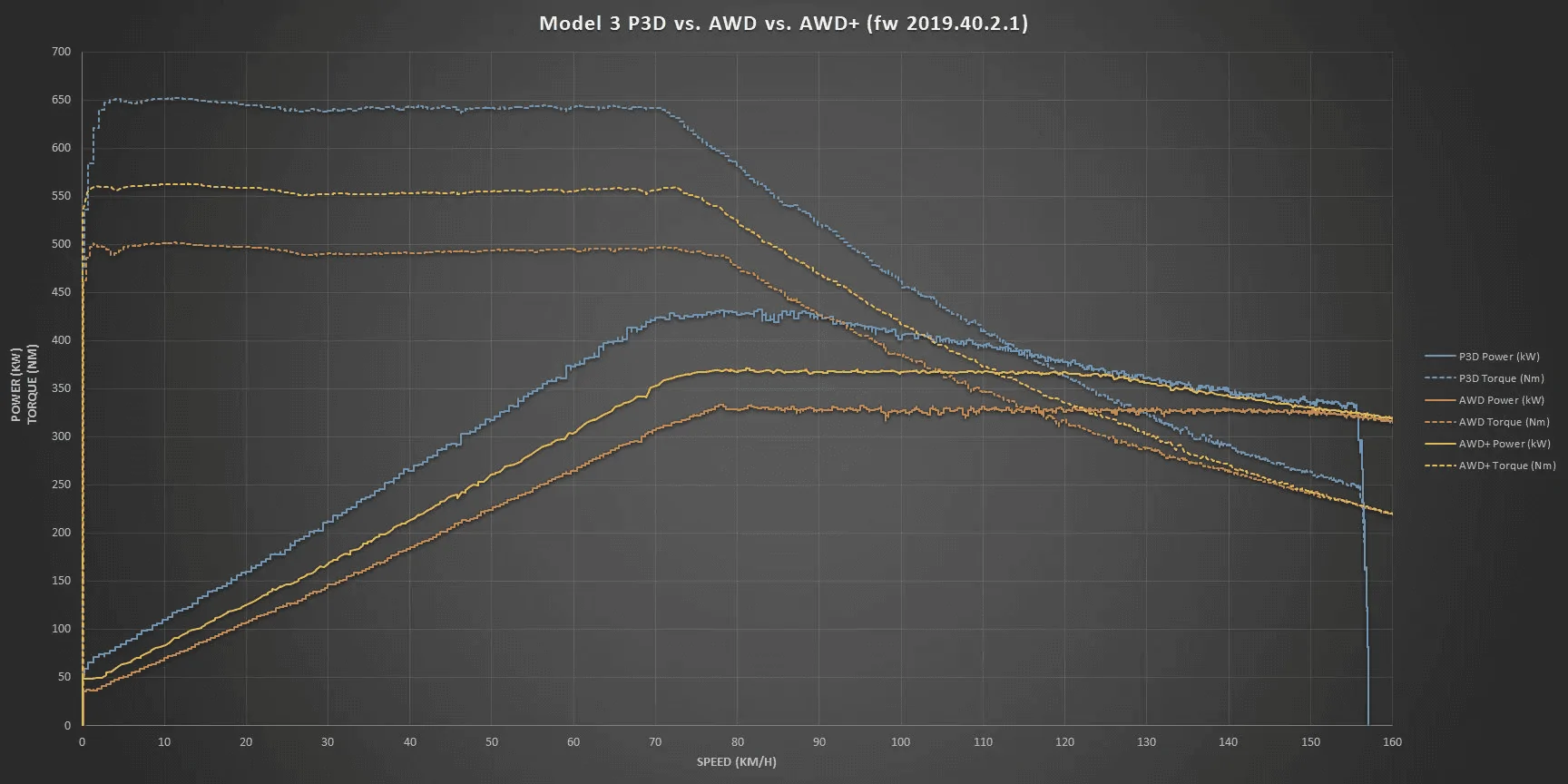
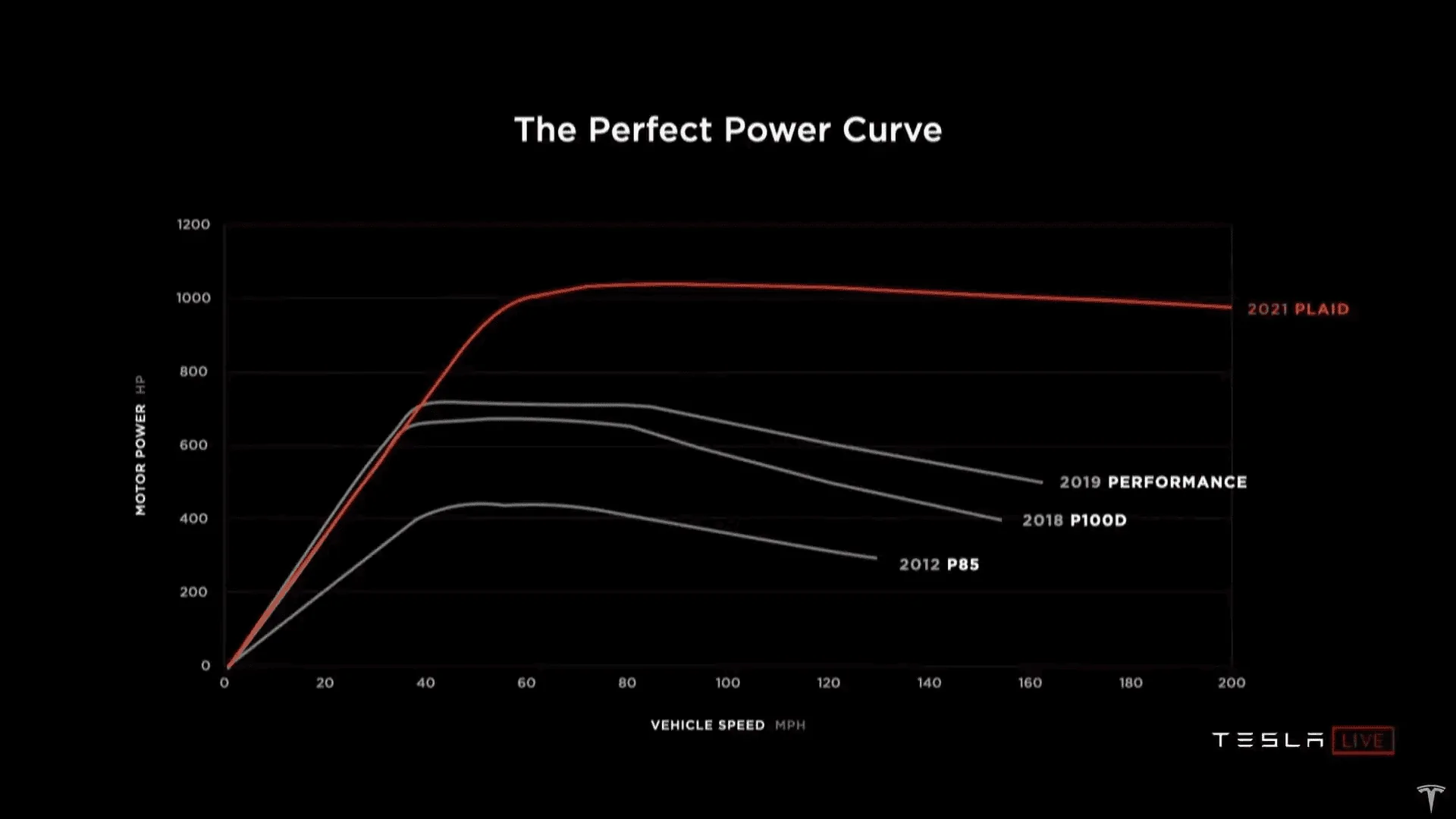
Mind you that the under 50-60 mph HP curve is being software limited due to traction and I am sure a bit of safety thrown in there as well. I am just not convinced your going to gain anything really with a power split device unless perhaps you are looking for a track car that has a more prepped surface and want to use a lower end motor. Even that said, electron efficiency would not be a concern for a 1/4 mile car anymore than gas milage is, LOL.
The Tesla semi is already disgusting quick compared to a ICE semi. I don't think I want a 100k LB vehicle being able to accelerate paste me and cut me off.


Ogre
Well-known member
- First Name
- Dennis
- Joined
- Jul 3, 2021
- Threads
- 166
- Messages
- 10,735
- Reaction score
- 27,050
- Location
- Ogregon
- Vehicles
- Model Y
Anyone who claims a thing will have “multiple times the performance” gets an eye roll from me.You could take the same two motors that Tesla is using, incorporate the power split device and get MULTIPLE times the performance than the two motors provide by themselves. It would be a completely different animal.
Maybe this is why nobody has done it before, they are completely incapable of grasping the concept.
There are hard limits on efficiency. People might squeeze an extra 5% efficiency out of an electric motor. “Multiple times” is nonsense.
Sponsored
Similar threads


- Replies
- 17
- Views
- 2,537
