Sponsored

Large Trailers and WD, before and after experiences?

mikeg112

Well-known member
First Name
Michael
Joined
Mar 2, 2024
Threads
5
Messages
82
Reaction score
153
Location
Bay Area, CA
Vehicles
Model Y, Cybertruck
Country flag
Recently upgraded from a 22ft single axle travel trailer to a 30ft Rockwood double axle (7200lbs). I’ve run weight distribution on other trucks in the past, but when towing the 22ft with the CT I didn’t need to use a WD as it was extremely stable.

Fast forward to the new 30ft trailer, I’m being very honest…it tows amazingly well and it’s just like our other trailer! It’s a 1,000lb hitch tongue weight, I don’t feel the sway when a big rig is next to us, and even driving one time in 30mph+ winds, we didn’t feel a sway like we had in other trucks.

Coming here to ask those who tow large rigs and trailers, anyone did a before and after test on a weight distribution setup? I’m getting so much mixed reviews on does Tesla officially support a WD or not, looking to hear from folks what your before and after experience was with towing. Not looking for a lecture from the tow police as I’m a believer in a proper tow setup, just looking to hear from folks who have done before and after, and how was the difference you had in doing so ??
Sponsored


 

faithworks

Member
First Name
Erik
Joined
Feb 22, 2025
Threads
0
Messages
8
Reaction score
4
Location
Canada
Vehicles
Model Y, Cybertruk
Occupation
retired
Country flag
Same here. I’m going to move our 30’ airstream 8500# from my Ford F150 with a WD to the Cybertruk. I’m thinking we won’t need it because of the weight of the Cybertruk. I towed a trailer with the Model Y and you couldn’t even tell you had a trailer behind.
 

mongo

Well-known member
Joined
May 27, 2024
Threads
5
Messages
4,520
Reaction score
5,497
Location
SE Michigan
Vehicles
Cyberbeast
Country flag
I'm still in the theoretical trailer space and looking forward to hearing people experiences.

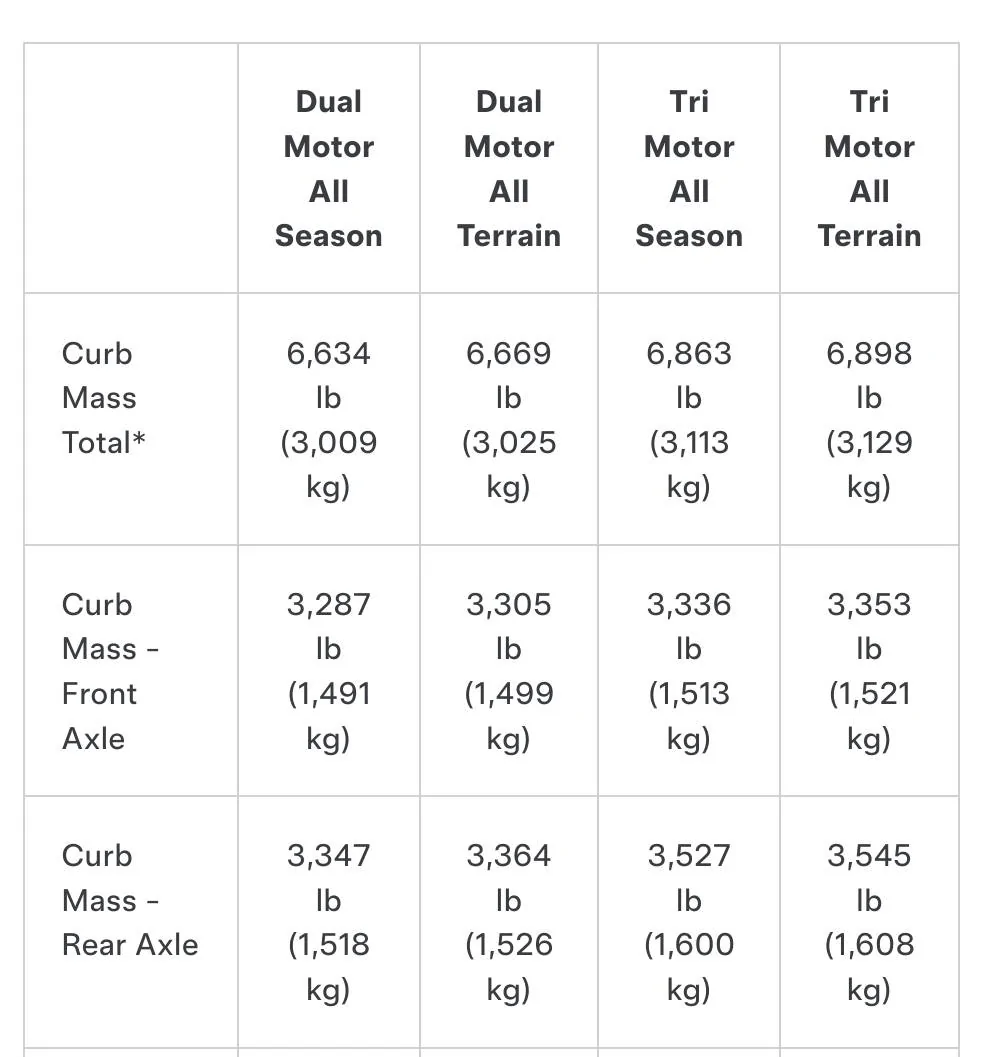
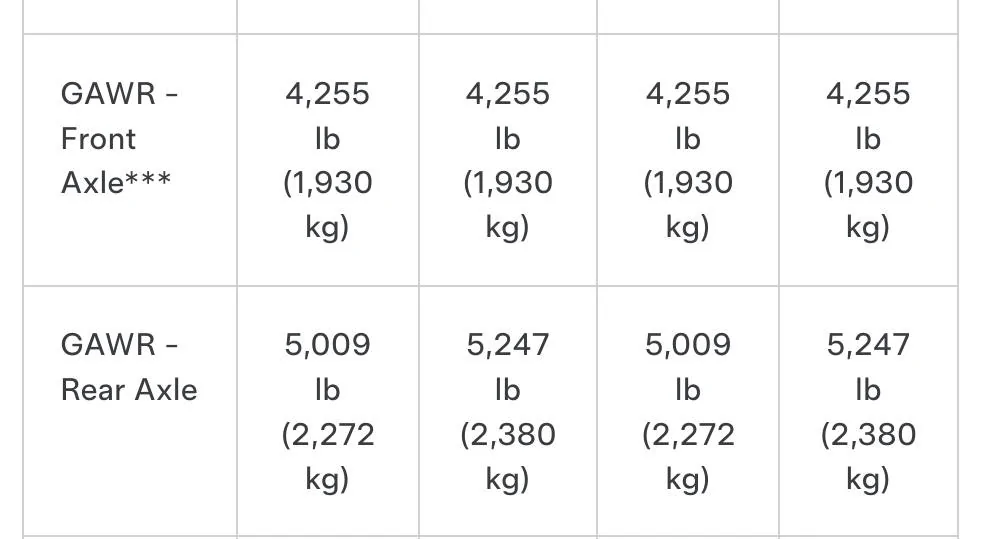
At max tongue weight with the Tesla specified 49 inch max rear axle to ball distance (basically ~8 pin to ball), it loses ~375 pounds from the front axle and puts 1,475 on the rear. Highest capacity variant is AWD with All Terrain tires and it has 1,833 pounds of rear axle capacity (GAWR-curb). So, with just the trailer, only 358 pounds of capacity remain.

Air suspension will level the stance, but doesn't fix the distribution.

https://www.tesla.com/ownersmanual/cybertruck/en_us/GUID-12A976DD-EB60-431B-AFF1-5A37E95006DB.html

Tesla ran towing tests with a WD setup, but haven't given any official guidance.
Tesla Cybertruck Large Trailers and WD, before and after experiences? SmartSelect_20250328_082548_Firefox
Tesla Cybertruck Large Trailers and WD, before and after experiences? SmartSelect_20250328_082608_Firefox
 

HaulingAss

Well-known member
Joined
Oct 3, 2020
Threads
28
Messages
10,308
Reaction score
20,719
Location
Western Washington, USA
Vehicles
Cybertruck DM, 2010 F-150, 2018 Performance Model 3, 2024 Performance Model 3
Country flag
I'm still in the theoretical trailer space and looking forward to hearing people experiences.

At max tongue weight with the Tesla specified 49 inch max rear axle to ball distance (basically ~8 pin to ball), it loses ~375 pounds from the front axle and puts 1,475 on the rear. Highest capacity variant is AWD with All Terrain tires and it has 1,833 pounds of rear axle capacity (GAWR-curb). So, with just the trailer, only 358 pounds of capacity remain.

Air suspension will level the stance, but doesn't fix the distribution.
I don't see a problem with the weight distribution, considering the front axle only loses ~375 lbs out of an unloaded ~3,300 lbs. It would make sense to put your heaviest luggage in the frunk to help out, but I don't think even that would be very critical, especially with two adults in the front seats.

The very rigid chassis and hitch mount of the Cybertruck is a huge advantage in reducing the possibility of oscillations from trailer sway. In comparison, a mild steel twin I-beam frame acts like a giant spring which encourages dangerous trailer sway to happen at the most inopportune moments. The Cybertruck is in a different league when it comes to trailer stabilty.
 
OP
OP
mikeg112

mikeg112

Well-known member
First Name
Michael
Joined
Mar 2, 2024
Threads
5
Messages
82
Reaction score
153
Location
Bay Area, CA
Vehicles
Model Y, Cybertruck
Country flag
I don't see a problem with the weight distribution, considering the front axle only loses ~375 lbs out of an unloaded ~3,300 lbs. It would make sense to put your heaviest luggage in the frunk to help out, but I don't think even that would be very critical, especially with two adults in the front seats.

The very rigid chassis and hitch mount of the Cybertruck is a huge advantage in reducing the possibility of oscillations from trailer sway. In comparison, a mild steel twin I-beam frame acts like a giant spring which encourages dangerous trailer sway to happen at the most inopportune moments. The Cybertruck is in a different league when it comes to trailer stabilty.
I agree 100% on the rigid chassis, The low center of gravity with the battery pack and GigaCasting is what I also thinks make it different than everything else on the market as well. Plus with electronic sway control I’m now thinking if it’s needed, hopefully someone with a before and after on a 30ft rig could chime in ???


mongo

Well-known member
Joined
May 27, 2024
Threads
5
Messages
4,520
Reaction score
5,497
Location
SE Michigan
Vehicles
Cyberbeast
Country flag
I don't see a problem with the weight distribution, considering the front axle only loses ~375 lbs out of an unloaded ~3,300 lbs. It would make sense to put your heaviest luggage in the frunk to help out, but I don't think even that would be very critical, especially with two adults in the front seats.
It's not so much the loss on the front, it's that it shifts to the rear.
After trailer is connected, rear axle only has 358 pounds left while payload has 1400 (AWD AT)and front axle has 1325. Frunk cargo unloads the rear axle at ~10% so max frunk of 441 gives 44 unload putting axle capacity at 402 for rear and 840 front, with 959 of payload. Four 150 pounds passengers would exceed the rear axle rating.
With tri-motor remaining capacity is 181 pounds rear, 792 front, 729 payload. Rear axle would be over the limit with three 150 pounds passengers.

If one gets a range extender which will likely be in 500-700 pound range with ~80% weight bias toward the rear axle, 1,100 pound tongue is off the table without WD.
 

HaulingAss

Well-known member
Joined
Oct 3, 2020
Threads
28
Messages
10,308
Reaction score
20,719
Location
Western Washington, USA
Vehicles
Cybertruck DM, 2010 F-150, 2018 Performance Model 3, 2024 Performance Model 3
Country flag
It's not so much the loss on the front, it's that it shifts to the rear.
After trailer is connected, rear axle only has 358 pounds left while payload has 1400 (AWD AT)and front axle has 1325. Frunk cargo unloads the rear axle at ~10% so max frunk of 441 gives 44 unload putting axle capacity at 402 for rear and 840 front, with 959 of payload. Four 150 pounds passengers would exceed the rear axle rating.
With tri-motor remaining capacity is 181 pounds rear, 792 front, 729 payload. Rear axle would be over the limit with three 150 pounds passengers.

If one gets a range extender which will likely be in 500-700 pound range with ~80% weight bias toward the rear axle, 1,100 pound tongue is off the table without WD.
That may all be true, but similar limitations exist on all 1/2 ton trucks. In fact, the Cybertruck is at or near the top of the class in terms of how much it can tow without going over the rated limits. And, in my experience, the Cybertruck is rated very conservatively. As one example, if I put the entire payload capacity in the truck bed (overloading the rear axle) the Cybertruck doesn't drive like it's a problem, while the F-150 drives like a drunk sailor, hood line pointing for the sky, rear axle on the rubber bump stops.
 

Cyber Man

Well-known member
Joined
Dec 30, 2023
Threads
11
Messages
1,049
Reaction score
2,259
Location
California
Vehicles
BMW X1, Porsche Cayenne, R1T Perf max, Cyberbeast
Country flag
That may all be true, but similar limitations exist on all 1/2 ton trucks. In fact, the Cybertruck is at or near the top of the class in terms of how much it can tow without going over the rated limits. And, in my experience, the Cybertruck is rated very conservatively. As one example, if I put the entire payload capacity in the truck bed (overloading the rear axle) the Cybertruck doesn't drive like it's a problem, while the F-150 drives like a drunk sailor, hood line pointing for the sky, rear axle on the rubber bump stops.
Exactly! I think Tesla is trying to be as conservative as possible. I don’t know whether it’s because of liability concerns or safety concerns. Either ways, I’m also looking for any official guidance from Tesla on recommended WD. I used to have Hensley hitch in my old trailer. I would love to either buy that or Propride hitch. These will add more to the tongue weight, but will completely eliminate sway and provide the best WD option. I hope Tesla gives some recommendations on WD/Sway controls in the near future. We can sit and do all the theoretical math we want all day. Nothing will be better than OEM released numbers, because they drive the vehicle under various configurations before putting those numbers on specs.
 

HaulingAss

Well-known member
Joined
Oct 3, 2020
Threads
28
Messages
10,308
Reaction score
20,719
Location
Western Washington, USA
Vehicles
Cybertruck DM, 2010 F-150, 2018 Performance Model 3, 2024 Performance Model 3
Country flag
Exactly! I think Tesla is trying to be as conservative as possible. I don’t know whether it’s because of liability concerns or safety concerns. Either ways, I’m also looking for any official guidance from Tesla on recommended WD. I used to have Hensley hitch in my old trailer. I would love to either buy that or Propride hitch. These will add more to the tongue weight, but will completely eliminate sway and provide the best WD option. I hope Tesla gives some recommendations on WD/Sway controls in the near future. We can sit and do all the theoretical math we want all day. Nothing will be better than OEM released numbers, because they drive the vehicle under various configurations before putting those numbers on specs.
The Europeans regularly tow with less tongue weight, as a percentage of the trailer weight, typically closer to 7.5% vs. the American rule of thumb of 10% plus a bunch extra for good measure (depending upon who you talk to). If your tow setup is balanced, and the truck frame doesn't store excessive energy (as flexible steel chassis tend to do), I believe it's much safer to be closer to 7.5%. It's flexy American trucks that created the preference for more tongue weight. The Cybertruck doesn't need it if the geometry of the tow setup is correct and the trailer is also stiff.

American truck tow limits are often stated too generously, unless everything is perfect. Most people cannot ever tow at the stated tow limit without exceeding other limits (such as rear axle rating). That's why a common rule of thumb in America is to never tow at the stated limits.

I believe the rigidity of the Cybertrucks hitch and chassis, and the fact that it's closer to the rear axle than the typical American pickup, combined with the low front overhang, lack of a heavy engine and transmission up front (the Cybertruck has a much lower and more centralized mass), means the Cybertruck is more at home towing near it's rated limits. In other words, it's a bit more conservatively rated than the typical American pickup.

Of course, if you believe the media characterizations, you would think the hitch is too weak and it would be best to back off the tow ratings to prevent ripping the rear of the truck off. This is just ridiculous misinformation. The stiff aluminum structure is actually better for towing heavy loads and keeping all that mass safely under control.
 

mongo

Well-known member
Joined
May 27, 2024
Threads
5
Messages
4,520
Reaction score
5,497
Location
SE Michigan
Vehicles
Cyberbeast
Country flag
Full agreement that official guidance would be preferred. Until that happens, all we have are the published specifications/ limits.

Cybertruck is impressive in that its max towing and payload stats are true simultaneously. For the F-150, the max towing version has a different build and option package set than the max payload version.
FWIW, F-150 also calls out that WD is required for trailers over 5,000 pounds, and that maximum trailer frontal area is 65 ft² if towing capacity is over 7,701. Lightning maxes out at 60 ft² with extended range battery.
Sponsored


Top