
Sponsored

Solar battery tender for long term parking?

mongo

Well-known member
Joined
May 27, 2024
Threads
5
Messages
4,524
Reaction score
5,505
Location
SE Michigan
Vehicles
Cyberbeast
Country flag
Yes, if it detects 12V, it will engage a boost inverter. But AFAIK, if it detects 48V, it doesn't.
Sure, but it can't direct connect a 30-50V noncurrent limited supply to the MV battery.
It may be that it will directly feed the internal 48V bus from the external supply in that range versus using a boosted 12V source. Then the MV battery gets charged from that internal rail.
Sponsored

 

Woodrick

Well-known member
First Name
Ed
Joined
Dec 30, 2023
Threads
6
Messages
4,786
Reaction score
4,762
Location
Gainesville Ga
Vehicles
Model 3, Model Y, Cybertruck AWD
Occupation
Consultant
Country flag
Sure, but it can't direct connect a 30-50V noncurrent limited supply to the MV battery.
It may be that it will directly feed the internal 48V bus from the external supply in that range versus using a boosted 12V source. Then the MV battery gets charged from that internal rail.
Are you assuming that or know it as fact?
I really haven't heard anyone who has dove into the workings of that surface.

And it's not as if thread isn't talking about just that.
 

mongo

Well-known member
Joined
May 27, 2024
Threads
5
Messages
4,524
Reaction score
5,505
Location
SE Michigan
Vehicles
Cyberbeast
Country flag
Are you assuming that or know it as fact?
I really haven't heard anyone who has dove into the workings of that surface.

And it's not as if thread isn't talking about just that.
I'm assuming they would be wise enough not to allow a unlimited current supply to connect directly to a depleted lithium ion battery as that could be *bad*. Somewhere between the jump post and the battery should be a switching regulator to control battery charge current.
It could be part of the left controller, in which case it handles the interface between the MV battery and the PCS 48V volt feed (though it could also be direct connect when MV is happy and the PCS adjusts the bus voltage to match SOC)

As for the rest of my post, I'm not in the circle of trust so it also comes with the caveat of "may".

My point it bringing it up is that a 12V or 48V solar charge controller likely will not play well with the jump post/vehicle whereas a real direct connection might fair better. However, given the level of diagnostics, any outside energy source may trip a fault. Jump post does seem the most compatible though.
 

CyberTrk

Well-known member
Joined
Nov 16, 2019
Threads
9
Messages
201
Reaction score
235
Location
Cyberspace
Vehicles
サイバートラック
Country flag
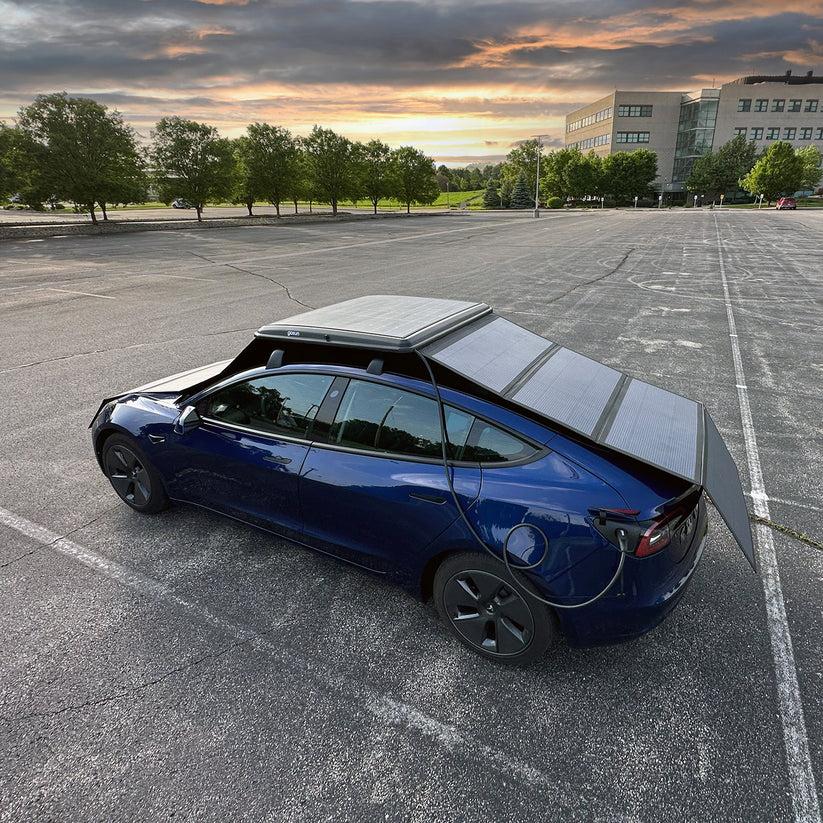
This has a built in 12V inverter and is only a level 1 charger. Possibly a small battery and charger controller too but not sure though.

7_302be1d9-2dd3-46bb-a174-5656d52f62b9.jpg
I imagine that each panel will have its own micro-inverter because otherwise since those panels have different orientations and inclinations, each panel will have a different voltage, making otherwise any combination of string inefficient.

The typical usage will be to park in a east-west direction, so the front panels will produce solar energy in the morning, then around noon the top panel will produce solar energy, and then in the afternoon the rear panels will produce energy.

An alternative will be to park in a north-south direction, so most of the solar energy will be produce around noon time. This orientation would be recommended in winter because of the low inclination of the sun above the horizon.
 

Woodrick

Well-known member
First Name
Ed
Joined
Dec 30, 2023
Threads
6
Messages
4,786
Reaction score
4,762
Location
Gainesville Ga
Vehicles
Model 3, Model Y, Cybertruck AWD
Occupation
Consultant
Country flag
I'm assuming they would be wise enough not to allow a unlimited current supply to connect directly to a depleted lithium ion battery as that could be *bad*. Somewhere between the jump post and the battery should be a switching regulator to control battery charge current.
It could be part of the left controller, in which case it handles the interface between the MV battery and the PCS 48V volt feed (though it could also be direct connect when MV is happy and the PCS adjusts the bus voltage to match SOC)

As for the rest of my post, I'm not in the circle of trust so it also comes with the caveat of "may".

My point it bringing it up is that a 12V or 48V solar charge controller likely will not play well with the jump post/vehicle whereas a real direct connection might fair better. However, given the level of diagnostics, any outside energy source may trip a fault. Jump post does seem the most compatible though.
Why would you assume this?
After all, how do you jump one 12V batter against another? I'll agree that most people use so cheap of jumper cords, that their current is limited.


Woodrick

Well-known member
First Name
Ed
Joined
Dec 30, 2023
Threads
6
Messages
4,786
Reaction score
4,762
Location
Gainesville Ga
Vehicles
Model 3, Model Y, Cybertruck AWD
Occupation
Consultant
Country flag
I imagine that each panel will have its own micro-inverter because otherwise since those panels have different orientations and inclinations, each panel will have a different voltage, making otherwise any combination of string inefficient.

The typical usage will be to park in a east-west direction, so the front panels will produce solar energy in the morning, then around noon the top panel will produce solar energy, and then in the afternoon the rear panels will produce energy.

An alternative will be to park in a north-south direction, so most of the solar energy will be produce around noon time. This orientation would be recommended in winter because of the low inclination of the sun above the horizon.
I expect that the panels are in series, as is commonly the case for a lot of solar, and then MPPT controller / Inverter is used.
 

mongo

Well-known member
Joined
May 27, 2024
Threads
5
Messages
4,524
Reaction score
5,505
Location
SE Michigan
Vehicles
Cyberbeast
Country flag
Why would you assume this?
After all, how do you jump one 12V batter against another? I'll agree that most people use so cheap of jumper cords, that their current is limited.
The charging dynamics of lithium ion batteries are completely different from lead acid. That's why lithium batteries have BMS that monitor over voltage, undervoltage, excessive discharge current, excessive charge current, and temperature. Whereas lead acid get direct connection to vehicle loads (well, fused connections) and a 100+ Amp alternator (though those are getting smarter these days).

Jumping a cold lead acid is fine. Jumping a cold (<-10C) lithium will permanently damage it.

The 48V battery in Cybertruck is 4Ah. Typical LFP charge rates are 1C. Tesla LFP cars have a peak C rate of 3 or less for the main thermally regulated pack. So absolute max for the 48V battery would be 12 Amps.

The 48V bus voltage range is 28V to 58V, nominal is 44V to 50V. If the internal resistance is 0.1 ohm, connecting a 50V supply to a 28V battery yields 220A charge current or 50+ C rate. If the battery were only at 44, then 60 Amps or C of 15.

That caps charging the Cybertruck 48V battery at 12 Amps. Even allowing for 0.5 Ohm total resistance, that requires being within 6 volts of the battery.
 

SESHBE

Member
First Name
James
Joined
Jul 2, 2024
Threads
0
Messages
19
Reaction score
9
Location
California
Vehicles
2015 Tundra, CT on reservation
Occupation
Solar/Electrical Contractor
Country flag
I expect that the panels are in series, as is commonly the case for a lot of solar, and then MPPT controller / Inverter is used.
I would hope it has two mppt inputs. One on the front and one on the back.
Sponsored


Top