
Sponsored

Ogre

Well-known member
First Name
Dennis
Joined
Jul 3, 2021
Threads
166
Messages
10,735
Reaction score
27,050
Location
Ogregon
Vehicles
Model Y
Country flag
I wondered the same. It would be wild if the doors used a kind of exoskeleton approach, leaving the doors hollow and comparatively lighter than regular doors. And also allowing for ample sound dampening and cubby hole goodness.


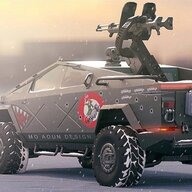
My Jimmies will remain unrustled until I start to see the gigapress install started, followed by casting calibration parts thrown in the bins, and finally "leaks" of the CT getting dirty in the wild doing stuff like this:


The Jimmies shall then begin rustling.
They have enough space in Texas right now to build a proper off road testing course. It could double as a training route for people who do on-site pickup and opt for the Cybertruck off-road orientation course along with their purchase.
 

charliemagpie

Well-known member
First Name
Charlie
Joined
Jul 6, 2021
Threads
48
Messages
2,982
Reaction score
5,369
Location
Australia
Vehicles
CybrBEAST
Occupation
retired
Country flag
Just as a sidenote, Joe Justice said Austin could even make 10 million cars.

Which seems absurd when our estimates hover around 2 million. The estimate gap is too wide.

Let's split the difference and say 6 million.. Still sounds crazy, but if possible, scaling to 1 million 4680 packs might be a lot faster than we expect. Automation is king.
 

CyberGus

Well-known member
First Name
Gus
Joined
May 22, 2021
Threads
91
Messages
10,236
Reaction score
33,889
Location
Austin, TX
Vehicles
1981 DeLorean, 2024 Cybertruck
Occupation
IT Specialist
Country flag
Just as a sidenote, Joe Justice said Austin could even make 10 million cars.

Which seems absurd when our estimates hover around 2 million. The estimate gap is too wide.

Let's split the difference and say 6 million.. Still sounds crazy, but if possible, scaling to 1 million 4680 packs might be a lot faster than we expect. Automation is king.
Joe Justice has the same enthusiasm as Elon, but without the restraint


JBee

Well-known member
First Name
JB
Joined
Nov 22, 2019
Threads
18
Messages
4,913
Reaction score
6,362
Location
Australia
Vehicles
Cybertruck
Occupation
. Professional Hobbyist
Country flag
I'm not going to argue the minutia regarding the upper structure of the CT not being a pure "exoskeleton". It derives its strength through a combination of the outer skin and significantly fewer subframe members.
I think we have an issue understanding the definition of the term exoskeleton in the first place, and what it includes and doesn't:

Exoskeleton
noun
  1. a rigid external covering for the body in some invertebrate animals, especially arthropods.
If we apply the "rigid external covering" rule, we get the 3mm SS skin of the CT. That means;
  1. front fender - could be used structurally but needs deformability for front and offset crumple zone - the outside fender skin is not in right location to transfer loads to the inside of the suspension arms
  2. Front and rear doors - are only attached to the cabin structure using hinges and a door lock - the the skin is main structure that holds the door together (as is on most cars) and provides side intrusion protection but carries no load until they are pressed into the cabin frame on impact
  3. The rear fender and sail - these will most likely transfer some dynamic bed load offer torsional rigidity in the bed, but most of the load carried in the bed will go straight into the rear cast that holds up the bed and attached to the inside of the suspension arms
  4. Because the vault cover moves it provides no structural component and need to be supported by the midgate and rear fender sail walls
  5. The frunk hood also moves and like the doors will only add to the "exoskeleton" if compressed into the cab frame - I'm not sure how they will do pedestrian impact using 3mm steel. The hood will at least need suspension to absorb some impact and reduce g force
  6. The windscreen and rear glass - these are probably the most structural components on the CT that fit the "exoskeleton" definition - but they can be found on heaps of other vehicles including other Trslas, and Tesla wasn't the first to use glass like that either. (Think windscreens)
  7. Underbody - technically the structural pack is also on the outside skin, but the whole battery structure, because of its thickness, can hardly be called a "covering" to fit with the definition, let alone MY doesn't call it that either. From what we have seen so far underbody panels will be added to the front rear castings, as having a thick SS skin across those parts in a flat orientation does little to nothing, except make maintained and repairs more difficult.


Unlike virtually every heavy duty pick-up the CT doesn't need a ladder frame. That's HUGE.
And;

The "exoskeleton" does more than what you see above with exponentially fewer parts, exponentially fewer welds, and exponentially less machinery, requires less factory floor space, fewer inspection requirements, has a significantly lower vehicle weight, and reduced assembly time.
So given the "covering" definition above there is no way to justify all those benefits to the addition of a front and rear fender "exoskeleton". The primary reasons for these benefits are the structural pack and front and rear castings, along with the cabin structure that every other car on the planet has.

A traditional truck has a ladder frame which supports the load. It has a body which supports the cabin, the skin of the truck, internal panels, and protects the occupants. The body has internal structure.
Thats fine, but we are trying to identify what a exoskeleton actually is, and what part we should call that structure, which at least somehow different to what has been done before. BTW the "truss" includes the cabin which is the same in every car, except for the distinct triangular shape. I think I actually used the same bridge picture in another discussion a while ago. ?

-

I think the whole issue is simply one of terminology and definition, calling something a name does not make it so, and I think Tesla and EM are good at creating terminology in an attempt to differentiate their product, without there being to much acknowledgement of where or who else uses it. Everyone does this, but that doesn't mean we should fall victim to "fanboism" and make up what we think it means, and include things that have been so long before a CT even arrives.

Every idea is built up from a lot of other ideas, and so accordingly I can 100% agree the CT is a good product from various perspectives, design and parts, but I don't believe the "exoskeleton" added much more than more jargon and publicity.

Happy to proved rong though if someone knows what it is without warping the definition. :)
 

SparkChaser

Well-known member
First Name
Leigh
Joined
Sep 10, 2020
Threads
31
Messages
719
Reaction score
992
Location
San Francisco CA
Vehicles
CyberTruck Ticket Holder, Ford Ranger, Mini Coup
Occupation
Airline Inspector
Country flag
Probably not this simple but a plan lay out of maybe the frunk, front and rear fenders and a tail gate. The roof and windshield must be load bearing glass with a sub structure.

Tesla Cybertruck Cybertruck timeline schedule prediction -- Agree or Disagree? fljxy3aacc141
 

firsttruck

Well-known member
Joined
Sep 25, 2020
Threads
205
Messages
2,761
Reaction score
4,441
Location
mx
Vehicles
none
Country flag
I think we have an issue understanding the definition of the term exoskeleton in the first place, and what it includes and doesn't:

Exoskeleton
noun
  1. a rigid external covering for the body in some invertebrate animals, especially arthropods.
If we apply the "rigid external covering" rule, we get the 3mm SS skin of the CT. That means;
  1. front fender - could be used structurally but needs deformability for front and offset crumple zone - the outside fender skin is not in right location to transfer loads to the inside of the suspension arms
  2. Front and rear doors - are only attached to the cabin structure using hinges and a door lock - the the skin is main structure that holds the door together (as is on most cars) and provides side intrusion protection but carries no load until they are pressed into the cabin frame on impact
  3. The rear fender and sail - these will most likely transfer some dynamic bed load offer torsional rigidity in the bed, but most of the load carried in the bed will go straight into the rear cast that holds up the bed and attached to the inside of the suspension arms
  4. Because the vault cover moves it provides no structural component and need to be supported by the midgate and rear fender sail walls
  5. The frunk hood also moves and like the doors will only add to the "exoskeleton" if compressed into the cab frame - I'm not sure how they will do pedestrian impact using 3mm steel. The hood will at least need suspension to absorb some impact and reduce g force
  6. The windscreen and rear glass - these are probably the most structural components on the CT that fit the "exoskeleton" definition - but they can be found on heaps of other vehicles including other Trslas, and Tesla wasn't the first to use glass like that either. (Think windscreens)
  7. Underbody - technically the structural pack is also on the outside skin, but the whole battery structure, because of its thickness, can hardly be called a "covering" to fit with the definition, let alone MY doesn't call it that either. From what we have seen so far underbody panels will be added to the front rear castings, as having a thick SS skin across those parts in a flat orientation does little to nothing, except make maintained and repairs more difficult.


And;


So given the "covering" definition above there is no way to justify all those benefits to the addition of a front and rear fender "exoskeleton". The primary reasons for these benefits are the structural pack and front and rear castings, along with the cabin structure that every other car on the planet has.


Thats fine, but we are trying to identify what a exoskeleton actually is, and what part we should call that structure, which at least somehow different to what has been done before. BTW the "truss" includes the cabin which is the same in every car, except for the distinct triangular shape. I think I actually used the same bridge picture in another discussion a while ago. ?

-

I think the whole issue is simply one of terminology and definition, calling something a name does not make it so, and I think Tesla and EM are good at creating terminology in an attempt to differentiate their product, without there being to much acknowledgement of where or who else uses it. Everyone does this, but that doesn't mean we should fall victim to "fanboism" and make up what we think it means, and include things that have been so long before a CT even arrives.

Every idea is built up from a lot of other ideas, and so accordingly I can 100% agree the CT is a good product from various perspectives, design and parts, but I don't believe the "exoskeleton" added much more than more jargon and publicity.

Happy to proved rong though if someone knows what it is without warping the definition. :)
------------

If manufacturing expert Sandy Munro considers Cybrertruck to be made from exoskeleton that is good enough for me :)


------------

Cybertruck E1 - Body Structure Comparison
Episode 1: The first episode of the Cybertruck Competitive Comparison Series from MunroLive. Sandy gives his overview of the exterior body including thoughts on the geometry, material selection and tooling implications. Sandy ends the video with a some thoughts about each competitive truck's strategy. Please tune in every Wednesday to follow along as Sandy reviews a different area of the Cybertruck. Next week Sandy will discuss Suspension, Ride, & Handling.
May 27, 2020
Munro Live

-----


--------------------------------------------

Cybertruck E3 - Driveline & Off-Roading
Jun 10, 2020
Munro Live

----


--------------------------------------------
 
Last edited:

JBee

Well-known member
First Name
JB
Joined
Nov 22, 2019
Threads
18
Messages
4,913
Reaction score
6,362
Location
Australia
Vehicles
Cybertruck
Occupation
. Professional Hobbyist
Country flag
I just like calling things what they are and hate when things are called something they are absolutely not. Without definition we have nothing to talk about except gray goo entropy. And that is worse than my prose...?

And if you only learnt the terminology from those pages that means you either already had the right understanding of the subject, or are still blissfully ignorant of the structural differences discussed, let alone what they are called. I'm thinking you are in the first group, but some aren't, hence some effort from my side to explain what I mean and what the difference is.

I've always been more than a one line, ten like poster. ;) :p


Ogre

Well-known member
First Name
Dennis
Joined
Jul 3, 2021
Threads
166
Messages
10,735
Reaction score
27,050
Location
Ogregon
Vehicles
Model Y
Country flag
There are no “Exoskeleton“ trucks or cars right now that I know of. The term has no real meaning.

So it seems hard for me to get my head around arguing that one is or isn’t one. You are just arguing over whether your interpretation of a concept is more relevant than someone else’s at that point, not talking about the actual thing.

It’s pretty clear that the skin of the Cybertruck is at least partly structural. The bottom of the vehicle is almost 100% structural. That is the sum of the outside of the vehicle. There are some other structural pieces, but if you’ve ever eaten crab, you know that creatures with exoskeletons also have internal structural elements as well.

You seem to think the truck has changed so it’s no longer an exoskeleton. I think it’s far more likely that the truck has always been this way and your understanding of the word is not the same as Musk’s.
 

JBee

Well-known member
First Name
JB
Joined
Nov 22, 2019
Threads
18
Messages
4,913
Reaction score
6,362
Location
Australia
Vehicles
Cybertruck
Occupation
. Professional Hobbyist
Country flag
There are no “Exoskeleton“ trucks or cars right now that I know of. The term has no real meaning.

So it seems hard for me to get my head around arguing that one is or isn’t one. You are just arguing over whether your interpretation of a concept is more relevant than someone else’s at that point, not talking about the actual thing.

It’s pretty clear that the skin of the Cybertruck is at least partly structural. The bottom of the vehicle is almost 100% structural. That is the sum of the outside of the vehicle. There are some other structural pieces, but if you’ve ever eaten crab, you know that creatures with exoskeletons also have internal structural elements as well.

You seem to think the truck has changed so it’s no longer an exoskeleton. I think it’s far more likely that the truck has always been this way and your understanding of the word is not the same as Musk’s.
Possibly.
I haven't changed my thoughts much on exoskeleton, except the more I look at it the more I see there is not much left to be an "exoskeleton" anymore. If you want to call the whole structure "exoskeleton" including casts, pack and cabin etc, then the definition of exoskeleton becomes meaningless because that is the wrong word to use for it, even if a crustacean has internal parts.

BTW I'm not sure you read the list I wrote explaining each part in more detail, but the only structual part of the floor is the structual pack, and the castings would hold the other underbody panels on.

This might all sound pedantic but the meanings and especially the functionality of the parts involved have a direct relevance on manufacturing and production scheduling.

If we call this "exoskeleton" a thing, and that thing needs specialised machinery to build said "thing", all our production scheduling assumptions go out the window too.

Reality is they already make a structual pack and front and rear castings, windscreen and rear roof glass and cabin structure that are already at least 80-90% of the structural build of the CT. (They are all also present in the MY but no-one mentions the term.) That makes the manufacturing of the "exoskeleton" skin, that is limited to the front and rear fenders much, much less important in the scheduling of things then it at first seems.

Accordingly I'd expect manufacturing to proceed without any hold-ups from the exoskeleton, because it is a misnomer in the understanding of the fabrication of the things that make up the CT.
 

Ogre

Well-known member
First Name
Dennis
Joined
Jul 3, 2021
Threads
166
Messages
10,735
Reaction score
27,050
Location
Ogregon
Vehicles
Model Y
Country flag
"exoskeleton" anymore
I’m not convinced the car has actually changed at all.

That’s my whole point. You keep asserting that it’s different now, but the truck is physically the same and we have no signs that it has changed.

You’ve essentially created this idea in your head of what it should look like and decided that it doesn’t match that… thus it must have changed.

I don’t buy the “Changed“ part.

It is the way it’s always been. You are holding it up to a standard which has never existed.
 

CyberGus

Well-known member
First Name
Gus
Joined
May 22, 2021
Threads
91
Messages
10,236
Reaction score
33,889
Location
Austin, TX
Vehicles
1981 DeLorean, 2024 Cybertruck
Occupation
IT Specialist
Country flag
If Elon says it's an exoskeleton, then it's a damn exoskeleton. And it's awesome.

Do not make me pull this thread over, unless you want to taste my BAW
 

Throwcomputer

Well-known member
Joined
Jul 9, 2021
Threads
26
Messages
1,168
Reaction score
2,960
Location
Staten Island, NY
Vehicles
07 Ridgeline, Vintage Vespas, 02 Harley Sportster
Occupation
TV & Film
Country flag
If Elon says it's an exoskeleton, then it's a damn exoskeleton. And it's awesome.

Do not make me pull this thread over, unless you want to taste my BAW
Cause when Elon says something.. its fact.

ahem.. he's going to buy Twitter, or Manchester United.
Sponsored


Top