
Sponsored

FRUNK on the Cybertruck?

JBee

Well-known member
First Name
JB
Joined
Nov 22, 2019
Threads
18
Messages
4,913
Reaction score
6,362
Location
Australia
Vehicles
Cybertruck
Occupation
. Professional Hobbyist
Country flag
Oh, no. I didn't say it was not possible to design Cybertruck so the front grill area would open with the hood, I said Tesla would not design it that way because it involves too many compromises. It's all about strength to weight ratio, safety and cost to produce. If an item is too heavy for an elderly owner to lift into the frunk, they will wheel it into the bed.

Yes, the Cybertruck frunk will have a slighly higher lift-over height than the F-150 and this is a good design trade-off for the structural inegrity in the event of impact. I see you compared the Cybertruck front structure to the front structure of the Model 3 and Model Y but this is a very poor comparison because they are such different vehicles with different construction and capacities. The Model 3&Y do not need to protect the occupants with up to a 3500 lb. load in the bed and cabin. And niether does the F-150 Lightning. It has only 2000 lbs. max payload and that's on the standard range model, the 300-mile version is only 1800 lbs.

It's important to realize that increasing the payload of a vehicle increases the need for impact strength. It needs to manage that much more energy in the event of frontal impact. Having the 3mm stainless sheet in the "grill" area not welded in a cohesive manner to the side panels would require an excessive amount of extra structure in the front casting increasing the cost and weight of the vehicle and reducing its off-road capability (as well as on road handling and efficiency/range). The trade-offs are not worth a frunk that loads from the front instead of from the top.
I won't rehash the points that RVAC made regarding the safety design.

As for the vehicle mass affecting the front structure design, I didn't say they would use the exact MY cast or design, rather the comment was to negate your assumption that the CT front grill was required for crash protection. It is not on the MY, and I doubt it will be on the CT. There is also no reason, or information regarding if at all the front grill will be 3mm SS.

Your load height argument was also incorrect, and as per the other thread, where we have a claimed picture of the CT structure, it's most likely that the "exoskeleton" has been mostly replaced by internal structures as predicted by any of us here. The rear fenders for one, under the sail storage flaps, play a minimal role. There is not much "exoskeleton" left that can claim to be load bearing.

You renaming things, or redefining names, doesn't make "you" right in any way.

If you were a serious CT aficionado, you would of pointed out that the lifting grill is not likely because of the amphibious feature, and that it would be better to have some sort of front bow, that didn't need waterproofing. In saying that inflatable seals could of dealt with that, and I expect the front frunk seals to be fairly beefy, seeing that "low" nose is likely to dip under the waves from time to time.

I was wondering how long it would take to pick that up...but hey, no ones perfect right? ;)
Sponsored


Jhodgesatmb

Well-known member
First Name
Jack
Joined
Dec 1, 2019
Threads
89
Messages
6,487
Reaction score
9,025
Location
San Francisco Bay area
Website
www.arbor-studios.com
Vehicles
Tesla Cybertruck FS AWD, Tesla Model Y LR
Occupation
Retired AI researcher
Country flag
I won't rehash the points that RVAC made regarding the safety design.

As for the vehicle mass affecting the front structure design, I didn't say they would use the exact MY cast or design, rather the comment was to negate your assumption that the CT front grill was required for crash protection. It is not on the MY, and I doubt it will be on the CT. There is also no reason, or information regarding if at all the front grill will be 3mm SS.

Your load height argument was also incorrect, and as per the other thread, where we have a claimed picture of the CT structure, it's most likely that the "exoskeleton" has been mostly replaced by internal structures as predicted by any of us here. The rear fenders for one, under the sail storage flaps, play a minimal role. There is not much "exoskeleton" left that can claim to be load bearing.

You renaming things, or redefining names, doesn't make "you" right in any way.

If you were a serious CT aficionado, you would of pointed out that the lifting grill is not likely because of the amphibious feature, and that it would be better to have some sort of front bow, that didn't need waterproofing. In saying that inflatable seals could of dealt with that, and I expect the front frunk seals to be fairly beefy, seeing that "low" nose is likely to dip under the waves from time to time.

I was wondering how long it would take to pick that up...but hey, no ones perfect right? ;)
"it's most likely that the "exoskeleton" has been mostly replaced by internal structures" ???????

and you are getting on someone else's case? This is total BS. The exoskeleton design exists and won't change at all. All cars have internal stampings for doors as seen in that photo in the BIW. The CT was always going to have those, and the only question was what they would be made of and how. I like the statement: "You renaming things, or redefining names, doesn't make "you" right in any way" as it applies to your deciding about the exoskeleton with no data to back it up.

You wonder why no one picked up on the flotation aspect of the CT wrt frunk? Maybe no one gives a damn. I do not think that the frunk design will have any impact on its ability to float but I don't really care either.
 

JBee

Well-known member
First Name
JB
Joined
Nov 22, 2019
Threads
18
Messages
4,913
Reaction score
6,362
Location
Australia
Vehicles
Cybertruck
Occupation
. Professional Hobbyist
Country flag
"it's most likely that the "exoskeleton" has been mostly replaced by internal structures" ???????

and you are getting on someone else's case? This is total BS. The exoskeleton design exists and won't change at all. All cars have internal stampings for doors as seen in that photo in the BIW. The CT was always going to have those, and the only question was what they would be made of and how. I like the statement: "You renaming things, or redefining names, doesn't make "you" right in any way" as it applies to your deciding about the exoskeleton with no data to back it up.

You wonder why no one picked up on the flotation aspect of the CT wrt frunk? Maybe no one gives a damn. I do not think that the frunk design will have any impact on its ability to float but I don't really care either.
Dude chill.

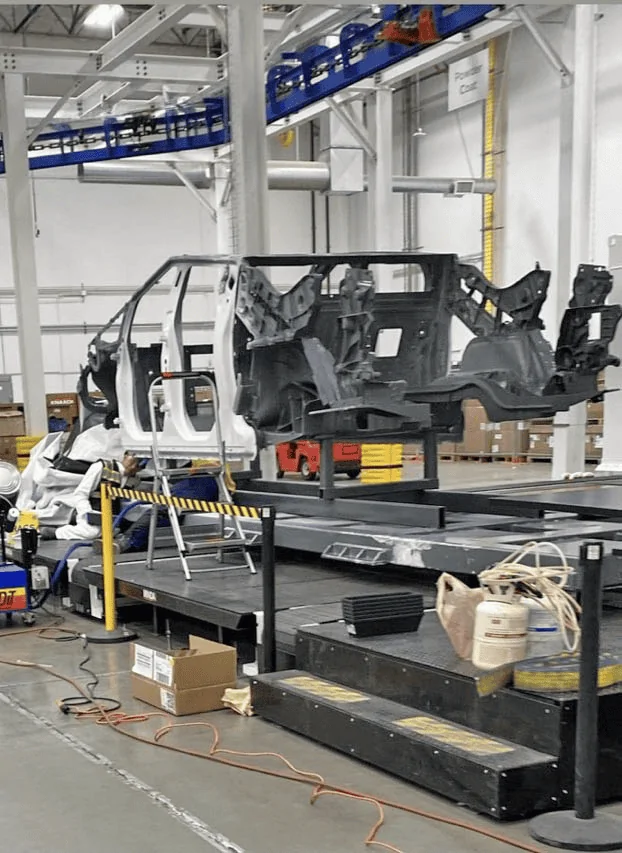
Please highlight for my inferior mind what parts are "exoskeleton" and "structural" in this photo:

Tesla Cybertruck FRUNK on the Cybertruck? 1670903093621


Given that the definition of exoskeleton is:

exoskeleton

ĕk″sō-skĕl′ĭ-tn
noun
  1. A hard outer structure, such as the shell of an insect or crustacean, that provides protection or support for an organism.
  2. In zoology and anatomy, any structure produced by the hardening of the integument, as the shells of crustaceans or the scales and plates of fishes and reptiles, especially when such modified integument is of the nature of bone, as the carapace of a turtle or the plates of a sturgeon; the dermoskeleton: opposed to endoskeleton.
The picture depicts the nature of a endoskeleton, being "internal structure".

If you want to join the renaming club good for you. But I posted a long set of reasons on my thoughts, which you didn't care to refute whatsoever in another thread.

How about you prove to me what part you think is exoskeleton? I think that will be much easier, because I think you only have the front fenders left that fit the definition...:eek::eek::rolleyes:;)

And even those haven't been confirmed to do anything for the vehicle structure yet.
 

HaulingAss

Well-known member
Joined
Oct 3, 2020
Threads
28
Messages
10,308
Reaction score
20,724
Location
Western Washington, USA
Vehicles
Cybertruck DM, 2010 F-150, 2018 Performance Model 3, 2024 Performance Model 3
Country flag
As for the vehicle mass affecting the front structure design, I didn't say they would use the exact MY cast or design, rather the comment was to negate your assumption that the CT front grill was required for crash protection. It is not on the MY, and I doubt it will be on the CT. There is also no reason, or information regarding if at all the front grill will be 3mm SS.
You may have misunderstood my analysis. I have never said the gigacasting could not be large enough or made strong enough to be safe enough in a crash without the grill area being structural, no doubt it could. My analysis was that it would add a lot of undesireable weight. I'm not sure how you missed that.

Your load height argument was also incorrect, and as per the other thread, where we have a claimed picture of the CT structure, it's most likely that the "exoskeleton" has been mostly replaced by internal structures as predicted by any of us here. The rear fenders for one, under the sail storage flaps, play a minimal role. There is not much "exoskeleton" left that can claim to be load bearing.
Make no mistake, it's a given that the 3mm stainless steel skin will be load bearing. The Cybertruck is engineered as a composite structure and all major elements will act in synergy to create class-leading strength and rigidity. If you think Tesla would use 3mm hardened stainless steel skin over the rest of the exoskeleton without leveraging it's strength, then you don't understand how Tesla approaches design work. This kind of stainless is so strong that it's a given it will comprise a very significant portion of the strength and rigidity of the chassis and that tesla will leverage this strength to the maximum extent that is practical.

You renaming things, or redefining names, doesn't make "you" right in any way.

If you were a serious CT aficionado, you would of pointed out that the lifting grill is not likely because of the amphibious feature, and that it would be better to have some sort of front bow, that didn't need waterproofing. In saying that inflatable seals could of dealt with that, and I expect the front frunk seals to be fairly beefy, seeing that "low" nose is likely to dip under the waves from time to time.

I was wondering how long it would take to pick that up...but hey, no ones perfect right? ;)
Now this part is just silly and doesn't deserve a detailed response except to say that the Cybertruck will not be a bonafide amphibious vehicle, you are just misunderstanding the context of Elon's comments.

As the Cybertruck was designed, it was pointed out that it would be buoyant in water, for a short period of time. A design decision was made that it's OK if it doesn't take on water and immediately sink to the bottom, if it floats for a short time, it might be enough to make it to the other side of the water by spinning the tires. This is true of the Tesla Model S also, maybe a bit moreso for the Cybertruck. This is all Elon's comments meant. It's highly unrealistic to believe or hope the Cybertruck will be designed to safely navigate a real body of water or be a real amphibious vehicle. Anyone who thinks otherwise is out there in left field and will be sorely disappointed.
 
Last edited:

HaulingAss

Well-known member
Joined
Oct 3, 2020
Threads
28
Messages
10,308
Reaction score
20,724
Location
Western Washington, USA
Vehicles
Cybertruck DM, 2010 F-150, 2018 Performance Model 3, 2024 Performance Model 3
Country flag
Dude chill.

Please highlight for my inferior mind what parts are "exoskeleton" and "structural" in this photo:

1670903093621.webp


Given that the definition of exoskeleton is:

exoskeleton

ĕk″sō-skĕl′ĭ-tn
noun
  1. A hard outer structure, such as the shell of an insect or crustacean, that provides protection or support for an organism.
  2. In zoology and anatomy, any structure produced by the hardening of the integument, as the shells of crustaceans or the scales and plates of fishes and reptiles, especially when such modified integument is of the nature of bone, as the carapace of a turtle or the plates of a sturgeon; the dermoskeleton: opposed to endoskeleton.
The picture depicts the nature of a endoskeleton, being "internal structure".

If you want to join the renaming club good for you. But I posted a long set of reasons on my thoughts, which you didn't care to refute whatsoever in another thread.

How about you prove to me what part you think is exoskeleton? I think that will be much easier, because I think you only have the front fenders left that fit the definition...:eek::eek::rolleyes:;)

And even those haven't been confirmed to do anything for the vehicle structure yet.
All parts shown, with arguably the rear cab bulkhead excluded, are parts of the exoskeleton. The stainless steel will be laid on top of the depicted portions of the exoskeleton structure to create a composite exoskeleton. The term "exoskeleton" does not exclude a skeleton composed of a composite structure. Even in nature, animals with exoskeletons have voids within the exoskeleton to geive it depth and structure. The exoskeleton does not have to be perfectly homgenous.

Don't get too hung up on terminology. Elon christened it "exoskeleton" because it's going to be the strongest unibody vehicle ever mass-produced and all uni-body vehicles have what is essentially an exoskeleton. The depicted chassis has no real internal structure other than the rear bulkhead.


JBee

Well-known member
First Name
JB
Joined
Nov 22, 2019
Threads
18
Messages
4,913
Reaction score
6,362
Location
Australia
Vehicles
Cybertruck
Occupation
. Professional Hobbyist
Country flag
You may have misunderstood my analysis. I have never said the gigacasting could not be large enough or made strong enough to be safe enough in a crash without the grill area being structural, no doubt it could. My analysis was that it would add a lot of undesireable weight. I'm not sure how you missed that.


Make no mistake, it's a given that the 3mm stainless steel skin will be load bearing. The Cybertruck is engineered as a composite structure and all major elements will act in synergy to create class-leading strength and rigidity. If you think Tesla would use 3mm hardened stainless steel skin over the rest of the exoskeleton without leveraging it's strength, then you don't understand how Tesla approaches design work. This kind of stainless is so strong that it's a given it will comprise a very significant portion of the strength and rigidity of the chassis.


Now this part is just silly and doesn't deserve a detailed response except to say that the Cybertruck will not be a bonafide amphibious vehicle, you are just misunderstanding the context of Elon's comments.

As the Cybertruck was designed, it was pointed out that it would be buoyant in water, for a short period of time. A design decision was made that it's OK if it doesn't take on water and immediately sink to the bottom, if it floats for a short time, it might be enough to make it to the other side of the water by spinning the tires. This is true of the Tesla Model S also, maybe a bit moreso for the Cybertruck. This is all Elon's comments meant. It's highly unrealistic to believe or hope the Cybertruck will be designed to safely navigate a real body of water or be a real amphibious vehicle. Anyone who thinks otherwise is out there in left field and will be sorely disappointed.
No worries.

Please provide proof that the change in design to have a lifting grill would impact vehicle mass negatively. The structure for crash absorption would be in the bumper not behind a wimpy piece of flat SS that if unfolded (we have no indication of the grill shape) would just bend like a banana. There is also no evidence that everything will be 3mm, I pretty sure it won't seeing Tesla knows how to design vehicles.

My comment regarding you renaming things is that you don't seem to know what to call things properly. Just call it what it is and don't get carried away in the hype of the terminology. I learnt what a exoskeleton was in the 80's, and yeah back then it was cool. But now in 2022? :cool:

BTW could you please explain to me the load path from the rear bed and passenger compartment to the wheel contact patches on the road? In particular what parts of the "exoskeleton skin" transfer these loads? Thx.
 

JBee

Well-known member
First Name
JB
Joined
Nov 22, 2019
Threads
18
Messages
4,913
Reaction score
6,362
Location
Australia
Vehicles
Cybertruck
Occupation
. Professional Hobbyist
Country flag
All parts shown, with arguably the rear cab bulkhead, are parts of the exoskeleton. The stainless steel will be laid on top of the depicted portions of the exoskeleton structure to create a composite exoskeleton. The term "exoskeleton" does not exclude a skeleton composed of a composite structure. Even in nature, animals with exoskeletons have voids within the exoskeleton to geive it depth and structure. The exoskeleton does not have to be perfectly homgenous.

Don't get too hung up on terminology. Elon christened it "exoskeleton" because it's going to be the strongest unibody vehicle ever mass-produced and all uni-body vehicles have what is essentially an exoskeleton. It has no real internal structure to the chassis other than the rear bulkhead.
It has to be on the outside to be an exoskeleton. Not the inside.
 

JBee

Well-known member
First Name
JB
Joined
Nov 22, 2019
Threads
18
Messages
4,913
Reaction score
6,362
Location
Australia
Vehicles
Cybertruck
Occupation
. Professional Hobbyist
Country flag
Exactly. Which is why one could argue that any bulkheads are not part of the exoskeleton.
um in a normal world yes, but the rear seat bulkhead is technically outside when the vault is open?

Anyways, just to be clear I don't have a problem with the Tesla design at all or if it works or not, just with the widespread use of "exoskeleton" to describe everything in the structure.

My point is simply it has to be external to be called exoskeleton, in particular the skin, which is the only interface to the "outside".
 

HaulingAss

Well-known member
Joined
Oct 3, 2020
Threads
28
Messages
10,308
Reaction score
20,724
Location
Western Washington, USA
Vehicles
Cybertruck DM, 2010 F-150, 2018 Performance Model 3, 2024 Performance Model 3
Country flag
No worries.

Please provide proof that the change in design to have a lifting grill would impact vehicle mass negatively. The structure for crash absorption would be in the bumper not behind a wimpy piece of flat SS that if unfolded (we have no indication of the grill shape) would just bend like a banana. There is also no evidence that everything will be 3mm, I pretty sure it won't seeing Tesla knows how to design vehicles.
3mm stainless steel sheet is one step away from what is commonly called "steel plate". And the cold-rolling increases surface harness and tensile strength very significantly. Calling it "wimpy" illustrates you don't understand the material. This kind of metal, used to create an unbroken nose around the front of the Cybertruck, with the corners beveled as they have been on every public prototype, will be used to deflect vehicles hitting at various angles of frontal collisions. It's important that it is one cohesive piece, wrapping around to the front quarter panels. Cutting it so it could lift with the hinged hood would remove most of the strength and require substantially more additional strengthening around the frunk to retain the same crashworthiness. This should be self-evident to someone with a reasonable grasp of structural principles so I'm not going to spend hours trying to prove it.

BTW could you please explain to me the load path from the rear bed and passenger compartment to the wheel contact patches on the road? In particular what parts of the "exoskeleton skin" transfer these loads? Thx.
Certainly. The entire exoskeleton is designed to be unusually rigid. This means the entire exoskeleton comprises the load path to varying degrees. Some portions will be in compression while other portions will be in tension and also in torsion. This will change dynamically with the terrain and the specifics of where the cargo is loaded. This is at the essence of why it's an "exoskeleton".

It may be useful to note that the load path in such an exoskeleton design actually extends forward and aft of the front and rear wheels. the entire structure carries the load by remaining rigid. This is another reason why it's important that the nose of the Cybertruck does not raise with the hinged hood. Because even the nose is part of the load path in situations in which the Cybertruck is on non-level ground or the load is concentrated on one side of the bed.
 
Last edited:


HaulingAss

Well-known member
Joined
Oct 3, 2020
Threads
28
Messages
10,308
Reaction score
20,724
Location
Western Washington, USA
Vehicles
Cybertruck DM, 2010 F-150, 2018 Performance Model 3, 2024 Performance Model 3
Country flag
um in a normal world yes, but the rear seat bulkhead is technically outside when the vault is open?

Anyways, just to be clear I don't have a problem with the Tesla design at all or if it works or not, just with the widespread use of "exoskeleton" to describe everything in the structure.

My point is simply it has to be external to be called exoskeleton, in particular the skin, which is the only interface to the "outside".
The rear seat bulkhead is inside the vehicles structure. You are trying to define "inside" and "outside" based upon the cabin space but what is important here is the entire structure. It's not relevant whether it's "inside" or "outside" the cabin because the vault is part of the vehicles overall structure too, and that is relevant to the term "exoskeleton". And that is why I say the bulkhead is not properly part of the exoskeleton. It is being used to reinforce the exoskeleton internally.

I suggest you avoid getting too hung up on terminology. Words are intended to be useful to communicate ideas and concepts, not get in the way of understanding the nature of things.
 
Last edited:

JBee

Well-known member
First Name
JB
Joined
Nov 22, 2019
Threads
18
Messages
4,913
Reaction score
6,362
Location
Australia
Vehicles
Cybertruck
Occupation
. Professional Hobbyist
Country flag
3mm stainless steel sheet is one step away from what is commonly called "steel plate". And the cold-rolling increases surface harness and tensile strength very significantly. Calling it "wimpy" illustrates you don't understand the material. This kind of metal, used to create an unbroken nose around the front of the Cybertruck, with the corners beveled as they have been on every public prototype, will be used to deflect vehicles hitting at various angles of frontal collisions. It's important that it is one cohesive piece, wrapping around to the front quarter panels. Cutting it so it could lift with the hinged hood would remove most of the strength and require substantially more addition strengthening around the frunk to retain the same crashworthiness. This should be self-evident to someone with a reasonable grasp of structural principles so I'm not going to spend hours trying to prove it.


Certainly. The entire exoskeleton is designed to be unusually rigid. This means the entire exoskeleton comprises the load path to varying degrees. Some portions will be in compression while other portions will be in tension and also in torsion. This will change dynamically with the terrain and the specifics of where the cargo is loaded.
Sorry nothing in that post that has computable values.

You seem to not understand that the front of the CT should be "soft" for crash energy absorption to reduce the deceleration forces experienced by the passenger in case of a collision. Quite literally a dense pillow would be best, like your airbags. Having it "hard" and structural defeats the purposes of making it "safe" for passengers. Further the front of the CT should be "soft" for pedestrian impacts too. Really the only requirement for the front crumple zone to be "safe" is to absorb energy through deformation of it's structure in such a way to reduce sudden deceleration forces of the soft bodied endoskeleton passengers. The cabin structure is the only part of the vehicle that should remain dimensionally stable (to a certain degree) to protect the passengers from ingress. Your comments regarding deflecting vehicles etc are even more preposterous.

BTW your load path is just a collection of unrelated variables without any constants.

Let me redefine the query. Through what parts of the structure does the force of a load in the bed or passenger compartment make it's way to the road? Then, which of those parts are "exoskeleton"?

For example: The load in the bed would go through the bed floor, the rear cast, the suspension arms and air spring, to the wheel knuckle, bearings and axle, and then wheel bolts, wheel and tyre. At which point do the rear fenders play a roll given the picture of the structure above? Have a think about it.
 

HaulingAss

Well-known member
Joined
Oct 3, 2020
Threads
28
Messages
10,308
Reaction score
20,724
Location
Western Washington, USA
Vehicles
Cybertruck DM, 2010 F-150, 2018 Performance Model 3, 2024 Performance Model 3
Country flag
Sorry nothing in that post that has computable values.

You seem to not understand that the front of the CT should be "soft" for crash energy absorption to reduce the deceleration forces experienced by the passenger in case of a collision. Quite literally a dense pillow would be best, like your airbags. Having it "hard" and structural defeats the purposes of making it "safe" for passengers. Further the front of the CT should be "soft" for pedestrian impacts too. Really the only requirement for the front crumple zone to be "safe" is to absorb energy through deformation of it's structure in such a way to reduce sudden deceleration forces of the soft bodied endoskeleton passengers. The cabin structure is the only part of the vehicle that should remain dimensionally stable (to a certain degree) to protect the passengers from ingress. Your comments regarding deflecting vehicles etc are even more preposterous.

BTW your load path is just a collection of unrelated variables without any constants.

Let me redefine the query. Through what parts of the structure does the force of a load in the bed or passenger compartment make it's way to the road? Then, which of those parts are "exoskeleton"?

For example: The load in the bed would go through the bed floor, the rear cast, the suspension arms and air spring, to the wheel knuckle, bearings and axle, and then wheel bolts, wheel and tyre. At which point do the rear fenders play a roll given the picture of the structure above? Have a think about it.
I see you have some misconceptions about load paths. I don't think I can correct them here although it might help to add that the suspension is supported directly by the under portions of the exoskeleton. This will be the front and rear gigacastings which are important parts of the exoskeleton.

I can maybe help on the crashworthiness and energy absorption. The stainless sheet on the front of the Cybertruck does not really absorb any energy itself, it merely holds the front of the truck together which can help transfer high impact forces more evenly to the underlying structures. This is especially important to offset frontal collisions in which the impact is not perpendicular to the front of the truck.

As far as hitting pedestrians, I think you will find most trucks fare poorly here because the bumper height is roughly at knee level. And bumpers are generally made out of much heavier steel than auto bodies are. At least the cybertruck "bumper" is a little larger and flatter than a typical bumper which can help spread the forces out more evenly on an impacted body. One thing Tesla might do to increase the safety of pedestrians is to make the hood (hinged frunk cover) out of a thinner stainless steel, and perhaps not roll harden it, or roll harden it to a lesser degree. Of course, that would make it susceptible to hail damage. It will be interesting to see how Tesla handles the thickness and hardness of the hood material.

The real way to improve pedestrian safety is to include systems that can help avoid pedestrian impacts to begin with. I hope this is effective enough that we don't eventually end up with more systems on every vehicle (mandatory pedestrian airbags).
 
Last edited:

JBee

Well-known member
First Name
JB
Joined
Nov 22, 2019
Threads
18
Messages
4,913
Reaction score
6,362
Location
Australia
Vehicles
Cybertruck
Occupation
. Professional Hobbyist
Country flag
I see you have some misconceptions about load paths. I don't think I can correct them here although it might help to add that the suspension is supported directly by the under portions of the exoskeleton. This will be the front and rear gigacastings which are important parts of the exoskeleton.
Simply if it is not in the path it has no effect on the forces involved. That much should be obvious though right?

So now you want the front softer again for crash worthiness. Make up your mind buddy. Your going from deflecting cars to cushioning pedestrians. ;)
 

HaulingAss

Well-known member
Joined
Oct 3, 2020
Threads
28
Messages
10,308
Reaction score
20,724
Location
Western Washington, USA
Vehicles
Cybertruck DM, 2010 F-150, 2018 Performance Model 3, 2024 Performance Model 3
Country flag
Simply if it is not in the path it has no effect on the forces involved. That much should be obvious though right?

So now you want the front softer again for crash worthiness. Make up your mind buddy. ;)
JBee, I'm getting tired of your ignorant persistence.

I did not change my mind about anything, and anyone with an understanding of structural design will be able to see that.

You also appear to not understand that load paths are often not as direct as one might assume. One example would be to map the load path of a weight distributing hitch. Placing a weight in the bed of the Cybertruck will create load paths throughout the structure, depending upon where it is placed. Without understanding this, it is futile to continue.
Sponsored


Top