Sponsored

Electric Truck Economics - Worth the Price?

anionic1

Well-known member
First Name
Michael
Joined
Apr 30, 2021
Threads
29
Messages
1,666
Reaction score
2,014
Location
California
Vehicles
Cybertruck
Occupation
Estimator
Country flag
So let’s say you do need a battery just after 10 years. And you decide the truck is only worth $20k so why dump $20k in for a battery. So you sell it for $5k to $10k and let someone else deal with the battery. Let’s say you spent $65k spread out over 120 months. That’s just about $500/mo. Not accounting for gas cost savings. It seems like the gas cost savings alone will justify going with the EV. Really you would need to run a spreadsheet of all the cost including insurance etc. But I am certain the EV will come out on top. Plus, fuel tech has hit a plateau. In 10 years battery tech is certainly going to be cheaper and better. So maybe it’s $10k for a better replacement that gets you another 300k miles and chargers much faster
Sponsored


 

anionic1

Well-known member
First Name
Michael
Joined
Apr 30, 2021
Threads
29
Messages
1,666
Reaction score
2,014
Location
California
Vehicles
Cybertruck
Occupation
Estimator
Country flag
Here's a few more "idiots" for you.

"According to the Bureau of Transportation Statistics, in 2020, the average lifespan of a vehicle in the United States was 11.9 years."
https://www.capitalone.com/cars/learn/finding-the-right-car/how-long-do-cars-last/1512

"“The average lifespan [of a car] is now almost 12 years,” says Eric Lyman, chief analyst at TrueCar."
https://www.aarp.org/auto/trends-technology/how-long-do-cars-last/

"On average, a vehicle will last approximately 11-12 years on the road."
https://woodiesautoservice.com/blog/how-long-will-a-car-typically-last


Since it's not credible for both the average age AND lifespan to be 12 years, the statistics are being badly collected, presented, and/or interpreted. I'm having trouble finding the raw data to perform my own analysis.

Some of it may just be poor wording. For instance, families on average may have 2.3 children, but the average family has only whole children. As Pete pointed out, statistics are often misinterpreted, and "average" is usually a poor metric (median is more meaningful in most contexts).
I guess I am finally above average! My truck is a 2005 and my car is a 2008. Both should be retired but I am just too good at fixing stuff and to cheap to stop.
 

Rutrow

Well-known member
First Name
Dan
Joined
May 25, 2021
Threads
8
Messages
1,031
Reaction score
2,441
Location
Little Rock, Arkansas
Vehicles
Model S, Model 3, CyberTruck Tri-motor reservation
Occupation
Firefighter
Country flag
Since everyone is prattling on about average, mean, median, etc. I'd like to blow your minds with an amazing fact: Everyone dies before they reach their life expectancy. ?

It's true! I

It's because your life expectancy constantly increases as you age. If you're 90, your life expectancy is 95. If you're 100, it's 102. If you're 110, its 111. If you're 120... 120.5, ad infinitum. All statistics are guaranteed to be wrong... except on average.
 

jcryer3

Well-known member
First Name
John
Joined
Dec 9, 2019
Threads
2
Messages
55
Reaction score
59
Location
Houston
Vehicles
Tesla S, Ram Promaster
Occupation
Architect
Country flag
I also have concerns about the cost. I had a 2013 P85+. I sold it in 2021 as the warranty was about to go out on the drive train and battery. It only had 27,000 miles on it. I replaced the drive train under warranty, and the fellow that i sold it to had to replace the battery in 2022. It cost him $20k. I bought the Plaid in in 2021 and paid $140K. It has 5000 miles on it and the value is around $85K. So value and cost is beginning to bite on Teslas, and it does not feel good.
 

HaulingAss

Well-known member
Joined
Oct 3, 2020
Threads
28
Messages
10,366
Reaction score
20,849
Location
Western Washington, USA
Vehicles
Cybertruck DM, 2010 F-150, 2018 Performance Model 3, 2024 Performance Model 3
Country flag
So - no net economic benefit / neutral if you're lucky - but you get the untested reliability and range anxiety of a cybertruck? Lot's of reasons to own one - just don't be fooled into thinking $$ is one of them.
The interesting thing about the Internet is you can find people arguing that humankind never set foot on the moon. And they think their arguments make sense and no one can convince them otherwise.

Have you checked out how much it costs to rebuild a modern diesel or ecoboost truck engine and transmission these days? Do you have any idea how many miles an EV powertrain can go?

I didn't think so.


anionic1

Well-known member
First Name
Michael
Joined
Apr 30, 2021
Threads
29
Messages
1,666
Reaction score
2,014
Location
California
Vehicles
Cybertruck
Occupation
Estimator
Country flag
I do a lot of car maintenance and have had a lot of cars. Modern ICE cars can easily go 15 years and 200k miles with very basic maintenance in moderate climates. Heavy winter locations I can’t speak to. Teslas haven’t had that kind of time test yet but they are getting close. They have proven to hold up for that kind of mileage. After 200k miles on an ICE vehicle I would say it’s a crap shoot. And very likely that many parts are very worn and close to going out. And if you don’t do the work yourself, repair cost just seem to be getting stupid high to me $500 for an alternator etc.

Really I think what mostly drives people to give up on ICE vehicles by 12 years is more cosmetic and noises. Suspensions rattling, seals are looking worn, plastic trim is cracking, and paint is fading or starting to peel, possible rust. By 12 years most painted cars are looking old and people like shiny. And I think people start to justify selling or trading in thinking that it’s likely major mechanical costs are in the near future.

The CT stainless body has a big advantage like the delorean in that it will look good 40 years from now. The seals and plastic are another thing. So to me it might be worth getting that $10-$20k battery replacement after 12 years if it needs it. I can see the CT being the last vehicle I buy and I am 40.
 

HaulingAss

Well-known member
Joined
Oct 3, 2020
Threads
28
Messages
10,366
Reaction score
20,849
Location
Western Washington, USA
Vehicles
Cybertruck DM, 2010 F-150, 2018 Performance Model 3, 2024 Performance Model 3
Country flag
I bought the Plaid in in 2021 and paid $140K. It has 5000 miles on it and the value is around $85K. So value and cost is beginning to bite on Teslas, and it does not feel good.
You speak as if you regret buying a Plaid Model S in 2021. What, specifically, do you think is to blame for the depreciation you experienced?

Do you think a Plaid Model S or any other Tesla purchased today will have the same rate of depreciation you experienced?

Do you think a used car or a new car depreciates faster?

What does the term "supply and demand" refer to?

Do you know what the term "market value" means?

Just some things to ponder that could help you avoid disappointment with future purchases.
 

HaulingAss

Well-known member
Joined
Oct 3, 2020
Threads
28
Messages
10,366
Reaction score
20,849
Location
Western Washington, USA
Vehicles
Cybertruck DM, 2010 F-150, 2018 Performance Model 3, 2024 Performance Model 3
Country flag
Really I think what mostly drives people to give up on ICE vehicles by 12 years is more cosmetic and noises. Suspensions rattling, seals are looking worn, plastic trim is cracking, and paint is fading or starting to peel, possible rust. By 12 years most painted cars are looking old and people like shiny. And I think people start to justify selling or trading in thinking that it’s likely major mechanical costs are in the near future.
That's because the typical ICE car is built pretty crappily. The media likes to imply that Teslas are poorly built but they are actually built to be more durable than typical ICE vehicles which must cut costs on parts. Shock absorbers, fuel pumps, alternators, bearings and ball joints, frame and body materials, fuel tanks and lines, exhaust systems, etc, could all be built to last longer, but they are built to a price point.

The shocks on my F-150 with tow package were inadequate from day 1 and they got noticeably worse after only 20K miles. The door seals seeped rainwater from day 1, making the carpet smell musty and no Ford dealership could ever find the problem to affect a warranty repair. The tires it was eqipped with from the factory were so bad in terms of corner grip I had to replace them before they were half worn out. I gave the OEM tires away for free.

Tesla puts a lot of money and effort into building their cars to last as long as reasonably possible and keeps the price of replacement parts more reasonable than most manufacturers, partly because there is no third part dealership to take a cut.
 

PilotPete

Well-known member
First Name
Pete
Joined
May 8, 2023
Threads
12
Messages
1,578
Reaction score
3,969
Vehicles
Porsche, BMW, M3LR on order
Occupation
Chief Pilot
Country flag
That's because the typical ICE car is built pretty crappily. The media likes to imply that Teslas are poorly built but they are actually built to be more durable than typical ICE vehicles which must cut costs on parts. Shock absorbers, fuel pumps, alternators, bearings and ball joints, frame and body materials, fuel tanks and lines, exhaust systems, etc, could all be built to last longer, but they are built to a price point.
There has been an increase in mileage requirements for the legacy OEMs for almost 50 years. This is why you see turbo-charged engines and hybrids by many companies. ICE vehicles are NO different than BEVs when it comes to the laws of physics. The heavier the vehicle, the more power it takes to get it up to speed. So in order to meet CAFE standards, the OEMs have had to increase fuel efficiency. Thus in the 80's and 90's we had cars with tiny engines and crap for acceleration. But one of the ways to help fuel efficiency is to reduce the weight. Here is where the body panels got thinner, and the sub-structure got thinner, and all the car parts started moving towards the tin foil thickness. And, everything got smaller. Because, smaller means lighter. That is, until they ran afoul of crash testing. And so compromises were made. Remember when the aluminum truck bed came out? All the fuss and ads showing a truck and a front loader dropping a bed full of gravel and rocks into the truck bed, and the new aluminum beds started splitting and cracking open? Fortunately, bed liners fixed a large part of that.

Tesla isn't subject to CAFE standards because, they don't use gas or diesel. So the only incentive they have to make things lighter is range, and price. And Tesla seems aware that if there is too much compromise in the lighter and smaller direction, they and their reputation are toast. They can make a casting and make it tougher. They can use 3mm 30X SS for body panels. They can do quite a bit that the legacy gang can't. And I believe Tesla's business model of vertical integration from building cars AND servicing them, AND providing power for them, provides sufficient income to avoid "planned obsolescence" and the temptation to "underbuild" the vehicle. Therefore, Tesla is leading me to believe that they are building vehicles that will far outlast the legacy ICE vehicles in every way. As a result, I think you'll see depreciation on EVs improve almost exponentially over the next decade. If you keep your CT for 10 years, It may be worth as much or MORE than you paid for it (due to inflation)
 

CyberGus

Well-known member
First Name
Gus
Joined
May 22, 2021
Threads
91
Messages
10,271
Reaction score
34,016
Location
Austin, TX
Vehicles
1981 DeLorean, 2024 Cybertruck
Occupation
IT Specialist
Country flag
Since everyone is prattling on about average, mean, median, etc. I'd like to blow your minds with an amazing fact: Everyone dies before they reach their life expectancy. ?

It's true! I

It's because your life expectancy constantly increases as you age. If you're 90, your life expectancy is 95. If you're 100, it's 102. If you're 110, its 111. If you're 120... 120.5, ad infinitum. All statistics are guaranteed to be wrong... except on average.
"Visualize the intelligence of the average person, and then realize that 50% of the people are dumber than that." - George Carlin


jcryer3

Well-known member
First Name
John
Joined
Dec 9, 2019
Threads
2
Messages
55
Reaction score
59
Location
Houston
Vehicles
Tesla S, Ram Promaster
Occupation
Architect
Country flag
You speak as if you regret buying a Plaid Model S in 2021. What, specifically, do you think is to blame for the depreciation you experienced?

Do you think a Plaid Model S or any other Tesla purchased today will have the same rate of depreciation you experienced?

Do you think a used car or a new car depreciates faster?

What does the term "supply and demand" refer to?

Do you know what the term "market value" means?

Just some things to ponder that could help you avoid disappointment with future purchases.
I am not sure the reason for the aggression depreciation other than the price cuts by Tesla. The Plaid is an incredible vehicle to drive. It is has a few minor warranty issues, but nothing serious. Value is always determined by market value. That being said, it means that people are not willing to value the Plaid as much as us that own it are. Technology is the most rapid depreciating asset that you can own. I suspect that Teslas are viewed more as Technology than cars. IC vehicles that are over a 100 years old, can still be working; just add the gas. EVs will not hold up well over time because the technology will advance and their value will drop substantially. If we are going to drive EVs we have to expect that its technology will evolve. That was not the case with ICs.
 

HaulingAss

Well-known member
Joined
Oct 3, 2020
Threads
28
Messages
10,366
Reaction score
20,849
Location
Western Washington, USA
Vehicles
Cybertruck DM, 2010 F-150, 2018 Performance Model 3, 2024 Performance Model 3
Country flag
I am not sure the reason for the aggression depreciation other than the price cuts by Tesla.
I think you meant to say "aggressive" price cuts by Tesla. Meaning they are making them cost less to buy new. And obviously, that is why a used one depreciated faster than a Tesla will typically depreciate. Making nice cars more affordable is a good thing. You just paid a high price because a lot of other people wanted a new Plaid at the same time you did. That's where supply and demand plays into it.

The Plaid is an incredible vehicle to drive. It is has a few minor warranty issues, but nothing serious. Value is always determined by market value. That being said, it means that people are not willing to value the Plaid as much as us that own it are.
No, the difference is one of time frame. You bought a luxury/preformance car during a low interest period when asset prices of things like people's retirement stock portfolios were booming, and now the same luxury/performance car is worth a different amount, in part because it's now a used car, and in part because we are in a period of high borrowing interest rates and declining stock asset values.

IC vehicles that are over a 100 years old, can still be working; just add the gas. EVs will not hold up well over time because the technology will advance and their value will drop substantially. If we are going to drive EVs we have to expect that its technology will evolve. That was not the case with ICs.
That's why I always keep a few antique 1923 coupes in my driveway. Because they last over 100 years when I take the gas out of them. :LOL: Do you have any other ridiculous things to add?


ICE cars depreciate just as fast, if not faster, than a Tesla, on average. You will see this play out more favorably to Tesla over the next several years as people shun combustion vehicles for electric vehicles. You just happened to buy during one economic environment, and apparently, you want to sell in another economic environment. I say "apparently" because otherwise the depreciation wouldn't be relevant to you because you still have the same car you bought, albeit used.
 

Crissa

Well-known member
First Name
Crissa
Joined
Jul 8, 2020
Threads
138
Messages
19,571
Reaction score
31,477
Location
Santa Cruz
Vehicles
2014 Zero S, 2013 Mazda 3
Country flag
Actually, let me correct the record on this very common misconception. The typical car will remain on the road for 24 years or more unless it is lost to an accident.

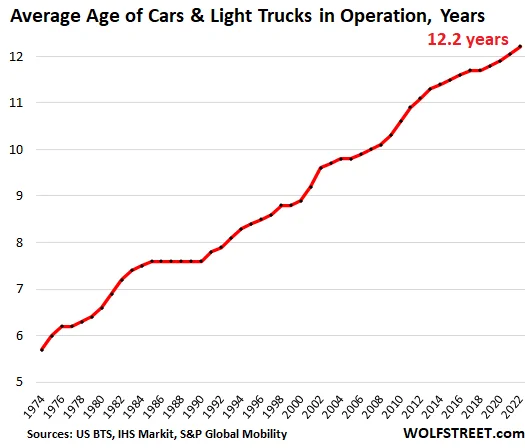
The average age of all vehicles on the road is over 12 years old (see this link). In order to get an average of 12 years you need (roughly) the typical or average new vehicle to last about 24 years.
"Unless they get in an accident."
"On the road" = "registered" ≠ "miles driven"

If the average age of a vehicle on the road is 11 years, they obviously need to last twice that long, right? If the typical vehicle only lasted 12 years, the average age on the road would be less than 6 years, right?
No. Each 100 year old car balances out three other bran new ones. Each 75 year old car balances out two, .

The average is just taking all cars ages - and none are zero - and dividing by total registrations. So you only need a few antiques of various ages to balance out the newer cars.

And it just counts registering the cars... so many of these older cars are basically museum pieces, only taken a couple miles a year. You're a thousand times more like to see a brand new car than any of these older cars.

Since it's not credible for both the average age AND lifespan to be 12 years, the statistics are being badly collected, presented, and/or interpreted. I'm having trouble finding the raw data to perform my own analysis.
Depends on how you define lifespan. The median car might only make it that far. With an average <5% total fleet annual scrapage rate, that means nearly all of them are gone after 20 years. But some are still around! Which shifts the average age higher.

-Crissa
 
Last edited:

Tiberius

Well-known member
Joined
Sep 2, 2023
Threads
0
Messages
198
Reaction score
422
Location
Texas
Vehicles
Model 3
Occupation
Chief cook and bottlewasher
Country flag

BayouCityBob

Well-known member
Joined
Apr 14, 2022
Threads
24
Messages
495
Reaction score
1,569
Location
Texas
Vehicles
2018 Model 3
Country flag
Here's a few more "idiots" for you.

"According to the Bureau of Transportation Statistics, in 2020, the average lifespan of a vehicle in the United States was 11.9 years."
https://www.capitalone.com/cars/learn/finding-the-right-car/how-long-do-cars-last/1512

"“The average lifespan [of a car] is now almost 12 years,” says Eric Lyman, chief analyst at TrueCar."
https://www.aarp.org/auto/trends-technology/how-long-do-cars-last/

"On average, a vehicle will last approximately 11-12 years on the road."
https://woodiesautoservice.com/blog/how-long-will-a-car-typically-last


Since it's not credible for both the average age AND lifespan to be 12 years, the statistics are being badly collected, presented, and/or interpreted. I'm having trouble finding the raw data to perform my own analysis.

Some of it may just be poor wording. For instance, families on average may have 2.3 children, but the average family has only whole children. As Pete pointed out, statistics are often misinterpreted, and "average" is usually a poor metric (median is more meaningful in most contexts).
Yeah I regret and apologize for using the "i" word even though it was directed at no one here, I still shouldn't have written that.

It is astonishing that these widely varied sources are making the same basic error. I can most helpfully point to the year-by-year sales data posted earlier and note that the number of vehicles actually in operation today (283 m) = 19 years of actual sales and that over the past 26 years, the vehicle sales have averaged 15.5 million a year and we are refreshing the fleet at a rate of just over 5% per annum which is to say a refresh rate of about 20 years if we lost zero to accidents and zero to export and zero were retired early for other reasons (e.g. driving a lot of miles) and the fleet was not growing. But we do lose a bunch to accidents and exports and early retirement and the fleet is growing not shrinking. And for all of these reasons it is painfully obvious that the average vehicle must last over 20 years or the totals do not add up.

And just a bit more food for thought, what this really says is that the vehicles sold in ~2000 lasted for 20 years. How long will the vehicles sold in 2023 last? Unknown. But the trend over the past forty years has been a growing average fleet age as vehicles last longer.

Back when I was a wee tike, vehicles only lasted 10 years or so and the average age was ~ 6 years.

Tesla Cybertruck Electric Truck Economics - Worth the Price? US-auto-average-age-2022-05-23
Sponsored


Top