
Sponsored
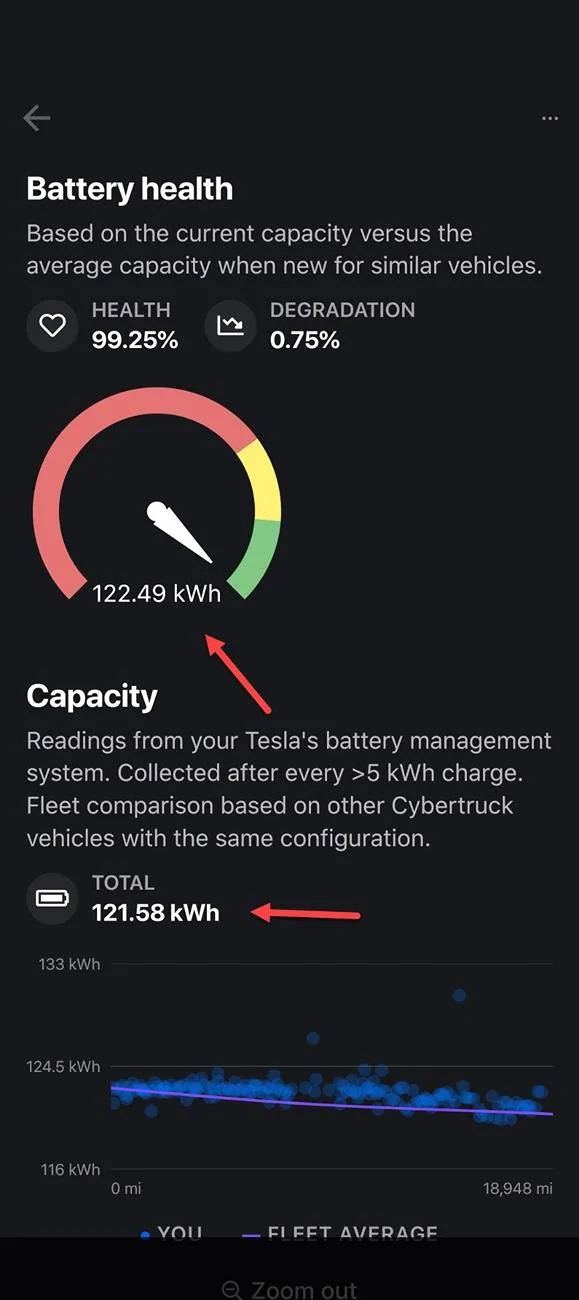
Cybertruck Battery Degradation after 11-months, 29,000-miles is still 0%
- Thread starter thecybertruckguy
- Start date
- Watchers 28

Gigahorse
Well-known member
Yea that is the problem, either Tesla has found some magical battery chemistry, and for some reason is not talking about it. ORRRRRRRRRRRRRR it is not being reported correctly in order to monkey with warranty status etc.Something definitely changed on Tesla's end.
I track my battery health myself by recording battery data via the API. After one year and a couple of months, with around 16k miles, my degradation was just over 4%, reporting 100% charge at slightly over 305 miles.
Then, after either 2025.8.4 or 2025.8.6 in April (they were released in quick succession), my car miraculously corrected its 100% charge back to 318 miles—just like new. It has been drifting down slowly since then. My current degradation is around 1.5%.
My theory is this: Tesla might have initially been overly cautious with the Cybertruck's battery, using historical fleet BMS data for battery range and charge calculations. Now, they may have corrected it after gathering more real-world data from this battery type.
Alternatively, Tesla might have released some battery buffer into user-accessible capacity, and I’m unsure how to interpret this. It could be good news if Tesla realized less buffer is needed, providing more usable range. However, it could be bad news if degradation is faster than expected, requiring additional capacity to maintain rated specs.
Gigahorse
Well-known member
I agree, but for those of us who own the truck which has now been on the road for 16+ months it is very fishy that for some reason the truck shows 0% degradation.Time will certainly tell but all these tools are just using an "API" to get info from the "BMS" so it is telling all the tools what the results of its forumlas are saying. The 2170 and 18650 BMS forumulas are certainly more mature for those chemistries and physical makeup/sizes. Recall the 4860 versions (diff generation I know) that were put in the Model Ys and did not work out well.
This is either a giant leap forward in battery technology that Tesla has not announced in thousands of vehicles, or it is someone messing with the battery reporting.
Gigahorse
Well-known member
Exactly, so the concern is. With 40k vehicles, many of which have 30k+ miles and have been around for 12+ months. WHY is the battery reporting not correct.Correct. Non-possible.

Ruffles
Well-known member
- First Name
- Steve
- Joined
- Jun 21, 2024
- Threads
- 16
- Messages
- 221
- Reaction score
- 384
- Location
- WA
- Vehicles
- Cyberbeast

I think the easiest explanation is that there are multiple APIs and multiple ways of calculating this data. Even two apps on the same truck get different readings.




65SoYoLO
Well-known member
- First Name
- Keith
- Joined
- Feb 9, 2021
- Threads
- 54
- Messages
- 2,016
- Reaction score
- 2,650
- Location
- Long Island NY
- Vehicles
- 2024 CyberTruck
- Occupation
- Retired truck driver
wow! I charged to 100% last night as I had some heavy duty towing to do today. It was 303 at 100% I am bummed. I have 32,000 miles.I have 43,615 miles on my dual motor. 100% charge is 312 miles. Was 318 new. I

Kryptek
Well-known member
- Joined
- Apr 1, 2024
- Threads
- 48
- Messages
- 554
- Reaction score
- 984
- Location
- Alaska
- Vehicles
- Cybertruck AWD Gray Interior VIN 4xxxx
Terrain, elevation, wind, weight all come into factors and so many other variables.wow! I charged to 100% last night as I had some heavy duty towing to do today. It was 303 at 100% I am bummed. I have 32,000 miles.
65SoYoLO
Well-known member
- First Name
- Keith
- Joined
- Feb 9, 2021
- Threads
- 54
- Messages
- 2,016
- Reaction score
- 2,650
- Location
- Long Island NY
- Vehicles
- 2024 CyberTruck
- Occupation
- Retired truck driver
It was not cold and I was sitting in the driveway and it said 100% 303 milesTerrain, elevation, wind, weight all come into factors and so many other variables.

HaulingAss
Well-known member
- Joined
- Oct 3, 2020
- Threads
- 28
- Messages
- 10,425
- Reaction score
- 20,955
- Location
- Western Washington, USA
- Vehicles
- Cybertruck DM, 2010 F-150, 2018 Performance Model 3, 2024 Performance Model 3
You probably just need to draw the SOC down to a very low level so the BMS can calibrate the bottom of the pack.It was not cold and I was sitting in the driveway and it said 100% 303 miles
65SoYoLO
Well-known member
- First Name
- Keith
- Joined
- Feb 9, 2021
- Threads
- 54
- Messages
- 2,016
- Reaction score
- 2,650
- Location
- Long Island NY
- Vehicles
- 2024 CyberTruck
- Occupation
- Retired truck driver
what % does it need to get to to calibrate itself?You probably just need to draw the SOC down to a very low level so the BMS can calibrate the bottom of the pack.

Speedr
Well-known member
- Joined
- Dec 17, 2023
- Threads
- 15
- Messages
- 665
- Reaction score
- 1,402
- Location
- Florida
- Vehicles
- Dual Motor Cybertruck
Tesla and the lab up in Canada they funded made breakthroughs years ago that a but eliminated battery degradation. I was always surprised me that they didn't implement it. Now with the Cybertruck, using TESLA'S batteries (not Panasonic's), it appears that we are finally seeing this breakthrough implemented. Also, while everyone else (i.e. CATL, BYD, etc.) are focused on improving fast charging, my guess is Tesla is focused on longevity to ensure their Robotaxis can go a million miles on a battery. In regards to not making a big deal out of it, it would Osbourne the other Tesla cars that don't have the 4680...

scottf200
Well-known member
- Joined
- Jul 31, 2021
- Threads
- 53
- Messages
- 2,221
- Reaction score
- 3,241
- Location
- Western NC
- Vehicles
- X; immed family 3 & Y
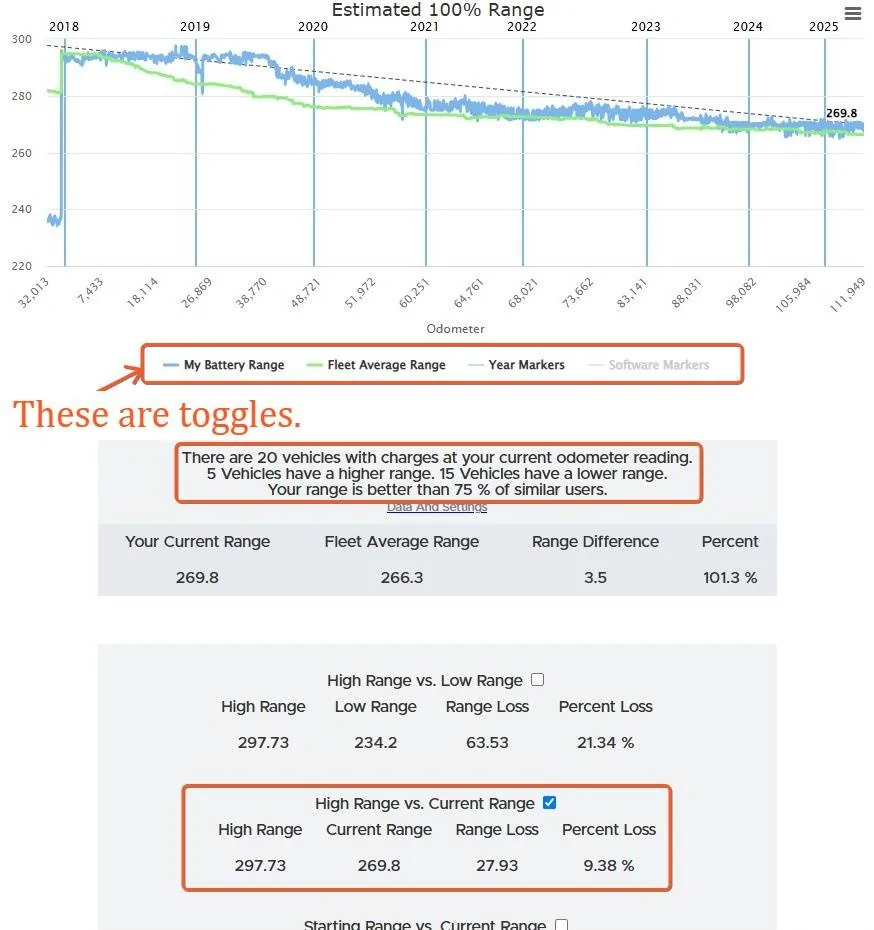
Can you show the graph from the TeslaFI menu: Charges -> Battery Report (link)I think the easiest explanation is that there are multiple APIs and multiple ways of calculating this data. Even two apps on the same truck get different readings.
I'm pretty sure old 3rd parties use to simulate a phone API to get data back but Tesla added a specific API last year or before for their official interface (and more data). I don't think the current API works for some legacy cars (X&S?) but certainly the new one does for the CT so I'd expect it to be the same data.
This is my '17 TMX version of it.
HaulingAss
Well-known member
- Joined
- Oct 3, 2020
- Threads
- 28
- Messages
- 10,425
- Reaction score
- 20,955
- Location
- Western Washington, USA
- Vehicles
- Cybertruck DM, 2010 F-150, 2018 Performance Model 3, 2024 Performance Model 3
There is no cutoff, it just gets a more accurate calibration the lower you go. IME, getting into the teens is good enough for most uses.what % does it need to get to to calibrate itself?

mjezzi
Well-known member
- First Name
- Mike
- Joined
- Nov 21, 2024
- Threads
- 6
- Messages
- 155
- Reaction score
- 152
- Location
- Boulder, CO
- Vehicles
- model 3, model y, cybertruck
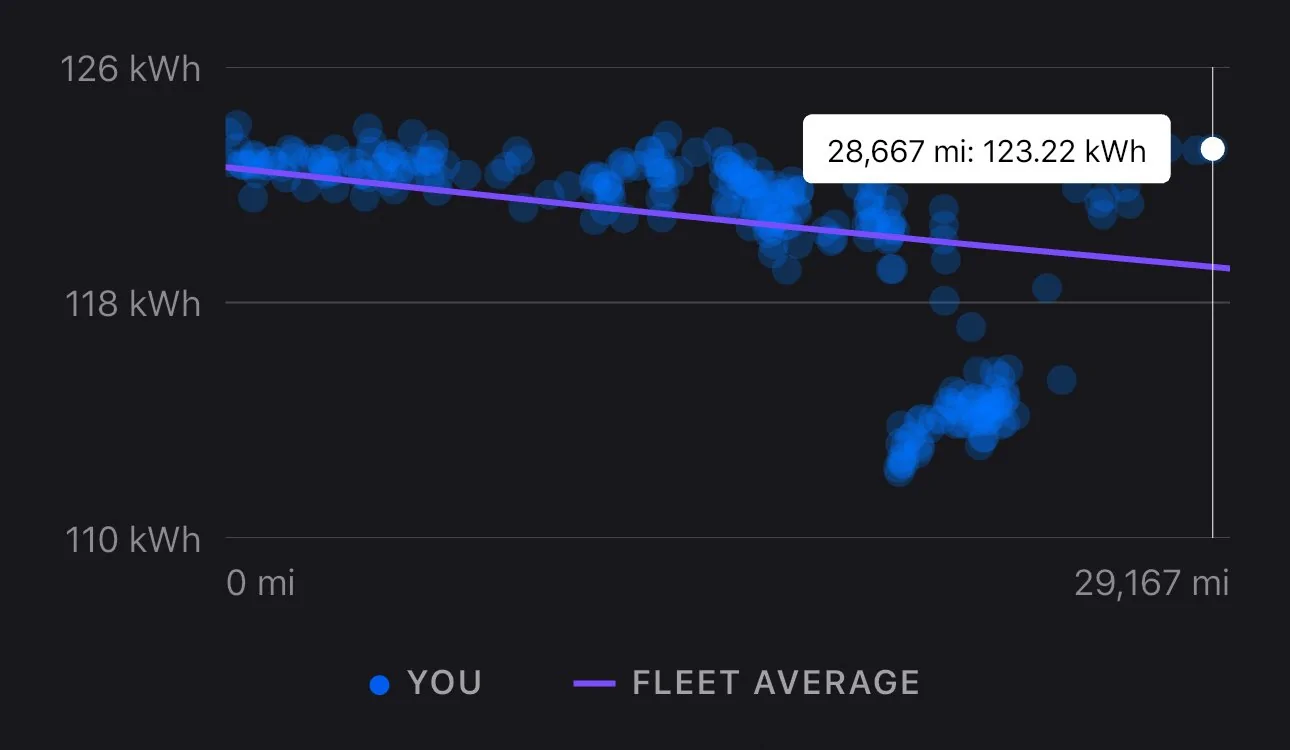
what’s your daily charge limit set to?Got back from a 5,900mi road trip last night and took a peak at my battery health this morning.
My FS Cybertruck (VIN 16,795) has nearly 29,000 miles on the odometer after almost a year of ownership, and Tessie (the data app) is still tracking my high voltage pack at 100% original capacity. ? 123kWh.
The truck's nav shows 313mi of the factory 318mi EPA-rated range at 100% charge. Tessie agrees with 313mi at 100%. Thats somewhere between 0.0-1.5% degradation after almost a year. Wow!
The dip in the graph is from my winter tires. Apparently that messes with the calculations, but I'm using the OEM All-Terrains now.
Maybe the 4680 is better than expected, or perhaps this is an outlier?

65SoYoLO
Well-known member
- First Name
- Keith
- Joined
- Feb 9, 2021
- Threads
- 54
- Messages
- 2,016
- Reaction score
- 2,650
- Location
- Long Island NY
- Vehicles
- 2024 CyberTruck
- Occupation
- Retired truck driver
100% is now only 305 mile range.
Sponsored
Similar threads


- Replies
- 41
- Views
- 8,673


