YDR37
Well-known member
- Joined
- Dec 29, 2023
- Threads
- 26
- Messages
- 1,452
- Reaction score
- 2,377
- Location
- California
- Vehicles
- Tacoma

The vehicle production capacities that Tesla lists in its earnings reports look like this:It should be understood that a production capacity of 125,000 is more of a theoretical maximum. It assumes no downtime for the production line for maintenance, no breakdowns, no supply chain hiccups, no anything. Tesla has often said that the production capacity is never realized, even when they want to make as many as possible. That said, since the 125,000 is accompanied by a ">" sign, it might be possible to hit close to 125,000 if everything went perfect for an entire year (and demand was sufficient to move them all). But 250,000 is literally impossible without an expensive new production line.
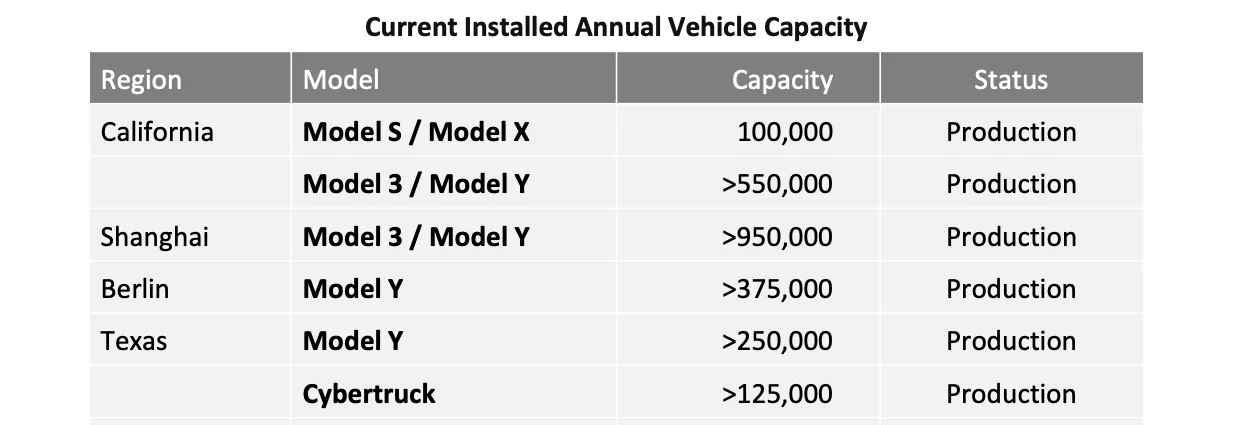
Add those numbers up (ignoring the ">" signs). You will get a global production capacity of 2,350,000 vehicles per year. Yet the ">" signs obviously imply that the real production capacity is higher. How much higher? Well, consider a Tesla statement in the 1Q 2025 shareholder deck (which also includes the table shown above):
So according to Tesla, ">2,350,000" really means "close to three million", and that's without "investing in new manufacturing lines." The math only works if you boost all of the ">" numbers by about 25%. And in that case, the true Cybertruck production capacity would be more than 150,000 per year.Plans for new vehicles, including more affordable models, remain on track for start of production in the first half of 2025. These vehicles will utilize aspects of the next generation platform as well as aspects of our current platforms and will be produced on the same manufacturing lines as our current vehicle lineup ... This should help us fully utilize our current expected maximum capacity of close to three million vehicles, enabling more than 60% growth over 2024 production before investing in new manufacturing lines.
OK, that's still less than 250,000 per year. But it does suggest that 125,000 per year is not a "theoretical maximum".
Sponsored
Last edited: