
Sponsored

500 MILE RANGE JUSTIFICATION, 139MPGe

Beetlebug62

Well-known member
First Name
Ken
Joined
Mar 24, 2025
Threads
6
Messages
475
Reaction score
823
Location
Maine, USA
Vehicles
2018 Tesla Model 3 LR-AWD, 2025 CyberTruck dual-motor
Occupation
retired
Country flag
Challenge accepted.

At the end of our 1000 mile race, according to AI, I will have $70 in my pocket to take my wife and I out to dinner. And who wouldn't want to spend the extra two hours and 41 minutes with my wife? Lol.

On a 1000 mile run, you will charge 3 times vs my 1 time. Each charge will cost 90 minutes, which will include getting on and off the highway, getting to the charger and plugging in. It could take 1 hour to fully charge at each charger.
Don't forget time is money. I just ran the ABRP simulation from PA to WI, and I saved 3hrs, which compared driving my way vs driving 55mph. When there's plenty of chargers, I don't really feel any desire to stretch out my road time.

My way, 5 stops, 1h43m charging; 14h17m total.
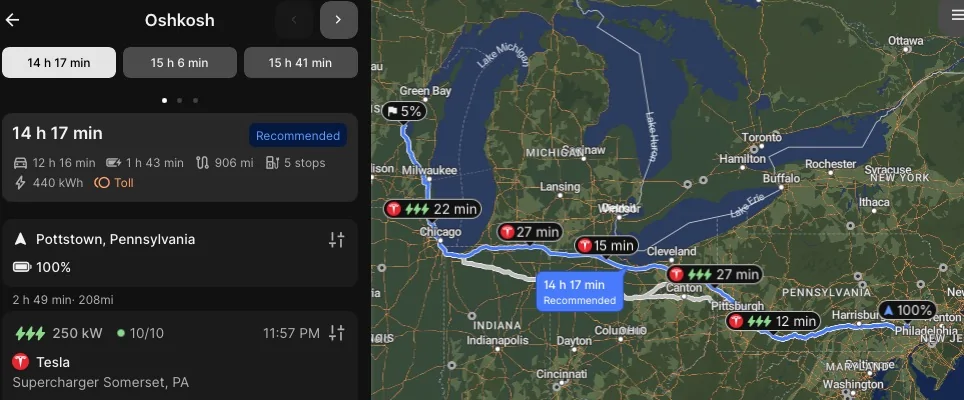
Tesla Cybertruck 500 MILE RANGE JUSTIFICATION, 139MPGe 1785114558267-0l


Going slow, 2 stops, using my CT's base efficiency, 1h28m charging, 17h17m total.
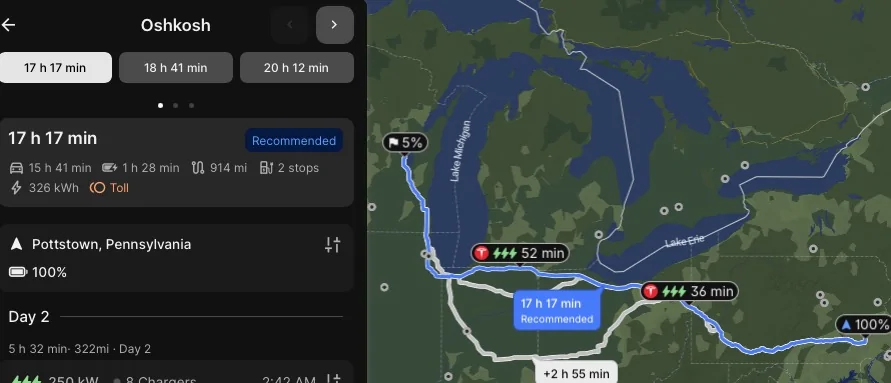
Tesla Cybertruck 500 MILE RANGE JUSTIFICATION, 139MPGe 1785114713060-qq
Sponsored

 
OP
OP
Taildragger

Taildragger

Well-known member
First Name
Tim
Joined
Sep 7, 2020
Threads
9
Messages
59
Reaction score
164
Location
19465
Vehicles
M3, MY, CT
Occupation
Engineer
Country flag
I’m retired so time is not an issue, am on Social Security on a fixed income.

I’m not claiming everyone should drive 55 mph. I’m saying I prefer to trade some travel time for lower energy use, lower charging cost, fewer or shorter charging stops, and a more relaxed trip.

That is not imaginary. Aerodynamic drag increases approximately with the square of speed. At 80 mph, the aerodynamic force is roughly twice what it is at 55 mph, and the power needed to overcome that drag rises even faster. The Cybertruck’s total consumption will not literally double because rolling resistance and accessory loads also matter, but the efficiency penalty at 80 mph is substantial.

For my trip, electricity costs as much as $0.43 per kWh, and a charging stop can consume considerably more time than the charger’s displayed charging time once I include exiting the highway, finding the charger, waiting, charging, and returning to the route. Driving faster is not automatically the fastest or cheapest overall strategy.

I stay in the right lane, avoid obstructing traffic, and comply with posted minimum-speed laws. Other drivers are free to choose 80 mph. I am equally free to choose a legal speed that saves energy and money. It is simply a different optimization: they prioritize road speed; I prioritize efficiency, cost, range, and a less frantic trip.

I bought an electric truck partly to conserve energy and CO2 emissions—not to prove I can turn electricity and my cash into aerodynamic drag as quickly as possible.
 
Last edited:

Outdoors

Well-known member
First Name
Outdoors
Joined
Nov 19, 2019
Threads
18
Messages
1,966
Reaction score
3,555
Location
North West Montana
Vehicles
S,CT,R2, Slate (order)
I’m retired so time is not an issue, am on Social Security on a fixed income.

I’m not claiming everyone should drive 55 mph. I’m saying I prefer to trade some travel time for lower energy use, lower charging cost, fewer or shorter charging stops, and a more relaxed trip.

That is not imaginary. Aerodynamic drag increases approximately with the square of speed. At 80 mph, the aerodynamic force is roughly twice what it is at 55 mph, and the power needed to overcome that drag rises even faster. The Cybertruck’s total consumption will not literally double because rolling resistance and accessory loads also matter, but the efficiency penalty at 80 mph is substantial.

For my trip, electricity costs as much as $0.43 per kWh, and a charging stop can consume considerably more time than the charger’s displayed charging time once I include exiting the highway, finding the charger, waiting, charging, and returning to the route. Driving faster is not automatically the fastest or cheapest overall strategy.

I stay in the right lane, avoid obstructing traffic, and comply with posted minimum-speed laws. Other drivers are free to choose 80 mph. I am equally free to choose a legal speed that saves energy and money. It is simply a different optimization: they prioritize road speed; I prioritize efficiency, cost, range, and a less frantic trip.

I bought an electric truck partly to conserve energy and CO2 emissions—not to prove I can turn electricity and my cash into aerodynamic drag as quickly as possible.
Sure. You can conserve all you want. You might end up dead or killing someone else for your frugality. Yes it will be your fault when someone hits you from behind.

Human eyes are much worse at judging how fast a gap is closing than judging movement across a field of vision. A driver coming up from behind at 85 mph often won't realize you are doing 55 mph until they are much closer than a football field away.

At 85 someone travels 187 feet from the time they think about hitting the brake to actual deployment of the brake. That leaves 113 feet to avoid you. Not enough time.

In Texas it is called the impediment effect. A leading cause of pileups in Texas. Maybe not your problem, but you will get a ticket in Texas for it.
 
OP
OP
Taildragger

Taildragger

Well-known member
First Name
Tim
Joined
Sep 7, 2020
Threads
9
Messages
59
Reaction score
164
Location
19465
Vehicles
M3, MY, CT
Occupation
Engineer
Country flag
I've been going 55MPH ever since it was a federal mandate in the Jimmy Carter era and I've never got hit or caused traffic issues. The federal mandate was due to an oil embargo. Sound familiar?
 
  • Like
Reactions: REM


Outdoors

Well-known member
First Name
Outdoors
Joined
Nov 19, 2019
Threads
18
Messages
1,966
Reaction score
3,555
Location
North West Montana
Vehicles
S,CT,R2, Slate (order)
Now I see why Tesla originally advertised a 500 mile range because I just verified it at 55MPH.
You might think that in your little fantasy world that. Yet Tesla didn't say a 500 mile range at 55mph is why they advertised 500 mile range. Tesla was smoking hopeium. Yet they didn't come up with anything meaningful in terms of matching the battery technology improvements with the stated claims of 500 mile range.

So let's see a 500 mile drive in the CT. Show us. All I see is napkin math and no real use of a 500 mile drive. Just AI math and nothing else.
 

Gaximus

Well-known member
Joined
Jun 22, 2024
Threads
24
Messages
1,497
Reaction score
2,358
Location
Mead, CO
Vehicles
CyberBeast, Model 3, Jeep Wrangler, Yamaha R6
Occupation
Software Developer
Country flag
This is 139 MPGe based on my $.13 per KWH off-peak rate. Absolutely astonishing. (Based on a $4/gallon gas price)

At a real-world Tesla Supercharger rate of $.43 per KWH, that's still 38.5 MPGe.
I’m confused by this, MPGe has nothing to do with the price of electricity, it’s similar to MPG and doesn’t change just because gas prices go up.
 

jimbobb23

Well-known member
Joined
Aug 9, 2024
Threads
3
Messages
270
Reaction score
517
Location
Texas
Vehicles
Cybertruck....
Country flag
EPA ratings are completely outdated and need to be replaced with real world data for the modern driver and highways. 75mph 80mph.
Cybertruck is great it just needs a max pack for those that need or want it.
Once CT gets over 70 the range drops dramatically. I wish 2 changes existed for EVs....the advertised range has to be the expected average range in 2 years (after battery loses initial margin) and range calculations in more normal freeway conditions.
 

Beetlebug62

Well-known member
First Name
Ken
Joined
Mar 24, 2025
Threads
6
Messages
475
Reaction score
823
Location
Maine, USA
Vehicles
2018 Tesla Model 3 LR-AWD, 2025 CyberTruck dual-motor
Occupation
retired
Country flag
I’m retired so time is not an issue, am on Social Security on a fixed income.

I’m not claiming everyone should drive 55 mph. I’m saying I prefer to trade some travel time for lower energy use, lower charging cost, fewer or shorter charging stops, and a more relaxed trip.

That is not imaginary. Aerodynamic drag increases approximately with the square of speed. At 80 mph, the aerodynamic force is roughly twice what it is at 55 mph, and the power needed to overcome that drag rises even faster. The Cybertruck’s total consumption will not literally double because rolling resistance and accessory loads also matter, but the efficiency penalty at 80 mph is substantial.

For my trip, electricity costs as much as $0.43 per kWh, and a charging stop can consume considerably more time than the charger’s displayed charging time once I include exiting the highway, finding the charger, waiting, charging, and returning to the route. Driving faster is not automatically the fastest or cheapest overall strategy.

I stay in the right lane, avoid obstructing traffic, and comply with posted minimum-speed laws. Other drivers are free to choose 80 mph. I am equally free to choose a legal speed that saves energy and money. It is simply a different optimization: they prioritize road speed; I prioritize efficiency, cost, range, and a less frantic trip.

I bought an electric truck partly to conserve energy and CO2 emissions—not to prove I can turn electricity and my cash into aerodynamic drag as quickly as possible.
I totally support an engineer documenting a cool roadtrip.

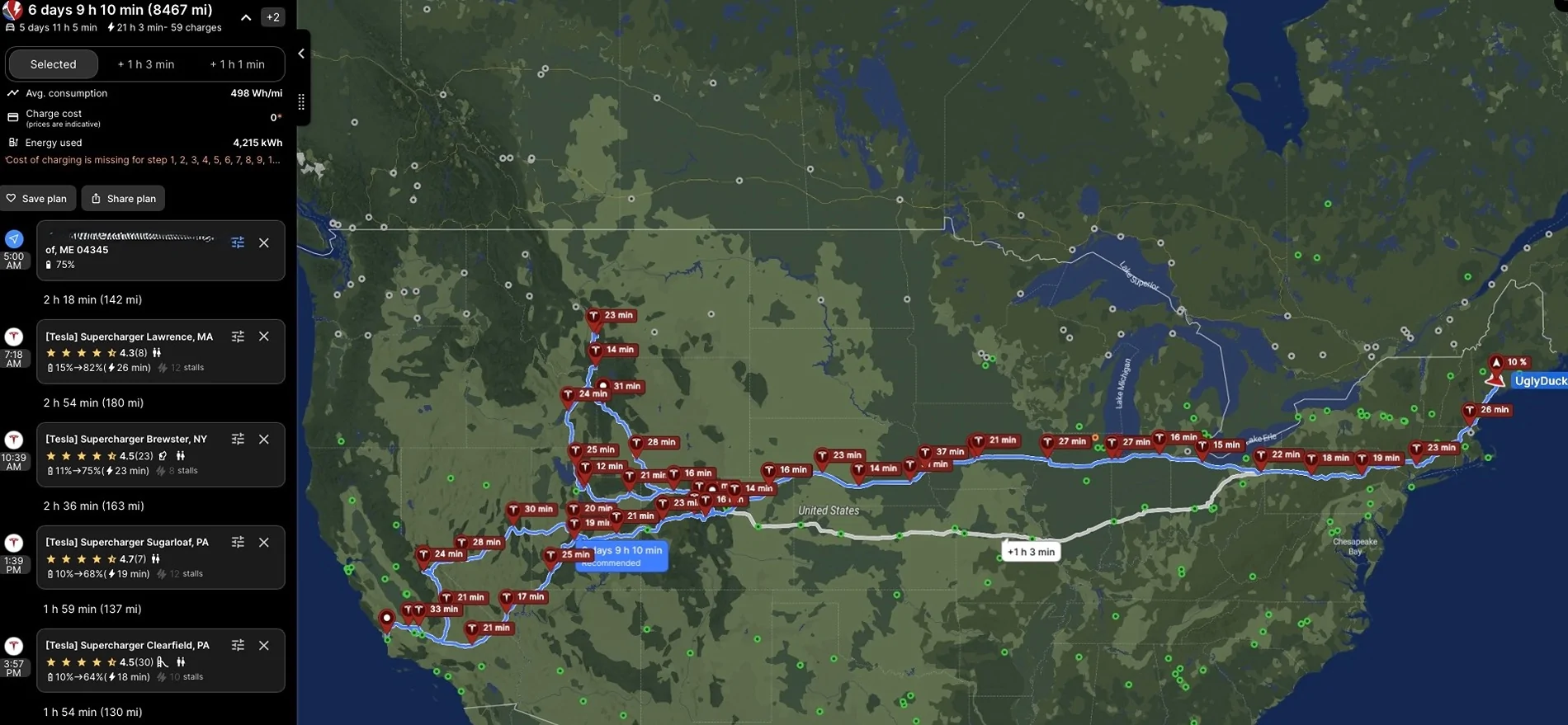
I just want everyone to be completely clear about the tradeoffs. Just in my example, the total charging time tradeoff is only 15mins, not much.

And, in ABRP, you can plug in an estimated travel time to and from the supercharger. In my limited experience, I just roadtripped 10k+ miles from Maine to Cali, to Montana and back with ~60 supercharging stops, so I plug in 2mins, as that's my estimate. The nav is going to look for the most time-efficient Supercharger stops on your roadtrip. And, normally, the people planning where to locate them, do a good job of placing them near the highway; not always, but often.
Tesla Cybertruck 500 MILE RANGE JUSTIFICATION, 139MPGe by default 2026-01-07 at 11.15.24 AM

And I like efficiency as much as the next person, but I was traveling in Winter when the temps were -4°F from Maine thru Ohio. It was never going to be very efficient!

As for whether driving fast is faster? Since I got my first Tesla in 2018, it's absolutely true that the faster you drive, the faster your roadtrip. You can test simulations on ABRP with real-world data. The time you save by driving fast, easily makes up for any additional time spent supercharging. And, as noted above, the supercharger time penalty for your 1000mi trip, was 15mins more of charging, but saving 3hrs of total travel time.

It all depends upon how you value your leisure time in retirement. If it's low, then by all means take your time. I'd drive on the side roads avoiding interstates. Far more interesting sightseeing.
Sponsored


Top