
Sponsored

Battery Degradation

HaulingAss

Well-known member
Joined
Oct 3, 2020
Threads
28
Messages
10,298
Reaction score
20,706
Location
Western Washington, USA
Vehicles
Cybertruck DM, 2010 F-150, 2018 Performance Model 3, 2024 Performance Model 3
Country flag
4680 NCM, my understanding:
after 12 months, -4%
each next 12 months, 1.8%
expect it tapers to 1.5% annually
after 10 years -20%, reason the warranty is in alignment with that
if more then -20, you get a new batt, at -20 nada
seems fair
Based on my experience with four other Tesla, and fleet averages in general, those numbers are very pessimistic. Sure, anything is possible on an individual pack, that's why we have warranties, but the average degradation would never look like that.

While it's true there is limited public data for the first generations of 4680 cells, Tesla is very conservative about releasing vehicles with new batteries until they have a very good idea of how the real-world degradation curves look.

And they would never release a battery that averaged the numbers you posted, it could bankrupt the company.
Sponsored


 

Outdoors

Well-known member
First Name
Outdoors
Joined
Nov 19, 2019
Threads
17
Messages
1,871
Reaction score
3,450
Location
North West Montana
Vehicles
S,3,Y,CT,CT(holding pattern) Slate is back on
At 300k I am at 11.7% of degradation on S. If it was 20% I wouldn't complain on the truck at the same point. Seen a 300k truck or SUV lately? Not so pretty.

Most don't hold stuff that long. Why they care I don't know.
 

kpanda17

Well-known member
Joined
Jun 8, 2023
Threads
25
Messages
988
Reaction score
1,001
Location
USA
Vehicles
Tesla Model 3RWD, Tesla Model MYP
Country flag
interesting, ICE is miles and little time that impacts/think rubber
with BEV is only time, does not seem to be cycles as much
also think the MS with 18650 battery is the industry best, goes with the cost of the car
MS battery degradation is one of lowest
 

carsly

Well-known member
First Name
Vin
Joined
Dec 13, 2023
Threads
93
Messages
1,529
Reaction score
2,898
Location
Princeton, NJ
Vehicles
LR Defender, CT AWD
Country flag
the other info that's helpful when looking at degradation is:
- charging behavior - supercharging vs. level 2; I'm almost exclusively Level 2 at 32 amps
- typical daily charge - I set mine at 70%, below Tesla's recommended daily maximum of 80%
- typical climate - Arizona vs Northern Yukon or somewhere in between, I'm in NJ but garage when it's below freezing, otherwise outdoors (very tight garage squeeze)

No idea on how much degradation in 7 months and 4,500 miles. Less than a cell phone, that's for sure.


Cyber Man

Well-known member
Joined
Dec 30, 2023
Threads
11
Messages
1,049
Reaction score
2,259
Location
California
Vehicles
BMW X1, Porsche Cayenne, R1T Perf max, Cyberbeast
Country flag
IMG_0657.jpeg


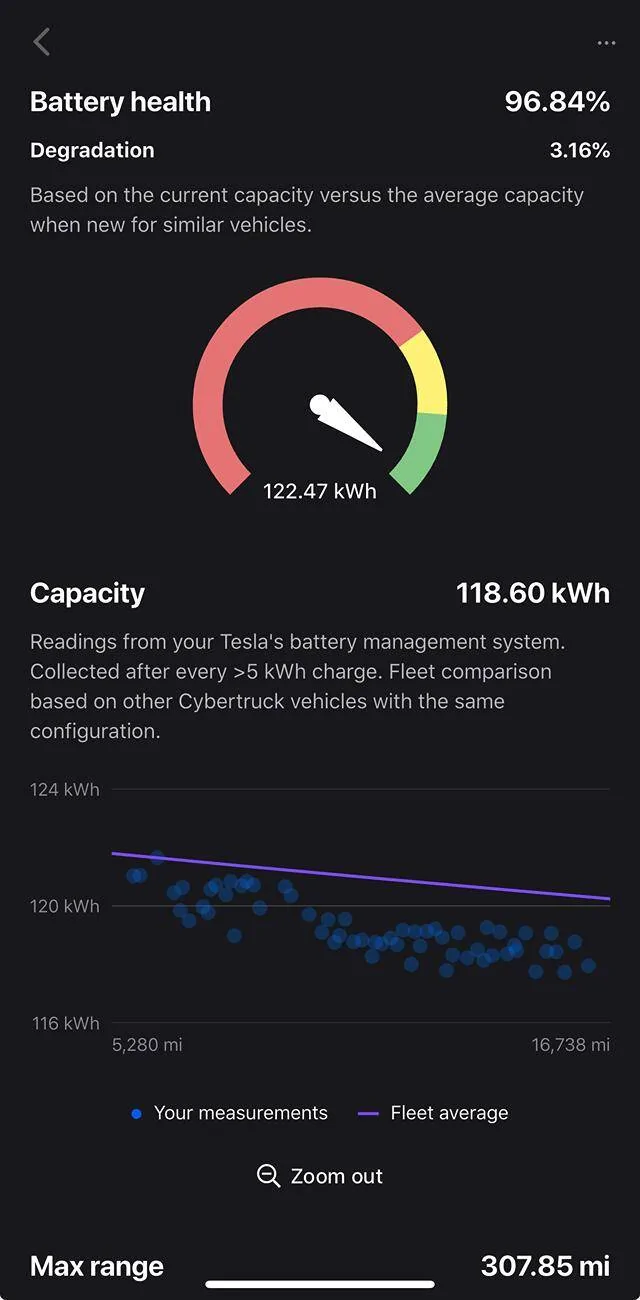
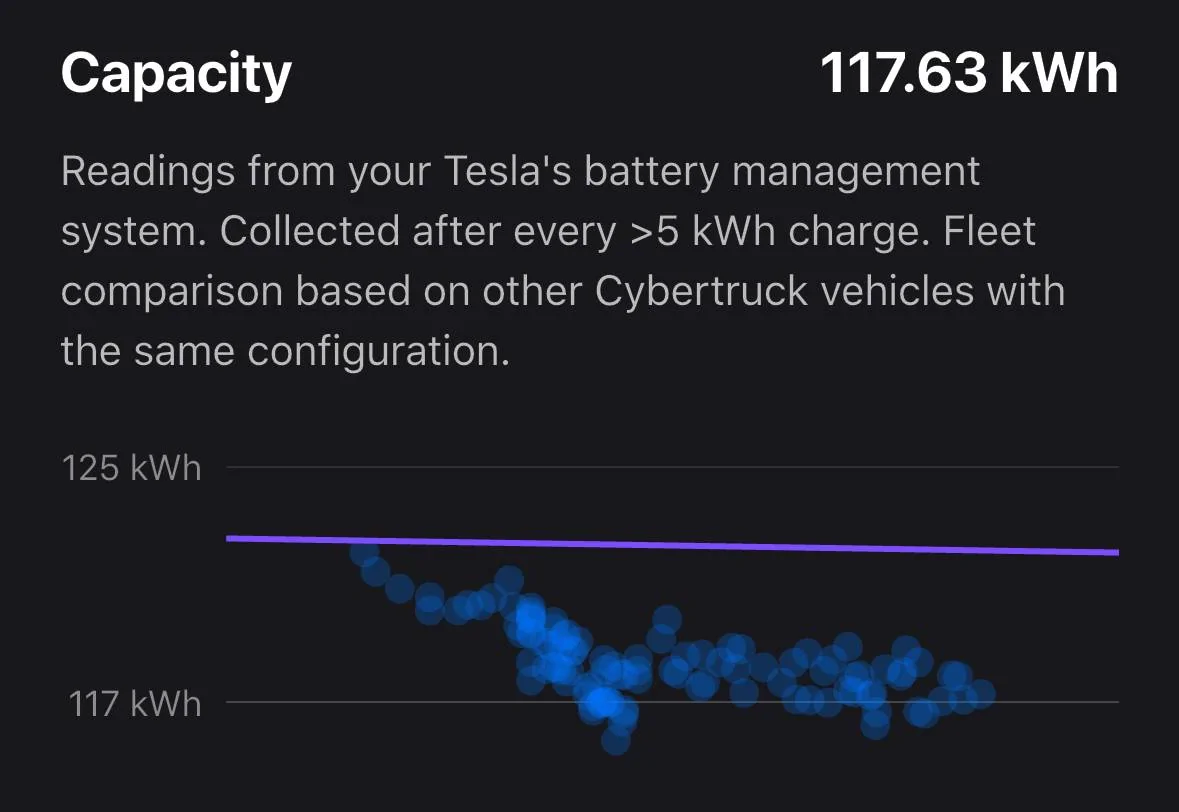
I front-loaded my early degradation by Supercharging exclusively in the first few months, but it’s leveled off.
Is it better to exclusively supercharge in the beginning to front-load degradation? I have free super charging for three months. I have been home charging to avoid battery degradation.
 

eswimm

Well-known member
Joined
Jun 6, 2024
Threads
3
Messages
556
Reaction score
995
Location
Charlotte, NC
Vehicles
Model Y, Cybertruck
Country flag
Is it better to exclusively supercharge in the beginning to front-load degradation? I have free super charging for three months. I have been home charging to avoid battery degradation.
It's likely better not to worry about it. The only thing I've learned from countless degradation discussions is that luck seems to play a larger role than anything somebody actually does. My 8 yr old Model X P100D had 6% degradation at 55k miles, charged to 90% every day, supercharge roughly 25%. 6 year old Model 3, charged to 90% weekly, supercharged <5%, 4% degradation at 36k miles. I still charge my Cybertruck to 90% daily, I'm not going to cut myself off from 10% of my range in some futile quest to have 1% less degradation in 8 years.
 

CyberGus

Well-known member
First Name
Gus
Joined
May 22, 2021
Threads
91
Messages
10,236
Reaction score
33,889
Location
Austin, TX
Vehicles
1981 DeLorean, 2024 Cybertruck
Occupation
IT Specialist
Country flag
Is it better to exclusively supercharge in the beginning to front-load degradation? I have free super charging for three months. I have been home charging to avoid battery degradation.
Degradation is highest initially, and tapers off with time as the cells “break in”. It’s normal.

The best thing you can do is avoid high SoC for protracted periods, particularly above 80%.
 

GatorCyber

Well-known member
Joined
Mar 14, 2024
Threads
13
Messages
599
Reaction score
714
Location
Florida
Vehicles
2024 Cybertruck FS; 2023 Model X (w/FSD)
Occupation
Real Estate Developer
Country flag
Supercharging does NOT degrade your battery faster than level 2 according to Jeff Dahn.
Keeping your car in a hot climate will degrade your battery more than a cold climate.
keeping your battery between 20-80% is recommended, but keeping it close to 50% all the time is best.
 

kpanda17

Well-known member
Joined
Jun 8, 2023
Threads
25
Messages
988
Reaction score
1,001
Location
USA
Vehicles
Tesla Model 3RWD, Tesla Model MYP
Country flag
Supercharging does NOT degrade your battery faster than level 2 according to Jeff Dahn.
Keeping your car in a hot climate will degrade your battery more than a cold climate.
keeping your battery between 20-80% is recommended, but keeping it close to 50% all the time is best.
remember as kids, we were told to store our unused batteries in the refrig


GatorCyber

Well-known member
Joined
Mar 14, 2024
Threads
13
Messages
599
Reaction score
714
Location
Florida
Vehicles
2024 Cybertruck FS; 2023 Model X (w/FSD)
Occupation
Real Estate Developer
Country flag
remember as kids, we were told to store our unused batteries in the refrig
The cold used to make my old batteries work again.

I spent 2 years during Covid in the LV desert with my Model 3. I rarely drove and kept it charged up to 80% all the time. I think the heat and keeping it at a high state of charge was part of my 8% degradation.
 

Jager

Well-known member
First Name
Jeff
Joined
May 25, 2020
Threads
25
Messages
338
Reaction score
1,089
Location
Virginia
Vehicles
2024 Cybertruck AWD, 2022 Model 3 LR AWD
Country flag
Supercharging does NOT degrade your battery faster than level 2 according to Jeff Dahn....
That's not exactly what Dr. Dahn says. What he suggests is that given the advanced thermal management hardware in Tesla's, and their sophisticated BMS software, supercharging should have minimal negative effect. Emphasis on should, and minimal.

The challenge is separating corporate speak - Dr. Dahn is one of Tesla's senior management - from actual, objective scientific reality.

Heat is a profound accelerant of degradation in Lithium-chemistry batteries. And Supercharging - first preconditioning; then the DC fast charge itself - raises pack temps to very high levels. Those high temps then persist for a considerable period of time. Tesla's pack thermal management is the best in the business, but it falls well short of what one would design if pack longevity was the overarching goal.

The bottom line is that those who Supercharge frequently have their pack sitting at elevated temps for much longer than they probably imagine.

Road trips in a Tesla are a beautiful thing. But my recommendation would be to use Supercharging as sparingly as possible. And when you do, keep the sessions as short as possible. Cathode expansion is a not-much-discussed element in pack degradation, but it's definitely a thing. Shorter, more-frequent Supercharger stops are better than fewer, longer stops.

The short list:
- Cold presents the greatest challenge to an EV battery, via potential Lithium plating while charging; and loss of efficiency otherwise. But manage through both those issues and....
- Cold is good for sleeping and storage; warm the pack before driving or charging. Keep the vehicle plugged in so warming the pack comes from the wall.
- Lower SOC's are always better. There is no lower bound where that does not apply, as long as the pack does not fully discharge.
- Frequent quick, shallow charge cycles are always better than fewer, longer, deeper cycles.
- L2 charging is always preferred over L3. Always.

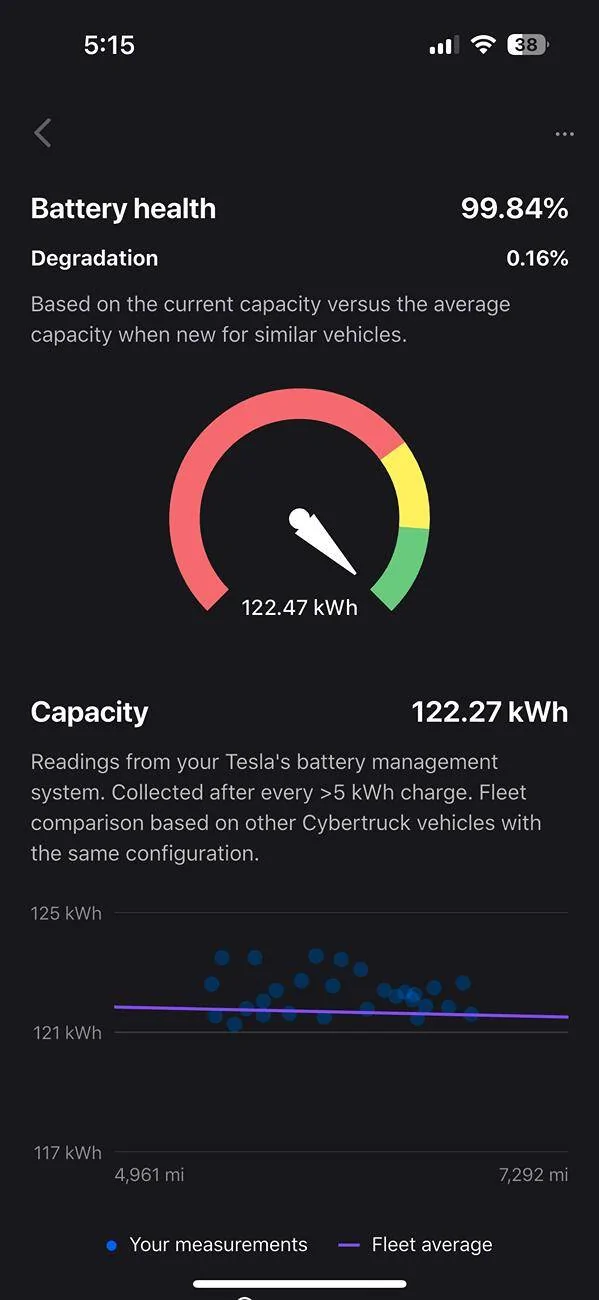
Tesla Cybertruck Battery Degradation Battery_Health-6798_Miles
 

HaulingAss

Well-known member
Joined
Oct 3, 2020
Threads
28
Messages
10,298
Reaction score
20,706
Location
Western Washington, USA
Vehicles
Cybertruck DM, 2010 F-150, 2018 Performance Model 3, 2024 Performance Model 3
Country flag
The challenge is separating corporate speak - Dr. Dahn is one of Tesla's senior management - from actual, objective scientific reality.
Jeff Dahn hasn't worked at Tesla since 2021. And he was never in Senior Management. He was the chair of a technical committee at Tesla Canada. He's a scientist. He doesn't speak "corporate speak", he's a scientist and an educator, through and through. And he's very good at both roles.

Heat is a profound accelerant of degradation in Lithium-chemistry batteries. And Supercharging - first preconditioning; then the DC fast charge itself - raises pack temps to very high levels. Those high temps then persist for a considerable period of time. Tesla's pack thermal management is the best in the business, but it falls well short of what one would design if pack longevity was the overarching goal.

The bottom line is that those who Supercharge frequently have their pack sitting at elevated temps for much longer than they probably imagine.
Sigh...Cold temps can be just as harmful to a battery as hot temps, the goldilocks temperature for charging is around 80F degrees, warmer than most N. American batteries are at idle. Home charging at 50F degrees is also not optimum. Most charging is not optimum, it's all about keeping the degradation in a range that makes sense.

Here's the truth of the matter: Cars that were Supercharged almost exclusively do not show more battery degradation than cars that were Level II charged almost exclusively. The proof is in the pudding.

The old wife's tale that Supercharging is worse than Level II charging needs to die. Charge using Level II or Level III when you need to, the BMS manages battery life. It just doesn't matter to any significant degree.

By far the best reason to Level II charge whenever possible is because it costs less.
 

CyberGus

Well-known member
First Name
Gus
Joined
May 22, 2021
Threads
91
Messages
10,236
Reaction score
33,889
Location
Austin, TX
Vehicles
1981 DeLorean, 2024 Cybertruck
Occupation
IT Specialist
Country flag
Cold temps can be just as harmful to a battery as hot temps
Higher temperatures are better for operational use, but lower temperatures reduce calendar degradation while not in use.

Of course, there is little you can do about the temperature.
Sponsored


Top