
Sponsored

Estimate cost of charging a Dual Motor

JBee

Well-known member
First Name
JB
Joined
Nov 22, 2019
Threads
18
Messages
4,913
Reaction score
6,362
Location
Australia
Vehicles
Cybertruck
Occupation
. Professional Hobbyist
Country flag
Consumption (joules/meter) is just power (joules/sec) divided by speed (meters/sec) so the vehicle clearly knows what the consumption is at any instant of time and that could be used in a control loop with a desired consumption as the setpoint. The problem is, of course, that speed will be all over the place as grade changes and wind gusts take place. I guess the loop output could be smoothed to prevent this resulting in smoother speed variation while still realizing an average consumption. But of course that's what we effectively do if we see consumption rate is too high (meaning we will run out of battery before reaching the destination). If the loop sees consumption above the set point it can only respond by asking for less total drain from the battery and the obvious way to do that is reduce power but there are other things that can be done such as turning down the A/C and reducing battery cooling but that's what Range mode does and that's what a prudent driver (the meat servo) does if he sees that consumption is too high.
I know its possible, even on an ICE but what reasons would they have not have a cruise like that. You could even set a min max velocity to override the consumption set point if you wanted...you could even let the radar cruise/ FSD nudge you to keep traffic flow. Enough options I think.
Sponsored


Crissa

Well-known member
First Name
Crissa
Joined
Jul 8, 2020
Threads
138
Messages
19,571
Reaction score
31,477
Location
Santa Cruz
Vehicles
2014 Zero S, 2013 Mazda 3
Country flag
Constant throttle is yuck for traffic flow. No two vehicles have the same lading and that makes all but the one in front run below optimal.

Just use regen to get it back.

-Crissa
 

ajdelange

Well-known member
First Name
A. J.
Joined
Dec 8, 2019
Threads
4
Messages
3,203
Reaction score
3,409
Location
Virginia/Quebec
Vehicles
Tesla X LR+, Lexus SUV, Toyota SR5, Toyota Landcruiser
Occupation
EE (Retired)
Country flag
You already have the functionality in that if you want to decrease consumption overall you just put the AP SP to 60 mph instead of 70. Fluctuation of consumption between -1000 Wh/mi and +1000 Wh/mi are acceptable as long as the average stays below, say +400 (sedan or crossover) but the fluctations in speed required to HOLD 400 would not be acceptable. Would you want a control algorithm that slowed to 30 mph on the freeway when a steep hill is encountered? IOW I think the current system in adequate for control of consumption. Get in an SoC pickle? Set the AP for slower speed, turn off the A/C and radio and watch the consumption curve to see if you have slowed enough. If destination SoC is still negative slow more or get off the road and charge.
 

JBee

Well-known member
First Name
JB
Joined
Nov 22, 2019
Threads
18
Messages
4,913
Reaction score
6,362
Location
Australia
Vehicles
Cybertruck
Occupation
. Professional Hobbyist
Country flag
In my case traffic flow is irrelevant, there is none over 600km, so speed fluctuations are irrelevant. In fact I doubt if other drivers would notice the fluctuations and wouldn't just overtake. Sure steep hills etc, but that can be solved with min max velocities.

But theres also a higher setpoint worth considering here, in that I would like to reach my destination at the highest possible speed and know I can make the distance. Remember, I don't have the luxury of lots of fasr chargers along the way. :)
 

Crissa

Well-known member
First Name
Crissa
Joined
Jul 8, 2020
Threads
138
Messages
19,571
Reaction score
31,477
Location
Santa Cruz
Vehicles
2014 Zero S, 2013 Mazda 3
Country flag
I certainly notice, since I drive a manual ^-^

Won't notice as much with Autopilot, but it get annoying after awhile to yo-yo along behind someone. It causes my spouse more motion sickness.

-Crissa


ajdelange

Well-known member
First Name
A. J.
Joined
Dec 8, 2019
Threads
4
Messages
3,203
Reaction score
3,409
Location
Virginia/Quebec
Vehicles
Tesla X LR+, Lexus SUV, Toyota SR5, Toyota Landcruiser
Occupation
EE (Retired)
Country flag
I really think you are looking for a solution to something that isn't really a problem. Let's look at how you get to your destination ASAP without running out of juice in a Tesla.

As I said in my previous post you don't really care if the utilization varies over ± 1000 Wh/mi as long as the average stays within the bound that lets you complete your trip given the charging you have available.

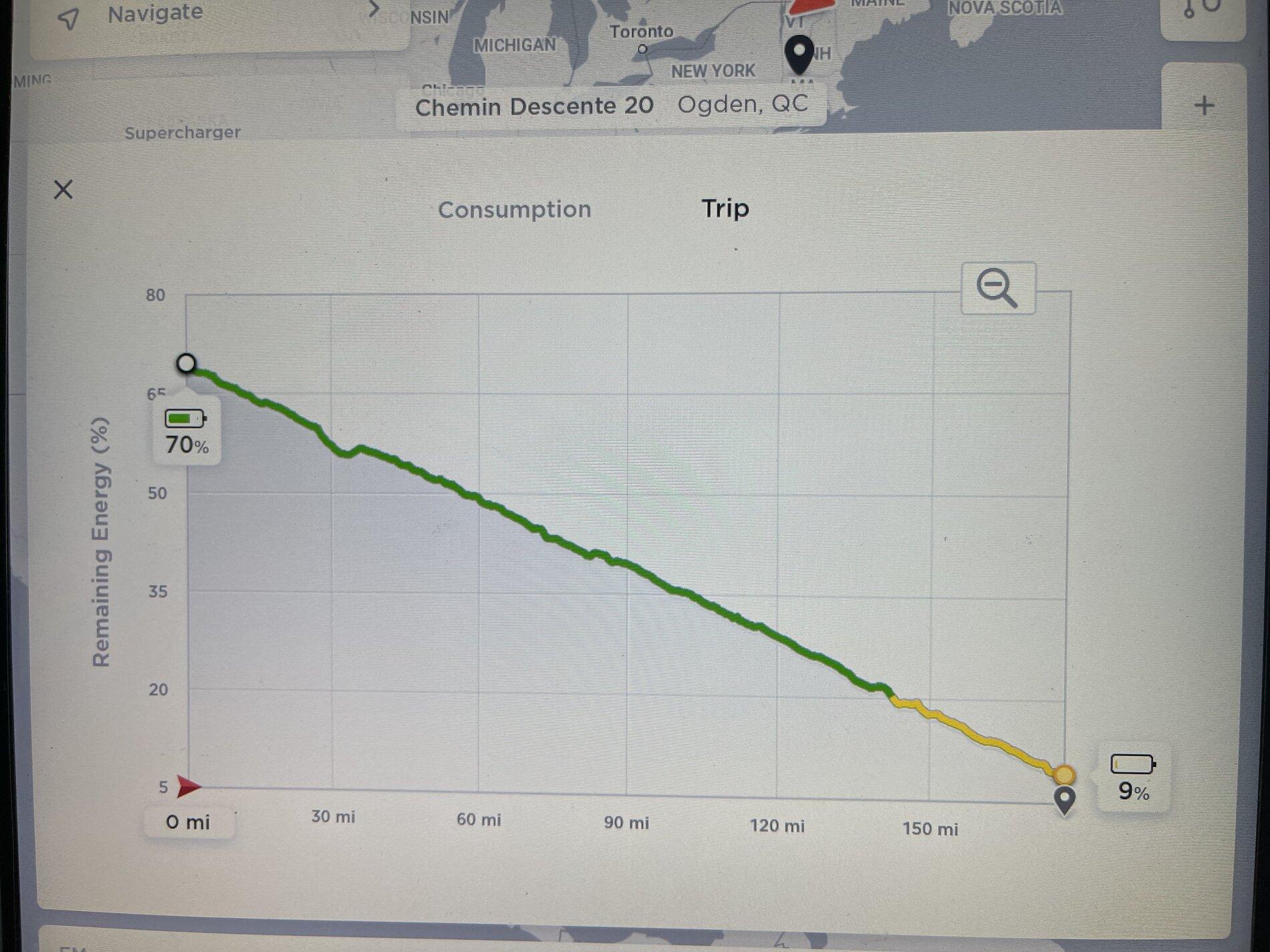
My X is currently charged to 70%. If I want to go to the Brattleboro SC about 189 miles away and drive the speed limit this is what I'd expect to see according to the car's navigation system.
Tesla Cybertruck Estimate cost of charging a Dual Motor IMG_1601

This says I'll arrive with 9% SoC. That's not enough to make me comfortable (and the yellow tells me I should be uncomfortable).

The average consumption (as best I can eyeball it off the pic but the answer is about right) for this trip is (.70 -.9)*351*282/189 =319 Wh/mi based on its use of .61 of the rated range of 351 miles and rated consumption of 282 Wh/mi. This is another opportunity for me to push again the idea that rated range and rated consumption are the important parameters in BEV performance evaluation.

The average consumption is the average slope of the curve. It's not that rare to see power consumption go up to 150 kw as when, for example, one has to accelerate from 60 mph to get around a truck on a hill. 150 kWh at 60 mph is consuming energy at the rate of 2500 Wh/mi. But who cares as long as that rate is not sustained for more than a few seconds? The average consumption is, as indicated by formula above, simply the difference in charge at the two ends of the curve converted to Wh and divided by the distance from one end of the curve to the other in miles. It is the average slope of the curve. Note that there are places along it where the slope deviates from the average. These are where the hills along the route are located and where the instantaneous consumption is higher or lower than the average consumption.

So if I get a call telling me I need to come down to Brattleboro how do I respond? The first thing I do is add 11% charge before departure to get the meatball at the destination up to 20% SoC and wipe out the yellow bits of the curve. Then as I drive I monitor that meatball to keep it at 20% or above (assuming that I refuse to break my general rule that I will not go below 20% - in fact I probably would). If it dips below 20% I then slow down until it gets back up to 20%. If it goes above 20% I speed up to get there faster.

So what have we got. A loop within a loop. The inner loop is the car's normal autopilot whose speed SP is determined by an outer loop whose PV is the estimated destination SoC and whose SP is the desired 20%. The outer loop happens to be meat - me. Probably 1% of readers here have ever heard of servo systems or know what Process Variable (PV) or set points (SP) are. Nonetheless they are the meat servos serving the function of the outer loop whenever they use the navigation system in their Teslas (or other vehicles ICE or BEV) in this way which is a perfectly normal and typical way to use it. Why is this inadequate?

Note that the inner loop (speed control) can be meat too as when the driver doesn't turn autopilot on.
 
Last edited:

HaulingAss

Well-known member
Joined
Oct 3, 2020
Threads
28
Messages
10,338
Reaction score
20,777
Location
Western Washington, USA
Vehicles
Cybertruck DM, 2010 F-150, 2018 Performance Model 3, 2024 Performance Model 3
Country flag
There is one other cost that some like to consider and that is the CO2 emission involved. If your utility burns natural gas it emits about 0.9 lb CO2 per kWh generated. If it burns coal it is about 2.13 lbs. From No. 4 you should be able to figure the CO2 cost per mile or per % SoC.
Most of the electricity delivered in America is a mix of sources including a number of low to no CO2 sources like nuclear, hydro, wind and solar so the CO2 emissions usually require a bit more math to calculate (and comes out a bit lower than the fossil only number would suggest).
 

ajdelange

Well-known member
First Name
A. J.
Joined
Dec 8, 2019
Threads
4
Messages
3,203
Reaction score
3,409
Location
Virginia/Quebec
Vehicles
Tesla X LR+, Lexus SUV, Toyota SR5, Toyota Landcruiser
Occupation
EE (Retired)
Country flag
Yes and I am hoping readers know how to figure out the effective amount of CO2 in a blend. Well let's just put an example down here. Let's say my utility gets 10% of it's energy from coal, 30% from nuclear and the rest (60%) from gas. The blend would contain (0.1*2.13 + 0.6*0.91) = 0.759 pounds of CO2 per kWh. Now let's say I blend that with 60% solar. The CO2 content of a kWh of this blend is 0.4*0.759 = 0.3036 pounds per kWh. My X takes 0.282 kW to go a mile so my carbon burden is 0.3036*0.282 = 0.0856 lbs/mi. In a CT using 0.45 kWh/mi it would be 0.1366.
 

HaulingAss

Well-known member
Joined
Oct 3, 2020
Threads
28
Messages
10,338
Reaction score
20,777
Location
Western Washington, USA
Vehicles
Cybertruck DM, 2010 F-150, 2018 Performance Model 3, 2024 Performance Model 3
Country flag
Yes and I am hoping readers know how to figure out the effective amount of CO2 in a blend. Well let's just put an example down here. Let's say my utility gets 10% of it's energy from coal, 30% from nuclear and the rest (60%) from gas. The blend would contain (0.1*2.13 + 0.6*0.91) = 0.759 pounds of CO2 per kWh. Now let's say I blend that with 60% solar. The CO2 content of a kWh of this blend is 0.4*0.759 = 0.3036 pounds per kWh. My X takes 0.282 kW to go a mile so my carbon burden is 0.3036*0.282 = 0.0856 lbs/mi. In a CT using 0.45 kWh/mi it would be 0.1366.
And to complicate things a bit, the time of day you charge can also impact the CO2 number quite a bit in most areas. In your hypothetical example, if the motorist knows he always charges in the middle of the night, there is a good chance the electricity is mostly nuclear (because nuclear plants are cheapest to keep running). Nuclear electricity is actually pretty expensive but most of the expense is not fuel but construction and operating costs. Because of that, there is almost zero savings in throttling them back at night. Coal takes hours to throttle back but the savings are substantial. Natural gas peaker plants are throttled on to meet instantaneous demand and off to save fuel costs. In the scenario above natural gas plants, especially the peaker plants, would likely be throttled back or shut off altogether in the middle of the night resulting in a very small percentage of their daytime generation during peak consumption periods.

This is why more utilities are starting to have "Time of Use" (ToU) billing schedules but even utilities that still have flat rate per kWh regardless of the time of use will have wildly fluctuating CO2 emissions per kWh depending upon the time of day.

One of the strengths of EV's, particularly as more utilities move to ToU billing, is they can charge during hours in which the electricity is the cleanest (and/or the cheapest). My point is, the CO2 footprint of EV's is generally over-estimated by not taking into account that most charging is done at home, at night (and this will only become more true as more utilities adopt ToU billing).

Both of our Model 3's have lower CO2 footprints than when we purchased them 3 years ago because our utilities are constantly adding more renewable energy sources and reducing electricity generated from coal.
 
Last edited:

ajdelange

Well-known member
First Name
A. J.
Joined
Dec 8, 2019
Threads
4
Messages
3,203
Reaction score
3,409
Location
Virginia/Quebec
Vehicles
Tesla X LR+, Lexus SUV, Toyota SR5, Toyota Landcruiser
Occupation
EE (Retired)
Country flag
To make it even more complex if you want to not all coal plants are equally dirty etc. The best you are going to be able to do is rely on the numbers the utility gives you. You must regard them as nominal.

The best way to insure small carbon footprint is to charge from the sun. I don't care much about my carbon footprint but the idea of getting something for nothing just sends me off into paroxysms of ecstasy.
 

HaulingAss

Well-known member
Joined
Oct 3, 2020
Threads
28
Messages
10,338
Reaction score
20,777
Location
Western Washington, USA
Vehicles
Cybertruck DM, 2010 F-150, 2018 Performance Model 3, 2024 Performance Model 3
Country flag
To make it even more complex if you want to not all coal plants are equally dirty etc. The best you are going to be able to do is rely on the numbers the utility gives you. You must regard them as nominal.
Yes, use the numbers the utility gives you but, if you know the time of use and the time balance of generation, you can discount (or multiply) their contribution to arrive at a better approximation. When EV's CO2 footprint is discussed in the popular media, EV's are generally credited with higher CO2 footprints than they deserve while ICE cars are credited with lower CO2 footprints than reality (by ignoring the CO2 footprint of drilling, transporting and refining gas and oil products. They also neglect all the chipped ICE motors, worn out and damaged ICE motors, etc. that pollute up to 10X what the "official numbers" say a stock (new) engine would. While EV's tend to get cleaner and cleaner through their useful lives.

The best way to insure small carbon footprint is to charge from the sun. I don't care much about my carbon footprint but the idea of getting something for nothing just sends me off into paroxysms of ecstasy.
I care deeply about humanities carbon footprint and what that will leave our children and grandchildren. I know our carbon footprint is part of the bigger picture and take reasonable steps to reduce our personal footprints as well to advocate that others and society in general adopt technologies that lead to a more useful planet for our offspring. Because we all need to work together to effect this kind of change. I'm amazed when I meet someone who is so dedicated to leaving their children/grandchildren a big inheritance but couldn't care less about global warming and fights in the State House of Representatives to apply even bigger annual license fees on EV's (but not ICE) in order to actively try to slow adoption of technologies we need to make the transition as rapidly as possible before we have nothing but wasteland left. It's irrational.

A mix of solar and (large scale) wind power are the bulk of the solution when combined with better, more efficient transmission lines to get the power where it needs to go, when it is needed. Then battery storage to round out the balance. With a surplus of solar we could get our grid to only 10% fossil generation in under a decade while creating millions of good jobs to replace those being lost through automation and other disruptions.
Sponsored


Top