Sponsored

Tire Blowout - Safety Benefit of Tri-Motor vs Dual Motor

mongo

Well-known member
Joined
May 27, 2024
Threads
6
Messages
4,654
Reaction score
5,653
Location
SE Michigan
Vehicles
Cyberbeast
Country flag
Turns out there was a nail and the tire had a slow leak. What caused it to literally explode is tire speed at the top of the tire is 2x your actual speed. So at over 120, the top of the tire was past 240mph, and the sheer forces basically Causes the nail to fly out and it literally exploded the tire as it ripped out!
While the top of the tire is going 240, the centrifugal force depends on the rotational speed which is based on the 120 ground speed. Imagine a tire inside the car spinning at the same speed.

120 MPH on a 26 inch diameter tire results in about 900 Gs of acceleration. A 16D nail weights around 0.3 ounces and would experience a force of just under 17 pounds.
Sponsored

 
OP
OP
CodeSection

CodeSection

Well-known member
First Name
Code
Joined
Oct 30, 2025
Threads
1
Messages
49
Reaction score
32
Location
Arizona / Colorado
Vehicles
2025 Kia EV9, 2018 Toyota Sequoia, 2020 Toyota 4Runner, 2006 Nissan Xterra
Country flag
A few things. Have not had a blow out in the CT, just a slow leak from a nail.

Also, not sure if all 3 motors are “on” in FSD and while likely cruising on the highway.

Im not sure the help against “pulling” is a per motor thing as much as it is a traction control thing dealing with torque vectoring. So it may come down more to what cars have better software for dealing with it.

As for blow outs I’ve had one at over 120mph on a long sweeper (on Easter with my aunt in the car!) that was off camber putting even more weight on the blown out wheel, in a sports car. Weird pull and balance dealing with the pull and somewhat giving into it, but not fighting it too much. Almost how you might “use the force” in making very small adjustments when you hit a long long long patch of ice.

By the time I stopped on the side of the road and the tire was almost completely off the rim doing some damage inside the wheel well. By some miracle the rim didn’t hit bare pavement as the wheel was still on by maybe the last inch. Which is to say, I can’t think of a blow out that could be much worse, albeit it was in a vehicle of less than half the weight of the cybertruck.

While I don’t recommend having this trip, as long as you keep calm, don’t over work the wheel, you should be ok.

That car had some advanced traction control but it basically didn’t do squat about the blow out. It was a 2012 car with pretty advanced traction control for the time including brake steer. I’m not sure anyone programs their TC to handle blow outs, but I would love to see comprehensive testing on the subject.

Wish I had more detail to give than the above, but weirdly living through what was pretty close to a worst case scenario makes me feel a bit better in that it wasn’t as bad as I feared and hopefully if it happens again it’s likely to happen under less stressed conditions.
Thanks for sharing your story! One would think that at that speed, things could have been worse, and it is nice to read that there were no serious issues. You definitely have the driving skills to handle a scenario like that. I hope never to have to find out how my driving skills react.

You mentioned "fear," and I must admit, I'm probably overthinking the "fear" of something occurring. Again, thanks for sharing!
 
OP
OP
CodeSection

CodeSection

Well-known member
First Name
Code
Joined
Oct 30, 2025
Threads
1
Messages
49
Reaction score
32
Location
Arizona / Colorado
Vehicles
2025 Kia EV9, 2018 Toyota Sequoia, 2020 Toyota 4Runner, 2006 Nissan Xterra
Country flag
Monitor your tire pressures like a hawk! In my above blow out I left the house and one tire was lower than others but I thought it was because it was cold. Turns out there was a nail and the tire had a slow leak. What caused it to literally explode is tire speed at the top of the tire is 2x your actual speed. So at over 120, the top of the tire was past 240mph, and the sheer forces basically Causes the nail to fly out and it literally exploded the tire as it ripped out!

So I’m not sure if that’s a common cause, but certainly can be a cause, particularly if the nail/screw is more on the sidewall of the tire.
Wow! I never knew that! A year ago, with our Sequoia, I ran over a drill bit that somehow punctured the back right tire's sidewall. I was driving on the highway and was about 5 miles from my office. I saw the tire low-pressure warning light come on and slowed, finally reaching my office. Since we had meetings outside the office, we took another vehicle.

Later that day, I needed to drive 120 miles back to our main office, so I decided to put air in the tire....adding ~5 pounds more. It got me to my other office. From there, I added more air and drove home. The next day, I got the tire repaired.

After reading your story, I will never do that again and will just cancel the appointments and get the tire repaired.

Thanks for following up!
 
OP
OP
CodeSection

CodeSection

Well-known member
First Name
Code
Joined
Oct 30, 2025
Threads
1
Messages
49
Reaction score
32
Location
Arizona / Colorado
Vehicles
2025 Kia EV9, 2018 Toyota Sequoia, 2020 Toyota 4Runner, 2006 Nissan Xterra
Country flag
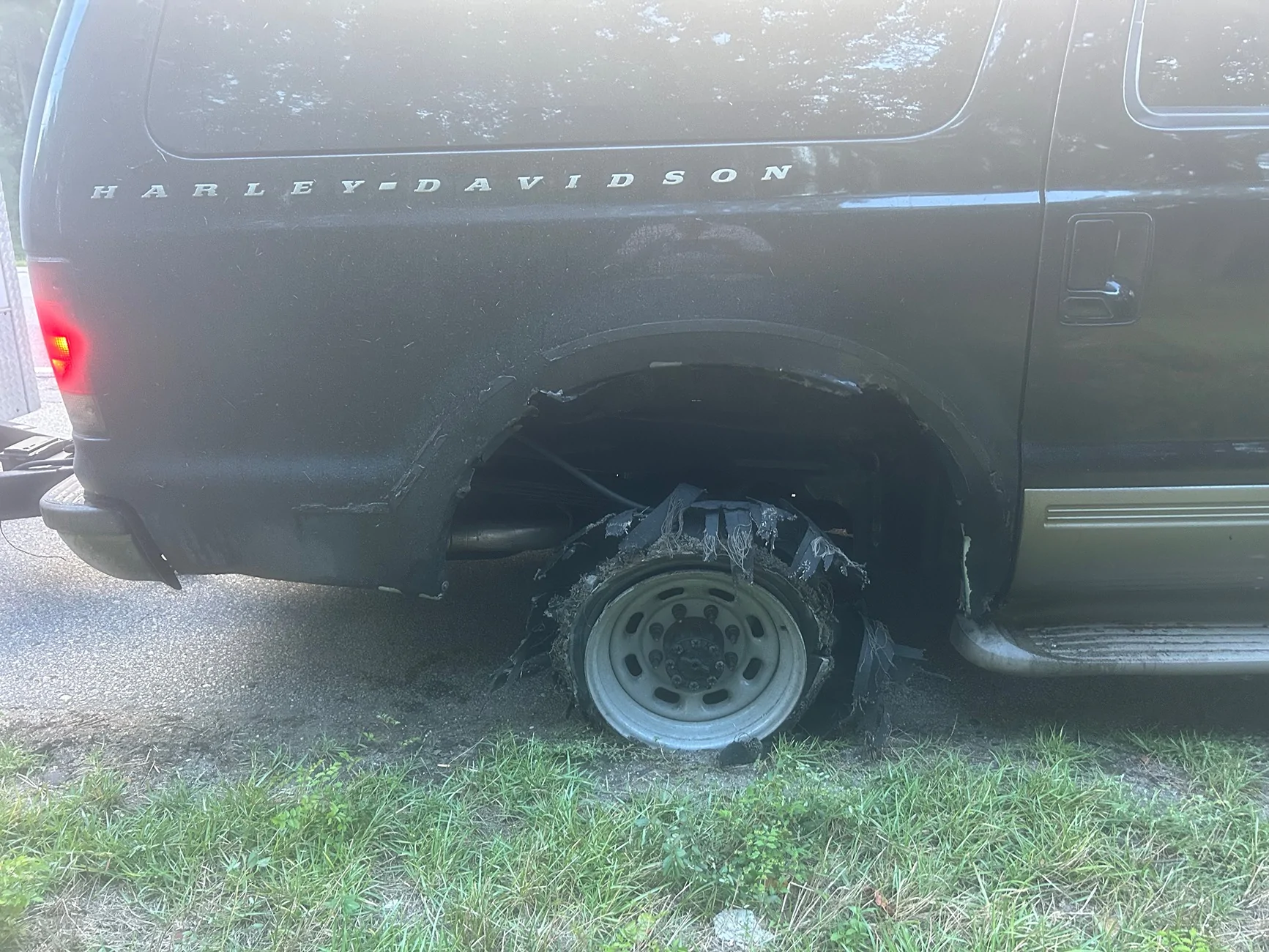
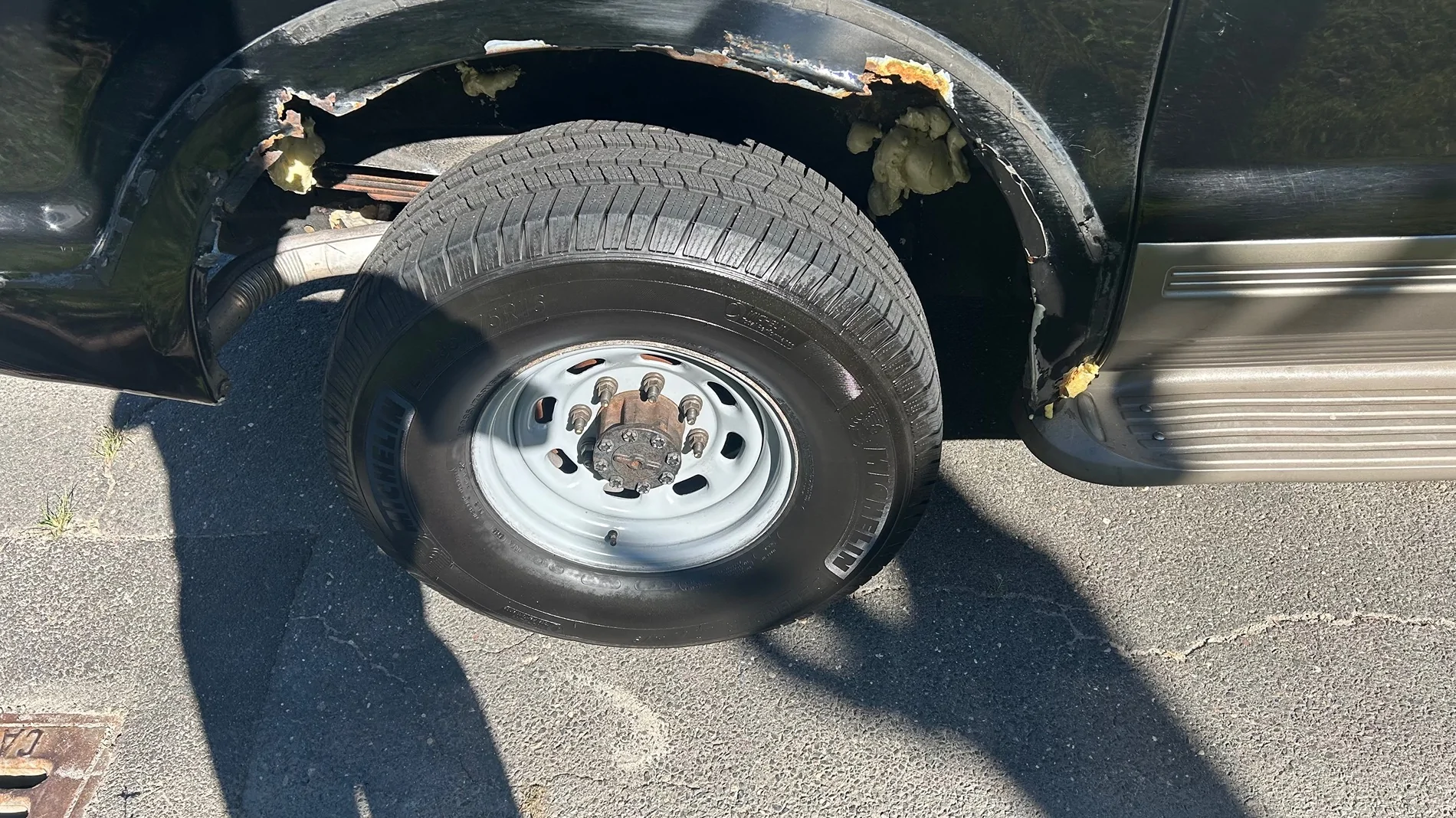
I had a blowout at 75 mph while towing on my ford excursion, the tire exploded and caused a lot of damage in the left rear quarter, of course the rear air conditioner and heater hoses were destroyed! I was on I95 North Carolina, I just moved Right, to the break down lane assessed the damage and called AAA. Final tab approximately $6500 in damage. Remarkably, the truck handled extremely well as the tire started shredding, and my truck did not even hit the rim on the asphalt. And it was the spare tire that blew!

IMG_8319.webp


IMG_8147.webp
That's a lot of damage! I'm starting to get the impression that not all tire blowouts are necessarily as bad as I have seen videos on, causing you to jerk off the highway.

Thanks for posting!
 
OP
OP
CodeSection

CodeSection

Well-known member
First Name
Code
Joined
Oct 30, 2025
Threads
1
Messages
49
Reaction score
32
Location
Arizona / Colorado
Vehicles
2025 Kia EV9, 2018 Toyota Sequoia, 2020 Toyota 4Runner, 2006 Nissan Xterra
Country flag
The extreme pull to one side of the road after a blow out is not caused by the engine/motor, it is caused by the tire not want to rotate like the other three tires.
That is what I understand as well. I also understood that on the Rivian with quad motors, once there is a blowout, the motors instantly apply more power to the wheel or side of the blowout to maintain driving direction. Supposedly, tri-motors behave the same way.

Thanks for posting!


OP
OP
CodeSection

CodeSection

Well-known member
First Name
Code
Joined
Oct 30, 2025
Threads
1
Messages
49
Reaction score
32
Location
Arizona / Colorado
Vehicles
2025 Kia EV9, 2018 Toyota Sequoia, 2020 Toyota 4Runner, 2006 Nissan Xterra
Country flag
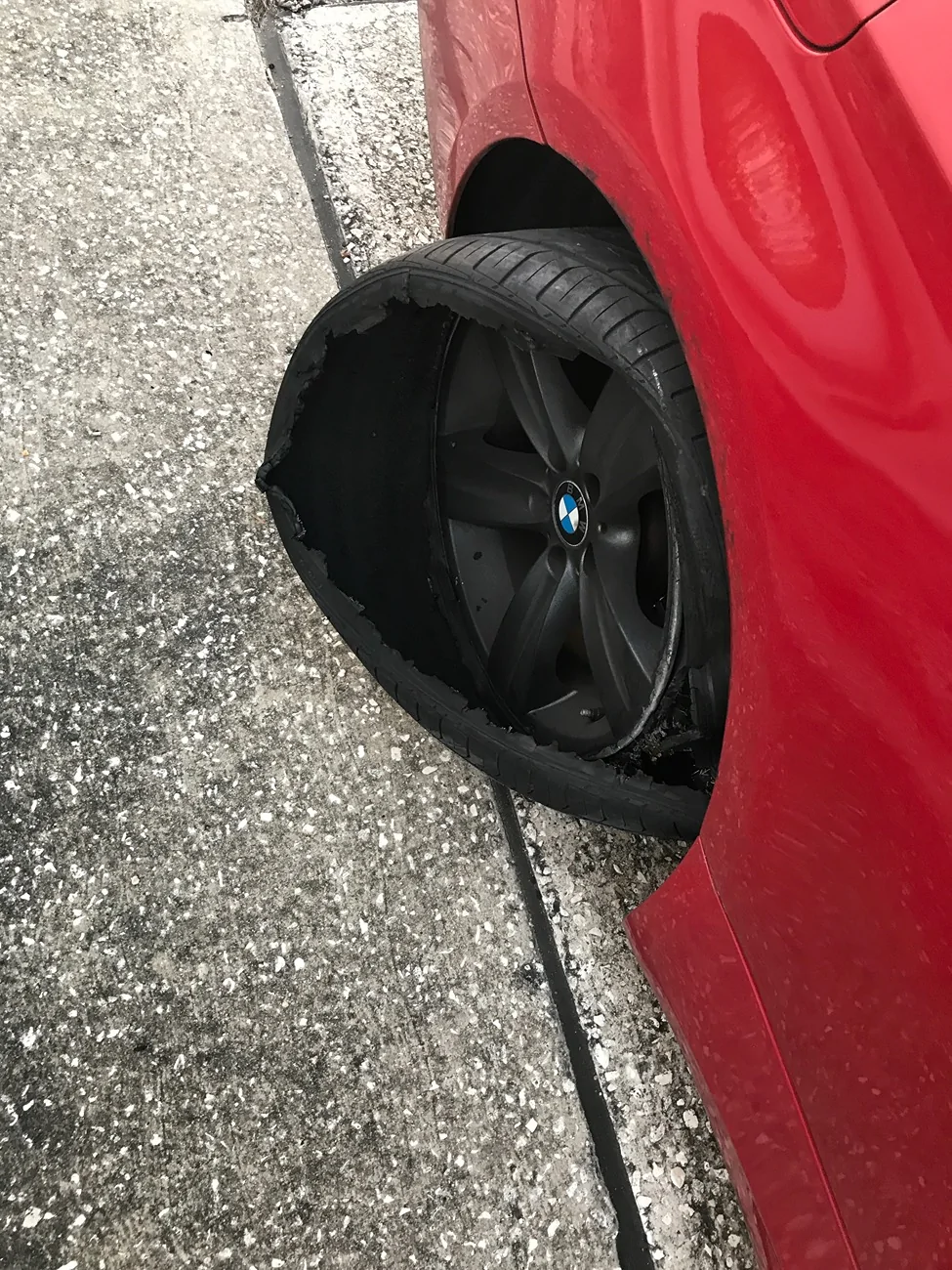
I am not sure if you have ever experienced a blowout or not. They can be very dangerous, but typically they are not. Typically a dangerous blowout would be at high speeds, and would effect a front, primary steer tire. I have had a blowout in a rear drive turbo BMW while traveling on an interstate in FL. I was driving with the flow of traffic, interpret that how you will. The car had low profile performance tires. It was rear drive, and I was easily able to maintain control. The tire did significant damage to the car (fender, fender liner, and fuel fill line 😬), as I slowed from highway speed to a safe stop on the shoulder. Interestingly, I was on my way to buy new tires.
All of that being said, the Beast has dual rear motors, but a single front motor. So I do not think the dual motors would impact a blowout the way you expect. I think Beast and AWD would handle a front blowout in a similar fashion. That said, you are driving one of the safest vehicles of its kind, on the road. When traveling at higher speeds, make sure the vehicle is set to a lower ride height, this will add to your safety.
Side note, if this is because you are hoping to justify to your spouse, buying a beast over all wheel drive, then everything I said above is false narrative, meant to deceive, and mislead. Including my anecdotal response, about a completely different type of vehicle.
1762178153737-11.webp
With your post, along with another recent post, I'm learning that some blowouts cause significant damage. That's a lot of force! Thanks for sharing your experience!

Haha, I like your "side note"! I am fortunate in many ways, and while my spouse does not know any prices, the price would not make a difference IF there was a safety advantage.

Thanks for the tip regarding lower ride height. If I may, I would like to ask follow-up questions on ride height.

I understand the higher ride height increases the chance of rollovers. But doesn't the lower ride height make you more exposed on the side? In that the side bars in the doors may be lower than the vehicle that broadsides you? Therefore, allowing the vehicle that hits you front-end to go over the CT's protective sidebar? Maybe the CT's lowest drivable height is higher than most other SUVs?

Hopefully, I'm making sense.

Again, thank you for taking the time to write.
 

Cyberskunk

Well-known member
First Name
Patrick
Joined
Apr 7, 2024
Threads
3
Messages
122
Reaction score
182
Location
Minnesoata
Vehicles
2025 AWD CT, 2020 3 LR AWD
Occupation
Tech
Country flag
With AWD unless you have a front and a rear blow out at the same time.... Stabiliy control can still handle a blow out on one end by what it does with the other end of the vehicle.

Doing actual intentional blow out testing on a course with both versions is the only way to really prove anything.

I would not be surprised if there was hardly any practical difference.
 
OP
OP
CodeSection

CodeSection

Well-known member
First Name
Code
Joined
Oct 30, 2025
Threads
1
Messages
49
Reaction score
32
Location
Arizona / Colorado
Vehicles
2025 Kia EV9, 2018 Toyota Sequoia, 2020 Toyota 4Runner, 2006 Nissan Xterra
Country flag
With AWD unless you have a front and a rear blow out at the same time.... Stabiliy control can still handle a blow out on one end by what it does with the other end of the vehicle.

Doing actual intentional blow out testing on a course with both versions is the only way to really prove anything.

I would not be surprised if there was hardly any practical difference.
That's all I'm looking for....stability control. If there is no measurable difference, at this point, I would go with the dual motor over the Beast's tri-motor.

Thanks for writing!
 

mongo

Well-known member
Joined
May 27, 2024
Threads
6
Messages
4,654
Reaction score
5,653
Location
SE Michigan
Vehicles
Cyberbeast
Country flag
With your post, along with another recent post, I'm learning that some blowouts cause significant damage. That's a lot of force! Thanks for sharing your experience!

Haha, I like your "side note"! I am fortunate in many ways, and while my spouse does not know any prices, the price would not make a difference IF there was a safety advantage.

Thanks for the tip regarding lower ride height. If I may, I would like to ask follow-up questions on ride height.

I understand the higher ride height increases the chance of rollovers. But doesn't the lower ride height make you more exposed on the side? In that the side bars in the doors may be lower than the vehicle that broadsides you? Therefore, allowing the vehicle that hits you front-end to go over the CT's protective sidebar? Maybe the CT's lowest drivable height is higher than most other SUVs?

Hopefully, I'm making sense.

Again, thank you for taking the time to write.
Cybertruck has a really low center of gravity due to the pack and drive unit locations. It's very resistant to rollover.
 

Trbizwiz

Well-known member
First Name
Tom
Joined
Apr 7, 2023
Threads
0
Messages
327
Reaction score
502
Location
Bradenton FL
Vehicles
Model X Plaid, Model Y Performance, Model 3 RWD, Dodge Challenger
Occupation
Logistics
Country flag
With your post, along with another recent post, I'm learning that some blowouts cause significant damage. That's a lot of force! Thanks for sharing your experience!

Haha, I like your "side note"! I am fortunate in many ways, and while my spouse does not know any prices, the price would not make a difference IF there was a safety advantage.

Thanks for the tip regarding lower ride height. If I may, I would like to ask follow-up questions on ride height.

I understand the higher ride height increases the chance of rollovers. But doesn't the lower ride height make you more exposed on the side? In that the side bars in the doors may be lower than the vehicle that broadsides you? Therefore, allowing the vehicle that hits you front-end to go over the CT's protective sidebar? Maybe the CT's lowest drivable height is higher than most other SUVs?

Hopefully, I'm making sense.

Again, thank you for taking the time to write.
While I’m not an engineer, do not work for Tesla, nor do I work for NTSB, but it seems the trucks shell body provides much of the side impact you’re concerned about. Check this out from Google AI
The Cybertruck's door protection comes from its ultra-high-strength, cold-rolled stainless steel exoskeleton, designed to absorb impact by carrying the majority of the side-impact load with its thick, rigid body panels
. This approach differs from traditional vehicles, which rely more on dedicated crumple zones. The steel skin is made of a custom 304L alloy engineered by Tesla and SpaceX to be extremely strong and corrosion-resistant, and in testing, it has shown the ability to resist penetration from 9mm and 45-caliber rounds.

  • Exoskeleton: The rigid, reinforced "exoskeleton" structural design is the primary feature for crash protection.
  • Door skin: The stainless steel body panels of the door are engineered to absorb a significant amount of the energy from a side impact, with the skin carrying much of the load.
  • Material strength: The 3mm thick 304L stainless steel is designed to be extremely strong, a characteristic proven in testing against high-caliber rounds.
  • Crash structure: The overall vehicle structure, including energy-absorbing ribs in the front and rear, is designed to dissipate energy during a crash.
  • Shock-absorbent mechanism: While it lacks traditional large "crumple zones," experts suggest other shock-absorbent mechanisms may compensate for this.


65SoYoLO

Well-known member
First Name
Keith
Joined
Feb 9, 2021
Threads
54
Messages
2,016
Reaction score
2,653
Location
Long Island NY
Vehicles
2024 CyberTruck
Occupation
Retired truck driver
Country flag
That is what I understand as well. I also understood that on the Rivian with quad motors, once there is a blowout, the motors instantly apply more power to the wheel or side of the blowout to maintain driving direction. Supposedly, tri-motors behave the same way.

Thanks for posting!
Once you get a blowout the rim is just spinning inside the tire. that wheel could be going a thousand miles an hour and it will not help.
 
OP
OP
CodeSection

CodeSection

Well-known member
First Name
Code
Joined
Oct 30, 2025
Threads
1
Messages
49
Reaction score
32
Location
Arizona / Colorado
Vehicles
2025 Kia EV9, 2018 Toyota Sequoia, 2020 Toyota 4Runner, 2006 Nissan Xterra
Country flag
While I’m not an engineer, do not work for Tesla, nor do I work for NTSB, but it seems the trucks shell body provides much of the side impact you’re concerned about. Check this out from Google AI
The Cybertruck's door protection comes from its ultra-high-strength, cold-rolled stainless steel exoskeleton, designed to absorb impact by carrying the majority of the side-impact load with its thick, rigid body panels
. This approach differs from traditional vehicles, which rely more on dedicated crumple zones. The steel skin is made of a custom 304L alloy engineered by Tesla and SpaceX to be extremely strong and corrosion-resistant, and in testing, it has shown the ability to resist penetration from 9mm and 45-caliber rounds.

  • Exoskeleton: The rigid, reinforced "exoskeleton" structural design is the primary feature for crash protection.
  • Door skin: The stainless steel body panels of the door are engineered to absorb a significant amount of the energy from a side impact, with the skin carrying much of the load.
  • Material strength: The 3mm thick 304L stainless steel is designed to be extremely strong, a characteristic proven in testing against high-caliber rounds.
  • Crash structure: The overall vehicle structure, including energy-absorbing ribs in the front and rear, is designed to dissipate energy during a crash.
  • Shock-absorbent mechanism: While it lacks traditional large "crumple zones," experts suggest other shock-absorbent mechanisms may compensate for this.
Thanks for the detailed info! I forgot how unique the CT is! It is reassuring that I do not need to be concerned with the sidebar's impact protection being physically lower when the CT is driving lower.
I know our Sequoia sits higher, and if I broadside many vehicles on the road, it will definitely go over those side impact bars.

Thanks again for the info! There is so much to learn, and I'm appreciative of those, like you, who have responded and patiently educated me about the CT.
 

CTOWannabe

Well-known member
First Name
CTO
Joined
Feb 28, 2024
Threads
8
Messages
151
Reaction score
142
Location
US
Vehicles
2025 Cybertruck AWD
Country flag
Wow! I never knew that! A year ago, with our Sequoia, I ran over a drill bit that somehow punctured the back right tire's sidewall. I was driving on the highway and was about 5 miles from my office. I saw the tire low-pressure warning light come on and slowed, finally reaching my office. Since we had meetings outside the office, we took another vehicle.

Later that day, I needed to drive 120 miles back to our main office, so I decided to put air in the tire....adding ~5 pounds more. It got me to my other office. From there, I added more air and drove home. The next day, I got the tire repaired.

After reading your story, I will never do that again and will just cancel the appointments and get the tire repaired.

Thanks for following up!
If that happens again, just keep it to 60mph or less and it should be safe enough for you to get to where you can get some help. Definitely minimize speed and distance all you can.

l think being aware of the danger helps a lot so when I recently had a nail in the cybertruck (luckily not the sidewall) I just drove like a grandma to get the tire fixed. I went 25 miles to take it direct to Tesla service and it was fine, but was hyper cautious the entire time.

Probably could have taken it to any tire place but I heard some Tesla tires can shed a lot of foam inside which I worried could be more of an issue in the truck with what I assume are tighter tolerances and calibrations for the software and traction systems to work well.
 

eser50

Well-known member
First Name
Enrique
Joined
Nov 7, 2024
Threads
0
Messages
81
Reaction score
67
Location
Oceanside, CA
Vehicles
'24 AWD CT, '18 Model S, '16 Mustang GT, '19 XC90
Country flag
My S had shrapnel from an accident during a rain storm, once the PSI on the tire got below a certain point, the car begins to limit its top speed gradually. I'd assume it's the same on any other Tesla.

I don't really think the 3 vs 2 motor argument would make much of a difference with regards to a blowout for the Cybertruck. If it was 2 motors in the front, maybe. A rear tire blowout typically won't run you off the road like a front tire may.

When I was younger and dumber, I bought a used BMW with what I now know were dry-rotted tires, and decided to see what it could do late at night on an empty highway. I hit 138, decided that was too fast and good enough, so as the road/wind noise died down, I started hearing a crazy loud noise and the car began to vibrate a bit.

It was my rear passenger tire that had disintegrated. No sign, other than the noise and vibration thankfully.
 
OP
OP
CodeSection

CodeSection

Well-known member
First Name
Code
Joined
Oct 30, 2025
Threads
1
Messages
49
Reaction score
32
Location
Arizona / Colorado
Vehicles
2025 Kia EV9, 2018 Toyota Sequoia, 2020 Toyota 4Runner, 2006 Nissan Xterra
Country flag
My S had shrapnel from an accident during a rain storm, once the PSI on the tire got below a certain point, the car begins to limit its top speed gradually. I'd assume it's the same on any other Tesla.

I don't really think the 3 vs 2 motor argument would make much of a difference with regards to a blowout for the Cybertruck. If it was 2 motors in the front, maybe. A rear tire blowout typically won't run you off the road like a front tire may.

When I was younger and dumber, I bought a used BMW with what I now know were dry-rotted tires, and decided to see what it could do late at night on an empty highway. I hit 138, decided that was too fast and good enough, so as the road/wind noise died down, I started hearing a crazy loud noise and the car began to vibrate a bit.

It was my rear passenger tire that had disintegrated. No sign, other than the noise and vibration thankfully.
Thanks for sharing your experience! I'll have to research if the Cybertruck has the same process for limiting speed.

Wow, it sounds like you were very lucky, especially after going 138 mph! Back in the day, my partner and I were transporting a critically ill patient from NM to AZ. On that shift, we had a Cadillac ambulance (hearse type). Our patient was initially stabilized; however, that later changed.

Our speeds exceeded 110 mph, and with lights and sirens, we passed many vehicles that I'm sure, looking back now, didn't even realize we were there until we passed them. Got the patient to the hospital, and he survived.

Later, while driving up a small incline into our station, we felt and could hear a thump, thump, thump.... It turns out that on our back left wheel, 3 out of the 5 lug nuts were stripped. I hate thinking about what could have happened......
Sponsored


Top