
Sponsored

FRUNK on the Cybertruck?

JBee

Well-known member
First Name
JB
Joined
Nov 22, 2019
Threads
18
Messages
4,913
Reaction score
6,362
Location
Australia
Vehicles
Cybertruck
Occupation
. Professional Hobbyist
Country flag
This is not about emotion so I need not chill. It is about what is/not known vs. conjecture.

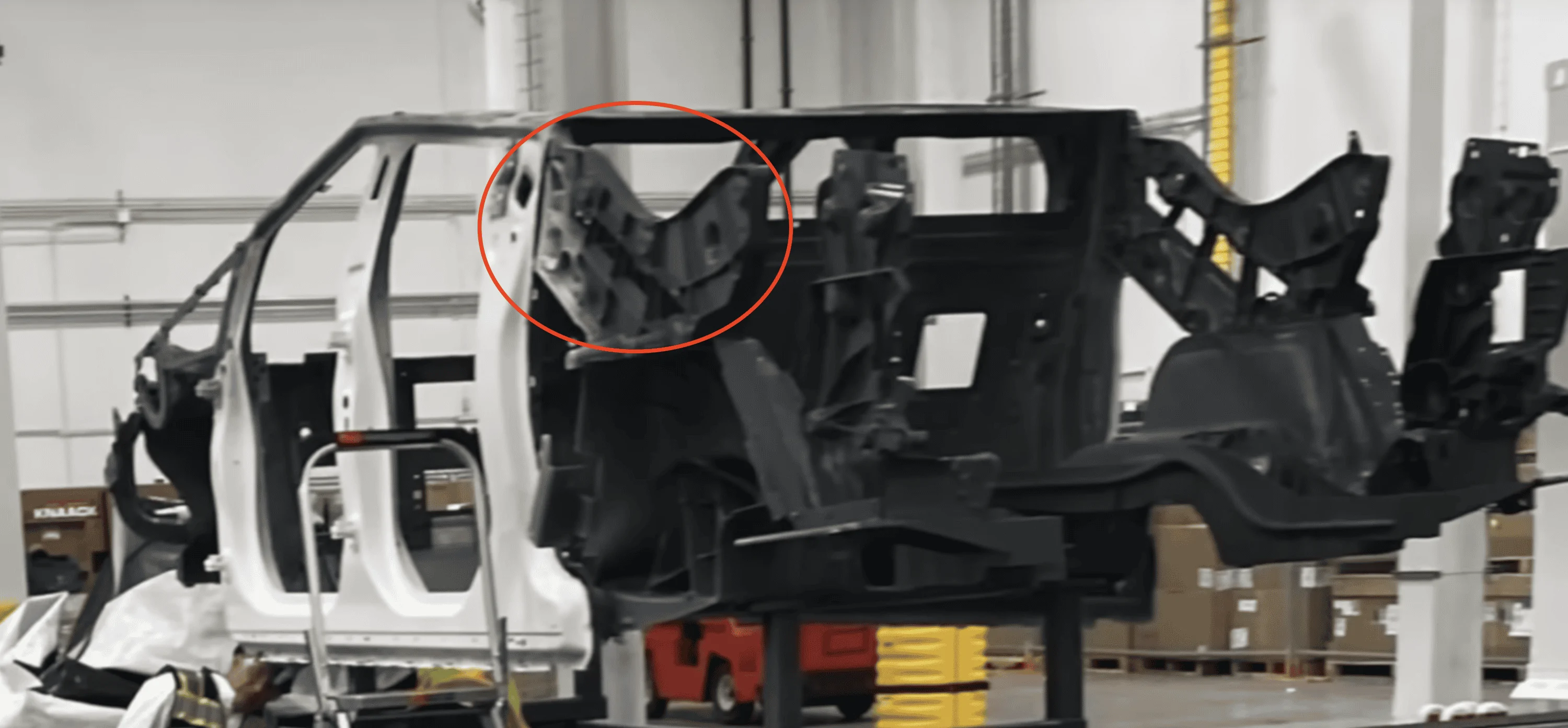
There is no SS outer skin shown in that photograph and any number of people (Sandy Munro included) have noted the same. This is fact. There are some inner stampings shown that are never load-carrying, and the 'casting' shown here (which I happen to believe is just a tooling jig for what is to come later) is, indeed, structural (for the drive unit and suspension but not for vehicle rigidity) and exists on every vehicle in some form but is not considered the skeleton as in a body on frame or unibody design to my knowledge.

I am not defining terms. Your definition of exoskeleton is fine with me. My challenge is that you are claiming that the SS skin has changed and you do not know (no one outside of Tesla does).It doesn't really matter to me how many words you have uttered on the subject, or how often, I disagree with the same arguments over and over again. If/When Tesla/Elon tell us that the SS skin has changed material, thickness, or dimensions, that is when we can chat about changes. Or, when we start seeing SS skins in the dumpster and can 'measure' them, even in an ad hoc fashion. But definitely not because of any user-promoted argument however logical or reasonable.
"So it would be bed, cast, suspension, wheels". Is the current argument about where the vertical load path from cargo to road is? If so, then sure, but that is not what the SS skin is for. On the other hand, if the argument is about the function of the 3mm SS outer skin, then the vertical load from cargo to road is an orthogonal discussion. If you watch the 2 videos I posted (one by ConnectingTheDots and the other by TheLimitingFactor), which I believe speak convincingly about the merits of a 3mm SS outer skin, they never talk about the vertical load path of cargo to road. Rather, they talk about the overall longitudinal and flexural rigidity of [any] vehicle and how the different designs achieve it. I no longer have the tools to perform an FEA on the design but I do believe that I would find, if I did perform one, that the 3mm SS outer skin does provide the claimed rigidity.
I am not claiming something "changed" rather that we never knew how thick or what construction was used in the first place. To be "handgun bulletproof" only requires the passenger cabin itself to be 3mm SS. The windows are the weak link here I think for this claim, but it will be better than any other vehicle off a assembly line.

From a design perspective there is no reason to artificially increase the length of the load path so that the fenders can be included structurally. Load will go the shortest path regardless. I think it is important to discern whether the load has to go to before making up assumptions of why something has to be rigid, like from corner to corner on the CT body, whereas in reality there will never be such a load applied across that section, as all loads in normal operation must terminate in a force on one of the wheels. Any force impact on the bodywork should be identified as a crash, or failure state instead.

In this case the load point for weight are the suspension springs/airbags which are actually meant to reduce torsional loads from wheel height offsets. In the front we have seen the shock/spring tower, which we can expect to be connected to the cast like in the MY.

In the back they are not visible, which leads me to believe they might be a pushrod system that is tucked under the bed. There is no indication of any opening to have the springs mounted above the tyre in the sail storage area, and it's physically not possible to have the springs next to the wheel without going into the bed area (remember it has no rear wheel arches in the bed). Also there are no visible springs in photos of the rear suspension arm assembly, like on the F150. Accordingly, I do not believe that the rear fender "exo" will have much to do with load transfer, except for "possibly" (the photo would show otherwise) to provide rigidity for the bed. But to be honest, I'm not sure you want 100% rigidity at all, as some form of deflection is essential to keep both the weight and point stress loads to a minimum. You'd rather have something flex than break.

The other thing worth considering is that if they are using a cross linked airbag suspension setup, with active control (which is claimed), then we actually end up with the same contact patch force in even and uneven terrain, until it reaches the suspension stop. This is actually really important for off-roading, because it means that more of the wheels have more traction more of the time. If so then technically, it will only see individual wheel load spikes when it reaches the end of the suspension stroke.

The wheelbase and position of the rear axle also plays a roll in weight distribution, and in the case of the CT it has a long wheelbase (hence the 4WS) and the bed is nearly centrally placed under the bed. This has the effect that most of the weight placed in the back places most of the force on the rear axle, and given the limited size, and even width of the bed, those forces will predominantly go into the rear axle with most loads. So even if you only load the front of the bed up with cement, the long wheelbase acts as a lever, and rear axle as the fulcrum. Essentially the front of the vehicle acts as wheelbarrow handles.

Overall the existence of the cast and attached suspension structure would lead me to believe that any forces being applied to the wheels would have to already be more inboard to reach the spring bushings at all, meaning that the external cladding is not positioned well to offer much, if any, assistance.

The passenger compartment shouldn't be overlooked in this scenario as well, in that 6 heavy guys with tools etc, could add up to half of the payload in itself, even with an empty bed. The frunk volume of 2-300l could also be 250kg or so. The largest component between the front and rear axle to take up torsional load will be the cabin structure, and it also has the best ability to absorb some flex over the length of the cabin.

The above is of course for normal operation and is not a failure state, like in a collision where things need to absorb energy by plastically deforming and decelerate gradually at a low rate. Here, like most vehicles there are two ways to achieving this. One is be having deforming structures around the cabin safety cell like crumple zones etc, the other is to have deforming and compliant structures inside the safety cell, like seat belts and airbags. The trick there is that both operate in unison and augment eachother to keep the g-forces to a minimum without producing any nasty spikes.

Many vehicles intentionally make a rigid safety cell to impede ingress, and dissipate side intrusion by allowing the structure to bend around the impact, as the wheels loose traction and vehicle accelerates laterally away from the impact. The CT will also benefit here from the structural pack. Overall the interaction of crash forces are very dynamic, and depends on the type of crash, of which no two crashes, in reality, are the same. So often modelling these is one of the hardest parts of vehicle design, seeing that you need to make sure the vehicle still has functionality too. For this reason an EV platform, with small motors, and underfloor battery, actually make things considerably less difficult as there is more space to accommodate gradual deceleration rates, as is evident in Teslas safety rating.

Overall though, the crash components of the vehicle are focused around passenger survivability and injury, primarily at the cost of vehicle survivability. At that point the front fender "exo" might have some value, if it can deform in such a way to absorb energy.
Sponsored

 
Last edited:
JBee

Well-known member
First Name
JB
Joined
Nov 22, 2019
Threads
18
Messages
4,913
Reaction score
6,362
Location
Australia
Vehicles
Cybertruck
Occupation
. Professional Hobbyist
Country flag
Is the inside sail wall even going to be providing much structural support as opposed to being mostly cosmetic given what we're seeing with these castings?

casging.png
Yes I think so too, and those components are placed on the inside of the wheel arch on the bed side, and also direct forces into the structural cast wheel "arch" that will attach to the rear suspension setup to put loads into the wheels. The more integrated the castings are with distributing the bed load the less superficial structure the rear vehicle body needs, so I expect the sail fenders to be largely unused for force distribution after seeing this photo.

PS Just between us two, without anyone else knowing, and without wanting to start the whole "exo" terminology discussion again, the windscreen and rear glass roof are technically the closest things the CT has to a functioning "exoskeleton". ;) ;) ;)

But every Tesla, and many Mercedes, BMW etc have that as well, and Tesla wasn't the first to do it.
 

Crissa

Well-known member
First Name
Crissa
Joined
Jul 8, 2020
Threads
138
Messages
19,571
Reaction score
31,475
Location
Santa Cruz
Vehicles
2014 Zero S, 2013 Mazda 3
Country flag
There is no exoskeleton in that photo... just a mocked up body in white.
An exoskeleton has an inside as well as an outside. This is the inside.

Notice how much bracing it needs to support itself.

A body in white doesn't need that much bracing to exists, because it's a frame.

-Crissa
 

HaulingAss

Well-known member
Joined
Oct 3, 2020
Threads
28
Messages
10,298
Reaction score
20,702
Location
Western Washington, USA
Vehicles
Cybertruck DM, 2010 F-150, 2018 Performance Model 3, 2024 Performance Model 3
Country flag
I am not claiming something "changed" rather that we never knew how thick or what construction was used in the first place. To be "handgun bulletproof" only requires the passenger cabin itself to be 3mm SS. The windows are the weak link here I think for this claim, but it will be better than any other vehicle off a assembly line.

From a design perspective there is no reason to artificially increase the length of the load path so that the fenders can be included structurally. Load will go the shortest path regardless. I think it is important to discern whether the load has to go to before making up assumptions of why something has to be rigid, like from corner to corner on the CT body, whereas in reality there will never be such a load applied across that section, as all loads in normal operation must terminate in a force on one of the wheels. Any force impact on the bodywork should be identified as a crash, or failure state instead.

In this case the load point for weight are the suspension springs/airbags which are actually meant to reduce torsional loads from wheel height offsets. In the front we have seen the shock/spring tower, which we can expect to be connected to the cast like in the MY.

In the back they are not visible, which leads me to believe they might be a pushrod system that is tucked under the bed. There is no indication of any opening to have the springs mounted above the tyre in the sail storage area, and it's physically not possible to have the springs next to the wheel without going into the bed area (remember it has no rear wheel arches in the bed). Also there are no visible springs in photos of the rear suspension arm assembly, like on the F150. Accordingly, I do not believe that the rear fender "exo" will have much to do with load transfer, except for "possibly" (the photo would show otherwise) to provide rigidity for the bed. But to be honest, I'm not sure you want 100% rigidity at all, as some form of deflection is essential to keep both the weight and point stress loads to a minimum. You'd rather have something flex than break.

The other thing worth considering is that if they are using a cross linked airbag suspension setup, with active control (which is claimed), then we actually end up with the same contact patch force in even and uneven terrain, until it reaches the suspension stop. This is actually really important for off-roading, because it means that more of the wheels have more traction more of the time. If so then technically, it will only see individual wheel load spikes when it reaches the end of the suspension stroke.

The wheelbase and position of the rear axle also plays a roll in weight distribution, and in the case of the CT it has a long wheelbase (hence the 4WS) and the bed is nearly centrally placed under the bed. This has the effect that most of the weight placed in the back places most of the force on the rear axle, and given the limited size, and even width of the bed, those forces will predominantly go into the rear axle with most loads. So even if you only load the front of the bed up with cement, the long wheelbase acts as a lever, and rear axle as the fulcrum. Essentially the front of the vehicle acts as wheelbarrow handles.

Overall the existence of the cast and attached suspension structure would lead me to believe that any forces being applied to the wheels would have to already be more inboard to reach the spring bushings at all, meaning that the external cladding is not positioned well to offer much, if any, assistance.

The passenger compartment shouldn't be overlooked in this scenario as well, in that 6 heavy guys with tools etc, could add up to half of the payload in itself, even with an empty bed. The frunk volume of 2-300l could also be 250kg or so. The largest component between the front and rear axle to take up torsional load will be the cabin structure, and it also has the best ability to absorb some flex over the length of the cabin.

The above is of course for normal operation and is not a failure state, like in a collision where things need to absorb energy by plastically deforming and decelerate gradually at a low rate. Here, like most vehicles there are two ways to achieving this. One is be having deforming structures around the cabin safety cell like crumple zones etc, the other is to have deforming and compliant structures inside the safety cell, like seat belts and airbags. The trick there is that both operate in unison and augment eachother to keep the g-forces to a minimum without producing any nasty spikes.

Many vehicles intentionally make a rigid safety cell to impede ingress, and dissipate side intrusion by allowing the structure to bend around the impact, as the wheels loose traction and vehicle accelerates laterally away from the impact. The CT will also benefit here from the structural pack. Overall the interaction of crash forces are very dynamic, and depends on the type of crash, of which no two crashes, in reality, are the same. So often modelling these is one of the hardest parts of vehicle design, seeing that you need to make sure the vehicle still has functionality too. For this reason an EV platform, with small motors, and underfloor battery, actually make things considerably less difficult as there is more space to accommodate gradual deceleration rates, as is evident in Teslas safety rating.

Overall though, the crash components of the vehicle are focused around passenger survivability and injury, primarily at the cost of vehicle survivability. At that point the front fender "exo" might have some value, if it can deform in such a way to absorb energy.
The load does not take the shortest path, it spreads over the area of the most resistance. The two are not the same. This is a fundamental misunderstanding you have of the way a load is transfered to the ground and is the reason you are not understanding the design of the Cybertruck and how the stainless-steel sheet is essential to it's cargo and towing capacities.


JBee

Well-known member
First Name
JB
Joined
Nov 22, 2019
Threads
18
Messages
4,913
Reaction score
6,362
Location
Australia
Vehicles
Cybertruck
Occupation
. Professional Hobbyist
Country flag
True, but let's not get too caught up in terminology. The fact is, the crab has an exoskeleton and so does the Cybertruck. Unless you want to say it's not an exoskeleton, then it doesn't have one, at least not for anyone who thinks it doesn't. I'm not saying it's logical to say Cybertruck doesn't have an exoskeleton, or that a crab doesn't either, but it's really just a descriptor and people can use whatever terminology they want.

I've made the case why the Cybertruck is an exoskeleton, because it's unibody and the entire structure is structural. There is a bumble bee buzzing around these parts that doesn't seem to understand load paths and thinks since the skin is outside the most direct path from the bed to the suspension that it must be entirely outside the load path.

However, load paths are graduated. There is the main load path but that does not imply the rest of the structure is not in the load path. Also, load paths change dynamically. For example, a static load path could have a more direct path to the ground but if the truck is driving on uneven surfaces the load path can dynamically move all through the structure.

The heavier the load, and the more uneven the ground and the faster the truck is moving over uneven ground, the more the load path will be transfered to the stainless steel exterior. The mechanism that causes this is deflection of the structural elements. Yes, they actually deform slightly before they break. This is what can cause large loads to be transfered from the core of the exoskeleton out to the composite skin. The skin takes more and more of the load as the core of the exoskeleton deforms further.

The stainless steel skin will actually prevent the core from failing by taking on a sharply increasing amount of the load as the loadings increase, whether due to speed on a bumpy road or merely the sheer weight of the cargo in a more static situation. And the core of the exoskeleton supports the skin to keep it from buckling. Thats why I call it a composite exoskeleton. Not because it is not entirely an exoskeleton, but because the skeleton itself is made up of a composite of materials acting as one unit.

Even anthropods of the animal kingdom have composite exoskeletons for additional strength and resilience. That is, their exoskeletons have distinct layers giving the composite the required properties. In otherwords, the exoskeleton is not homogenous:

From Wikipedia:


You will note that the insect exoskeleton has two primary layers bonded tightly together and acting as one: the top lime green layer called the Exocuticle- and the lower blue layer called Endocuticle. There is also a very thin, skin like covering of the exocuticle called the Epicuticle that provides abrasion resistance and makes the exterior smooth and slippery. It probably adds some stiffness and sheer strength as well.

So, the idea that a "true" exoskeleton is only the outer layer is false. These insects rely upon the layered construction of their exoskeleton for strength and resilience just as the Cybertruck uses a layered composite construction to leverage the strengths of different materials and different shapes to adequately handle the forces as the load path moves through the structure. It will be incredibly rigid so it would be difficult to "see" the load path move around, through the structure, but just know that's exactly what's happening as the truck drives on uneven surfaces. You could place a 3,000 lb. steel cube in the bed of the Cybertruck and it would barely stress the structure. Now take it on an uneven trail at 10-15 mph and the loads involved climb dramatically due to dynamic loading relating to the momentum of the steel cube and also of the Cybertruck itself (including the battery).

This kind of situation develops suprisingly large torsion loads through the chassis and puts the 3mm stainless steel skin to real work. Even the load path of the weight of the battery will be transfered through the skin of the Cybertruck through dynamic loading. If the skin of the truck were not tightly bonded to the other elements of the exoskeleton, the underlying structure would be a real flexi-flyer before it broke. The outer layer of the exoskeleton is what prevents it from twisting, bending and failing. It is absolutely critical to the structural integrity of the Cybertruck.

I hope this helps the buzzing bee understand why the Cybertruck has an exoskeleton and why it matters. It's what will give the Cybertruck the best cargo and towing capacity in its class while also having the lightest chassis in its class. Tesla creates superior value by leveraging the advantages of superior engineering. They are not worried about spending too much on engineering for three reasons:

1) The are incredibly efficient at difficult engineering due to using exceptionally talented engineers without a lot of corporate red tape and the best software and software know-how in the industry. Tesla loves to hire people for which this is child's play.
2) They plan on costing that engineering over millions of units, making the engineering very inexpensive on a per unit basis.
3) Tesla uses superior engineering skills to reduce manufacturing expenses, and this makes the vehicle lighter, stronger and less expensive to build (which means they can build and sell more of them because they offer more compelling value).

These processes look very different and move much faster at Tesla than they do at Ford or GM.
Hey @HaulingAss
I go through the points you raise in my post above to @Jhodgesatmb. Thx.
 
Last edited:

JBee

Well-known member
First Name
JB
Joined
Nov 22, 2019
Threads
18
Messages
4,913
Reaction score
6,362
Location
Australia
Vehicles
Cybertruck
Occupation
. Professional Hobbyist
Country flag
The load does not take the shortest path, it spreads over the area of the most resistance. The two are not the same. This is a fundamental misunderstanding you have of the way a load is transfered to the ground and is the reason you are not understanding the design of the Cybertruck
Sorry opposite is true. Please quote source for this assumption and why it is so.
 

HaulingAss

Well-known member
Joined
Oct 3, 2020
Threads
28
Messages
10,298
Reaction score
20,702
Location
Western Washington, USA
Vehicles
Cybertruck DM, 2010 F-150, 2018 Performance Model 3, 2024 Performance Model 3
Country flag
But every Tesla, and many Mercedes, BMW etc have that as well, and Tesla wasn't the first to do it.
True, they are all unibody vehicles. But what sets the Cybertruck apart from all other unibody vehicles is it has a tow rating of double or triple even the most stout unibody's. And the cargo capacity is also double or triple as well. So really, it's a whole new class of truck, the strongest unibody vehicle ever mass produced!

It certainly deserves the moniker "exoskeleton" more than all the rest put together.
 

firsttruck

Well-known member
Joined
Sep 25, 2020
Threads
205
Messages
2,761
Reaction score
4,441
Location
mx
Vehicles
none
Country flag
True, they are all unibody vehicles. But what sets the Cybertruck apart from all other unibody vehicles is it has a tow rating of double or triple even the most stout unibody's. And the cargo capacity is also double or triple as well. So really, it's a whole new class of truck, the strongest unibody vehicle ever mass produced!

It certainly deserves the moniker "exoskeleton" more than all the rest put together.
Yup, Cybrtruck will be the strongest uni-body because unlike regular uni-body where the skin/ fenders are only for aerodynamics & cosmetics the Cybertuck will use the skin/fender as structure.

The Cyertruck should be able to carry much more payload & tow more weight than any comparable physical dimensioned uni-body pickup but the Cybertruck will weight less because the skin/fenders are not just carried like a sack of potatoes.

That is why Cybertruck with structural skin/fender is a exoskeleton and not just a uni-body.
 
Last edited:

Sirfun

Well-known member
First Name
Joe
Joined
Dec 28, 2019
Threads
56
Messages
2,429
Reaction score
4,961
Location
Oxnard, California
Vehicles
Tesla Model Y , Chrysler Pacifica PHEV, Ford E-250
Occupation
Retired Sheet Metal Worker
Country flag
Yup, Cybrtruck will be the strongest uni-body because unlike regular uni-body where the skin/ fenders are only for aerodynamics & cosmetics the Cybertuck will use the skin/fender as structure.

The Cyertruck will should be able to carry much more payload & tow more weight than any comparable physical dimensioned uni-body pickup but the Cybertruck will weight less because the skin/fenders are not just carried like a sack of potatoes.

That is why Cybertruck with structural skin/fender is a exoskeleton and not just a uni-body.
3 mm stainless exoskeleton is a protective shell.
If that shell is attached to a substructure then they are virtually one structure, and incredibly strong.


JBee

Well-known member
First Name
JB
Joined
Nov 22, 2019
Threads
18
Messages
4,913
Reaction score
6,362
Location
Australia
Vehicles
Cybertruck
Occupation
. Professional Hobbyist
Country flag
Nice try guys!! :ROFLMAO::ROFLMAO:
 

RVAC

Well-known member
Joined
Aug 11, 2021
Threads
1
Messages
864
Reaction score
1,291
Location
-
Vehicles
-
Yes I think so too, and those components are placed on the inside of the wheel arch on the bed side, and also direct forces into the structural cast wheel "arch" that will attach to the rear suspension setup to put loads into the wheels. The more integrated the castings are with distributing the bed load the less superficial structure the rear vehicle body needs, so I expect the sail fenders to be largely unused for force distribution after seeing this photo.

PS Just between us two, without anyone else knowing, and without wanting to start the whole "exo" terminology discussion again, the windscreen and rear glass roof are technically the closest things the CT has to a functioning "exoskeleton". ;) ;) ;)

But every Tesla, and many Mercedes, BMW etc have that as well, and Tesla wasn't the first to do it.
:LOL:

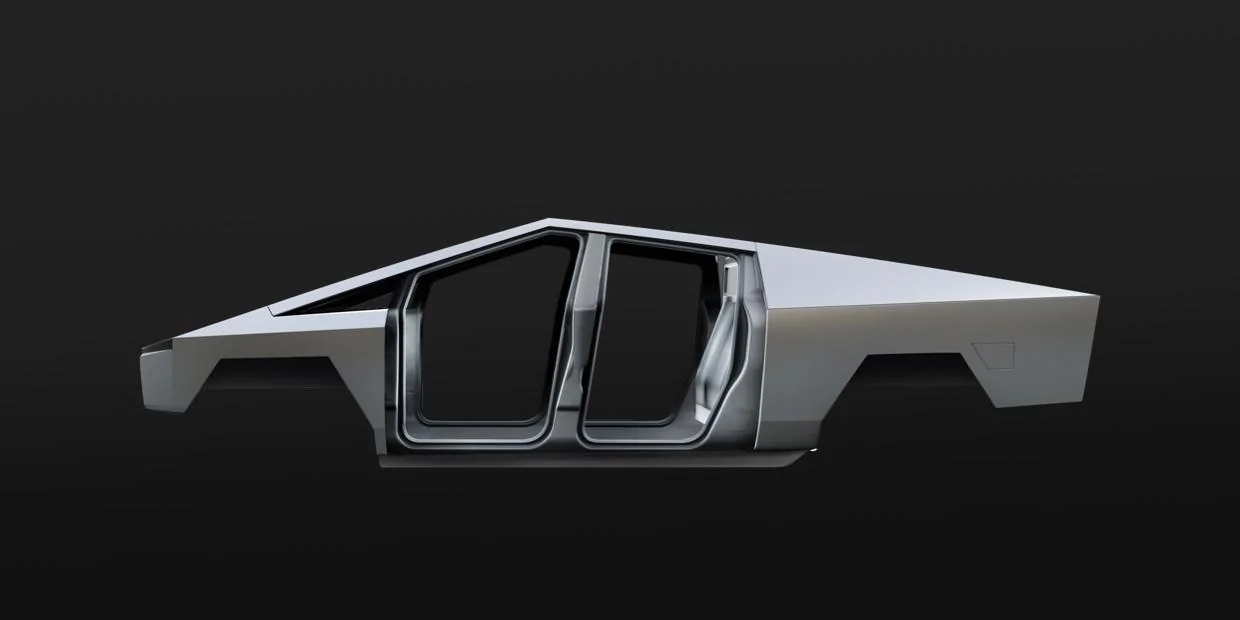
Yeah I try to stay away from the discussion around the 'exoskeleton' terminology if at all possible. I don't think it's completely false but I have to admit there's an element of marketing to it for sure, I was expecting the skin to play a bigger role, particularly in the bed. Cabin structure was as expected, not that it required much imagination on my part given it is pretty much identical to what they showed in the render below. As it is the exoskeleton skin is more of a supporting act to the primary structure which is the unibody, so in the purest sense of the term it isn't a true exoskeleton but I think it's fair game for Tesla to call it that way as it might not carry the exterior skin as dead weight like in a traditional unibody.

Tesla Cybertruck FRUNK on the Cybertruck? tesla-cybertruck-exoskeleton-1
 

JBee

Well-known member
First Name
JB
Joined
Nov 22, 2019
Threads
18
Messages
4,913
Reaction score
6,362
Location
Australia
Vehicles
Cybertruck
Occupation
. Professional Hobbyist
Country flag
It'll also exceed ladder frame trucks, too. Just like truss bridges exceed beam.

-Crissa
Listen to Sandy and weep...or go to university, get an engineering degree, and build a bridge and get over it!

Ladder frames are the future! :cool:


Top