

Cybergirl
Well-known member
- Joined
- Jul 3, 2020
- Threads
- 40
- Messages
- 872
- Reaction score
- 2,933
- Location
- Illinois and Arizona
- Vehicles
- Tesla Model Y LR, Model Y SR, Cybertruck AWD FS

- Thread starter
- #1
This is a long post, so to make a long story short, I have decided to replace my dual fuel generator with a large capacity power station to achieve range extension for off-road travel. I’ve chosen to install two EcoFlow Delta Pro power stations with a combined 7200 watts of charging power for a range extension of up to 20 miles. The dual Delta Pros are installed in the rear seat area of the Cybertruck cabin, not the vault. They are integrated with my 420 watt solar panel system and battery bank giving a total battery capacity of 9.5 kWh.
On our trip to Alaska and the Arctic Ocean (Tuktoyaktuk, NT), I took along my 120V 30A propane generator to add miles to the truck if I fell short of a charging station. I was concerned about the dearth of reliable charging stations north of Prince George, BC. If nothing else, having a way to add charge to the truck reduced the anxiety of being stranded with a dead battery hundreds of miles from the nearest charging source.
It turned out that we didn’t use the generator, although on one occasion, driving in freezing temperatures, strong winds, on a poorly maintained gravel road, I assumed we would have to resort to the generator to finish the 254 miles from Eagle Plains to Dawson City, Yukon. The prospect of having to unload the vault of camping gear in freezing temperatures to take out and set up the generator and propane tank to charge the vehicle at 24A (2.8 kW) for hours, drove home to me the functional limitations and inconvenience of my range extension strategy. I also learned that the restrictions on when I could run the generator at campgrounds and in the company of other campers, further exposed the weakness of this approach. It’s amazing how loud a generator is in the dead of night compared to daytime operation.
I began looking for alternative range extension solutions, and was again drawn to the use of battery power stations which I had once rejected. I own two small EcoFlow River units which have been reliable. EcoFlow customer support has been good, too, so I looked into their Delta Pro series (Delta Pro, Delta Pro 3, and Delta Pro Ultra). The Delta Pro 3 and Ultra provide built-in 240W split-phase power, a definite plus compared to the Delta Pro. They fell short in other important requirements, however, for my use case. My goal was to have a 20 mile driving reserve when off-roading in the Southwest where charging stations are often spaced far apart. I also wanted to add range to the truck in less than two hours with minimal setup time. It turned out that those goals were pretty much impossible to achieve.
With an overall driving efficiency of 474 Wh/mile, I figured I needed 9.5 kWh of reserve battery energy. I already have a 2.5 kWh solar battery system in my truck, so adding another 7 kW was needed. I also wanted to increase my charging speed from the generator’s 2.8 kW to 7 kW (Level 2 rate), and be able to add range in inclement weather at any time of day or night.
I have all I can do to lift my 100 lb generator into the vault. The Delta Pro 3 weighs 115 lbs for 4 kWh, and the Ultra’s 6.1 kWh battery weighs 116 lbs. The Delta Pro weighs 99 lbs for 3600 kWh.
After considering other brands (Jackery, Anker, BLUETTI), I decided to purchase two Delta Pros for $1400 each giving me a combined battery capacity of 7.2 kWh and 7.2 kW of combined 240V AC power when tied together with an extra cost accessory hub ($130).
To improve accessibility and convenience, as well as to protect the devices from road dust that the vault is only partly capable of protecting against on long, dusty desert roads, I decided to install the Delta Pros inside the cabin. It was a hard decision given how valuable cabin space is. Since I was unwilling to move our Bodega refrigerator from the cabin to the vault, there was only one way to get two Delta Pros into the rear seat area and still be able to fully recline the front seats - vertically - which presented another challenge. EcoFlow does not allow the stacking of units, and the Delta Pros must be securely fasten in place.
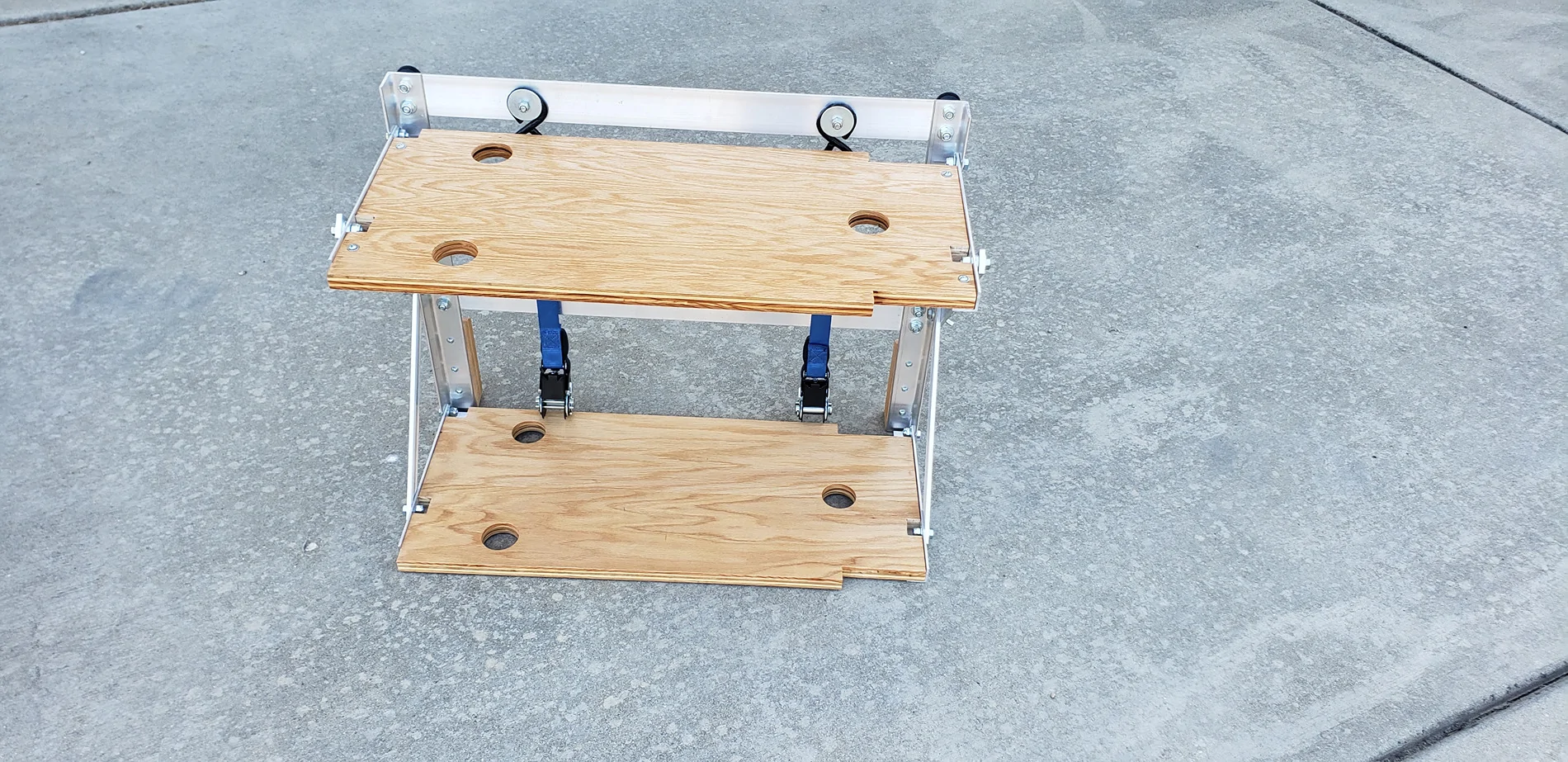
With Grok as my design consultant, I constructed a shelf to support the Delta Pros in the rear seat area using cargo straps to secure them in place. The shelf is made of 6061-T6 aviation grade aluminum and 3/4” plywood weighing 15 lbs:

The shelf is 25” wide, 20” high and 12” deep. The cutouts in the plywood accept the Delta Pro’s feet and wheels, preventing the device from sliding off the shelf. The short length of ratchet straps shown here is part of the system for securing the Delta Pros from movement within the vehicle.
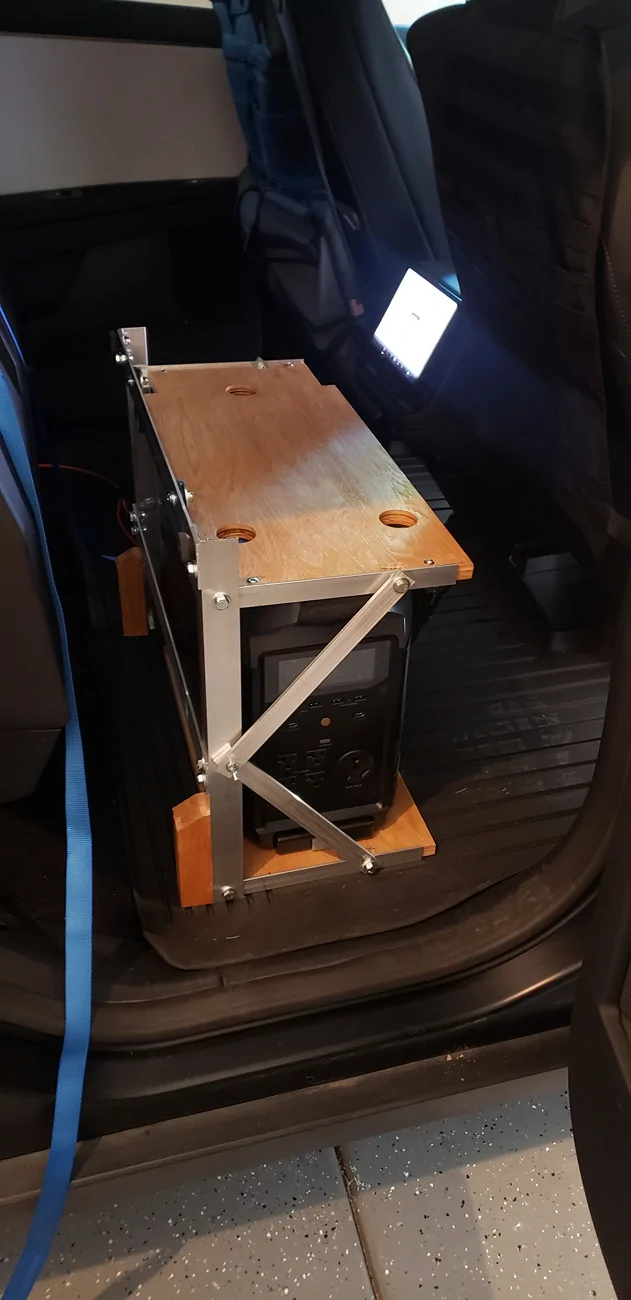
Here is the shelf in the Cybertruck with one Delta Pro in place on the lower shelf:

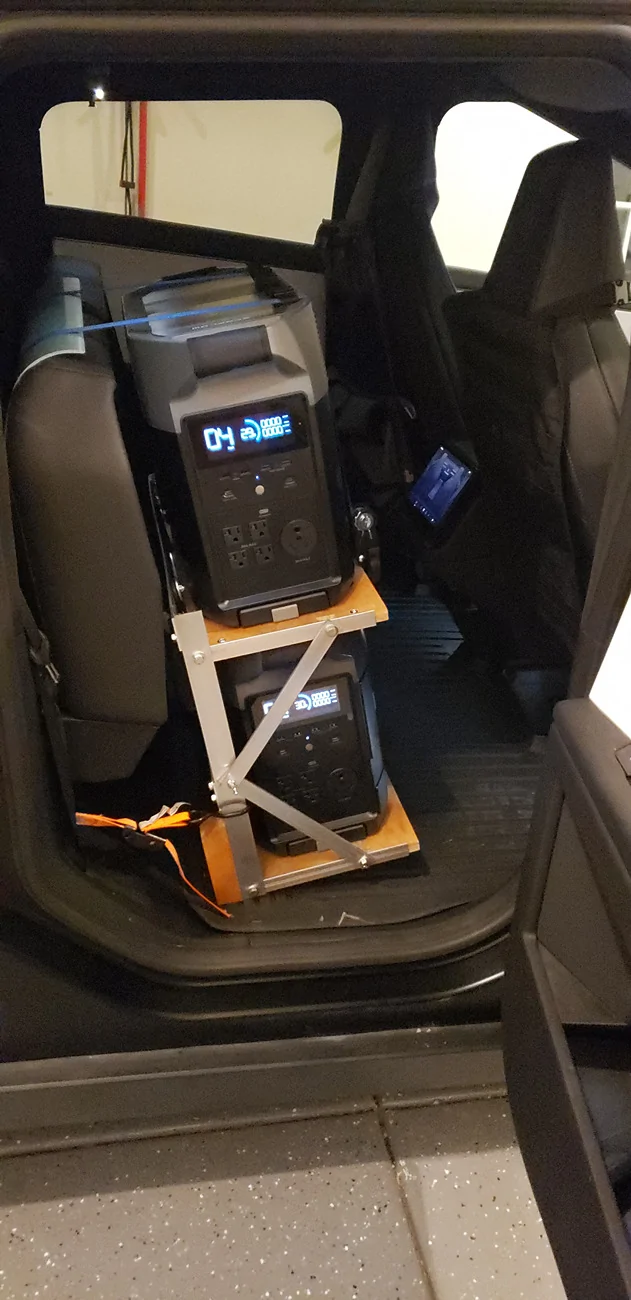
To provide space to fully recline the front passenger seat, the shelf is tilted back 15 degrees, parallel to the rear raised seat bottoms. 500 lb working load cargo straps anchor the shelf and power stations to the rear seat’s metal framework.
The Delta Pros can be charged from the 2.5 kWh solar battery (located under the Urander bed rack). A 10 AWG cable runs from the solar battery to the 15A XT60i DC input ports on the Delta Pros. Maximum charging power is 768W from the 25.6V solar battery. The Delta Pro batteries will stay charged even while powering the refrigerator and Starlink router/antenna.
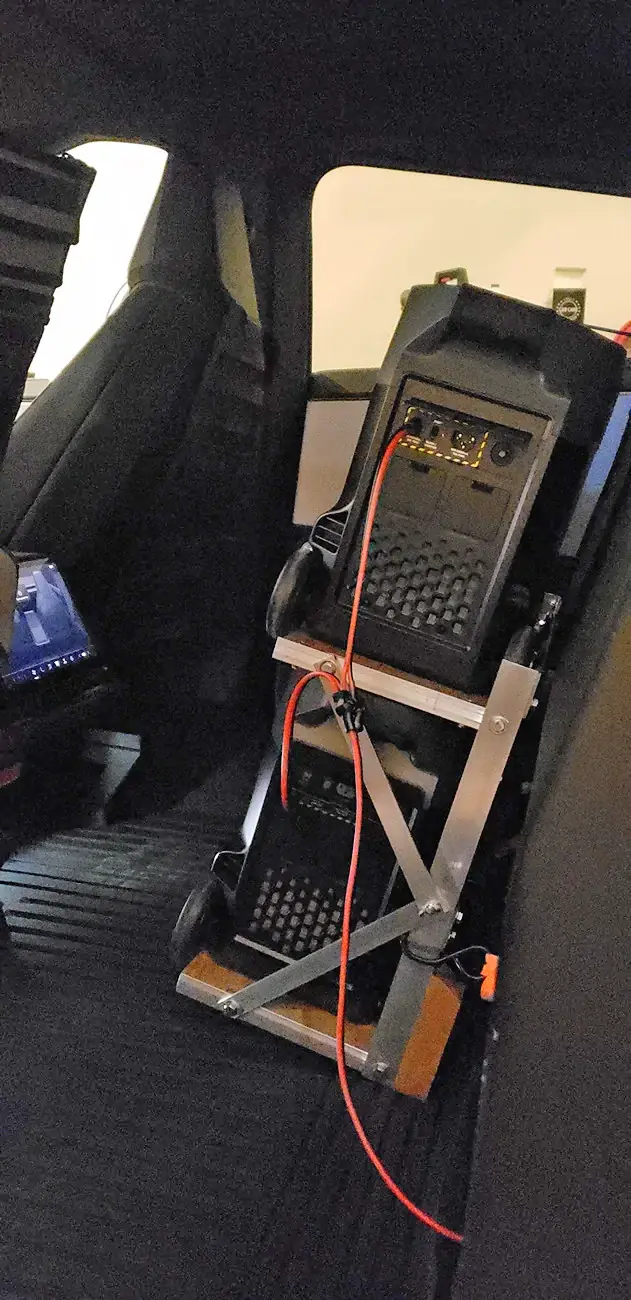
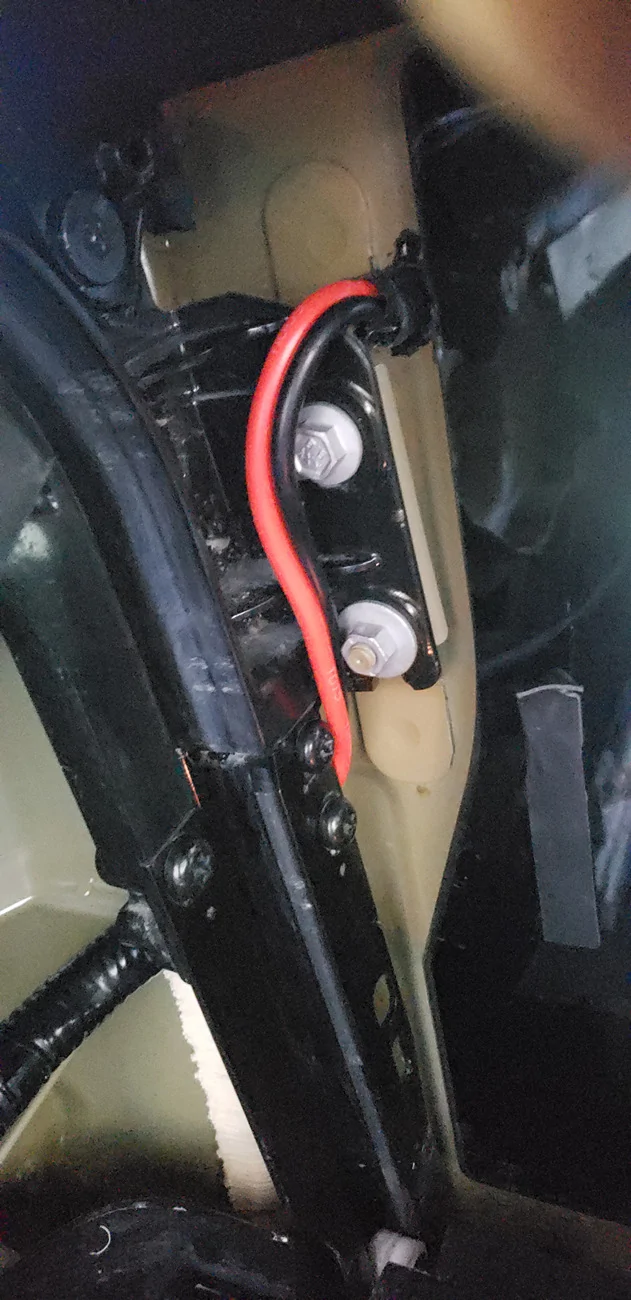
I was able to route the cable from the vault to the cabin through the rear bulkhead without interfering with the tonneau cover’s operation. The cable is routed within the sail, around the tonneau cover’s track where is turns down, and through a 1/2” hole drilled through the bulkhead at the left edge of the rear window:
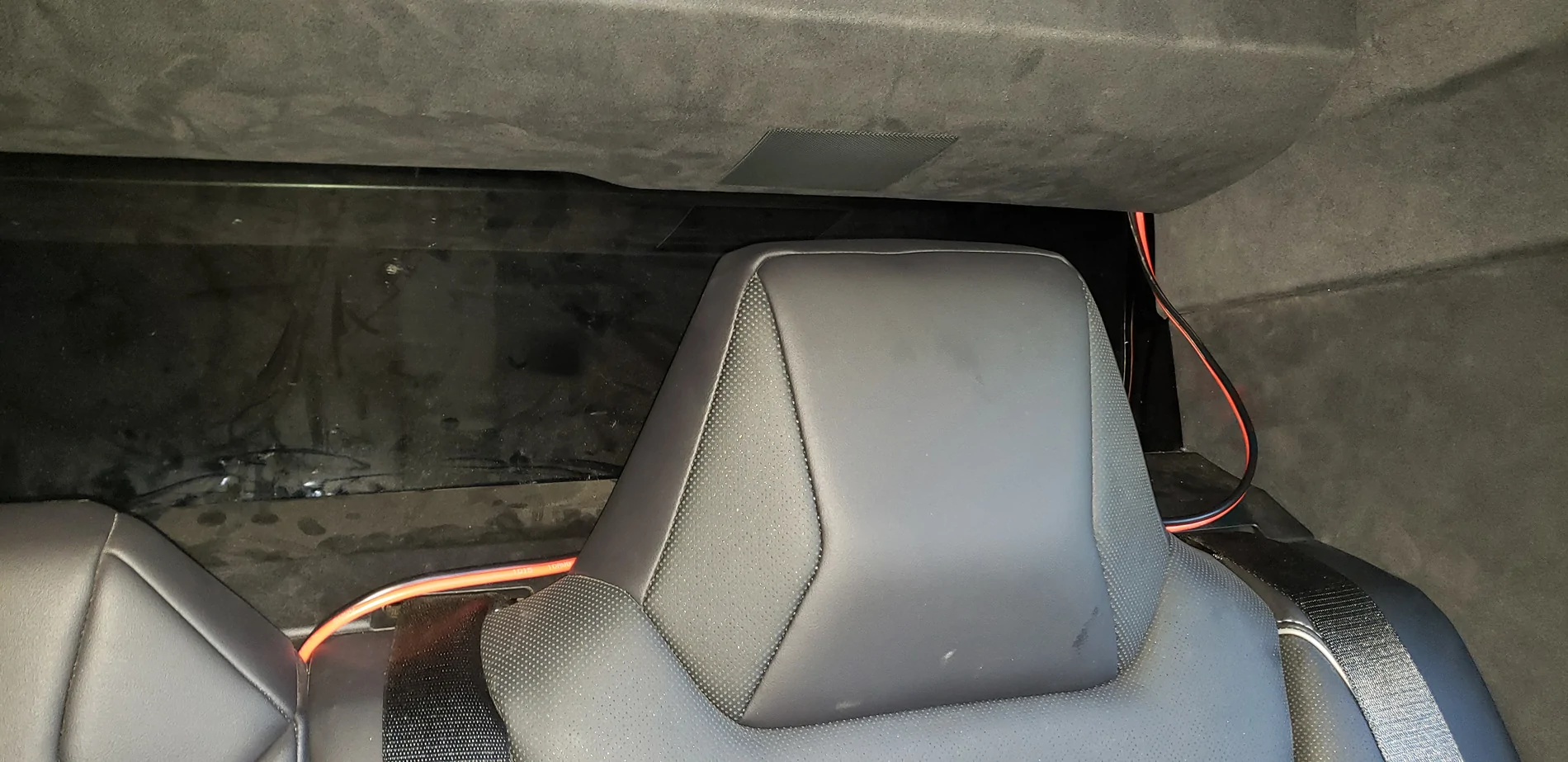
Here’s the cable inside the cabin. I didn’t try to hide the cable behind interior trim or within seat seams:
If the solar battery SoC is drawn down to 22V following a series of cloudy days, the Renogy Rover charge controller will disconnect power to the Delta Pros until the solar battery state of charge recovers.
To charge the Cybertruck from the Delta Pro batteries, I simply plug my mobile connector (14-50P) into the Double Voltage Hub with an L14-30 to 14-50R adapter. The Hub will supply 30A at 240V or 7200W of charging power. Accounting for inverter efficiencies, 7.2 kWh of Delta Pro battery energy will yield 6.48 kWh into the Cybertruck’s battery (7.2 x 0.90 = 6.48) in one hour. At 474 Wh/mile driving efficiency, that’s 13.67 miles of added range in an hour.
During this 1 hour charging interval, the Delta Pros battery was being charged with 750W of solar battery energy. With a DC to DC charging efficiency of 95%, that’s 0.7125 kWh to the Delta Pros battery. At the end of 1 hour the DP’s battery is virtually empty, but the solar battery still has 2.5 - 0.75 = 1.75 kWh remaining which is used to continue charging the Delta Pro’s battery. Over the next 2-1/2 hours, 1.75 x 0.95 x 0.837=1.39 kWh are added to CT’s battery for another 2.93 miles of range, a total range extension of 13.67+2.93=16.6 miles in 3-1/2 hours.
That’s 3.4 miles short of my 20 mile goal. I’d have to increase my driving efficiency to 393 Wh/mi to extend range to 20 miles. On the 254 mile drive from Eagle Plains to Dawson City I achieved 390 Wh/mi under adverse conditions, driving slowly, so with care, I should be able to eke out 20 miles of range extension if necessary.
Note: For better ventilation while charging, I will loosen the cargo straps allowing the shelf to return to vertical.
Another feature of the Delta Pro is the ability to charge it from a J-1772 Level 2 charger en route. An extra cost J-1772 adapter (X-stream EV adapter) is needed to charge for a Level 2 charger, e.g., ChargePoint. One can also add some charge to the Delta Pro battery from an outlet in the Cybertruck while Supercharging. The Cybertruck 120V outlet in the cabin can output 2.4 kW to both Delta Pros simultaneously for as long as the charging session lasts. Charging a Delta Pro directly from a Supercharger is not possible.
The one major advantage of the generator solution is that it’s capable of extending driving range by 60 miles from a 30 lb bottle of propane. I will certainly make use of the generator when more than 20 miles of range extension likely to be needed. Needing more than 20 miles of extra range with just the Delta Pros on board would be a problem. It would take at least 3 days to recharge the Delta batteries from my 420W solar panel under clear Arizona skies.
I haven’t put this system to the test yet. In a few days, we’re heading to Boca Chica, TX to, hopefully, see the launch of Starship 11. The new system will be put to good use, and provide an opportunity to wring out any bugs in the implementation.
On our trip to Alaska and the Arctic Ocean (Tuktoyaktuk, NT), I took along my 120V 30A propane generator to add miles to the truck if I fell short of a charging station. I was concerned about the dearth of reliable charging stations north of Prince George, BC. If nothing else, having a way to add charge to the truck reduced the anxiety of being stranded with a dead battery hundreds of miles from the nearest charging source.
It turned out that we didn’t use the generator, although on one occasion, driving in freezing temperatures, strong winds, on a poorly maintained gravel road, I assumed we would have to resort to the generator to finish the 254 miles from Eagle Plains to Dawson City, Yukon. The prospect of having to unload the vault of camping gear in freezing temperatures to take out and set up the generator and propane tank to charge the vehicle at 24A (2.8 kW) for hours, drove home to me the functional limitations and inconvenience of my range extension strategy. I also learned that the restrictions on when I could run the generator at campgrounds and in the company of other campers, further exposed the weakness of this approach. It’s amazing how loud a generator is in the dead of night compared to daytime operation.
I began looking for alternative range extension solutions, and was again drawn to the use of battery power stations which I had once rejected. I own two small EcoFlow River units which have been reliable. EcoFlow customer support has been good, too, so I looked into their Delta Pro series (Delta Pro, Delta Pro 3, and Delta Pro Ultra). The Delta Pro 3 and Ultra provide built-in 240W split-phase power, a definite plus compared to the Delta Pro. They fell short in other important requirements, however, for my use case. My goal was to have a 20 mile driving reserve when off-roading in the Southwest where charging stations are often spaced far apart. I also wanted to add range to the truck in less than two hours with minimal setup time. It turned out that those goals were pretty much impossible to achieve.
With an overall driving efficiency of 474 Wh/mile, I figured I needed 9.5 kWh of reserve battery energy. I already have a 2.5 kWh solar battery system in my truck, so adding another 7 kW was needed. I also wanted to increase my charging speed from the generator’s 2.8 kW to 7 kW (Level 2 rate), and be able to add range in inclement weather at any time of day or night.
I have all I can do to lift my 100 lb generator into the vault. The Delta Pro 3 weighs 115 lbs for 4 kWh, and the Ultra’s 6.1 kWh battery weighs 116 lbs. The Delta Pro weighs 99 lbs for 3600 kWh.
After considering other brands (Jackery, Anker, BLUETTI), I decided to purchase two Delta Pros for $1400 each giving me a combined battery capacity of 7.2 kWh and 7.2 kW of combined 240V AC power when tied together with an extra cost accessory hub ($130).
To improve accessibility and convenience, as well as to protect the devices from road dust that the vault is only partly capable of protecting against on long, dusty desert roads, I decided to install the Delta Pros inside the cabin. It was a hard decision given how valuable cabin space is. Since I was unwilling to move our Bodega refrigerator from the cabin to the vault, there was only one way to get two Delta Pros into the rear seat area and still be able to fully recline the front seats - vertically - which presented another challenge. EcoFlow does not allow the stacking of units, and the Delta Pros must be securely fasten in place.
With Grok as my design consultant, I constructed a shelf to support the Delta Pros in the rear seat area using cargo straps to secure them in place. The shelf is made of 6061-T6 aviation grade aluminum and 3/4” plywood weighing 15 lbs:
The shelf is 25” wide, 20” high and 12” deep. The cutouts in the plywood accept the Delta Pro’s feet and wheels, preventing the device from sliding off the shelf. The short length of ratchet straps shown here is part of the system for securing the Delta Pros from movement within the vehicle.
Here is the shelf in the Cybertruck with one Delta Pro in place on the lower shelf:
To provide space to fully recline the front passenger seat, the shelf is tilted back 15 degrees, parallel to the rear raised seat bottoms. 500 lb working load cargo straps anchor the shelf and power stations to the rear seat’s metal framework.
The Delta Pros can be charged from the 2.5 kWh solar battery (located under the Urander bed rack). A 10 AWG cable runs from the solar battery to the 15A XT60i DC input ports on the Delta Pros. Maximum charging power is 768W from the 25.6V solar battery. The Delta Pro batteries will stay charged even while powering the refrigerator and Starlink router/antenna.
I was able to route the cable from the vault to the cabin through the rear bulkhead without interfering with the tonneau cover’s operation. The cable is routed within the sail, around the tonneau cover’s track where is turns down, and through a 1/2” hole drilled through the bulkhead at the left edge of the rear window:
Here’s the cable inside the cabin. I didn’t try to hide the cable behind interior trim or within seat seams:
If the solar battery SoC is drawn down to 22V following a series of cloudy days, the Renogy Rover charge controller will disconnect power to the Delta Pros until the solar battery state of charge recovers.
To charge the Cybertruck from the Delta Pro batteries, I simply plug my mobile connector (14-50P) into the Double Voltage Hub with an L14-30 to 14-50R adapter. The Hub will supply 30A at 240V or 7200W of charging power. Accounting for inverter efficiencies, 7.2 kWh of Delta Pro battery energy will yield 6.48 kWh into the Cybertruck’s battery (7.2 x 0.90 = 6.48) in one hour. At 474 Wh/mile driving efficiency, that’s 13.67 miles of added range in an hour.
During this 1 hour charging interval, the Delta Pros battery was being charged with 750W of solar battery energy. With a DC to DC charging efficiency of 95%, that’s 0.7125 kWh to the Delta Pros battery. At the end of 1 hour the DP’s battery is virtually empty, but the solar battery still has 2.5 - 0.75 = 1.75 kWh remaining which is used to continue charging the Delta Pro’s battery. Over the next 2-1/2 hours, 1.75 x 0.95 x 0.837=1.39 kWh are added to CT’s battery for another 2.93 miles of range, a total range extension of 13.67+2.93=16.6 miles in 3-1/2 hours.
That’s 3.4 miles short of my 20 mile goal. I’d have to increase my driving efficiency to 393 Wh/mi to extend range to 20 miles. On the 254 mile drive from Eagle Plains to Dawson City I achieved 390 Wh/mi under adverse conditions, driving slowly, so with care, I should be able to eke out 20 miles of range extension if necessary.
Note: For better ventilation while charging, I will loosen the cargo straps allowing the shelf to return to vertical.
Another feature of the Delta Pro is the ability to charge it from a J-1772 Level 2 charger en route. An extra cost J-1772 adapter (X-stream EV adapter) is needed to charge for a Level 2 charger, e.g., ChargePoint. One can also add some charge to the Delta Pro battery from an outlet in the Cybertruck while Supercharging. The Cybertruck 120V outlet in the cabin can output 2.4 kW to both Delta Pros simultaneously for as long as the charging session lasts. Charging a Delta Pro directly from a Supercharger is not possible.
The one major advantage of the generator solution is that it’s capable of extending driving range by 60 miles from a 30 lb bottle of propane. I will certainly make use of the generator when more than 20 miles of range extension likely to be needed. Needing more than 20 miles of extra range with just the Delta Pros on board would be a problem. It would take at least 3 days to recharge the Delta batteries from my 420W solar panel under clear Arizona skies.
I haven’t put this system to the test yet. In a few days, we’re heading to Boca Chica, TX to, hopefully, see the launch of Starship 11. The new system will be put to good use, and provide an opportunity to wring out any bugs in the implementation.
Sponsored


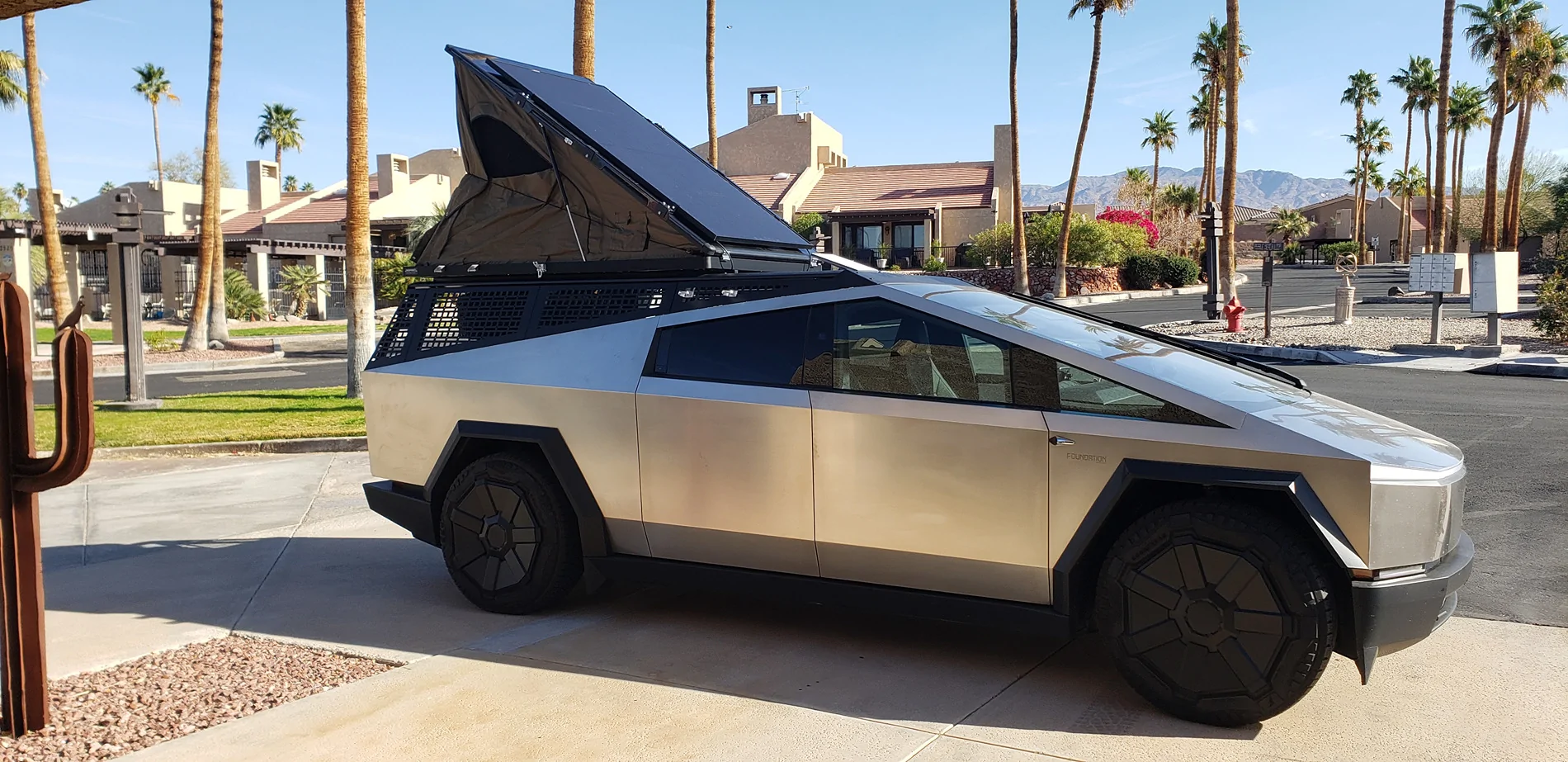



 if you don’t mind my asking, what’s the panel you’re using? The size looks just about perfect.