

Sponsored

Noticed sanding swirls & scratches on my newly delivered Cybertruck

Crissa

Well-known member
First Name
Crissa
Joined
Jul 8, 2020
Threads
138
Messages
19,571
Reaction score
31,477
Location
Santa Cruz
Vehicles
2014 Zero S, 2013 Mazda 3
Country flag
Tesla doesn't recommend a random orbit sander, they recommend an orbital sander. And based on this graphic they supply, I think it's clear they are speaking of a geared (dual action) orbital sander, not a random orbit sander.

1716005981273-b4.png


I think this is clear based upon the description they provide of the orbital sander having a consistent speed of rotation. Only a geared (Dual Action) orbital sander can provide this. Random Orbit sanders have a consistent orbital speed but the speed of rotation varies with the pressure because the sanding pad is free to rotate.

The results will be very different between the two. That probably explains why the results with the recommended grits comes out finer than expected (assuming you are using the Random Orbit Sander).

I think it would be very difficult to get consistent results with a random orbit sander compared to a geared Dual Action Sander.
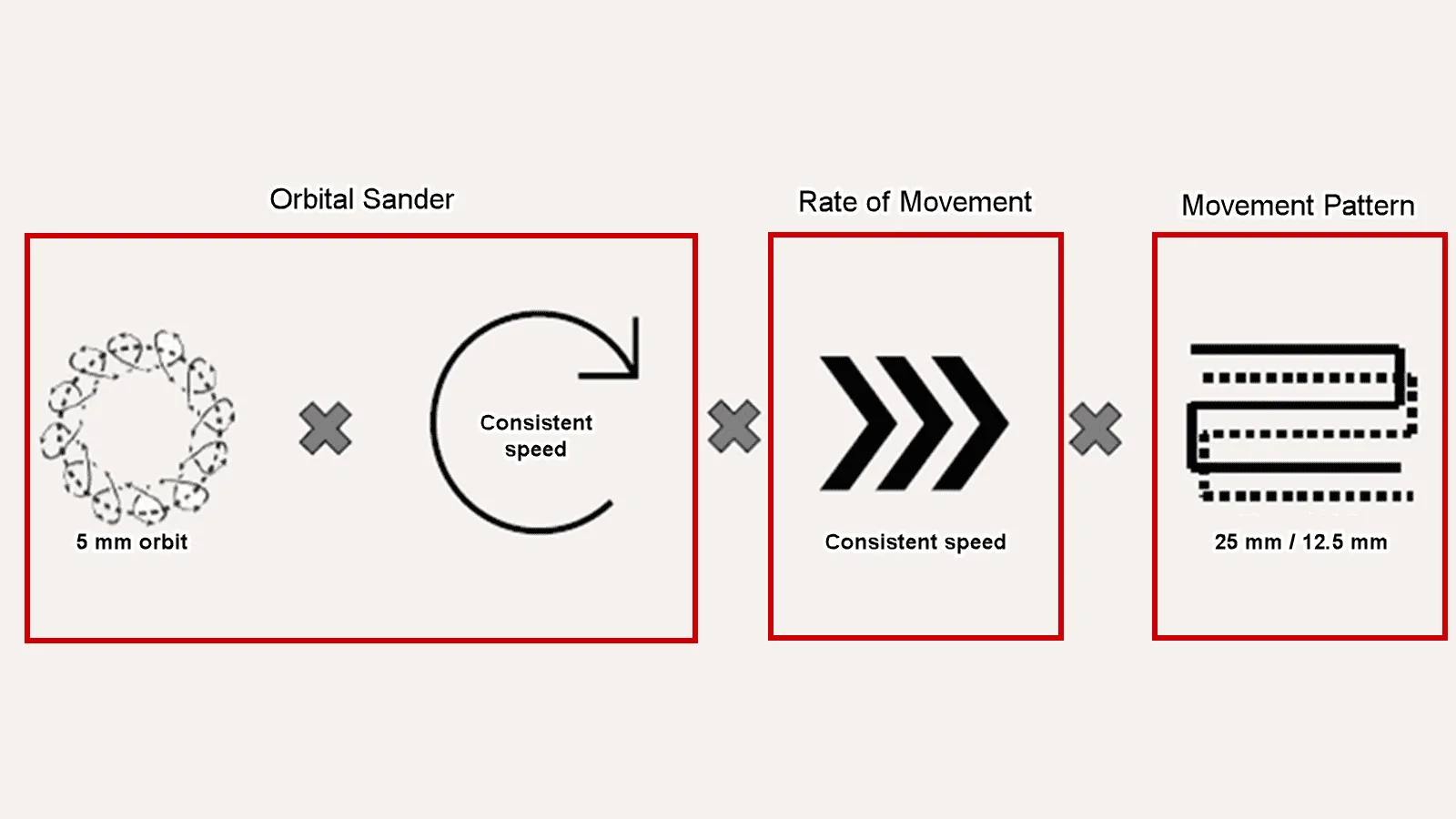
That is a random orbit sander in the first symbol?

-Crissa
Sponsored


jf64k

Well-known member
Joined
Dec 12, 2023
Threads
34
Messages
1,259
Reaction score
2,019
Location
San Diego
Vehicles
2020 MYLR (Lola), 2024 FS AWD (Deckard 263-54)
Country flag
Tesla doesn't recommend a random orbit sander, they recommend an orbital sander. And based on this graphic they supply, I think it's clear they are speaking of a geared (dual action) orbital sander, not a random orbit sander.

1716005981273-b4.png


I think this is clear based upon the description they provide of the orbital sander having a consistent speed of rotation. Only a geared (Dual Action) orbital sander can provide this. Random Orbit sanders have a consistent orbital speed but the speed of rotation varies with the pressure because the sanding pad is free to rotate.

The results will be very different between the two. That probably explains why the results with the recommended grits comes out finer than expected (assuming you are using the Random Orbit Sander).

I think it would be very difficult to get consistent results with a random orbit sander compared to a geared Dual Action Sander.
I agree that they call out an orbital sander with a 3/16” orbit. But I think what’s throwing people off is the first sentence in the opening paragraph of the Service Manual:

Scratches and surface discolorations of the exterior stainless steel body panels can be removed by sanding with a random orbital sander.
Probably the worst place for a typo, haha!!
 

ideaXfactory

Well-known member
First Name
IdeaX
Joined
Jan 8, 2024
Threads
6
Messages
339
Reaction score
429
Location
MO
Vehicles
Many trucks, and a Porsche
Occupation
Stainless, metals, art, polymath
Well, they are trying to make it sound as simple as possible, but they do use a random orbit sander. For a cheaper substitute the DEWALT 20V MAX Orbital Sander is pretty close. It is actually a random orbit.
 

HaulingAss

Well-known member
Joined
Oct 3, 2020
Threads
28
Messages
10,421
Reaction score
20,951
Location
Western Washington, USA
Vehicles
Cybertruck DM, 2010 F-150, 2018 Performance Model 3, 2024 Performance Model 3
Country flag
I agree that they call out an orbital sander with a 3/16” orbit. But I think what’s throwing people off is the first sentence in the opening paragraph of the Service Manual:


Probably the worst place for a typo, haha!!
Wow, I didn't even notice that!

The graphic that describes the type of sander specifies a 5 mm orbit on a rotary disc (because orbital sanders with square sanding pads never rotate, they only orbit) and further specifies that the rotary disc has a consistent speed of rotation, which cannot be achieved by a random orbit sander with the disc on a freely rotating bearing, it could only happen on a geared Dual Action (also called a "Forced Action") orbital sander.

The terminology in the tool world is a bit unfortunate because some manufacturers and users have started using the term "dual action" to refer to the random orbit action rather than to sanders that can switch from using a planetary gear to regulate the rotary action of the disc to the free-spinning random orbit action. Thus some sanders that only have one mode of sanding are sometimes called "dual action".

It could be that Tesla didn't want to limit the recommended tool only to the more expensive planetary gear machines, so by specifying a consistent speed of rotation they are saying, if you use a random orbit machine that special care should be taken to apply medium, even pressure. However, as the pad must overlap the edges of the flat body panels somewhat, it will be difficult to achieve a consistent rotation speed with anything but one of the planetary type dual action sanders.
 

agordon117

Well-known member
Joined
Jan 11, 2024
Threads
7
Messages
1,196
Reaction score
2,039
Location
Ohio
Vehicles
cybertruck foundation awd
Country flag
Wow, I didn't even notice that!

The graphic that describes the type of sander specifies a 5 mm orbit on a rotary disc and further specifies that the rotary disc has a consistent speed of rotation, which cannot be achieved by a random orbit sander with the disc on a freely rotating bearing, it could only happen on a geared Dual Action (also called a "Forced Action") orbital sander.

The terminology in the tool world is a bit unfortunate because some manufacturers and users have started using the term "dual action" to refer to the random orbit action rather than to sanders that can switch from using a planetary gear to regulate the rotary action of the disc to the free-spinning random orbit action. Thus some sanders that only have one mode of sanding are sometimes called "dual action".

It could be that Tesla didn't want to limit the recommended tool only to the more expensive planetary gear machines, so by specifying a consistent speed of rotation they are saying, if you use a random orbit machine that special care should be taken to apply medium, even pressure. However, as the pad must overlap the edges of the flat body panels somewhat, it will be difficult to achieve a consistent rotation speed with anything but one of the planetary type dual action sanders.
You made a good point here and earlier. I would argue though that based on my results, you won't know which tool was used. It's just that a forced action orbital sander would potentially require less of a steady hand to use. You don't have to apply a relatively consistent force to get it to reach the right motion. The difference I see in the door I did vs the factory finish isn't that theirs is more coarse, but that they were much less consistent with the end finish than I was.


ideaXfactory

Well-known member
First Name
IdeaX
Joined
Jan 8, 2024
Threads
6
Messages
339
Reaction score
429
Location
MO
Vehicles
Many trucks, and a Porsche
Occupation
Stainless, metals, art, polymath
Don't use the orbital sanders with a rectangular disk, or the big 8" pneumatic spinning orbital sanders (sanders that are more for polishing). Hope that helps a little if you are actually going to try it...

I believe the 5" circular red along with a backing pad is a decent substitute for the 6" red pad if you don't have easy access to them.

Very clean Stainless to start. Clean it again as you work.

It's not that hard, but yes, there are many ways to do it poorly.
 

HaulingAss

Well-known member
Joined
Oct 3, 2020
Threads
28
Messages
10,421
Reaction score
20,951
Location
Western Washington, USA
Vehicles
Cybertruck DM, 2010 F-150, 2018 Performance Model 3, 2024 Performance Model 3
Country flag
You made a good point here and earlier. I would argue though that based on my results, you won't know which tool was used. It's just that a forced action orbital sander would potentially require less of a steady hand to use. You don't have to apply a relatively consistent force to get it to reach the right motion. The difference I see in the door I did vs the factory finish isn't that theirs is more coarse, but that they were much less consistent with the end finish than I was.
The video I saw of the early production of the doors with Sandy Munro and Lars, Tesla's head of production, shows a robotic sander putting the final finish on with a minimal number of passes. If the panel was scratched at any earlier point, this would not be enough to polish the scratch away.

Many deliveries have had a relatively uneven sanding pattern, and due to how uneven some are, I'm assuming these were hand applied finishes by various Service Departments in which the employees were having their first go at polishing metal panels. They might not even have had the proper tool yet, but just improvising.

I'm wondering how you know whether your finish was from the factory robotic polisher or if it had been touched up after the truck came off the line, ie, at a delivery center.
 

ideaXfactory

Well-known member
First Name
IdeaX
Joined
Jan 8, 2024
Threads
6
Messages
339
Reaction score
429
Location
MO
Vehicles
Many trucks, and a Porsche
Occupation
Stainless, metals, art, polymath
The video I saw of the early production of the doors with Sandy Munro and Lars, Tesla's head of production, shows a robotic sander putting the final finish on with a minimal number of passes. If the panel was scratched at any earlier point, this would not be enough to polish the scratch away.

Many deliveries have had a relatively uneven sanding pattern, and due to how uneven some are, I'm assuming these were hand applied finishes by various Service Departments in which the employees were having their first go at polishing metal panels. They might not even have had the proper tool yet, but just improvising.

I'm wondering how you know whether your finish was from the factory robotic polisher or if it had been touched up after the truck came off the line, ie, at a delivery center.
I agree. They must have a second station on the line somewhere other than the one on that video. Then I think even a third area for little fixes. The third one is yet a different orbital sander, and I can see the obviously different coarser scratches where they used it on my truck on a small 3-4" strip.

Then the SC used a fourth polisher, that didn't match anything... A much finer polish grit left in a 8" circle. That was the one I had to fix myself because it simply bothered me.

By the way, if you happen drop your pad on the ground it's best to just get a new one. Don't allow shop/other contaminates be sanded back into the surface. Also, blow it and everything off frequently as it gets dusty. Don't use water on the surface while sanding.

Mostly the finish on my truck was very good, so I've not done much, other than fix the one I mentioned that bothered me.
 

HaulingAss

Well-known member
Joined
Oct 3, 2020
Threads
28
Messages
10,421
Reaction score
20,951
Location
Western Washington, USA
Vehicles
Cybertruck DM, 2010 F-150, 2018 Performance Model 3, 2024 Performance Model 3
Country flag
By the way, if you happen drop your pad on the ground it's best to just get a new one. Don't allow shop/other contaminates be sanded back into the surface. Also, blow it and everything off frequently as it gets dusty. Don't use water on the surface while sanding.

Mostly the finish on my truck was very good, so I've not done much, other than fix the one I mentioned that bothered me.
I wouldn't dive in with an orbital sander without a dust extraction setup, it completely changes the consistency of the resulting finish to suck away any loose abrasives as they shed. Blowing the dust off between patterns is not a good substitute to removing the dust as it's created.

All I have is a 5" Porter Cable random orbit sander (without a planetary gear for the rotation function). It has decent dust extraction but I'm not going to use this on the Cybertruck. It would be far too difficult to get a consistent finish, especially now that's old and worn from doing a ton of wood boat stuff. The modern, high-end tools are much more refined, right down to the starting and stopping of the motors. You still need a good touch, they just make it far easier.

I can see I'm developing a good case to add a Festool ROTEX RO 150 FEQ-Plus that I've wanted to add to the tool pile for some time.

If there is any job that is going to magnify the differences between various sanders, polishing the Cybertruck with a finish similar to factory finish is going to be it.
 

ideaXfactory

Well-known member
First Name
IdeaX
Joined
Jan 8, 2024
Threads
6
Messages
339
Reaction score
429
Location
MO
Vehicles
Many trucks, and a Porsche
Occupation
Stainless, metals, art, polymath
I wouldn't dive in with an orbital sander without a dust extraction setup, it completely changes the consistency of the resulting finish to suck away any loose abrasives as they shed. Blowing the dust off between patterns is not a good substitute to removing the dust as it's created.

All I have is a 5" Porter Cable random orbit sander (without a planetary gear for the rotation function). It has decent dust extraction but I'm not going to use this on the Cybertruck. It would be far too difficult to get a consistent finish, especially now that's old and worn from doing a ton of wood boat stuff. The modern, high-end tools are much more refined, right down to the starting and stopping of the motors. You still need a good touch, they just make it far easier.

I can see I'm developing a good case to add a Festool ROTEX RO 150 FEQ-Plus that I've wanted to add to the tool pile for some time.

If there is any job that is going to magnify the differences between various sanders, polishing the Cybertruck with a finish similar to factory finish is going to be it.
Nah it's fine. I specifically didn't use the dust extraction setup on the Dewalt. But then I've done this before, for like 40 years. Result matched perfect. - The pads Tesla specifies also don't have holes for dust extraction. Not positive about the Festool ROTEX RO 150 FEQ-Plus. Might be a bit more aggressive action than I would want to use. Watch out for some additional scratching along the holes. Not sure, I've not seen anyone else do it correctly yet. Dust collection is a good idea if you are wanting to take down the surface. Don't let it get hot though. Slow speed is better.


HaulingAss

Well-known member
Joined
Oct 3, 2020
Threads
28
Messages
10,421
Reaction score
20,951
Location
Western Washington, USA
Vehicles
Cybertruck DM, 2010 F-150, 2018 Performance Model 3, 2024 Performance Model 3
Country flag
Nah it's fine. I specifically didn't use the dust extraction setup on the Dewalt. But then I've done this before, for like 40 years. Result matched perfect. - The pads Tesla specifies also don't have holes for dust extraction. Not positive about the Festool ROTEX RO 150 FEQ-Plus. Might be a bit more aggressive action than I would want to use. Watch out for some additional scratching along the holes. Not sure, I've not seen anyone else do it correctly yet. Dust collection is a good idea if you are wanting to take down the surface. Don't let it get hot though. Slow speed is better.
Yes, I saw the recommended pads don't have dust holes in them. I just assumed the dust extraction would happen right through the non-woven pads. Are you saying they have a backing that doesn't pass air?
 

Jamezam

Well-known member
First Name
James
Joined
Mar 15, 2022
Threads
0
Messages
51
Reaction score
35
Location
Western, WA
Vehicles
2026 Model 3, 2026 Model Y, 2024 Cybertruck
Occupation
Retired military and government
Country flag
Do the recommended pads really sand that much? I was hoping to just refinish the hood while removing the mars/scratches you can’t feel with a fingernail.
 
Last edited:

ideaXfactory

Well-known member
First Name
IdeaX
Joined
Jan 8, 2024
Threads
6
Messages
339
Reaction score
429
Location
MO
Vehicles
Many trucks, and a Porsche
Occupation
Stainless, metals, art, polymath
I don't think they (the pads) will pass air, but a similar style is made that does, through holes that must match up exactly to the sander pad used.

On my pneumatic Orbital I changed out the hole suction surface to a solid one, hook and loop, just for the Cybertruck (test). That worked out the best for me, but the 3M orbital (and probably others) do require 90psi along with a pretty big compressor for the CFMs.
 

HaulingAss

Well-known member
Joined
Oct 3, 2020
Threads
28
Messages
10,421
Reaction score
20,951
Location
Western Washington, USA
Vehicles
Cybertruck DM, 2010 F-150, 2018 Performance Model 3, 2024 Performance Model 3
Country flag
Do the recommended pads really sand that much? I was hoping to just refinish the hood will removing the mars/scratches you can’t feel with a fingernail.
You should read Tesla's guide to Exterior Stainless Steel Panel Refinishing.

They have procedures for removing deep scratches (using grits as coarse as 180) as well as different procedures for light scratches or surface inconsistencies. It's pretty difficult to get deep scratches so most repairs will be of the lighter variety which has the goal of imparting fine scratches in a consistent manner. These scratches determine how the panel reflects light.

It sounds like you will use the procedures for light scratches and not much material will be removed. The thinnest panel measures 1.4 mm thick, so you will not be significantly altering the thickness of the panel. Even with a deep scratch the panel is only reduced in thickness slightly where the scratch is located and the sanding is feathered out around the scratch to prevent the repair from being visible.
 

lowtek

Well-known member
Joined
Oct 18, 2023
Threads
7
Messages
454
Reaction score
1,035
Location
Here
Vehicles
None
Country flag
I have to repair a self inflicted scratch, curious if this process would damage the FOUNDATION etching?
Sponsored


Top