
Sponsored
First Name
Taras
Joined
Dec 30, 2023
Threads
1
Messages
8
Reaction score
10
Location
Buckley, WA
Vehicles
2018 Model 3 AWD LR, 2024 Model Y AWD LR, 2024 AWD FS Cybertruck
Occupation
Photographer
Country flag
How much Total ? how many holes did they cut and did they completely patch them after?

interesting you decided to not power your whole main panel
Can't power the whole panel because the CT has a limited power output to 8kw I think
Sponsored


cgladue

Banned
Well-known member
Banned
First Name
Chad
Joined
Jan 30, 2024
Threads
13
Messages
1,759
Reaction score
1,955
Location
Massachusetts
Vehicles
2017 Model S 75D, 2018 Model 3 Performance
Occupation
Software Architect
Country flag
Can't power the whole panel because the CT has a limited power output to 8kw I think
11.5kw (48a) and you can power the whole panel, just turn off what you dont need, then you have options.
 

fhteagle

Well-known member
Joined
Sep 28, 2022
Threads
5
Messages
305
Reaction score
689
Location
Telluride, CO
Vehicles
2013 Volt, CT Res x2
Country flag
solar so the Gateway was connected to my main panel after the meter
That SolarEdge is a "grid-tied" only inverter, as in it needs a 60Hz waveform to follow before it will generate power, yesno? Did the installer offer the option to wire it in via the "backup" side of the Gateway? I get that the CT can't follow the SolarEdge, but could the SolarEdge follow the waveform the CT is producing and help carry loads? Or would that freak out the CT's inverters somehow?
 
OP
OP
schmo

schmo

Well-known member
First Name
Doug
Joined
Jan 18, 2024
Threads
2
Messages
106
Reaction score
179
Location
Austin, TX
Vehicles
Tesla Model S, Cybertruck AWD
Country flag
That SolarEdge is a "grid-tied" only inverter, as in it needs a 60Hz waveform to follow before it will generate power, yesno? Did the installer offer the option to wire it in via the "backup" side of the Gateway? I get that the CT can't follow the SolarEdge, but could the SolarEdge follow the waveform the CT is producing and help carry loads? Or would that freak out the CT's inverters somehow?
Good questions. Allowing the solar inverter to continue producing during an outage would be ideal.

I will ask Smart Charge America and let you know what I hear back.
 

JBee

Well-known member
First Name
JB
Joined
Nov 22, 2019
Threads
18
Messages
4,913
Reaction score
6,362
Location
Australia
Vehicles
Cybertruck
Occupation
. Professional Hobbyist
Country flag
That SolarEdge is a "grid-tied" only inverter, as in it needs a 60Hz waveform to follow before it will generate power, yesno? Did the installer offer the option to wire it in via the "backup" side of the Gateway? I get that the CT can't follow the SolarEdge, but could the SolarEdge follow the waveform the CT is producing and help carry loads? Or would that freak out the CT's inverters somehow?
For this to work the Solar inverter needs to be on the backup side of the Gateway, but the CT would be blind to what output the solar is producing, and the Cybertruck itself could not charge from the solar at the same time. The CT is bi-directional, but can only do one way at a time through the NACS, and I think the outlets are disengaged at the same time.

The only thing this would do is increase the capacity of the CT battery, by offsetting household power use with the solar being produced. This is actually pretty useful overall to extend CT battery life in a outage, but wouldn't charge your CT from solar when your network is down, and would be complicated to get the CT to follow the solar production output and your house load at the same time.

To do this you would need either a Powerwall (Which has it's own battery) or another a hybrid one that can handle off/on grid or another off-grid inverter with it's own battery supply to generate the required phase oscillation, for the existing solar inverter to connect to. With this the off grid inverter creates a base frequency power output, that the existing on-grid solar inverter can follow, meaning solar power "could" be used for CT charging. This would technically work, but is not ideal, and you'd be better off with a new inverter with the required functionality like the Powerwall.

The Powerwall is way simpler to integrate here, because it will automatically handle all the loads in your house, and CT charging, and know how much solar or grid power is available, and automatically switch between all of them depending on what is using the most and how much is available from where. The built in battery also gives you the ability to run the house without the CT when it isn't there, and buffer solar fluctuations on a cloudy day. Convenience wise it will be difficult to beat the automation and control of the Powerwall setup with the Gateway and USC.

If you were going completely off-grid the setup would be different, but the on/off grid makes things more complicated.


fhteagle

Well-known member
Joined
Sep 28, 2022
Threads
5
Messages
305
Reaction score
689
Location
Telluride, CO
Vehicles
2013 Volt, CT Res x2
Country flag
The Powerwall is way simpler to integrate here, because it will automatically handle all the loads in your house, and CT charging
I vaguely remember hearing that charging the CT from solar during grid down conditions is not turned on in software yet. Firmware update needed for PW, gateway, CT, or some combination of the above. Will be interesting to see how long it takes for that all to get to a state of "just works"....
 
Last edited:

JBee

Well-known member
First Name
JB
Joined
Nov 22, 2019
Threads
18
Messages
4,913
Reaction score
6,362
Location
Australia
Vehicles
Cybertruck
Occupation
. Professional Hobbyist
Country flag
I vaguely remember hearing that charging the CT from solar during grid down conditions is not turned in in software yet. Firmware update needed for PW, gateway, CT, or some combination of the above. Will be interesting to see how long it takes for that all to get to a state of "just works"....
Ah ok. I stand corrected then, I haven't seen anything on their website about that.

It really depends on the size of the solar system available and the percieved exposure to the risk of a power outage that doesn't allow you to charge the CT at home. 5kW of solar will only net you about 20kWh of charge per sunny cloudless day if your house doesn't use any as well. So unless you have 10kW or more it's sort of a mediocre solution.

Its also very location dependent as well and what risks you are exposed to in those locations. But in nearly every grid outage situation you can't really beat the low cost and overall independence and convenience of a liquid fuel powered ICE generator, especially so if it's only a intermittent emergency type use.
 
OP
OP
schmo

schmo

Well-known member
First Name
Doug
Joined
Jan 18, 2024
Threads
2
Messages
106
Reaction score
179
Location
Austin, TX
Vehicles
Tesla Model S, Cybertruck AWD
Country flag
For this to work the Solar inverter needs to be on the backup side of the Gateway, but the CT would be blind to what output the solar is producing, and the Cybertruck itself could not charge from the solar at the same time. The CT is bi-directional, but can only do one way at a time through the NACS, and I think the outlets are disengaged at the same time.

The only thing this would do is increase the capacity of the CT battery, by offsetting household power use with the solar being produced. This is actually pretty useful overall to extend CT battery life in a outage, but wouldn't charge your CT from solar when your network is down, and would be complicated to get the CT to follow the solar production output and your house load at the same time.

To do this you would need either a Powerwall (Which has it's own battery) or another a hybrid one that can handle off/on grid or another off-grid inverter with it's own battery supply to generate the required phase oscillation, for the existing solar inverter to connect to. With this the off grid inverter creates a base frequency power output, that the existing on-grid solar inverter can follow, meaning solar power "could" be used for CT charging. This would technically work, but is not ideal, and you'd be better off with a new inverter with the required functionality like the Powerwall.

The Powerwall is way simpler to integrate here, because it will automatically handle all the loads in your house, and CT charging, and know how much solar or grid power is available, and automatically switch between all of them depending on what is using the most and how much is available from where. The built in battery also gives you the ability to run the house without the CT when it isn't there, and buffer solar fluctuations on a cloudy day. Convenience wise it will be difficult to beat the automation and control of the Powerwall setup with the Gateway and USC.

If you were going completely off-grid the setup would be different, but the on/off grid makes things more complicated.
Thanks @JBee, good insight. The installer told me beforehand a Powerwall is required to make use of the solar panels during an outage. I rarely have outages so I passed on the Powerwall purchase.

Using solar just to assist the Cybertruck during an outage would be nice to have. Looking inside the Tesla Gateway 3V, it has a simpler design than the Tesla Gateway 2. There are no lugs for non-backup loads and no current transformer connections for monitoring external circuits like a solar inverter. It does have an RS-485 bus, which it uses to communicate with the UWC. My SolarEdge inverter also supports RS-485, but I doubt Tesla would consider an integration when they can just sell a Powerwall.

My installer has a good working relationship with Tesla since they did the employee installs here in the Austin area. I will ask about options for solar without a Powerwall and see what they get back.
 

JBee

Well-known member
First Name
JB
Joined
Nov 22, 2019
Threads
18
Messages
4,913
Reaction score
6,362
Location
Australia
Vehicles
Cybertruck
Occupation
. Professional Hobbyist
Country flag
Thanks @JBee, good insight. The installer told me beforehand a Powerwall is required to make use of the solar panels during an outage. I rarely have outages so I passed on the Powerwall purchase.

Using solar just to assist the Cybertruck during an outage would be nice to have. Looking inside the Tesla Gateway 3V, it has a simpler design than the Tesla Gateway 2. There are no lugs for non-backup loads and no current transformer connections for monitoring external circuits like a solar inverter. It does have an RS-485 bus, which it uses to communicate with the UWC. My SolarEdge inverter also supports RS-485, but I doubt Tesla would consider an integration when they can just sell a Powerwall.

My installer has a good working relationship with Tesla since they did the employee installs here in the Austin area. I will ask about options for solar without a Powerwall and see what they get back.
As before it really depends on your objectives and reasons to do it.

If you want energy independence thats one thing, but if you want to reduce costs, or increase redundancy for an outage, these are not all the same objectives, and the compromises between then become expensive.

As a general rule with anything I do for solar, I always go with more panels than is needed. This is directly because solar is not a stable continuous output, it varies from sun angle during the day and never stays still, seasonal angle and weather in general. Having a lot more panels smooths out the variablility and therefore increases availability, which in turn reduces battery size, which is the most expensive part seeing panel prices are still crashing.

It's important to understand that batteries are just like a fuel tank, you still have to fill them up with energy. So using the HUGE energy tankbin the CT is very cost effective if you have a way to charge it, say with lots of solar.

So if you do go on this endeavour to interconnect or upgrade, just keep in mind that installers will sell you the things that make them money, not the things that save you money, and that you can never have enough PV panels. I live completely off-grid, and having enough solar means we never run a generator, because even when its overcast and raining we are still producing PV power.

How many kW of PV do you have currently?
 
OP
OP
schmo

schmo

Well-known member
First Name
Doug
Joined
Jan 18, 2024
Threads
2
Messages
106
Reaction score
179
Location
Austin, TX
Vehicles
Tesla Model S, Cybertruck AWD
Country flag
As before it really depends on your objectives and reasons to do it.

If you want energy independence thats one thing, but if you want to reduce costs, or increase redundancy for an outage, these are not all the same objectives, and the compromises between then become expensive.

As a general rule with anything I do for solar, I always go with more panels than is needed. This is directly because solar is not a stable continuous output, it varies from sun angle during the day and never stays still, seasonal angle and weather in general. Having a lot more panels smooths out the variablility and therefore increases availability, which in turn reduces battery size, which is the most expensive part seeing panel prices are still crashing.

It's important to understand that batteries are just like a fuel tank, you still have to fill them up with energy. So using the HUGE energy tankbin the CT is very cost effective if you have a way to charge it, say with lots of solar.

So if you do go on this endeavour to interconnect or upgrade, just keep in mind that installers will sell you the things that make them money, not the things that save you money, and that you can never have enough PV panels. I live completely off-grid, and having enough solar means we never run a generator, because even when its overcast and raining we are still producing PV power.

How many kW of PV do you have currently?
I have an 8.4 kW system. I put panels everywhere I could fit them on my roof. Our Texas sun keeps them busy year round.

I am lucky to have few power outages in my neighborhood so using Powershare alone without Powerwalls is good enough for me.


JBee

Well-known member
First Name
JB
Joined
Nov 22, 2019
Threads
18
Messages
4,913
Reaction score
6,362
Location
Australia
Vehicles
Cybertruck
Occupation
. Professional Hobbyist
Country flag
I have an 8.4 kW system. I put panels everywhere I could fit them on my roof. Our Texas sun keeps them busy year round.

I am lucky to have few power outages in my neighborhood so using Powershare alone without Powerwalls is good enough for me.
That's a decent amount and should offer some incentive to get CT solar charging to work. Often space is the limiting factor. Obviously while the grid is operational you can still charge from your on solar now anyway, so you're getting most of the benefit already.

You can expect up to 41kWh/100miles per day in the summer and around 25kWh/60miles per day in winter from that system in Austin TX, IF you don't use power for anything else in the house. https://pvwatts.nrel.gov/pvwatts.php

Here that would be 53kWh and 24kWh. More humid and more clouds over your side, last year was a stinker when we were in Austin TX! Lots of thunderstorms and hail. ;)
 
OP
OP
schmo

schmo

Well-known member
First Name
Doug
Joined
Jan 18, 2024
Threads
2
Messages
106
Reaction score
179
Location
Austin, TX
Vehicles
Tesla Model S, Cybertruck AWD
Country flag
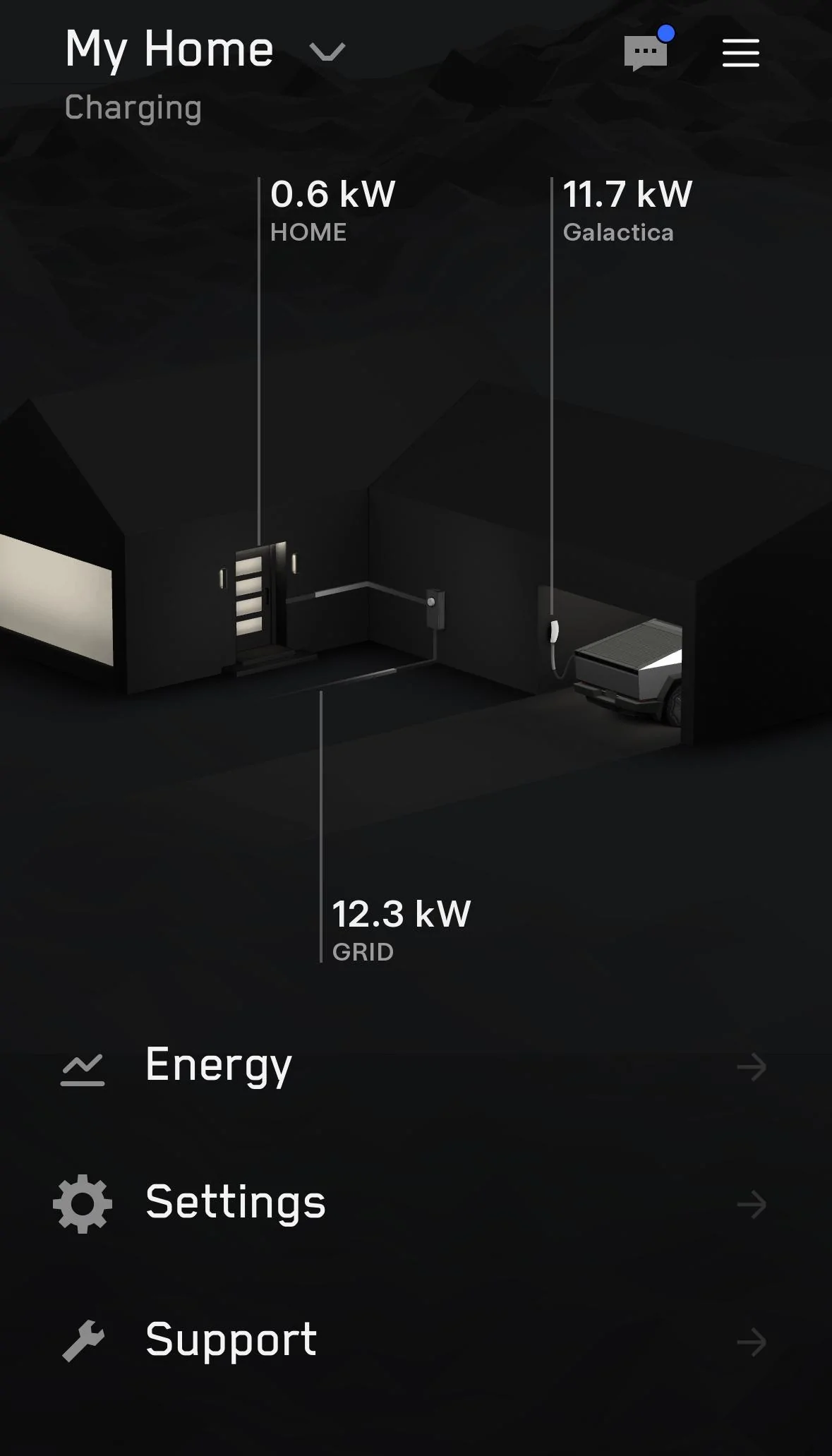
Interesting .. so new 3V gateway won’t let you see your solar production?
No, I didn’t see a current transformer connection to measure my solar inverter like the Tesla Gateway 2.
 
OP
OP
schmo

schmo

Well-known member
First Name
Doug
Joined
Jan 18, 2024
Threads
2
Messages
106
Reaction score
179
Location
Austin, TX
Vehicles
Tesla Model S, Cybertruck AWD
Country flag
Why only 60amp? Why not 100, 200?
The Cybertruck only has a single 48A charger onboard so a 60A circuit is all I needed for the UWC. The mobile charger maxes out at 32A.

My old Model S had two 40A chargers and could use a 100A circuit. Its mobile charger could do 40A.
Sponsored


Top