
Sponsored

Towing Range Numbers?

HaulingAss

Well-known member
Joined
Oct 3, 2020
Threads
28
Messages
10,308
Reaction score
20,718
Location
Western Washington, USA
Vehicles
Cybertruck DM, 2010 F-150, 2018 Performance Model 3, 2024 Performance Model 3
Country flag
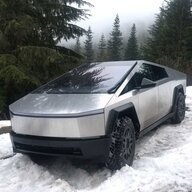
I understand the Ford Lightning has superior tow dynamics to the gasoline comparables. But there is no way it can even approach the tow dynamics of the Cybertruck for one major reason: the Cybertruck has a chassis stiffness better than million-dollar supercars.

The flexible chassis of the typical ladder frame, cab on body pickup truck is the bane of good towing dynamics. This is what exacerbates the deadly trailer sway oscillations (the mild steel ladder frame acts like a giant spring when loaded with a heavy trailer). These oscillations can either dampen out or increase in amplitude, it depends upon how the chassis deals with that energy. I've seen the mayhem caused by this shockingly common phenomenon as I tour the scenic highways of the American west on my motorcycle countless times. Almost always the twisted wreckage reveals the tow vehicle was an American pickup. As these vehicles age, their frames are constantly rusting away, especially around the welds. While new pickups have the same problem when towing near their max. rated loads, the more they rust, the more the ladder frame flexes.

Cybertruck is exceptionally rigid to begin with, and the exoskeleton design, made from rust resistant alloys and high-strength boron steels that are enclosed and protected from road spray, will not significantly degrade in the short amount of time that it takes the mild steel of a ladder frame to rust away. You can go on dealership lots and look under brand new trucks and see the orange rust has already started, even before they have their first owner.

The 300-mile Lightning is heavier than both the Cybertruck and its gas-powered F-150 brother, so it has a stiffer frame to deal with all that weight. But it is still a ladder frame made from mild steel, with similar flex/spring issues of the frame on it's gas counterpart, just to a smaller degree. And the rust will still happen.
Sponsored


 

Woodrick

Well-known member
First Name
Ed
Joined
Dec 30, 2023
Threads
6
Messages
4,786
Reaction score
4,762
Location
Gainesville Ga
Vehicles
Model 3, Model Y, Cybertruck AWD
Occupation
Consultant
Country flag
Good video of a CT towing another off-road electric vehicle (3k lbs) with a flat towing attachment, so not a great test since there is no tongue weight - but I'll take it since it's slim pickings at present:


This is a tri-motor Cyberbeast model with AT tires - so only 301 miles rated range. From what I heard, they were consuming an average of about 800wh/mile when towing this vehicle. So since we know that the CT battery is 123kw from prior testing - that's 123000wh. 123000/800=153.75 miles using the entire pack if my math is right. If we assume you use 80% of the pack - for example going from 90% to 10% towing over a longer range using SC stations - that'd be 123 miles per charge towing under this load. This was only 3k lbs with zero tongue weight - I'd surmise moving up to 8-10k lbs would require much higher wh/mile consumption - but we'll have to wait and see.
Agree, but you gotta factor the wind profile of the towed trailer behind the truck.
 

HaulingAss

Well-known member
Joined
Oct 3, 2020
Threads
28
Messages
10,308
Reaction score
20,718
Location
Western Washington, USA
Vehicles
Cybertruck DM, 2010 F-150, 2018 Performance Model 3, 2024 Performance Model 3
Country flag
Trailer sway is a somewhat complex dynamic, influenced by many factors, but there is no doubt that flex in the chassis of the tow vehicle is a major factor in exacerbating and amplifying whatever tendency there is for the oscillation to start in the first place. Full stop. Because I never said a flexy frame caused trailer sway. Try to follow along.

Towing from the rear receiver hitch on CT will be similar to any other similar sized truck. You will need sway control and weight distribution.
I didn't say it eliminates the need for weight distribution hitches, although the low rear overhang of the Cybertruck (distance from rear axle to tow reciever) coupled with the load equalizing qualities of the independent air suspension will minimize the need for weight distribition hitches with trailers that might need weight distribution on the F-150.

Sway control devices are a band aid to fix a problem and will absolutely not be required on the Cybertruck with a properly setup and balanced trailer. They would be completely superfluous.


The CyberTruck still has plenty of non-stainless steel in its structure. Corrosion of the steel components is not magically prevented on CyberTruck compared to legacy auto makers. Not an issue in new vehicles.
I didn't say there could be no corrosion on the Cybertruck, I said it was made out of more corrosion resistant materials and that the the most corrosion prone portions of the Cybertruck are not exposed to road salts and the weather like they are on a traditional ladder frame that begins rusting before you drive it home.
 
Last edited:

HaulingAss

Well-known member
Joined
Oct 3, 2020
Threads
28
Messages
10,308
Reaction score
20,718
Location
Western Washington, USA
Vehicles
Cybertruck DM, 2010 F-150, 2018 Performance Model 3, 2024 Performance Model 3
Country flag
Don't split hairs with me. If you want to take exception to what I'm saying, give a specific example that is comparable to the Cybertruck dual motor and significantly lighter. i'll show you why it's not comparable. None of the Lightnings are weighed with a tonneau cover or topper, they have much smaller wheels and tires, soft aluminum bodies, no bedliners, no adjustable suspension, and no four-wheel steering.

All of those things add weight, yet the Cybertruck still comes in slightly lighter and with slightly higher EPA range (again, when comparing like for like tires).
 

HaulingAss

Well-known member
Joined
Oct 3, 2020
Threads
28
Messages
10,308
Reaction score
20,718
Location
Western Washington, USA
Vehicles
Cybertruck DM, 2010 F-150, 2018 Performance Model 3, 2024 Performance Model 3
Country flag
I didn't say air suspension load leveling completely compensated for weight distribution, but from a factual standpoint, it certainly does help. So you are disagreeing with nothing.


VDR

Well-known member
Joined
Nov 23, 2023
Threads
0
Messages
47
Reaction score
53
Location
BC
Vehicles
R1S
Country flag
If after all that, you arrive at anything more than “agree to disagree,” then that’s fine
I agree that the more aerodynamic/lighter/lower profile combination (1.3-1.8mi/kwh) yield better results than a larger/heavier (.9-1.1mi/kwh) combination. You initially quoted large (aero wise) so that is why I did not agree, most of your examples were not large as proven by the single axle/lower profile and/or streamline configuration.
Absolutely nobody trailers to 0% SOC and very few charge to 100% especially when out on the road so there is no point in telling someone they can go X distance if they use the full capacity of the battery. Seriously who goes to 0% SOC while towing?
I would love to see your initial claims be practically attainable but I just don't think it is viable with a truly large load.
Agree to disagree I guess, but I was just speaking from my experience towing a multitude of different trailer combinations/weights & other large trailer examples online. Most of the examples you presented are only a fraction of the CT tow capacity/capability and extrapolated to 0% SOC.
For practical real world use 80% of full capacity is a much more realistic amount to work off of especially when towing.
I am interested on towing range as this is my use-case for Cybertruck.
It all depends on the aero/speed/weight(uphill battle). I have towed plenty through mtn. passes and it is quite alarming how quick the kw disappear on the way up, likely way below 1mi/kwh.
Towing a 7000lb dump trailer 40 miles up 4200ft used 55kw. It is drastically better going back down.
 
Last edited:

HaulingAss

Well-known member
Joined
Oct 3, 2020
Threads
28
Messages
10,308
Reaction score
20,718
Location
Western Washington, USA
Vehicles
Cybertruck DM, 2010 F-150, 2018 Performance Model 3, 2024 Performance Model 3
Country flag
You're digging a hole for yourself and illustrating how little you actually know about towing and the dynamics involved.

Because as the tow ball is lowered, the tongue weight increases. This increases the weight on the rear axle of the tow vehicle.

And the same "hood in the sky" rotation of the tow vehicle causes the vehicle's own weight to transfer to the rear axle, from the front axle. The self-leveling action of the air suspension causes the tow ball and trailer tongue to rise up, reducing tongue weight and the hood of the tow vehicle to drop, rotating more vehicle weight from the rear axle to the front axle. It's simple geometry based upon the center of gravity of both the trailer and the tow vehicle being above their respective axles.

That you don't understand this important dynamic at all tells me you should not be setting up towing combinations. This is towing 101. I knew this before my 19th birthday.

So why are you arguing with me as if you know what you're talking about? You should be asking me how it is, not telling me.
 

Rutrow

Well-known member
First Name
Dan
Joined
May 25, 2021
Threads
8
Messages
1,031
Reaction score
2,441
Location
Little Rock, Arkansas
Vehicles
Model S, Model 3, CyberTruck Tri-motor reservation
Occupation
Firefighter
Country flag
That's absolutely true for most tow vehicles, but is all but, or completely eliminated, with rear wheel steering vehicles that use In-Phase steering at higher speeds. So long as the steering angle of the rear wheels is equal to that of the front wheels, the hitch point tracks in the direction of the turn, without that moment arm, counter steer, that most bumper pull trailers experience.

CyberTruck can greatly reduce the sway that is induced with quick evasive maneuvers. It'll be as rock solid as a 5th wheel or goose-ball hitch.
 

HitchHiker71

Well-known member
First Name
Craig
Joined
Dec 7, 2019
Threads
0
Messages
67
Reaction score
104
Location
Delaware
Vehicles
2018 RAM 1500 Limited Tungsten Edition
Occupation
IT Director
Country flag
You're digging a hole for yourself and illustrating how little you actually know about towing and the dynamics involved.

Because as the tow ball is lowered, the tongue weight increases. This increases the weight on the rear axle of the tow vehicle.

And the same "hood in the sky" rotation of the tow vehicle causes the vehicle's own weight to transfer to the rear axle, from the front axle. The self-leveling action of the air suspension causes the tow ball and trailer tongue to rise up, reducing tongue weight and the hood of the tow vehicle to drop, rotating more vehicle weight from the rear axle to the front axle. It's simple geometry based upon the center of gravity of both the trailer and the tow vehicle being above their respective axles.

That you don't understand this important dynamic at all tells me you should not be setting up towing combinations. This is towing 101. I knew this before my 19th birthday.

So why are you arguing with me as if you know what you're talking about? You should be asking me how it is, not telling me.
Having owned both a 2012 RAM 1500 CC with the rear coil over suspension and a 2018 RAM 1500 CC with the four corner air suspension and having towed the same boat/trailer with both trucks, I can definitely attest to the fact that the air suspension does exactly what you are saying - it provides better stability when towing without doubt, in part by reducing rear squat and keeping the truck level while towing. It also makes it a bit easier to mount the trailer onto the ball using entry/exit mode (lowest air suspension setting).

I don’t think I would ever purchase another pickup in the same class without an air suspension after having owned and towed with both.
Sponsored


Top